

Let me start with the conclusion: if a project is considering Poland merely because of “low cost and ease of registration,” the answer in 2026 is already no; if a project genuinely needs the Polish market, the more realistic path may instead be to first obtain a MiCA CASP authorization in another EU member state and then enter Poland through passporting.
In recent years, Poland was once a country that very easily made the shortlist for many crypto projects entering Europe.
The reasons were not complicated. The old VASP registration regime was relatively light, and company formation and operating costs were also attractive. For teams hoping to first obtain a European regulatory status and then gradually validate their business, Poland appeared to offer both “cost” and “EU market” advantages. Our early global crypto payment compliance map also, based on the legislative progress at the time, treated Poland as one of the potential low-cost pathways to an EU CASP.
But by August 2026, this logic has undergone a fundamental change.
The problem is not even merely that “CASP applications have become stricter”; rather, Poland has developed a situation more peculiar than that of other EU member states:
The old VASP regime has ceased to be effective, MiCA is fully applicable, yet Poland’s own MiCA implementing legislation has still not been stably put in place.
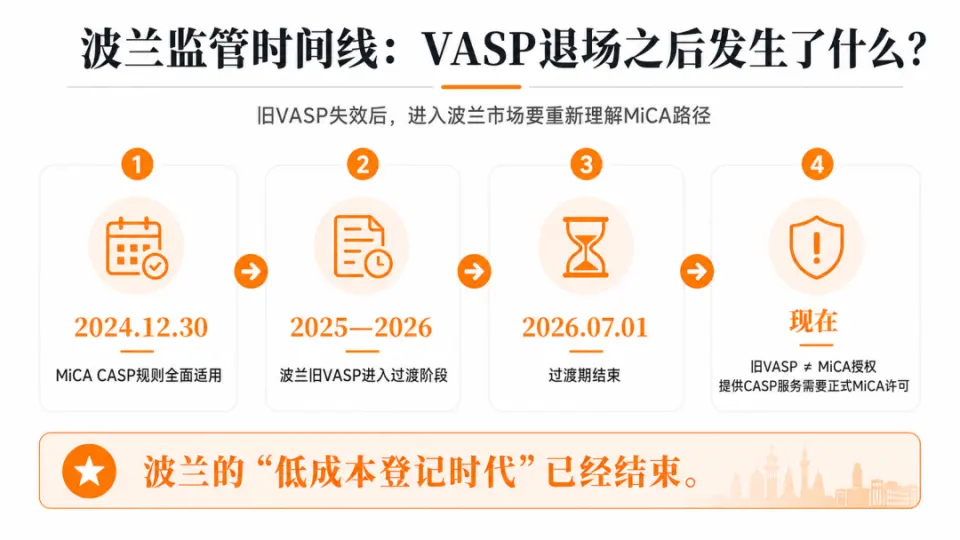
After July 1, 2026, Poland’s old VASP regime formally loses its significance
To understand present-day Poland, one must first clearly distinguish two points in time.
MiCA’s main rules on CASPs have been fully applicable since December 30, 2024, but for virtual asset service providers that had previously operated under a member state’s old regime, MiCA allows member states to establish a transitional period. Poland adopted a relatively long transitional arrangement, and existing VASPs were once able to continue operating until around July 1, 2026.
But that window has now closed.
On June 30, 2026, the Katowice Tax Administration Chamber published a notice on the Polish government’s official website, explicitly reminding market participants that, after the end of the transitional period on July 1, 2026, the former virtual currency activity registration no longer constitutes authorization to provide crypto asset services under MiCA.
The supervisory authority even further reminded that if an institution still has not obtained a MiCA authorization granted by an EU member state as of July 1, it should be regarded as a higher-risk service provider; the former registration authority itself also has no power to issue MiCA CASP authorizations.
Therefore, for project teams, purchasing, registering, or promoting a so-called "Polish VASP" today can no longer resolve the genuine issue of access to the EU market.
A more peculiar problem: Poland's own MiCA legislation is still undergoing repeated changes.
If it is merely an upgrade from VASP to CASP, there is in fact no substantive difference between Poland and Lithuania.
What truly makes Poland peculiar is the progress of its domestic supporting legislation.
As an EU regulation, MiCA is directly applicable, but Member States still need to clarify through domestic regimes the competent authority's authorization, supervision, penalties, fees, and specific procedures. On June 23, 2026, the KNF publicly stated that, because Poland's domestic law implementing MiCA had not yet entered into force, Polish public administrative bodies, including the KNF, had not at that time been formally designated as MiCA competent authorities, with the exception of the supervision of electronic money token issuers. At the same time, the KNF also stated that it had made corresponding preparations to assume MiCA supervisory responsibilities.
The KNF itself also publicly stated in May 2026 that it was ready to assume crypto asset market supervision responsibilities, and noted that CASP licensing would involve the knowledge and experience of management personnel, capital, and other relatively stringent reviews.
The problem is that the domestic law has never been smoothly brought to final implementation.
On May 15, 2026, the Polish Parliament passed a new version of the Crypto Asset Market Act; on June 11, the President refused to sign the bill. The Presidential Office publicly explained that it supports establishing a regulatory framework for the crypto asset market, but considered that the text passed at that time still had issues requiring adjustment.
Therefore, based on the Polish official public information available to date, Poland has ended the old VASP transitional period, but its domestic MiCA implementation regime remains in the process of legal adjustment.
This gives rise to a very practical problem:
Projects should not now understand "registering a company in Poland and then directly applying for a Polish CASP" as a route that is already as highly standardized as those in Lithuania or Malta.
Therefore, the statement that "Polish CASP costs are low" is no longer sufficient.
In the past, when a project chose Poland, the comparison usually came down to a few numbers: company registration costs, local employee salaries, office expenses, legal fees, and the VASP registration timeline.
These factors still exist today, but their importance has declined.
After MiCA implementation, regardless of where the home country is chosen, CAS will not turn CASP back into the "light license" of the old VASP era.
More importantly, if a jurisdiction currently has significant uncertainty regarding the implementation of even its domestic licensing procedures, then an enterprise saving some operational costs while bearing the risk that the application window, regulatory process, and subsequent arrangements cannot be accurately predicted may not be a worthwhile bargain.
Therefore, when assessing Poland today, the question should be shifted from:
Old questionWhere is the cheapest place to obtain a CASP?
to:
The real questionWhere can a project obtain a CASP with greater certainty and serve Poland and other EU markets over the long term? Wanting to serve the Polish market does not mean one must obtain a CASP in Poland.
This is precisely one of the most important changes brought by MiCA's unified licensing system.
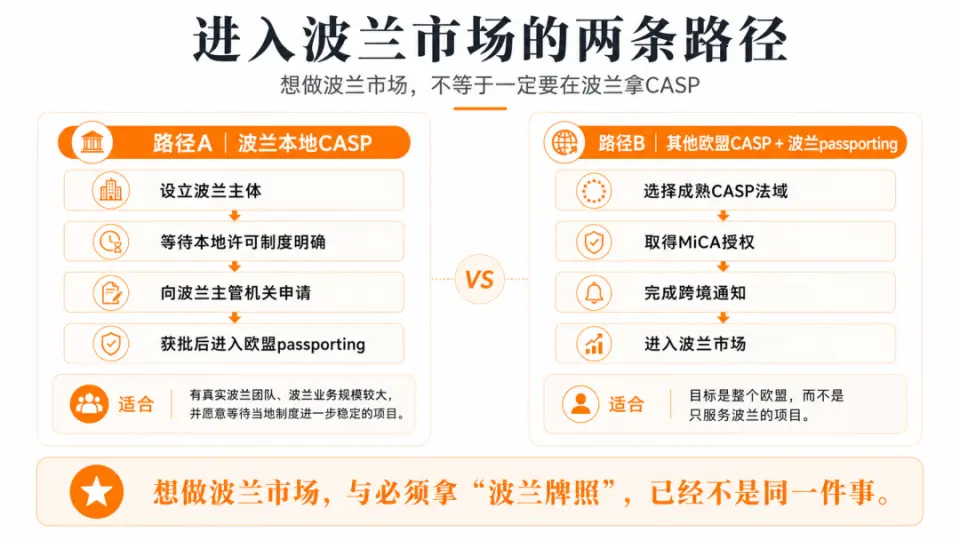
A CASP authorization under MiCA does not only serve the country where the license is located. A CASP that has obtained formal MiCA authorization may, after completing notification in accordance with the cross-border service rules, provide authorized crypto-asset services in other EU member states. ESMA also clearly distinguishes between "operating under the old regime's transition" and "formal MiCA authorization": old VASPs do not enjoy EU passporting rights, and only after formally obtaining MiCA authorization can they enter the unified cross-border mechanism.
Therefore, a project that clearly intends to serve Polish clients does not necessarily have to make Poland the home Member State for its CASP.
For example, an enterprise may first compare Lithuania, Malta, France, Germany or other Member States that have already established a stable CASP authorization mechanism, and determine the home Member State based on its team, clients, banking relationships and regulatory communications; after obtaining CASP authorization, it may then cover Poland through the MiCA cross-border notification mechanism.
This logic is entirely different from the old VASP era.
In the past, it was: to enter Poland → register a Polish VASP.
Now it may be: to enter the entire European Union → choose the most suitable home Member State for the CASP → then passport into Poland.
Does that mean Poland is not worth considering at all?
Not exactly.
Poland remains an important market in the European Union, and the KNF has clearly expressed its readiness and regulatory capacity to assume MiCA supervisory responsibilities. (knf.gov.pl)
If a project already has its core team, technical personnel, client resources or long-term operational plans in Poland, then waiting for the local regulatory framework to further stabilize and treating Poland as a future home Member State for the CASP may still have commercial rationale. This is particularly so where an enterprise genuinely intends to place its key management personnel, offices, compliance team and client operations in Poland, in which case a local CASP entity and actual operations can form a more natural match.
However, if a project is preparing to register a shell company merely because it has heard that "Poland is low-cost," while its main team remains in Asia, its clients cover all of Europe, and its banking and payment channels are not in Poland, then there is no need at present to insist on a "Polish CASP."
For such projects, it is usually more realistic to give priority to comparing EU jurisdictions that can already accept MiCA applications on a stable basis.
A simple assessment can be made by looking at three questions:
First, is Poland your core market?
If it is not, and you merely intend to use Poland as a gateway into the European Union, you should re-compare CASP home Member States.
Second, are you prepared to establish genuine operations in Poland?
Without local management, personnel and long-term operational planning, the significance of the cost advantage will decline markedly.
Third, do you currently need "low cost" more, or "certainty"?
For projects preparing to cooperate with banks, institutional clients and major payment channels, certainty of the regulatory path is usually more important than saving a portion of upfront costs.
How we typically support such projects
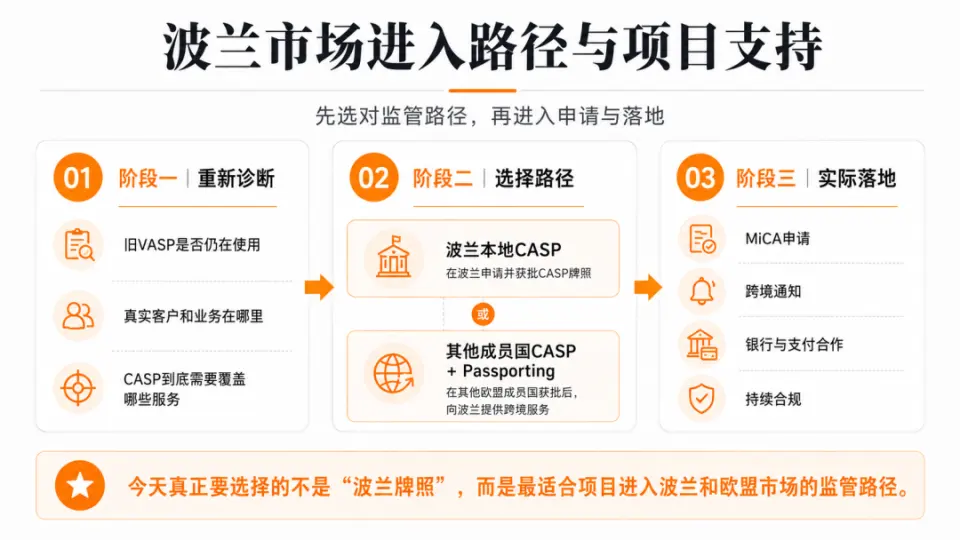
For projects that originally intended to pursue the Polish VASP or Polish CASP route, the first step is usually not to continue the application directly, but to reassess Poland's position within the overall European structure.
If a project merely needs access to the Polish client market, it may first compare CASP authorisation and passporting routes in other EU Member States; if Poland is indeed the main operating centre, it will be necessary to continuously track local legislation, the competent authority and the formal application mechanism, and to prepare the team and materials in advance in accordance with MiCA standards.
In specific projects, we typically first complete the "EU CASP Jurisdiction Comparison" and the "Business Functions and MiCA Service Scope Analysis", breaking down businesses such as client regions, wallet control, stablecoin exchange, asset transfer and fiat payment, and then determine in which Member State the CASP entity should be established.
For teams that already hold an old Polish VASP registration, it is also necessary to separately review existing clients, contracts, website publicity and fund flows, so as to avoid continuing to rely on the old registration as a basis for MiCA market access.The Polish authorities have already made clear that, after July 2026, the old VASP registration will no longer confer the qualification to provide MiCA crypto-asset services.
If another EU member state is ultimately chosen as the home member state, it will also be necessary to design in parallel the passporting notifications for the Polish market, local marketing, client agreements, banking and payment partnerships, and the service and liability boundaries among the group's various entities.
Conclusion: Is Poland still a low-cost option?
If the so-called "low-cost option" means obtaining a European regulatory status quickly through a relatively light registration process, as in the past VASP era, then the answer is already clear: that path has come to an end.
As of July 2026, the old Polish VASP regime can no longer support MiCA crypto asset services; at the same time, Poland's domestic MiCA implementing framework is still undergoing legislative adjustments. For a new project now preparing to enter Europe, choosing Poland as the CASP home member state simply because of lower corporate and personnel costs can hardly be described as truly "efficient." (Gov.pl)
But if a project genuinely needs the Polish market, MiCA offers another answer.
Firms do not have to tie "clients in Poland" to "the license must be in Poland." First establishing a CASP in an EU member state with a more mature regulatory pathway and a better fit with the team and business, and then serving Poland through passporting, can be a solution more worth comparing at the current stage. (European Securities and Markets Authority)
Poland has not lost its market value; what it has lost is the old story that "a cheap license registration is enough to enter Europe."
/ END.
*This article is an original article of Mankun Law Firm and represents only the personal views of the author. It does not constitute legal consultation or legal advice on any specific matter. For reprinting and legal consultation, please add customer service:mankunlawyer。