

Identifying risks and providing pathways.
Introduction
As the Web3 wave sweeps across the globe, PayFi (Payment Finance, a concept first proposed by Lily Liu, Chair of the Solana Foundation, in 2024), as an innovative sector connecting traditional payments with blockchain technology, is rapidly reshaping the landscape of cross-border payments. Imagine: users leverage blockchain technology to achieve instant, low-cost global transfers without banking intermediaries, while still enjoying the value stability anchored by stablecoins. This is not merely a technological upgrade, but the dawn of financial democratization.
As the Web3 hub of the Middle East, the United Arab Emirates (UAE), represented by Dubai’s Virtual Assets Regulatory Authority (VARA) and the Abu Dhabi Global Market (ADGM), has constructed a globally leading crypto-friendly framework. However, for entrepreneurs and investors targeting the UAE market, hidden “minefields” lie behind the allure of PayFi—namely, business compliance risks. As with any emerging market, the “double-edged sword” effect of regulation is evident:Substantial opportunities exist, yet the cost of non-compliance is high.
In the first half of 2025, the Central Bank of the UAE (CBUAE) imposed fines totaling over AED 20 million (approximately USD 5.4 million) on several payment institutions for inadequate performance of Anti-Money Laundering/Counter-Financing of Terrorism (AML/CFT) obligations.
This article will take “identifying risks and providing pathways” as its core, systematically analyzing the business compliance risks of PayFi in the UAE. By combining the latest regulatory developments with real-world cases, we aim to deconstruct these issues layer by layer, with the goal ofidentifying “red lines”and providing strategies and insights for risk prevention.
PayFi: From Concept to Global Opportunities in the Desert Oasis
1.1 What is PayFi? Why is it “Hot” in 2025?
PayFi is the payment branch of Decentralized Finance (DeFi), focusing on optimizing the core elements of payment processes—speed, security, and inclusivity—using blockchain and smart contracts. Unlike traditional payments (such as the SWIFT system, where average cross-border transfers take 3–5 days), PayFi achieves near-real-time settlement through stablecoins (such as USDT and USDC) or algorithmic payment protocols. Typical applications include:
-
Cross-border remittances: Providing instant transfer services for multinational trade and international labor.
-
Merchant payments: E-commerce platforms integrating crypto payment gateways.
-
Embedded finance: Seamless cashing out of virtual assets in Web3 games.
Messari estimates that PayFi’s liquidity target will reach USD 200–250 million, indicating strong growth momentum. PayFi’s popularity stems from its effective resolution of pain points: the high friction of traditional payments (5–7% loss in currency conversion) and barriers formed by regulation and industry. Its disintermediated design makes it the preferred choice for emerging economies—for example, the mobile payment revolution in Africa has already “leaped forward” with the aid of blockchain.
1.2 The UAE: PayFi’s “Gold Coast” or “Regulatory Maze”?
Why has the UAE become a “favorite” for PayFi? The answer lies in its strategic positioning. As a G20+ member that regained its status on the Financial Action Task Force (FATF) white list (successfully removed from the grey list in 2024), the UAE expects the digital economy to account for 20% of its GDP in 2025. The Web3 Festival PayFi Summit in April further catalyzed market enthusiasm, while Dubai’s Vision 2031 plan aims to make virtual assets a pillar industry. Giants such as Huma Finance and Athar Finance achieved significant business milestones in 2025.
Specific Opportunities:
-
Tax Haven:Corporate income tax is only 9% (effective from 2023), and crypto transactions are exempt from Value Added Tax (VAT).
-
Sandbox Mechanism:VARA’s Innovation Testing License allows projects to test in a “controlled environment” for 6–12 months without requiring a full license.
-
Infrastructure:ADGM in Abu Dhabi supports Fiat-Referenced Tokens (FRTs), perfectly aligning with PayFi’s need for stable payments.
-
Talent and Capital:In 2025, crypto startup financing in the UAE exceeded USD 1 billion, with Middle Eastern investors accounting for 40%.
-
Regulatory Exploration:The Dubai International Financial Centre’s (DIFC) latest proposal removes the cap on crypto investments for funds, benefiting PayFi embedded funds.
Compared to 2024, the UAE has upgraded from a “crypto haven” to a “PayFi laboratory,” but do not celebrate too early. The UAE has a“Federal + Emirate + Free Zone”three-tier compliance architecture. PayFi businesses may simultaneously touch upon the CBUAE’s payment laws and VARA’s virtual asset rules. A slight misstep could result in “multiple surprises” from different regulatory bodies.
The UAE PayFi Regulatory Framework—Who is “Gatekeeping”?
The UAE’s regulatory system is like a precise net, covering the entire chain from traditional payments to blockchain innovation. In 2025, with the implementation of new CBUAE laws, PayFi projects must withstand the test of a unified framework, peeled back layer by layer as follows:
2.1 Core Regulatory Bodies and Division of Labor
The regulation of PayFi business in the UAE presents a “divide and rule” pattern, with four pillars each performing their respective duties:
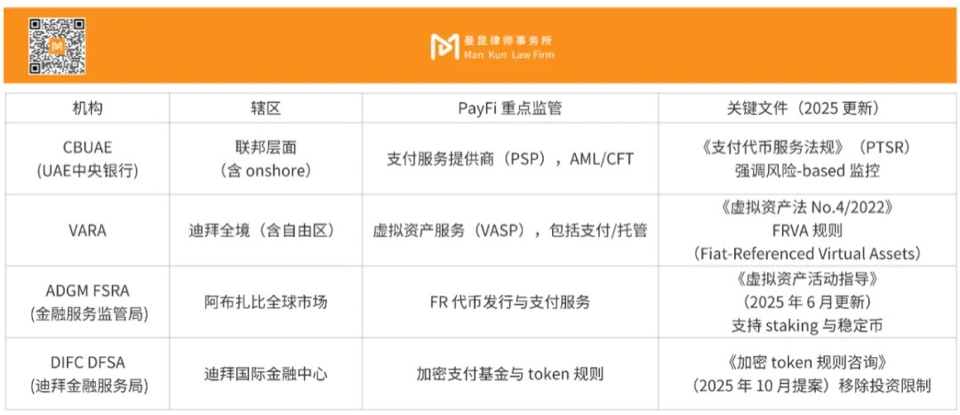
Tip:If you are a PayFi startup, prioritize VARA—it basically covers 90% of virtual asset activities, and the approval cycle is only 3–6 months. However, cross-jurisdictional business (such as issuing FRTs in ADGM) requires dual filing to avoid a “jurisdictional vacuum.”
2.2 Licensing Requirements: From “Entry-Level” to “Full Package”
PayFi is not “plug and play.”According to VARA’s seven categories of Virtual Asset Service Provider (VASP) licenses, payment-related businesses require at least dual licenses for Advisory and Payment Services. Application thresholds include:
1. Capital:Minimum AED 100,000 (approximately USD 27,000), rising to AED 1,000,000 for high-risk projects.
2. AML and Risk Control Systems:Fulfill AML and “Travel Rule” obligations, monitoring and reporting transactions as required.
3. Technical Audit:Blockchain nodes must undergo technical certification to prevent potential malicious attacks.
4. Localization:At least one UAE resident executive, and the office must be located in Dubai.
But remember: Sandbox ≠ Exemption. Violations during the testing period still incur fines starting from AED 500,000.
2.3 Global Alignment: The “Spillover” Impact of FATF and MiCA
UAE regulation is not isolated. In 2025, the FATF’s guidance for VASPs requires PayFi platforms to track the full path of on-chain transactions, which the UAE has fully adopted. The European Union’s Markets in Crypto-Assets (MiCA) regulation also has indirect effects: UAE merchants accepting euro-denominated stablecoins must comply with reserve disclosure requirements.
Through this framework, we can see that UAE regulation is a balancing act of “innovation-friendly + zero tolerance for risk.” Next, we will further analyze business compliance risks.
Analysis of Business Compliance Risks—Case-Driven “Wake-Up Calls”
3.1 Risk One: Insufficient AML/CFT Monitoring—The Invisible Killer of the “Money Laundering Black Hole”
Interpretation: According to the CBUAE’s “AML Guidance,” PayFi platforms must implement anti-money laundering obligations based on a risk-based approach, including Customer Due Diligence (CDD), transaction monitoring, and Suspicious Transaction Reporting (STR). Initial fines for violating regulatory provisions can reach AED 5 million, and serious cases may face license revocation.
Case Analysis: Fuze Platform’s AML Failure
In August 2025, VARA imposed penalties on Fuze, a crypto payment platform registered in Dubai, due to significant deficiencies in its AML/CFT systems, including ineffective monitoring of high-risk transactions and failure to report suspicious activities in a timely manner, leading to potential money laundering loopholes. As a VASP providing stablecoin payment services with a monthly processing volume exceeding millions of dollars, Fuze had numerous oversights in customer due diligence. Following VARA’s investigation, not only were undisclosed fines imposed, but an independent “Skilled Person” was appointed to supervise rectification, ensuring the platform addressed its risk control shortcomings within three months.
3.2 Risk Two: Licensing and Operational Violations—The Fatal Flaw of “Driving Without a License”
Interpretation: Article 15 of VARA Law No. 4/2022 stipulates that any VASP activity must obtain prior licensing; operating without approval constitutes “illegal operation.” ADGM requires filing before the issuance of FRTs; otherwise, it is considered a violation.
Case Analysis: VARA’s Collective “Crackdown” on 19 VASPs
In early October 2025, VARA initiated enforcement actions against 19 crypto payment and virtual asset service providers operating without licenses. These companies were largely involved in PayFi-related stablecoin transfers and marketing activities, promoting services in Dubai without obtaining VASP licenses. One typical company was cited for operating in violation of regulations for several months, attracting over a thousand retail users. VARA issued cease-and-desist orders and imposed fines ranging from AED 100,000 to AED 600,000 (totaling over AED 5 million), with some companies also required to undergo independent compliance reviews.
3.3 Risk Three: Data Privacy and Cybersecurity—The Double Blow of “Hackers + Leaks”
Interpretation: The DIFC Data Protection Law (PDPL, 2021) requires PayFi entities to obtain consent for processing personal data and report any data security incidents. VARA’s FRVA rules have added cyber resilience standards: platforms must undergo penetration testing to prevent DDoS attacks. Fines for violations can reach up to AED 10 million.
Case Analysis: Privacy Leak Scandal at a DIFC-Registered Platform
In mid-2024, a FinTech payment platform registered in the DIFC (involving crypto wallet services) leaked data of approximately 50,000 users, including transaction histories and KYC information, due to a phishing attack, leading to frequent subsequent fraud cases. The DFSA investigation found that the platform failed to enforce Multi-Factor Authentication (MFA) and encrypted storage, violating the data incident reporting obligations under Article 28 of the PDPL. The platform was fined AED 4 million and forced to suspend operations for three months for rectification, with collective user lawsuits further amplifying losses.
3.4 Risk Four: Sanctions and Cross-Border Compliance—The Unexpected “Landmine” of “Geopolitics”
Interpretation: The CBUAE collaborates with the Office of Foreign Assets Control (OFAC) in enforcement. PayFi must ensure sanctions compliance and the implementation of information sharing and verification under the Travel Rule.
Case Analysis: CBUAE Bank’s OFAC-Linked Penalty
In July 2025, the CBUAE imposed a AED 3 million fine on an unnamed UAE bank because its payment system processed stablecoin transfers involving high-risk jurisdictions (suspected Iran-related links) without implementing OFAC sanctions screening and Travel Rule sharing, resulting in cross-border compliance loopholes. The bank’s crypto payment channel, originally intended for legitimate MENA remittances, became entangled in an investigation due to lax monitoring, leading to partial asset freezes and a six-month rectification period.
Practical Guide to Risk Prevention—From “Passive Response” to “Active Escort”
Law is not a shackle, but a solid shield for the long-term development of compliant operations. Based on the aforementioned risks, entrepreneurs (project parties) and investors (LPs/VCs) have different focuses for risk identification and prevention, broadly as follows:
4.1 General Prevention Framework: Building a “Compliance Closed Loop”
1. Initiate Risk Assessment:Conduct compliance assessments and audits before launch or investment, covering key areas such as business model sustainability, compliance risk control, and technical security.
2. Internalize Policies:Develop a compliance manual, implement team training in advance, and foster a compliance culture.
3. Empower with Technology:Integrate effective on-chain analysis and monitoring tools to strengthen risk monitoring and mitigation.
4. Continuous Monitoring:Regularly evaluate the effectiveness of the entire process of risk identification, monitoring, and mitigation, and update and improve as necessary.
4.2 For Entrepreneurs: The “Five-Step Method” for Project Implementation
Step 1: Licensing Path Planning
-
Assess jurisdiction: For example, VARA is the preferred choice for PayFi in Dubai.
-
Business planning: Use the sandbox as a bridge, transitioning to a full license after testing.
Step 2: Three Lines of Defense for Compliance Risk Control
-
Build a team commensurate with the scale of the business.
-
Leverage information systems to achieve automated risk monitoring.
Step 3: Sanctions Screening “Firewall”
-
Implement initial and ongoing sanctions compliance screening for customers.
-
Strive to avoid risk exposures such as connection points easily subject to “long-arm jurisdiction.”
Step 4: Data and Security Fortress
-
Adopt high-specification information security and data protection configurations.
-
Regularly conduct system availability and penetration testing to ensure dynamic compliance.
4.3 For Investors: The “Traffic Light” System for Due Diligence
Investors should not just look at the whitepaper—compliance is the key to alpha (excess returns).
1. Preliminary Screening: Check VARA or other regulatory license statuses through official channels. Green light: Full license; Red light: Only claims of holding a license by the project party.
2. In-Depth Due Diligence: Conduct due diligence through professional institutions, reviewing various data and reports.
3. Risk Grading: Conduct risk assessments based on product and business models.
4. Exit Mechanism: Embed compliance trigger clauses in contracts (redemption upon violation).
Compliance First: The Path for PayFi Implementation in the Middle East
As PayFi business in the UAE develops rapidly, it has entered a stage of institutionalized and standardized regulation.In 2025, the Central Bank of the UAE and the Dubai Virtual Assets Regulatory Authority (VARA) successively strengthened Anti-Money Laundering (AML/CFT) and licensing approval mechanisms, establishing compliance baselines through typical enforcement cases.
VARA penalized the crypto payment platform Fuze in August 2025 for deficiencies in its anti-money laundering systems, and in October of the same year, collectively fined 19 virtual asset service providers for operating without licenses, demonstrating the regulators’ zero-tolerance attitude towards “unlicensed operations” and risk control oversights.These measures reflect the risk-oriented and proportionality principles in the UAE’s virtual asset regulation, providing predictable legal boundaries for the PayFi compliance framework.
In the future, if PayFi enterprises wish to operate long-term in the UAE, they should apply for licenses and embed compliance assessment mechanisms at the initial stage of business planning, ensuring that license applications, customer due diligence, data protection, and sanctions screening all comply with local and international standards.
Stricter regulation does not mean restricted innovation, but rather establishes market trust and fund security through the rule of law.It is foreseeable that the UAE will continue to promote the legalization and transparency of the virtual asset payment system under the principles of “open innovation and prudent regulation,” providing a demonstrative path for regional digital financial order.