
OpenAI's first hardware device is a smart speaker without a screen. This article does not discuss specifications; it simply does the math: OpenAI will most likely sell this device at a loss, and what it really wants to earn is from the 94.5% of its 900 million ChatGPT users who have not yet paid. Incidentally, it also clarifies whether Chinese hardware manufacturers can copy the same playbook.
On July 14, Bloomberg reporter Mark Gurman disclosed what OpenAI's first hardware device looks like: a screenless smart speaker that can be carried from room to room, planned for launch in 2027 and to be announced this year.
It is powered by the GPT-Live real-time voice model that went live just last week, and is equipped with a camera and several sensors to "understand" the environment you are in; it will also read your emails and remember your preferences. Internally, OpenAI defines it as "an AI companion that lives at home and is somewhat human-like," and has even designed a mechanical structure that can rotate on its own to make it feel more "alive." The design is led by the team of former Apple chief designer Jony Ive; last year OpenAI spent nearly USD 6.5 billion to acquire his company io.
A few days ago, Apple sued OpenAI for misappropriation of hardware trade secrets and also sought an injunction. OpenAI's response was that it had "not seen any evidence."
It is certainly a lively story. But if we shift the lens from the news back to the business itself, a more striking contrast emerges. The Information previously reported the pricing of this device:USD 200 to 300 per unitFor reference, the average price of smart speakers in the Chinese market in the third quarter of 2025 was only RMB 280, equivalent to about USD 40, so OpenAI's device is five to seven times that. And this RMB 280 market has been declining for the fourth consecutive year.
A category that has been on the decline for four years of sales
First, let us look at what the broader market of this business looks like.
According to data from RUNTO Technology, in the third quarter of 2025, China's smart speaker sales across all channels 3.057 million units, down 11.9% year on year, and the decline is still widening compared with the first half of the year. Looking further back, full-year sales in 2024 were 15.70 million units, down 25.6% year on year; in 2025 they are projected to fall further to 14.20 million units. This is the fourth consecutive year of decline.
Many people's first reaction is: it missed the AI wave. But the data does not support that explanation. In the same report, in the first three quarters of 2025, the sales penetration rate of large models in smart speakers had already reached 33%, meaning one in three units had a large model installed. Penetration has risen, yet sales are still falling.
This sentence is worth pausing on:installing a large model did not create new demand for smart speakers.
The market is also highly concentrated. Xiaomi, Baidu and Tmall Genie together accounted for 97.2% of the share, with Xiaomi alone accounting for 48.8%. This is a stagnant installed base that cannot be sold and is locked down by three giants.
Against this background, OpenAI's choice looks anomalous: in a category from which everyone is retreating, it insists on entering now at a high price. Either it has misjudged the market, or it is calculating an entirely different equation.
What OpenAI sells is not a speaker
The answer is the latter. In OpenAI's business, hardware is merely the shell; the real product is the subscription.
Its one-sentence model is this: you spend USD 200 to 300 to buy a speaker, and OpenAI makes almost no profit on the hardware, or even subsidizes it; what it wants is to turn you from "a free user who occasionally uses the web version of ChatGPT" into a paying subscriber who has an AI entry point in the home around the clock and pays monthly. Hardware is the customer-acquisition channel; the subscription is the revenue.
Why must it be a speaker as the form factor? Put the several things OpenAI has that can house hardware side by side, and the reasoning becomes clear.
The first reference point is the voice recorder. The Shenzhen company Plaud has already proven the path of "hardware plus subscription": cumulative shipments exceeding 2 million units, sales in more than 170 countries, and annualized software subscription revenue surpassing USD 100 million, with an overall revenue target of USD 500 million for 2026, all without taking a single dollar of venture capital. Its secret is that roughly half of people who buy the hardware upgrade from the free tier to a paid subscription. This proves one thing: a small piece of hardware can cultivate the habit of paying monthly. What OpenAI wants is this same flywheel, except it wants to replicate it at a higher average selling price and across more comprehensive household scenarios.
The second reference point is Codex, OpenAI's coding Agent. At the software layer, OpenAI has long since won. In the first half of 2026, Codex's weekly active users grew more than fivefold, and over 10% of users run three or more Agents simultaneously. The marginal cost of software approaches zero, so it grows rapidly. But precisely because software is so smooth, the growth ceiling arrives early: users' attention and usage time are limited. Making hardware is the second growth curve OpenAI is seeking for "software time hitting its ceiling."
The third reference point is voice input, that is, tools of the Whisper type. It is a pure tool, used and then set aside, with high gross margins but little sustained revenue to be extracted from users, and open-source alternatives are everywhere. A speaker is different: it is not a tool but an "entry point": online around the clock, exclusively occupying the scenarios of cooking, getting up at night, and soothing children, turning a software function into a permanent piece of furniture in the home.
A comparison of the three makes it clear. The voice recorder proved the model, Codex exposed the ceiling of software, and Whisper showed that tools cannot earn long-term money. OpenAI chose the speaker because only it can do two things at once: cultivate a subscription habit and occupy "that entry point in the home that is always on."
Two sets of accounts: hardware that loses money, and subscriptions that actually make money
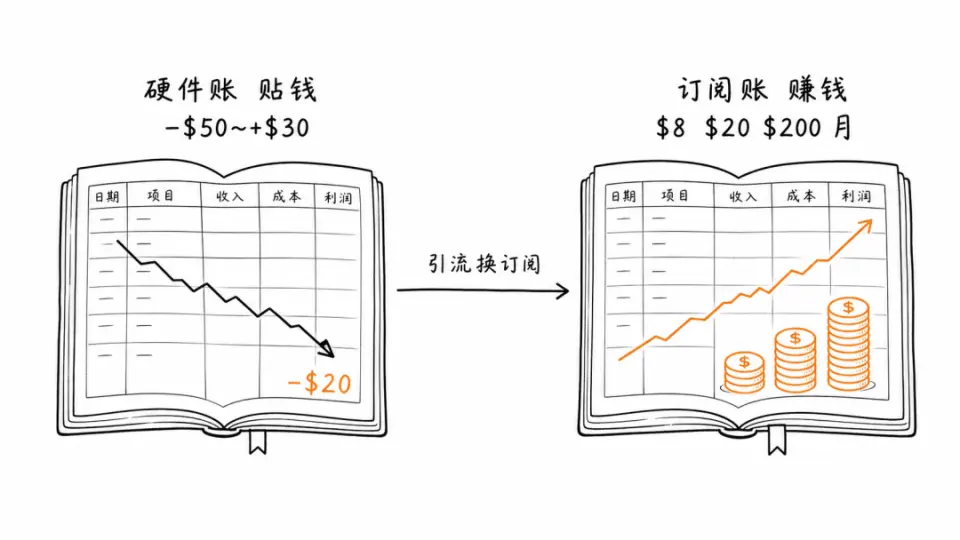
Breaking this business down into two sets of accounts makes it clearer.
The first is the hardware account, and this one is destined to lose money. A screenless speaker with a camera, sensors, a battery, and industrial design by Jony Ive has an estimated bill of materials of roughly USD 120 to 180; after adding channel commissions, logistics, returns and exchanges, and the initial small-batch ramp-up, the gross margin per unit falls roughly between negative USD 50 and positive USD 30 . By comparison, Plaud's hardware can start at USD 159 without losing money, while OpenAI prices higher yet has to subsidize, with the difference largely burned on the design premium and low initial production volumes. This is not a miscalculation; it is deliberate: the hardware is a loss leader used to drive traffic.
The second set of accounts is the subscription account, and this is the actual objective. GPT-Live is tiered: free users can only use the simplified version, and to use the full version they must upgrade to Go at USD 8 per month, Plus at USD 20, or Pro at USD 200. In other words, people who buy the speaker and want to get the full capabilities out of the device are structurally pushed toward paying. Based on Plaud's 50% upgrade rate and the assumption that household users are more price-sensitive, the incremental subscription revenue a single speaker can generate in a year is approximately in the range of USD 115 to 240 , which is three to eight times the hardware loss. Looking at this item alone, breaking even would take 5 to 13 months.
But a larger figure is hidden behind this. To build hardware, OpenAI spent nearly USD 6.5 billion acquiring io. Spread across every speaker sold in the future, this is the true customer acquisition cost.Whether this business is self-sustaining depends not on unit economics but on whether initial shipments can reach the tens of millions of units, amortizing these billions in design investment. If it can be amortized, it is a good business; if not, it is an expensive cash burn.
The real imagination of the subscription account does not lie in the speaker itself. ChatGPT today has 900 million weekly active users, with only just over 50 million paid subscriptionswith a conversion rate of approximately 5.5%The remaining 94.5% who have not paid are precisely the prey this speaker is targeting. Put another way: every one-percentage-point increase in the conversion rate means 9 million more paying users and annual revenue on the order of a billion US dollars. Raising it from 5.5% to 11% could yield an incremental tens of billions of US dollars.
So the ceiling of this business lies not at all in the smart-speaker market, which has been declining for four years, but in the free-of-charge habit of ChatGPT's 900 million users.OpenAI's nominal rival is Amazon's Echo; its real rival is the fact that users cannot be bothered to pay for the web version. The speaker is a siphon it has inserted into its own pool of free users.
But the economics are not without soft spots. GPT-Live is full-duplex real-time voice, listening and speaking at the same time, with GPT-5.5 underneath handling complex reasoning; for an always-on speaker, the inference cost during actual conversation is far higher than that of an occasional question on a phone. By rough calculation, the monthly inference cost burned by a heavy user is very likely higher than the subscription fee that user contributes. What OpenAI is betting on is not that every user is profitable, but the law of large numbers: using the subscriptions of a large number of light users to subsidize the consumption of a small number of heavy users.
Two sets of accounts
Only one leg of the moat is real
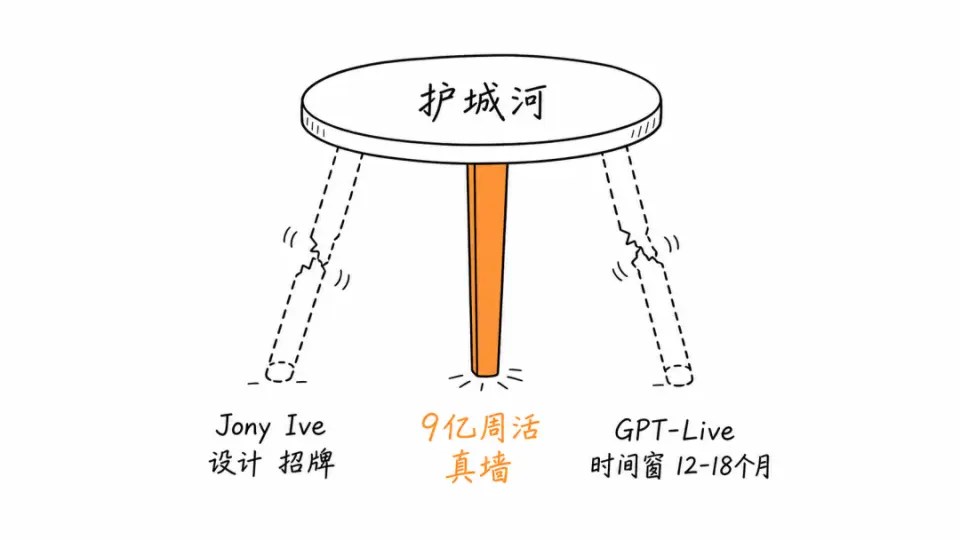
A business that loses money in exchange for subscriptions fears most that others will copy it tomorrow. OpenAI claims to hold three moats, but only one of them truly holds up.
The first is the GPT-Live real-time voice model. It is indeed ahead right now, but large voice models are a race that the entire industry is sprinting toward; it will probably take Google and Chinese manufacturers 12 to 18 months to catch up on full duplex. This is a first-mover time window, not a wall.
The second is Jony Ive's design. This is more like a valuable signboard, useful for fundraising and storytelling. But a speaker is a screenless square box, and the gap that industrial design can open up is far smaller than with phones; for Shenzhen white-label factories to copy a shell is a matter of weeks.
The third, and the only real wall, is ChatGPT's 900 million weekly active usersXiaomi and Baidu make smart speakers, and they have channels and supply chains, but neither has a ready-made user pool already installed on 900 million people's phones that can push upgrades at any time. This pool downgrades OpenAI's hardware from 'spending money to acquire new users' to 'converting the existing base'—cold-start ammunition that others cannot buy with money.
The problem is that this single leg does not stand stably either, because it is undermining itself.
On one hand, OpenAI's story is that 'the stronger the model, the more a dedicated home entry point is needed.' On the other hand, the same GPT-Live has already been rolled out globally on iOS, Android and the web since July 8. Since the voice assistant on the phone is equally good and free, why would users pay more than 200 US dollars separately for a speaker? The entire increment of a speaker relative to a phone actually comes down to only three points: you do not need to take out your phone, the camera has a fixed viewpoint, and a family can share one device. Among these three, as the phone experience continues to improve, the first will become increasingly thin; the second—'a camera permanently in the living room'—is precisely the one that provokes the most resentment; only the third barely counts as solid.
These are also the most likely ways this business could die. The most fatal is that the subscription conversion rate falls short of expectations: the entire logic of subsidizing the hardware rests on 'the conversion rate must be significantly higher than the current 5.5%.' Once the first batch of speakers has been sold for six months and the conversion rate still does not rise, loss-making hardware becomes a pure loss. The second is that mass production and legal affairs drag down the pace: the io team has only about 55 people, the first product will not arrive until 2027, and Apple's trade-secrets lawsuit could delay the entire hardware plan at any time. The third is that the entry point is undermined by the platforms: this speaker needs to read your emails and enter your home, but your email is in Gmail, your calendar is in iOS, and your smart home is in someone else's ecosystem. If Apple or Google tightens permissions for third-party always-on microphones at the system level, it becomes an isolated island.
Moat
For Chinese players, this is a different set of accounts
At this point, many friends in the hardware business will feel an impulse: OpenAI has entered the field—is AI hardware the next iPhone moment, and should I also make an AI speaker?
First, pour some cold water and see who is shouting 'the next iPhone moment.' It is mostly those selling chips and solutions, investors looking for someone to take over, and media chasing traffic. They make money from your entry: you buy development boards, you pay tuition, you turn the project into a good story, and they profit—whether your speaker ultimately sells is irrelevant to their accounts. This is not the same set of accounts as that of people who genuinely enter the hardware business.
More critically, Chinese manufacturers simply cannot copy OpenAI's set of accounts.
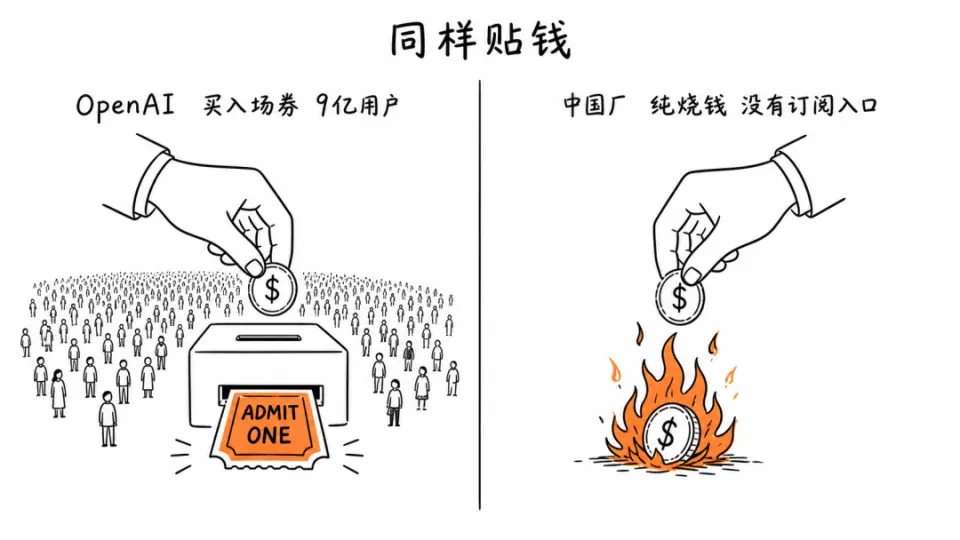
It subsidizes hardware sales because behind it are conversion options from 900 million weekly active users, self-developed models, and a closed loop that can collect subscriptions into its own pocket. These three determine that its 'subsidizing' is buying a ticket to a hundred-billion-dollar market. If a Chinese solution provider copies 'subsidizing hardware sales,' all it copies is the subsidy: you do not have 900 million users, so the conversion option equals zero; you use someone else's model, so the data moat equals zero; the subscription entry point is in the platform's hands, so you cannot even collect the monthly fee. For the same action, OpenAI is investing, while you are purely burning money.
The numbers are colder. The average price of speakers in China is 280 yuan, and the gross profit per hardware unit is estimated at less than 50 yuan; the market has fallen for four consecutive years and is 97.2% occupied by three giants. A new player squeezing in is fighting for the less than 3% of remnants in a shrinking pool. And 'integrating a large voice model' has long ceased to be a threshold: one-third of existing speakers have large models installed, and people who can do it are everywhere.
So who can actually touch this? Let us break the groups down.
Those who can genuinely reach it are the home-appliance giants that already hold exclusive scenarios or nationwide channels and can still afford to maintain a compliance team—players at the level of Midea, Haier and Xiaomi. Their supply chains and channels, which cannot be copied, happen to match the threshold of this business, and they can also keep subscription revenue on their own books rather than handing it over to a platform.
Those who should hold back and wait for signals are the small and medium-sized teams that have model-integration capability but neither channels nor scenarios. Wait for two specific signals before moving: first, the emergence in China of a full-duplex real-time voice model comparable to GPT-Live, which does not exist today; second, clear implementation of the filing rules for devices such as always-on home devices. Rushing in before the signals arrive amounts to betting on a model foundation that does not yet exist, plus a regulatory position that has not yet been settled.
Those who should steer clear above all are the small Shenzhen factories that want to make low-margin white-label AI speakers. The reason is straightforward: subsidizing hardware buys you no recurring revenue of your own. OpenAI subsidizes because it wants subscriptions from 900 million people; when you subsidize, it is a pure loss.
Two sets of accounts
Finally, another hurdle for this speaker in China
What has been calculated above are all commercial accounts. For those who want to land this business in China, there is one last cost to add in, and it is somewhat different from the other costs.
First look at the policy ground. A device with a camera, running all year round and also reading your emails, collects audio and video, faces and voiceprints from the home, including children's information; under the Personal Information Protection Law, these are sensitive personal information, requiring separate consent, guardian consent and an ex ante personal information protection impact assessment. If the data is to be transmitted to an overseas model for inference, it also runs into the security assessment for cross-border data transfer. Connecting to an overseas large model itself also falls within the extraterritorial application clause in Article 20 of the Interim Measures for the Administration of Generative Artificial Intelligence Services. On these points, the current law leaves almost no room to maneuver.
And regulation is not merely on paper. On October 22, 2025, the Ministry of Industry and Information Technology notified 20 smart terminals that infringed users' rights and interests, directly naming products such as the "Xinghuo Xiaofeixia AI Smart Speaker" and the "Astronaut Smart AI Large Model Speaker", as well as several home cameras; the problems centered on failure to inform users of personal information processing rules, collection beyond scope, unlawful transmission of data to the cloud, and collection of faces without separate notice. On this front, regulation has moved from spot checks to normalized special campaigns and delisting.
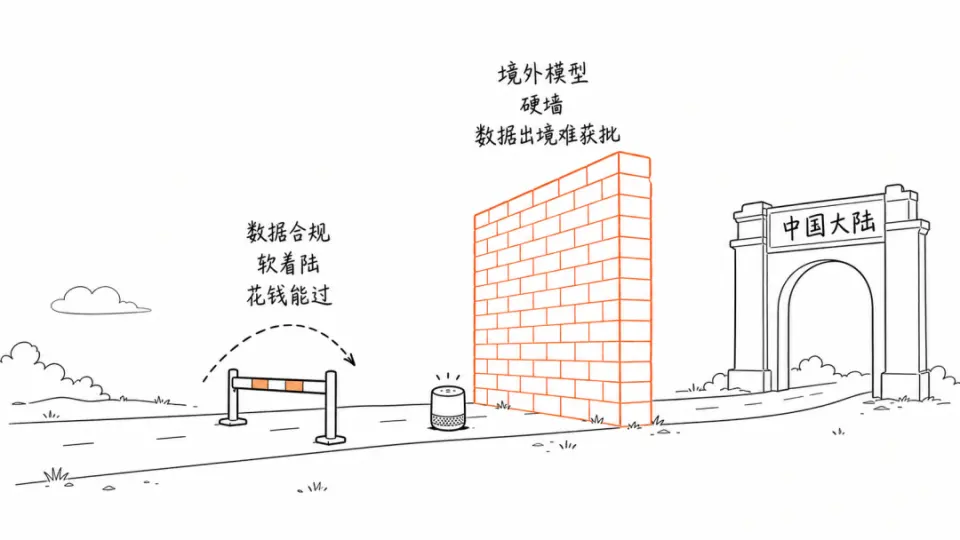
These are costs that money can solve. Filing, separate consent, permission controls and transmission encryption are all items that can be rectified; the speaker manufacturers named above were given deadlines to rectify rather than being delisted. Discounting such risks into the accounts means a certain compliance investment plus a small-probability compensation for personal information infringement, which most business owners can accept as an operating cost after running the numbers. Adding a clear separate checkbox on the authorization page, routing children's information through guardian consent, and keeping records of the personal information protection impact assessment process—if these items are done properly, the first-tier pitfalls are basically filled in.
What truly cannot be filled in with money is another hard hurdle: the engine of this speaker is the overseas GPT-Live, while OpenAI's services are already non-compliant and unavailable in mainland China. Combined with the extraterritorial application clause for overseas large models, and with the security assessment for cross-border transfer of home face and children's data being almost impossible to obtain approval for, the original form of this speaker cannot enter the compliant market in mainland China. This is not a cost item that rectification can solve; it is a prohibited zone inherent in the product form itself.
So for entrants in China, there is only one path that can truly be implemented: replace the overseas model with a large model already filed in China, keep data processed locally on the device as far as possible without cross-border transfer, and then obtain the compliance filings one by one. If you get this path working, what you are actually doing is already another business, with another set of accounts. OpenAI's speaker, living in the living room and connected to a brain across the ocean—you can refer to its product thinking, but you cannot copy its accounts.
Compliance hurdle
Back to the question at the beginning. Smart speakers have been on the market for four years and sales have been falling the whole time, so why is OpenAI determined to make one now? Because what it has always been calculating is not the smart speaker's account, but the account of the more than 800 million people among those 900 million who have not yet started paying. Whether this speaker can succeed will be known in 2027; but at least what can be confirmed now is that, before you enter the field along with it, you must first figure out which set of accounts you are actually calculating.

