

Can you tolerate this?
I have been relatively busy with work recently and have not paid close attention to market conditions. Yesterday, when I opened the Binance app, I immediately noticed a promotional campaign for a stablecoin issued by the Trump family.USD1The promotion prominently advertised an annualized yield of 20% on demand deposits.
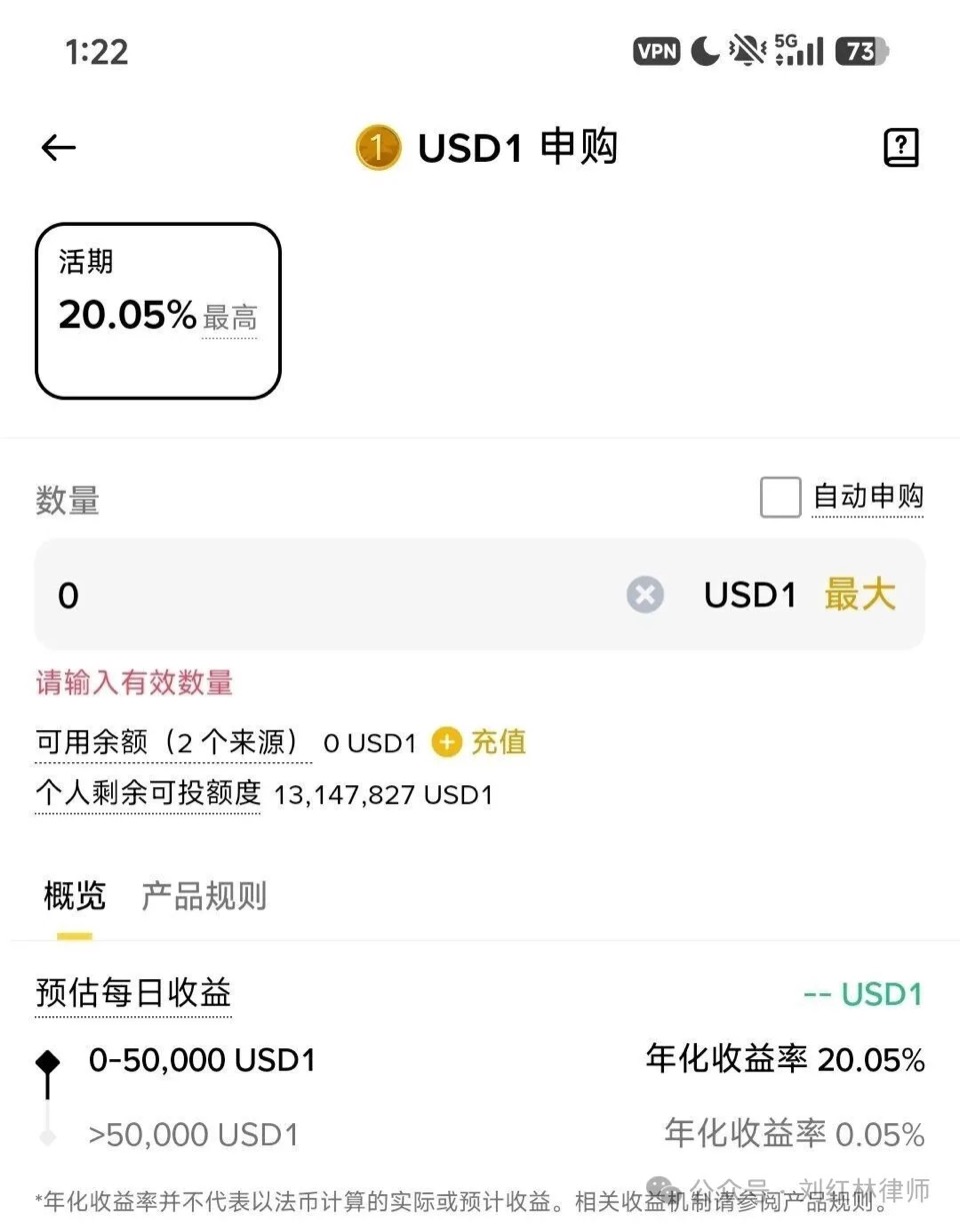
Recalling that the recent annualized yield on demand deposits in the digital renminbi reached as high as 0.5%, one cannot help but remark on how aggressively the capitalist machinery in the United States extracts value.
This reminds me that after Circle’s listing in June 2025, it also conducted similar high-yield USDC incentive campaigns on multiple platforms. Binance’s strong promotion of USD1 suggests that Mr. CZ is once again seeking to “make progress” in the United States.
Of course, the purpose of this article is not merely to comment on current events, but to discuss the underlying essence through these phenomena. In the crypto world, such “high-yield incentives” for stablecoins will continue to exist, but behind them liesa tacit cat-and-mouse game between global regulators and participants in the stablecoin sector.。
What does this mean?
We must understand a key background: whether under the EU’s Markets in Crypto-Assets (MiCA) Regulation or the U.S. Clarity for Payment Stablecoins Act currently being advanced, the core logic of regulators follows one ironclad rule—Stablecoin issuers are strictly prohibited from paying interest to users.
This is understandable. If Circle could directly distribute 5% U.S. Treasury interest to USDC holders, it would effectively become a bank, raising the question of how traditional banks could survive.
Yet the reality is that stablecoins held by users continue to generate yields, with returns even dozens of times higher than bank deposit rates.Where does this money come from? This is, in essence, a sophisticated game of legal structure design.
Today, Attorney Hong Lin will examine, from the perspectives of legal compliance and commercial architecture, how top-tier players such as Coinbase, PayPal, and Ethena “legally” channel funds to users while operating on the edge of the red line prohibiting interest payments.
Strategy 1: Coinbase & Circle—Recharacterizing “Stablecoin Interest” as “Marketing Expenses”
This is currently the most textbook example of compliance operations, akin to an art form of transferring value between affiliated parties. As is known, Circle is the issuer of USDC, but its largest distribution channel is Coinbase. According to publicly disclosed SEC filings (particularly the Cooperation Agreement signed by both parties in August 2023), their profit-sharing mechanism is quite intriguing.
On the surface, Circle holds U.S. dollar reserves to purchase Treasury bonds, earning substantial interest. Regulatory rules explicitly stipulate that Circle, as the issuer, must absolutely not distribute this interest to token holders.
In practice, Circle and Coinbase have entered into a sophisticated revenue-sharing agreement. Circle pays Coinbase a substantial fee based on the volume of USDC held on the Coinbase platform. In financial reports, this payment is not labeled as “interest sharing,” but rather as “Distribution Fees” or “Platform Service Fees.”
The final link in the fund channeling chainis that, after receiving these funds, Coinbase turns around and launches the “USDC Rewards” program for users, offering an annualized yield of approximately 4.7%.
Coinbase drafts its User Agreement with considerable cunning:“The rewards provided by Coinbase are not paid by the issuer Circle; rather, they are loyalty rewards funded directly by Coinbase as part of its marketing campaigns.”
As you can see, the legal logic forms a perfect closed loop:
Circle did not pay interest; it paid B2B service fees;
Coinbase did not pay interest; it issued marketing red packets;
The funds received by users are legally characterized not as "financial fruits" but as "gifts" or "marketing proceeds."
This is why Coinbase has recently even made high yields an exclusive benefit for Coinbase One members—further cementing that this is a "member perk" rather than "deposit interest."
Strategy 2: PayPal & PYUSD—Leveraging DeFi to Generate Compliant Yield
PayPal-issued PYUSD is similarly constrained by the "interest prohibition." As a traditional financial giant, PayPal’s strategy is to channel users toward DeFi protocols.
In terms of architectural design, PayPal partnered with Spark, a masked protocol of MakerDAO (now Sky Protocol). Within the PayPal interface or partner wallets, users are effectively depositing PYUSD into Spark’s smart contracts.
The flow of funds becomes interesting: The yield does not come from PayPal’s balance sheet, but from the operations of on-chain protocols (Spark uses these funds to lend on-chain or invest through real-world assets (RWA) mechanisms).
This constitutes a perfect compliance isolationWhen facing regulatory accountability, PayPal can simply shrug off responsibility by stating: “We merely provided a Web3 gateway; the yields were earned by users themselves within decentralized protocols. That is the operation of code and has nothing to do with us.” This approach cleverly leverages the defense of “technological neutrality” to isolate the compliance liabilities of centralized entities through smart contracts.
Strategy 3: Ethena (USDe) — The Effectiveness of the “Points Strategy”
Whereas the aforementioned models still operate within the framework of traditional finance, Ethena has upended the status quo by introducing a model based on “synthetic assets plus points-based options.” The significant controversy surrounding USDe in compliance circles stems from the fact that it is not, in essence, a stablecoin, but rather a “structured hedge fund.”
Its yield sourcesdo not involve purchasing treasury bonds, but rather earning funding rates by shorting ETH on exchanges. Such yields are exceptionally high during bull markets.
To circumvent securities laws, Ethena cannot directly distribute these trading profits to users, as doing so would almost certainly result in USDe being classified as a “security” (inevitably satisfying the Howey Test).
Consequently, Ethena devised the “points strategy”: instead of providing monetary payments, it issues “points.” The official position maintains that these points hold no monetary value and serve solely as proof of activity. However, it is an open secret in the market that these points correspond to future token (ENA) airdrops. Moreover, certain platforms (such as Whales Market) allow for the pricing and trading of these points.
By introducing “uncertainty of yield” (as the amount of tokens redeemable for points is uncertain), Ethena attempts to break the chain of “reasonable expectation of profit” under the Howey Test. Before regulatory enforcement actions are taken, this form of “shadow interest” has already absorbed billions of dollars in liquidity.
Strategy 4: Exchange “Perks” — The Accounting Game of Customer Acquisition Cost (CAC)
Those familiar with chasing promotional perks know that exchanges such as Binance often offer annual percentage rates (APR) of 10%–20% for deposits of FDUSD or USD1, which are clearly higher than treasury bond yields. Where does this money come from?
For accounting purposes, this is not an interest expense; it iscustomer acquisition cost (CAC)。
The underlying logic of Launchpool (new token mining)) is that the exchange distributes these assets free of charge to stablecoin holders through listing fees or token allocations provided by project sponsors.
From a legal characterization perspective, this constitutes an "airdrop" or "promotional gift." Users' holding of stablecoins does not directly generate fiat currency returns; instead, they receive an asset subject to price volatility. Regulators find it difficult to prohibit enterprises from engaging in loss-leading marketing practices. As long as the exchange is willing to subsidize users with this portion of profits (even at a loss), it constitutes a lawful commercial promotion.
Mankun Lawyers' Summary
Reviewing these cases reveals that regulatory provisions "prohibiting interest payments on stablecoins" have, in practice, become a form offormalism。
As long as U.S. dollar interest rates remain at elevated levels,the time value of moneyIt cannot simply vanish into thin air. While regulators have blocked the door of “direct interest payments by issuers,” capital will open countless windows through “distribution agreements,” “DeFi nesting,” “points options,” and “marketing subsidies.”
For Web3 entrepreneurs, the implication here is clear:Do not attempt to confront regulation head-on by issuing “interest-bearing stablecoins,” as that would be walking straight into the line of fire; instead, you can use commercial design to transform “interest” into “service fees,” “points,” or “membership benefits.”
This is not exploiting loopholes; in legal terms, it is calledstructural compliance。
Such structural design for commercial innovation and legal compliance is part of our daily practice. If you have needs for commercial innovation and compliance structure design for your Web3 project, please feel free to contact Mankun Law Firm.
Author of this article
Liu Honglin, Founder of Mankun Law Firm. Member of the Youth Work Committee of the Shanghai Lawyers Association, Member of the Informationization Work Committee of the Shanghai Lawyers Association, and Member of the Legal Technology Committee of the Shanghai Lawyers Association. Lawyer Liu Honglin has 10 years of experience in law and internet entrepreneurship, having previously served as Vice President of a strategic investment legal technology company at Tencent and as Legal Manager of a private equity fund at a listed company. He specializes in proposing practical and actionable solutions for cases from the perspectives of business models and legal practice, thereby maximizing commercial interests for clients.
About Mankun
Mankun Law Firm was established in 2015 and is a boutique law firm in China specializing in the Web3.0 new economy and deeply engaged in the blockchain industry. The Mankun team possesses unique and diverse industry backgrounds, with members coming from renowned legal service institutions, state judicial organs, internet technology companies, crypto asset institutions, and blockchain industry think tanks.
Based on a profound understanding of the new economy sector, continuous attention to and research on policies and regulations, and extensive practical experience, the Mankun team is adept at providing comprehensive legal services from the perspectives of business models and legal practice. These services include business architecture design, project financing and investment, transaction planning, operational compliance, resolution of complex civil and commercial disputes, prevention and control of criminal risks, and criminal defense for new economy enterprises in fields such as Web3.0, blockchain, AI, NFTs, digital collectibles, crypto funds, crypto payments, DeFi, real-world assets (RWA), and GameFi.
Mankun Law Firm is headquartered in Shanghai and maintains branch offices in Hong Kong (China), Silicon Valley (United States), Shenzhen, Hangzhou, Zhengzhou, Chengdu, and other locations. To meet the global compliance development needs of Web3.0 industry clients, Mankun has established local offices in major global crypto-finance cities and selected local professional blockchain service partners, providing clients with professional legal and compliance services that combine global reach with deep expertise in China.