

Introduction
Looking back from the beginning of 2026, 2025 was a year that reshaped the crypto world—Bitcoin reached new highs, key projects were implemented, and the market steadily advanced with rationality. Yet the more profound change came from the maturation of global regulation: rules on stablecoins, licensing, and anti-money laundering were clearly implemented in multiple countries, injecting long-awaited certainty into the industry.
Notably, the EU’s Markets in Crypto-Assets (MiCA) Regulation, fully implemented since late 2024, entered a critical phase of application in 2025. This unified framework covering 27 countries serves as a beacon, delineating compliance boundaries while illuminating new growth opportunities. As the transition periods in many countries formally ended in the fourth quarter of last year, the European market underwent quiet but profound restructuring—68 newly licensed entities entered the market in a concentrated wave. While traditional Virtual Asset Service Providers (VASPs) successfully transformed into Crypto-Asset Service Providers (CASPs), entirely new forces also made a strong debut.
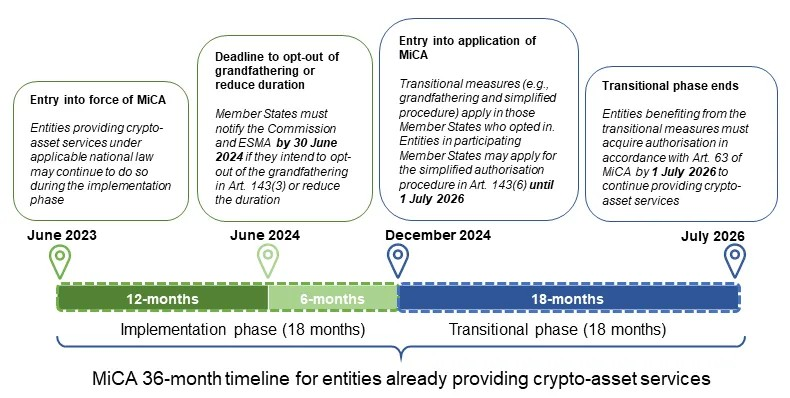
(Source: Latest guidance from the ESMA website)
This article willstart from the latest regulatory developmentsto outlinethe types and characteristics of newly licensed entities, interpret the differentiated approaches across countries, and reveal the next steps in the industry’s evolution.Helping you penetrate the changes and gain insight into the true pulse of the European market.
Mapping the 68 Newly Licensed Entities and the New Landscape of the European Market
1. The Logic of Service Licensing: A License Does Not Equate to Universal Authority
The core of the Markets in Crypto-Assets (MiCA) Regulation lies in establishing uniform market access thresholds for crypto-asset service providers across Europe. Entities that are licensed and approved by the relevant National Competent Authorities (NCAs) may legally operate throughout the European Union via the "EU Passport" mechanism. Under MiCA, licensed entities may provideten categoriesof services, includingcustody, operation of trading platforms, exchange, order execution, and investment adviceetc.
However, the scope of authorization granted by a license is highly differentiated, depending on the combination of services selected at the time of application. Common business logics include:
- Platform-based Services:Operating a trading platform typically requires ancillary services such as custody, exchange, and order execution to support a complete transaction lifecycle.
- Asset Management Services: Portfolio management often needs to be combined with order execution to facilitate dynamic rebalancing of assets under management.
- Standalone Services: Custody, investment advice, transfer services, and other activities may also exist independently, making them suitable for institutions that focus on specialized niches.
It should be noted that the aforementioned service combinations are not mandatory; they merely reflect a common business logic. Large integrated platforms (such as Coinbase and Kraken) typically apply for multiple licenses because mutual support among services can create a closed-loop user experience. However, small or specialized institutions may offer only a single service. It is entirely acceptable to operate solely as a custody wallet provider, an independent advisory firm, or a cross-chain bridge operator.
In practice, various combinations of business activities primarily appear in scenarios where entities seek to provide"one-stop"services. If an entity intends to operate a highly specialized business or faces budget constraints, it can avoid reliance on other services, thereby reducing costs and administrative burdens. This also means that when an institution advertises that it holds a MiCA license, one should not assume by default that it is authorized to perform all possible activities.
Understanding this point helps us view the strategies and capabilities of newly licensed institutions more objectively and clarify the following common misconceptions:
- Does holding a MiCA license mean full compliance and zero risk? Not necessarily. A license only indicates that the entity may conduct business within the scope of its authorization; it does not exclude other operational and market risks.
- If an institution advertises that it holds a MiCA license, does this mean it is qualified to provide all services? Not necessarily. Its actual business activities may be limited to a specific segment, such as custody, exchange, or advisory services.
- If an institution provides portfolio management services, must it also be capable of executing trading orders? Not necessarily. The institution may achieve trade execution through cooperation with third-party licensed service providers.
2. Key Characteristics of Newly Licensed Entities Added in Q4
The addition of 68 newly licensed institutions in the fourth quarter of 2025 was directly attributable tothe concentrated expiration of the MiCA unified regulatory transition period in most Member StatesInstitutions that previously operated by relying on the pre-existing Virtual Asset Service Provider (VASP) regimes in various jurisdictions facedthe ultimate deadline of "obtain a license or exit the market,"thereby triggering a concentrated wave of compliance applications and transitions.
This phenomenon is both a natural outcome of the regulatory transition period and a reflection of the strategic choices made by institutions in adapting to the new rules. Whether international giants or local emerging players, all completed their identity transitions before the deadline, highlighting the distinct trends of stratified evolution and ecosystem consolidation within the crypto industry as it moves toward standardization.
- Significant Increase in Total Numbers: The total number of licensed entities reached 133, with 68 new licenses issued in the fourth quarter alone—a significant acceleration far exceeding the growth seen in the first three quarters.
- Concentration of Services: Services are primarily focused on custody, transfer, and exchange. The proportion of entities holding full-service or multi-service licenses is low, while those with narrow-scope authorizations dominate.
- Geographic Concentration: Approximately 60% of these entities are concentrated in Western Europe (with a combined total of 42 in Germany, France, the Netherlands, Austria, and Ireland), while Eastern Europe and European Economic Area (EEA) countries such as Liechtenstein are beginning to show increased activity.
- Rise of the Nordic Region: The Nordic region has emerged unexpectedly: Finland increased from one licensed entity in the fourth quarter to five, and Sweden went from having none to establishing its first licensed entities.
- Cross-Border Activity: High passport utilization rate, with most institutions covering more than 10 EU member states.
Tiering of Newly Licensed Entities: Tension Between Emerging and Traditional Players
Overall, these newly licensed entities can be broadly categorized into three types:Industry Giants, Mid-Tier Players, and New EntrantsThis classification is based on their scale, market influence, and breadth of services.
1. Industry Giants: Driving Market Harmonization
Among the entities licensed in the fourth quarter, the entry of industry giants was particularly noteworthy. These institutions typically tend toapply for authorization covering five or more categoriesof services, building “one-stop” platforms that encompasscustody, trading, and exchangeand other multifunctional capabilities, thereby rapidly responding to the demands of the EU single market.

UK digital bank Revolut has obtained a license in Cyprus to provide six services, including custody, operation of trading platforms, and fiat currency exchange, positioning it to onboard its more than 50 million users into the crypto world. Global exchange KuCoin has secured five service licenses in Austria, covering core functions such as custody, exchange, and underwriting; meanwhile,Blockchain.com(Malta) and crypto bank AMINA EU (Austria) have also entered the market as comprehensive service providers.
Key Features:
- Economies of Scale:These licensed entities typically enjoy international or cross-continental reputations, with large user bases, substantial capital, and mature technologies. They are expected to rapidly expand operations and capture market share within the EU single market.
- Internal Integration:Market entry is often achieved through the establishment of subsidiaries, strategically mitigating external risks.
2. Mid-Tier: Steady and Prudent Players
Operating alongside the giants are mid-tier licensed entities, which typically have stable and medium-sizeduser basesandmature technologies in specific areas, previouslyrelied on national-level VASP registration。

For example, Bitonic B.V., established in 2012, is the oldest and largest local bitcoin broker in the Netherlands. It has long focused on the domestic market, providing stable and reliable services with virtually no major security incidents, thereby earning the trust of individual clients. On November 21, the company obtained a MiCA license, authorizing it to provide custody, exchange, order execution, and transfer services. This represents the standard development path for mainstream platforms in the Netherlands—currently, most other newly licensed institutions in the country also hold authorizations for these types of services.
Another typical case is Renta 4 in Spain, a well-established bank undergoing transformation. With a moderate scale and good reputation in traditional investment fields, it has recently been approved to provide custody and transmission services.
The advantage of such mainstream institutions lies in their in-depth understanding of the local market. Typically, under the premise of controllable compliance costs, they opt for a mid-range service portfolio to avoid direct competition with large international platforms, thereby becoming a trustworthy choice for ordinary users.
Characteristics:
- Deep local presence followed by expansion: Services limited to a single country, or gradually moving toward multi-passport authorization.
- Mid-range service portfolio: 3–5 types of services.
- Lower risk: Existing compliance foundation and high user loyalty.
3. New Entrants: Rising Stars
Emerging or localized licensed entities are often small in scale. The emergence of such institutions gives the impression of a rush to “catch up” for fear of missing the last train under MiCA.
However, they also fill certain local gaps. Typical examples include six local banks in Germany (Volksbank Mittlerer Schwarzwald eG, Hannoversche Volksbank eG, VR TeilhaberBank Metropolregion Nürnberg eG, etc.), all of which received approval in December but can only provide order execution services. The advantages of these emerging institutions lie in theirflexibility and cost advantages。
Characteristics:
- Niche Services: Focusing on localized pain points in the crypto asset market.
- Potential Risks: With a small user base and limited or yet-to-commence business volume, these entities may easily become targets for future mergers and acquisitions or struggle to fulfill compliance obligations over the long term.
Distribution of Newly Licensed Entities: Underlying Market Drivers
Institutional styles vary significantly across regions, reflecting differences in local economies, user habits, and regulatory environments. Western European countries such as Germany, France, and the Netherlands dominate new approvals, while Eastern European countries such as Slovakia, Slovenia, and Latvia offer more retail-oriented services.
1. Regional Differences:
Eastern Europe: Pronounced retail orientation and concentrated compliance push
In Q4, ten newly licensed entities were added across Eastern European countries, primarily in Slovakia, Slovenia, and Latvia. These entities generally focus on retail service bundles, commonly offering “custody + exchange + transfer” packages, with limited involvement in operating trading platforms. For example, in Slovakia,FUMBIand other entities hold authorizations for more than five services, while Latvia’s BlockBen focuses on the niche segment of “gold tokenization.”
This phenomenon is mainly driven by:
- Concentrated compliance conversions before the end of the transition period;
- A local market dominated by retail investors, with lower participation from institutional capital;
- Relatively lower compliance costs compared to Western Europe, attracting numerous local startups and small- and medium-sized entities;
- Limited regulatory approval resources, leading to concentrated processing of backlogged applications in Q4.
Newly licensed entities in Western European countries: France and Germany as examples
Germany and France are the primary representatives of newly licensed entities in Western Europe. Germany added 16 entities, the vast majority of which are traditional banks providing only single services such as order execution or transmission; France added five entities, among which the crypto division of Société Générale, one of France’s “big three” banks, applied only for custody and transfer services, reflecting a “narrow-scope compliance” approach.
Although Western Europe boasts mature financial infrastructure and institutional capital, higher compliance costs have prompted many entities to streamline their service offerings to control initial expenditures. This also indicates that the vibrancy of the crypto assets market does not fully correlate with the scale of regional economies.
EEA Country – Liechtenstein
The emergence of this new name is striking, reflecting the preference of licensed entities registered in the country.There are two such entities in total.Their services revolve around custody, conveying a high-end positioning characterized by being "small yet specialized." This is because itsneutral and low-tax environmentattractsprivate banksand asset management. Furthermore, although Liechtenstein is not a member of the European Union, the Markets in Crypto-Assets Regulation (MiCA) still applies,making the EU passport highly valuable.;The market is niche and high-end,with investors primarily consisting of professional players such as family offices.
2. Industry Consolidation Trends: Implicit Restructuring Rather Than Explicit Mergers and Acquisitions
Although no significant merger and acquisition cases were observed in the fourth quarter, the industry has been quietly consolidating. Many major players have chosen to establish their own subsidiaries within the European Union rather than acquiring other entities. This approach allows them to maintain full control over their operations while avoiding the complexities and risks associated with due diligence and regulatory approvals.
The report indicates that, throughout 2025, small institutions have already been acquired by mainstream platforms,while in the fourth quarter the prevailing trend was for entities to “go it alone” by filing independent applications before the end of the transition period.
Conclusion
Based on incomplete statistics and actual data feedback, the current success rate of MiCA applicationsis not as high as one might expect;regulators’ review approach continues to emphasize substance:a license is not obtained by piling up application materials, but is the natural outcome of a genuine and reliable business model.
- ForinvestorsIn terms of,a MiCA license is not a once-and-for-all “shield”;the license is only the starting point, not the endpoint. Obtaining a license does not necessarily mean that the business is mature. Investors should exercise due diligence to ascertain whether specific services are offered and which countries are covered by the passport, so as to use such services with greater confidence.
- Foroperators, the emergence of numerous new entities in certain countries or regionsdoes not necessarily indicate lower regulatory complexity; rather, it may reflect tailored business strategies or expedient measures adopted by existing service providers. The actual costs incurred in preparing for a MiCA license。
are also significant and should not be underestimated. Applicants may wish to ask themselves whether they truly need such a license. While a proactive attitude toward compliance is commendable, clarifying one’s positioning and long-term objectives may be a more prudent course of action. We hope this article helps you navigate the European crypto-asset market and identify opportunities amidst ongoing changes., applicants may wish to ask themselves: Do they truly need this license? While a proactive attitude toward compliance is commendable, clarifying one’s positioning and long-term objectives may be the wiser course of action. We hope this article helps you navigate the European crypto asset market and identify opportunities amidst the changes.
Author
Huang Wenjing, Compliance Consultant at Mankun Law Firm (Shenzhen). With seven years of experience in financial compliance (anti-money laundering) and virtual assets industry compliance, holding international certifications in anti-money laundering and sanctions compliance, and having served in AML compliance roles at multiple Fortune 500 companies, he is adept at translating regulatory requirements into actionable business solutions.
Yan Xuesong, Paralegal at Mankun Law Firm (Shenzhen). Holds an LL.M. in Arbitration and Dispute Resolution from City University of Hong Kong, the Chinese Legal Professional Qualification, and the Stage I Mediator Accreditation from the Hong Kong Mediation Accreditation Association Limited (HKMAAL). Previously worked with capital markets teams at leading Chinese law firms (“Red Circle” firms) and various financial institutions. Proficient in legal matters related to capital markets, entity formation, and corporate international expansion, currently focusing on compliance and regulatory research in Web3.
About Mankun
Mankun Law Firm was established in 2015 as a boutique law firm in China specializing in the new Web3.0 economy and deeply rooted in the blockchain industry. The Mankun team boasts a unique and diverse industry background, with members hailing from renowned legal service providers, state judicial organs, internet technology companies, crypto asset institutions, and blockchain industry think tanks.
Leveraging a profound understanding of the new economy, continuous attention to and research on policies and regulations, and extensive practical experience, the Mankun team excels in providing comprehensive legal services from the perspectives of business models and legal practice. These services include business structure design, project financing and investment, transaction planning, operational compliance, resolution of complex civil and commercial disputes, prevention and control of criminal risks, and criminal defense for enterprises in the new economy sectors such as Web3.0, blockchain, AI, NFTs, digital collectibles, crypto funds, crypto payments, DeFi, real-world assets (RWA), and GameFi.
Headquartered in Shanghai, Mankun Law Firm has branch offices in Hong Kong (China), Silicon Valley (USA), Shenzhen, Hangzhou, Zhengzhou, and Chengdu. To meet the global compliance development needs of Web3.0 industry clients, Mankun has established local offices in major global crypto-financial hubs and selected professional local blockchain service partners, providing clients with professional legal and compliance services that combine global breadth with deep expertise in China.