
This regulatory“reshuffling”is not a rejection of innovation, but rather a critical step in moving the crypto asset market from its“experimental phase”intothe “maturity phase.”a critical step.
With the rapid development of the crypto asset market in the European Union, the regulatory landscape is also evolving. In particular, since the Markets in Crypto-Assets Regulation (MiCA) entered into force in 2024, the stablecoin market has undergone significant adjustments. Multiple trading platforms have delisted certain stablecoins that failed to meet MiCA compliance requirements, while compliant stablecoins (such as USDC and EUROC) have gradually come to dominate the market.This shift not only reflects increasingly stringent regulatory policies, but also marks a new stage in the compliance process for stablecoins in the EU market.
This article will guide you through the impact of MiCA on the stablecoin market, analyze the rapid rise of compliant stablecoins, and explore compliance strategies for crypto-asset service providers (CASPs) operating in the EU market in the future.
Changes in the EU Stablecoin Market: Observing Compliance Trends Through the Wave of Delistings
Since late 2024, the EU crypto asset market has undergone a structural adjustment driven by MiCA regulation. Affected by the new rules, several major trading platforms have successively delisted stablecoins that do not comply with MiCA requirements, particularly those issued by entities not licensed or registered in the EU, such as Tether’s USDT. This process has led to noticeable changes in market share—Compliant stablecoins (such as USDC and EUROC) are experiencing rapid growth, while USDT and others are being delisted from mainstream trading markets.
To provide a more intuitive understanding of this trend, the chart below illustrates the changes in the proportion of MiCA-compliant and non-compliant crypto assets in total trading volume since the beginning of 2024. As shown in the chart, non-compliant crypto assets still dominated at the beginning of the year, but as regulatory policies were progressively implemented, the trading share of compliant crypto assets continued to rise.
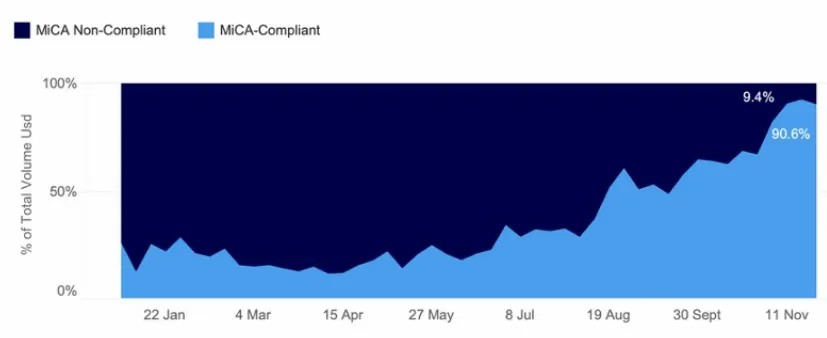
(As of the end of 2024, stablecoins compliant with MiCA standards had captured the majority of the European market. As of November, Circle’s EURC, Société Générale’s EURCV, and Banking Circle’s EURI collectively accounted for 91% of the market share.)
As illustrated in the chart, by mid-November, MiCA-compliant crypto assets accounted for 90.6% of total trading volume, leaving non-compliant crypto assets with only 9.4%. This shift in data intuitively reflects the market’s rapid response and adaptation to regulatory requirements.
Following the entry into force of MiCA, several major exchanges have successively completed the delisting of non-compliant stablecoins:
-
In January 2025, Crypto.com announced the delisting of ten stablecoins, including USDT, Wrapped Bitcoin (WBTC), DAI, and Pax Dollar (USDP), across Europe to comply with EU regulatory requirements;
-
In February 2025, Coinbase removed Tether (USDT) from the list of tradable assets available to its European customers;
-
From February to March 2025, Kraken announced a phased delisting of stablecoins such as USDT, PYUSD, EURT, and TUSD in the European Economic Area (EEA), completing the delisting by the end of March and ceasing all trading;
-
In March 2025, Binance announced the cessation of trading services for all non-MiCA-compliant stablecoins (including USDT, TUSD, DAI, etc.) in the European Economic Area, with automatic conversion into compliant stablecoin assets by March 31.
These actions indicate that MiCA has not only reshaped the market landscape but also clarified the“compliant stablecoin”dominant position in the EU market.
Meanwhile, following the launch of USDC, Circle successfully introduced EURC, a euro-pegged stablecoin, to meet European Union regulatory requirements. As a regulated euro-denominated stablecoin, EURC fills a market gap and is poised to play a key role in the European market after the exit of U.S. dollar stablecoins such as those issued by Tether.
Although U.S. dollar stablecoins remain dominant globally, euro-denominated stablecoins (such as EURC and EURS) are gradually gaining greater policy support as regulation tightens.
The MiCA Regulatory Framework: Redefining Stablecoin Compliance
The European Union’s Markets in Crypto-Assets Regulation (MiCA) establishes the first unified regulatory framework for stablecoins, providing a systematic classification of the legal nature and regulatory requirements applicable to different types of stablecoins. Under MiCA, stablecoins are primarily categorized into two types:
-
Asset-Referenced Tokens (ARTs):Their value is intended to remain stable by referencing one or more fiat currencies, commodities, crypto assets, or a combination thereof;
-
E-Money Tokens (EMTs):Primarily used for payment purposes, their value is maintained stable by referencing a single official currency. Typical examples include USDT and USDC.
With respect to regulatory arrangements, MiCA expressly provides that issuers of EMTs must be electronic money institutions (EMIs) or credit institutions authorized in the European Union. This means that stablecoin issuance activities must be brought within the scope of supervision under the existing financial system and comply with compliance requirements similar to those applicable to electronic money. Specific obligations include:
-
Disclosure:Issuers are required to submit a white paper to regulators, comprehensively setting out the redemption mechanism, risk disclosures, and the composition of reserve assets;
-
Reserve Management:Reserve assets must fully cover the issuance volume and maintain high liquidity to ensure redemption capacity;
-
Interest Restrictions:Issuers are prohibited from paying interest to token holders to prevent stablecoins from being instrumentalized as investment products;
-
Systemic Oversight:For "significant e-money tokens (significant EMTs)" with potential systemic risks, direct supervision is implemented by the European Banking Authority (EBA).
Following the formal implementation of MiCA, EU regulators successively issued supporting guidelines to strengthen enforcement. On July 5, 2024, the EBA issued a statement clarifying that the provisions of MiCA concerning asset-referenced tokens (ARTs) and e-money tokens (EMTs) officially took effect on June 30, 2024.Thereafter, unlicensed stablecoins are prohibited from being issued, traded, or listed within the European Union.Meanwhile, compliant issuers must continuously report to regulators on the status of reserve assets and the operation of redemption mechanisms to ensure market transparency and investor protection.
Furthermore, in January 2025, the European Securities and Markets Authority (ESMA) issued a statement providing supplementary clarification on the obligations of crypto-asset service providers (CASPs). ESMA requires that CASPs must completely cease providing trading, exchange, or acquiring services for stablecoins that do not comply with MiCA requirements by the end of the first quarter of 2025, permitting users to exit only through a "sell" mode.
Overall, through the coordinated oversight of the EBA and ESMA under MiCA,a comprehensive compliance framework has been established, covering stablecoin classification, issuance qualifications, reserve requirements, and market exit mechanisms.This framework not only strengthens financial stability and consumer protection within the EU, but also provides a referenceable institutional model for global stablecoin regulation.
USDT’s Dilemma: A Giant Beyond the Compliance Threshold
Although USDT has not been“comprehensively banned”by EU regulators, its compliance status in the EU market is increasingly challenged following the formal entry into force of the stablecoin provisions under the Markets in Crypto-Assets Regulation (MiCA). To address the regulatory pressure brought by MiCA, institutions including major exchanges such as Coinbase, OKX, and Kraken have successively announced the delisting or restriction of USDT trading. This trend is primarily driven by the following factors:
1. Failure to Meet MiCA’s Compliance Threshold
MiCA stipulates that issuers of electronic money tokens must be authorized electronic money institutions or credit institutions in the European Union. However, Tether Limited, the issuer of USDT, has not obtained any form of electronic money institution (EMI) license in the EU, nor has it submitted a whitepaper compliant with MiCA requirements to regulators.Its reserve disclosure practices and internal compliance framework fail to meet EU regulatory standards, thereby leading to USDT being classified as a “non-compliant stablecoin.”
2. Potential Financial Stability Risks
Under MiCA, issuers of significant stablecoins must ensure strict liquidity management. As the largest stablecoin by market capitalization, any loss of stability by Tether would likely pose risks to the EU financial markets.
3. Reserve Transparency and Audit Issues
Transparency is a core element of the MiCA regulatory framework.Tether has long been subject to controversy due to inadequate reserve disclosures, with its public filings lacking support from comprehensive third-party audits. The U.S. Commodity Futures Trading Commission (CFTC) and the Securities and Exchange Commission (SEC) have separately imposed penalties on Tether for false reserve statements, further undermining its credibility in the context of European Union regulation.
4. Deficiencies in Regulatory Registration and Jurisdictional Compliance
Tether Limited is registered in the British Virgin Islands and is not integrated into the EU regulatory framework, nor is it subject to direct supervision by the financial regulators of any Member State. This means that, as a matter of law, it struggles to meet MiCA’s requirements regarding the traceability of issuers and regulatory accessibility.
In light of the foregoing factors, the principles advocated by MiCA, namely“transparency, auditability, and accountability”make it difficult for USDT to attain a lawful status in the EU market. In implementing MiCA, both the European Banking Authority (EBA) and the European Securities and Markets Authority (ESMA) emphasize that stablecoin issuers should establish mechanisms for ongoing reserve disclosure and risk management reporting, whereas Tether’s current compliance capabilities are clearly insufficient.
Accordingly, on the eve of the full effectiveness of MiCA, major European trading platforms have chosen to proactively adjust their business layouts, gradually reducing or discontinuing USDT trading and settlement functions, so as to mitigate regulatory risks and align with policy directions.
These developments signify that the EU is promoting the compliance and localization of the stablecoin ecosystem through market-based measures. In this regulatory environment, compliant euro-denominated stablecoins (such as EUROe and EURCV) are expected to enjoy broader growth prospects.
Why USDC and EUROC Are Regarded as Compliant Stablecoins
Unlike USDT, the issuers of USDC and EUROC—Circle France SAS—have obtained an electronic money institution license from the French financial regulator, the ACPR, and strictly adhere to the requirements of the Markets in Crypto-Assets Regulation (MiCA), thereby satisfying applicable compliance obligations. This has led to their formal recognition in the market as compliant stablecoins, securing regulatory approval for their status as stablecoins.
In terms of issuance, USDC and EUROC comply with MiCA’s requirements in areas such as reserve management, compliance disclosures, and liquidity safeguards, thereby ensuring theirlawfulnessandcomplianceSpecifically, these two stablecoins offer the following significant compliance advantages:
1. Audit and Transparency:USDC regularly publishes audit reports conducted by third-party institutions, transparently disclosing its reserve structure. This practice not only enhances market confidence in its compliance but also aligns with MiCA’s requirements for stablecoin transparency.
2. High Liquidity and Safety of Reserves:USDC’s reserves consist entirely of cash and short-term U.S. Treasury securities, meeting MiCA’s high liquidity requirements. This ensures the stablecoin’s redeemability and effectively mitigates potential market risks.
3. Widespread Adoption by Financial Institutions:USDC has been widely adopted by numerous mainstream financial institutions and payment service providers, establishing a strong compliance reputation. As one of the major global payment channels, its compliance status has been recognized by international regulatory authorities.
4. Compliance within the Eurozone:Euro-denominated stablecoins such as EUROC are gradually gaining support from EU regulatory authorities. They are regarded as potential core instruments for compliant transactions and payments within the Eurozone and are expected to occupy a more prominent position under the MiCA regulatory framework.
As MiCA is progressively implemented, the compliance status of USDC and EUROC is expected to be further consolidated.In particular, given that Tether (USDT) has not yet completed its compliance remediation under the Markets in Crypto-Assets Regulation (MiCA), USD Coin (USDC) and Euro Coin (EUROC) have already secured significant positions in the European stablecoin market. They are expected to continue expanding their market share, thereby further consolidating their dominant position in the euro area.
Compliance Recommendations for CASPs
For crypto-asset service providers (CASPs) that plan to apply for authorization or are already operating within the European Union, ensuring compliance is key to smooth operations and obtaining regulatory approval.As MiCA is progressively implemented, EU regulators are imposing increasingly stringent requirements on the crypto-assets industry. Therefore, CASPs must take a multi-faceted approach to ensure that their business activities and products comply with EU regulatory requirements. The following are specific compliance recommendations:
1. Prioritize compliant stablecoins issued by electronic money institutions (EMIs)
When selecting stablecoins for payments or trading, CASPs should prioritize compliant stablecoins issued by EMIs, such asUSDCandEUROCThese stablecoins not only meet MiCA’s regulatory requirements but also offer greater transparency and stability, providing institutions with enhanced compliance assurance. Choosing compliant stablecoins helps reduce compliance risks and enhances an institution’s reputation and customer trust. In particular, when facing regulatory scrutiny, compliant stablecoins represent the most prudent choice.
2. Regularly monitor the latest regulatory lists and guidelines issued by ESMA and EBA
The European Securities and Markets Authority (ESMA) and the European Banking Authority (EBA) are crucial regulatory bodies in the implementation of MiCA. They regularly publish regulatory lists, guidelines, and policy updates concerning crypto assets. CASPs should closely monitor the latest notices and guidelines issued by these authorities to ensure that their operations and products comply with current regulatory requirements. This is particularly important as the implementing measures under MiCA continue to be updated. Timely tracking of these policy changes is essential for CASPs. Only by closely monitoring regulatory developments can CASPs effectively mitigate compliance risks and ensure that their operations remain within the EU legal framework.
3. Establish an internal token assessment mechanism to ensure products meet MiCA standards
In the course of their operations, CASPs handle various types of crypto assets, including stablecoins, tokens, and other crypto assets. Therefore, establishing a robust internal token assessment mechanism is key to ensuring that products meet MiCA standards. The assessment mechanism should include reviews of each crypto asset’s compliance, transparency, risk management, and other relevant aspects, ensuring that all products used meet legal requirements. Such a mechanism enables CASPs to promptly identify potential compliance issues and implement corrective measures at an early stage, thereby avoiding penalties during regulatory inspections.
4. Avoid using unauthorized or insufficiently transparent stablecoins to prevent compliance risks from affecting license approval.
For Crypto-Asset Service Providers (CASPs), the use of unauthorized or insufficiently transparent stablecoins may expose them to significant compliance risks, potentially even impacting their license approval. Stablecoins not approved by regulatory authorities (such as certain non-compliant stablecoins not authorized under MiCA) often lack transparent reserve management and may pose potential risks. This not only affects the institution’s compliance status but may also cause serious damage to its reputation. Therefore, CASPs should strictly review the compliance of stablecoins when making selections and avoid using non-compliant products that could adversely affect their license applications or operations.
In summary, for CASPs to operate smoothly in the EU market and obtain regulatory approval, they must attach great importance to compliance issues. By adopting measures such as selecting compliant stablecoins, regularly monitoring regulatory developments, establishing internal assessment mechanisms, and avoiding the use of non-compliant products, CASPs can effectively reduce compliance risks and lay a solid foundation for their long-term future development. Meanwhile, compliance is also a crucial pathway to earning customer trust and gaining market recognition.
Conclusion
The implementation of MiCA has not only reshaped the stablecoin landscape in the European Union but is also influencing the global crypto assets ecosystem.
Over the coming year, the boundary between compliant and non-compliant entities will become clearer:
-
The exit of non-compliant stablecoins from the EU market is an inevitable evolution of the regulatory framework;
-
Compliant stablecoins (such as USDC and EUROC) will enjoy more robust development prospects based on transparency and trust.
This regulatory“reshuffling”is not a negation of innovation, but rather a transition of the crypto market from the“experimental phase”ushering inthe “maturity stage”a critical step.