
For lawyers, one scenario should feel very familiar.
An event ends, or a friend makes an introduction, and you add a potential client on WeChat. The other person says: "Lawyer Liu, send me your introduction." So you scroll through your phone, find your CV, and then look for a team introduction. If the person wants to learn about a particular practice area, you may also need to send a several-dozen-page PPT.
From the lawyer's side, all the materials that should be prepared have been prepared. But from the client's side, having just met someone, they have to dig through several files to find the information they need, which is indeed a bit of a hassle. If they want to forward it to a partner to take a look, they also have to add a note: what this lawyer does, and why it is worth talking to him.
At home over the weekend, I vibe-coded the Mankun Law Firm mini program, simply wanting to get this small thing done well first.
Let a lawyer hand out a business card in WeChat; after the client taps it open, they can continue to learn about this person, see what he has written, and then find the legal services relevant to them.
Yesterday, I introduced "putting Mankun lawyers into your AI." Today, the Mankun mini program is officially launched.
We have taken another step closer to the scenarios that Mankun uses every day to serve clients in the AI era.
Mankun mini program homepage: entering lawyer introductions, professional content and legal services from WeChat. Screenshot of the development version.
Give lawyers a business card they are willing to share
When building the mini program, I thought of the business card first. Everyone is familiar with this thing; in the past it went in a card holder, and now it is more often sent in WeChat. For Mankun lawyers, the most direct need is: after getting to know a client, having one's own introduction that can be sent out at hand.
The shared card stays simple. The other person can see at a glance the lawyer's name, position and photo, know who the friend recommended, and easily find it again from the chat history.
Tapping open the card reveals the complete lawyer profile page: practice areas, educational background, professional experience and related introductions are all here. Clients can first learn what this lawyer has done and what he is good at, and then decide where to continue the conversation.

Attorney profile page: practice areas, educational background and professional experience. Development version screenshot.
But if we stopped there, I think it would not be enough.
When clients look for a lawyer, of course they consider the school the lawyer graduated from, work experience and service experience. But when the client is actually about to entrust a project to you, they often also want to know: do you truly understand this industry? Do you have your own judgment on the problems I am currently facing?
"Familiar with a certain industry" is easy to put into an introduction. What I value more is whether a lawyer continuously follows this industry and is willing to write out his or her research and judgment. To some extent, these articles are his proof of work in this industry.
Moreover, it is proof of work with real-world timestamps. Articles have publication dates, so one can look back: when a certain business first emerged, what was this lawyer concerned about; after the rules changed, did he continue his research. Put several years of articles together, and a person's investment in the industry has a concrete record. Clients can also use this to understand a little more about where exactly the "familiarity with this industry" he speaks of is reflected.
Therefore, we gather the professional articles a lawyer has previously published, as well as related public updates, onto the individual page. After reading the resume, clients can continue to learn through these materials: which issues this lawyer has long focused on, how he analyzes specific business, and how he updates his judgment as the industry changes.
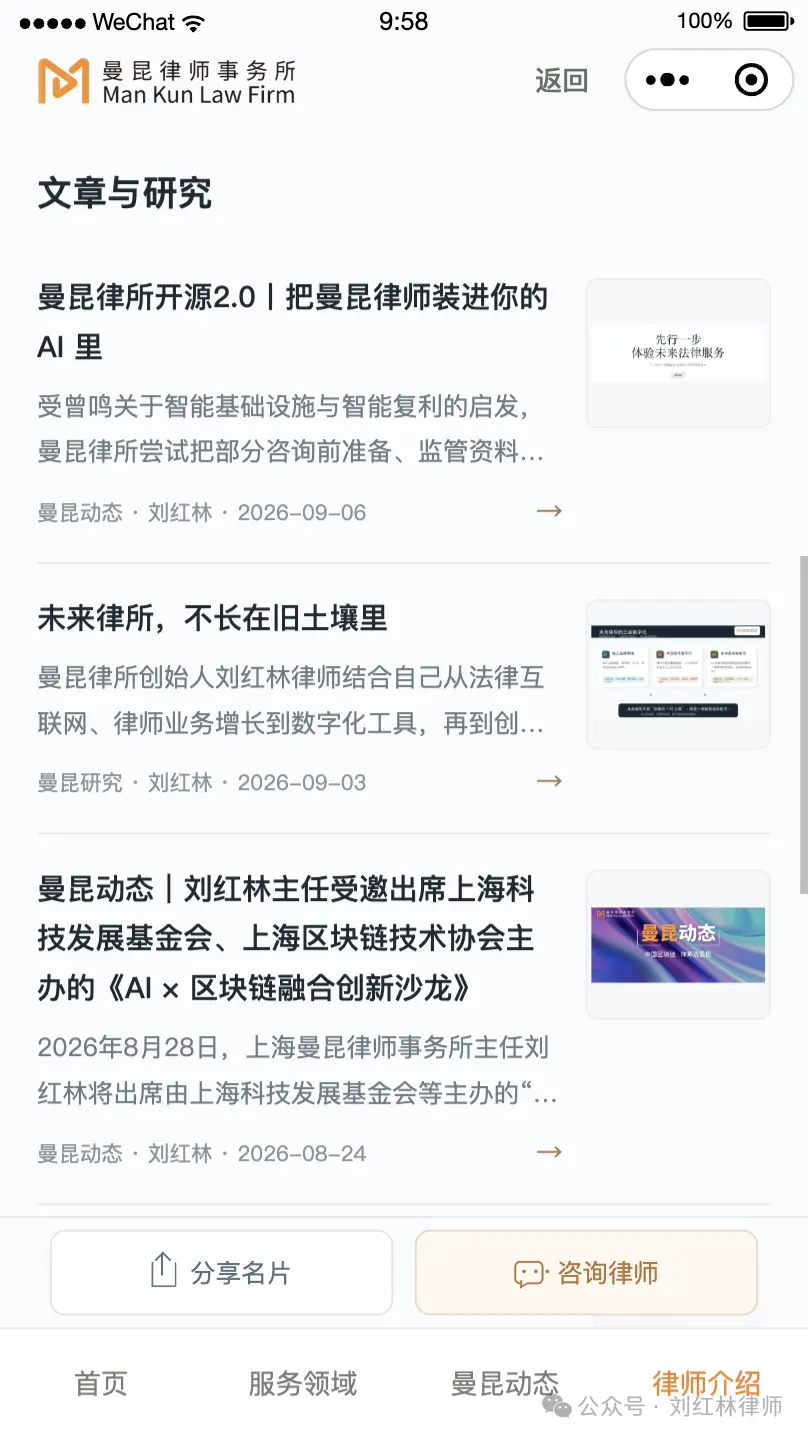
Past articles retain the title, author and publication date, recording the lawyer's ongoing research and judgment. Development version screenshot.
For example, an entrepreneur doing cross-border payments has just met a Mankun Law Firm lawyer. He can first look at this lawyer's practice areas, then read an article about crypto payments. If the accounts, business structure and fund flows discussed therein happen to be the very issues he is currently dealing with, the next conversation will have a concrete starting point: "The situation you mentioned in your article, we have encountered it too."

Open the professional article and continue reading "The Focus of AI Payments Is Not Payment Itself." Development version screenshot.
In this way, the next conversation need not start again with self-introductions. The research a lawyer takes the time to write down does not stop at the day it is published; instead, it is used again and again in later client communications.
From this perspective, the lawyer introduction in the Mankun mini-program can be understood as a lawyer's personal webpage within the WeChat ecosystem. What is handed over is a business card; once opened, it is a place where one can continuously learn about him.
Turn the introduction into something clients are willing to read
Another problem we wanted to solve is how legal services are introduced.
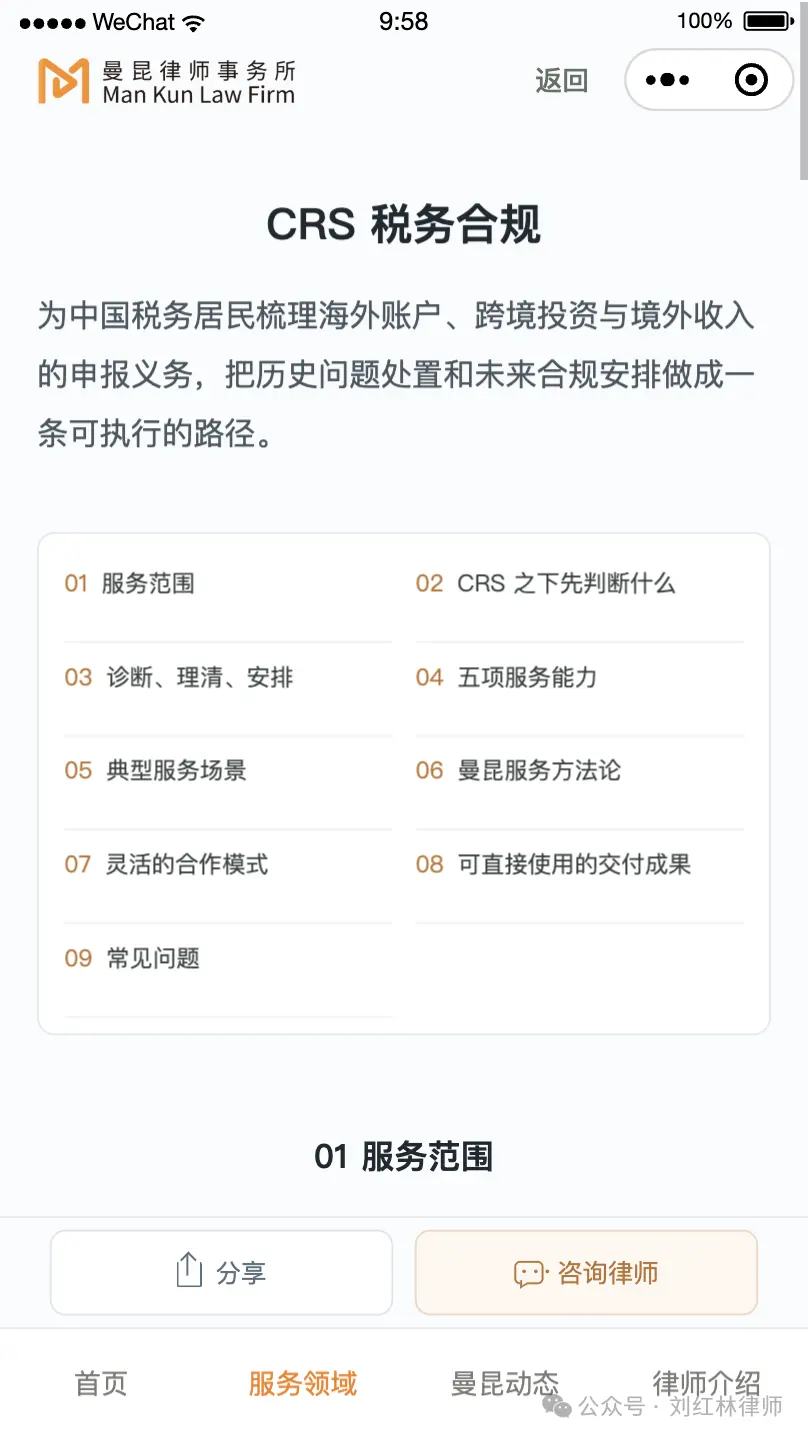
Legal service details: using CRS tax compliance as an example, view the service introduction and content directory. Development version screenshot.
Lawyer teams usually do not lack introductory materials. The firm has the firm's version, practice groups have their own versions, and individual services have separate versions. To appear comprehensive, the documents grow thicker and thicker; yet when actually sending them to clients, one still needs to remind the recipient: "You should mainly look at these pages toward the back."
What clients want to clarify at this point is usually quite specific: what types of problems can you help me handle, is this service suitable for my situation, and who should I talk to next.
The Mankun mini program places team and legal service introductions on pages that can be browsed directly and forwarded onward. When a lawyer introduces a certain practice, they can send the relevant pages to the client; when the client needs to seek colleagues' opinions, they can also conveniently forward them so that everyone discusses the same content.
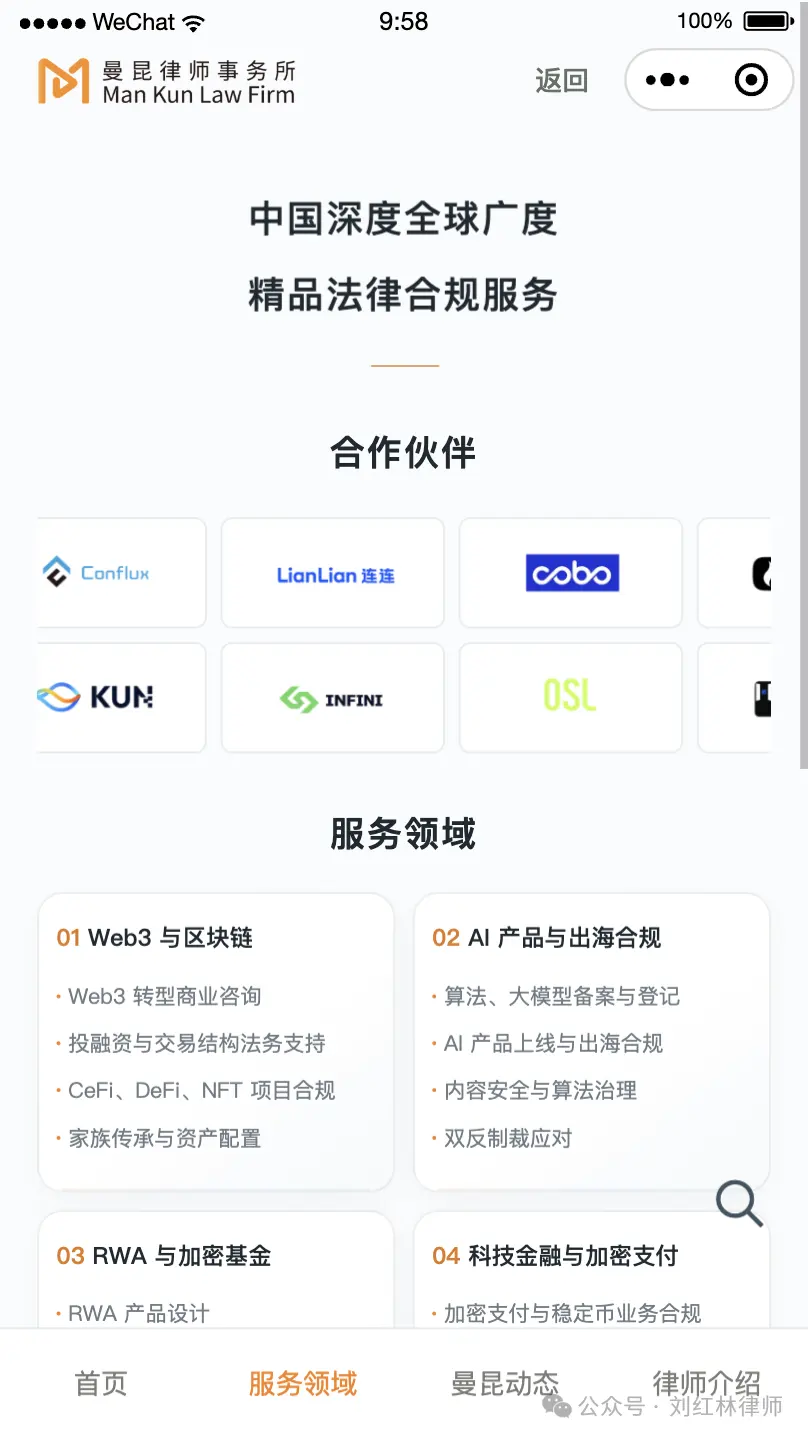
Practice areas homepage: browse the Mankun team and legal services. Development version screenshot.
Taking cross-border tax services as an example, clients can start from the typical scenarios on the page and see which situation is closer to their own: overseas investment unreported for many years, overseas remuneration and multiple identities, or assets scattered across multiple jurisdictions. By first finding the issue relevant to themselves and then learning about the corresponding service content, subsequent communication more easily gets to the point.
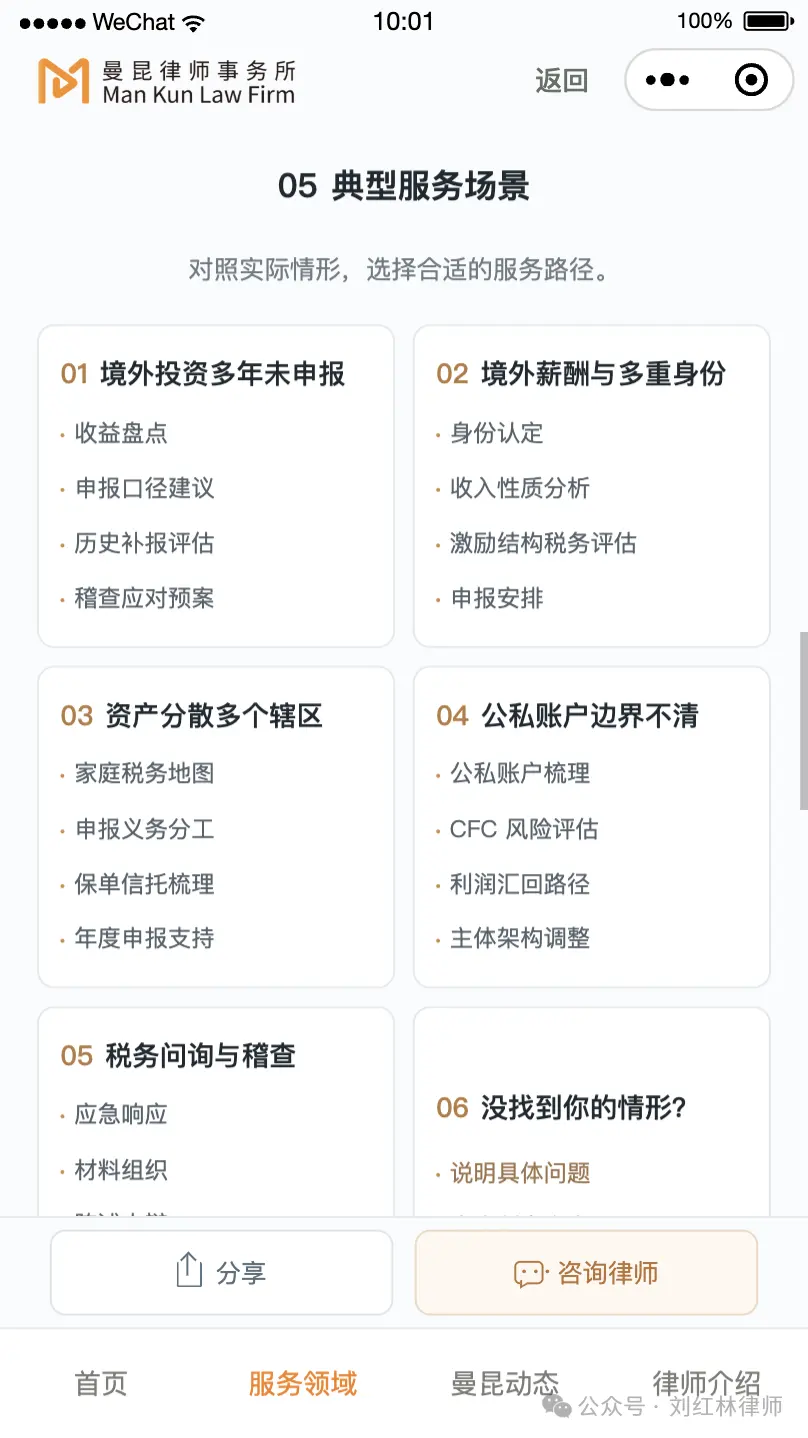
Typical service scenarios: learn about services starting from practical issues such as overseas investment, remuneration and multiple identities. Development version screenshot.
This is also what I understand as the productization of legal services: translating lawyers' professional capabilities into service content that clients can understand. Only when clients can see where their own problems fall and what help the team can provide are they in a position to continue discussing cooperation. The mini program makes this introduction easier to open and easier to enter into a real business conversation.
In the future, when introducing the team and the practice, lawyers can flip through fewer documents, and clients need not first download a large set of materials. Click to take a look first, and discuss further wherever interest arises.
This is what we hope the mini program will first solve.
The same professional accumulation, appearing where clients are accustomed to looking
The Mankun Law Firm website already featured lawyer introductions, professional articles, news updates, and legal service content. When we built the Mini Program, we reused the same content system so that this accumulated material could also be used within WeChat.
A client researching an issue on a computer can enter through the official website; when receiving a friend's recommendation in WeChat, they can open it through the Mini Program. Behind these two entry points are the same group of lawyers and the same set of professional content. When the team maintains the material, there is also a unified source, reducing the trouble of updating different versions everywhere.
For a law firm, writing articles, organizing services, and maintaining lawyer profiles are all tasks that colleagues have completed one by one. Since the work has already been done, clients should be able to find it more easily when needed, and lawyers should be able to use it at any time when introducing their practice.
A research piece on crypto payments can be found by readers on the official website, and can also appear on the author's personal page, becoming a basis for clients to learn about that lawyer. The same legal service can be seen when a client actively searches for it, and can also be shared by a lawyer in a specific conversation.
Clients do not need to understand how the system behind it is built. It is enough that, in the place they are accustomed to, they can smoothly find information, understand the content, and contact the right person.
An AI law firm must start from the first encounter with a client
After completing these tasks, some may ask: what does introducing lawyers, publishing articles, and sharing service pages have to do with an AI law firm?
My understanding is that if AI is to be used to rebuild Mankun Law Firm, we must return to how the firm conducts business every day. Starting from the first time a lawyer meets a client, we should look at which tasks can be made smoother and which information is worth retaining.
The starting point of legal services often comes earlier than the signing of an engagement contract.
A person first reads an article, is introduced to a lawyer by a friend, learns about the team, and then comes with questions for a consultation. During this process, many valuable exchanges have already taken place. In the past, they were often scattered across different people's WeChat messages and memories, and when the next colleague took over, they might not know where the previous discussion had reached.
We hope to gradually connect these business stages. On the premise of obtaining necessary authorization and protecting client privacy and confidential information, the questions clients proactively raise, the needs they have confirmed, and subsequent service feedback can be retained in an orderly manner and used in the next stage of work.
For example, we hope that in the future, when a client comes to consult from a certain service page and has already clearly stated where the company is located, what business it engages in, and what problems it has encountered, the lawyer taking over can continue asking along these lines. When another colleague needs to participate, they can also know what has already been communicated and what has not yet been confirmed. The client does not need to repeat everything from the beginning to a different person.
Only when such information accumulates does AI have a more concrete basis for its work. It can assist in organizing requirements, searching for relevant research, and preparing discussion materials, after which lawyers verify the facts, make judgments, and organize the services. If nothing is retained about what the client wants to do or what has already been confirmed, even the most powerful model will find it difficult to understand this particular engagement out of thin air.
When I discussed Mankun AI yesterday, I mentioned "intelligent compounding." Applied to a law firm, what concerns me more is a specific matter: after completing a service, can the team retain experience that will be useful next time? Where do clients often fail to understand, which materials always need to be supplemented back and forth, and which kinds of questions make the business clearer more easily? If such feedback can feed into the next round of work, then the more business the team does, the better the team has a chance to become.
The mini-program is a starting point on this path.
For now, we will first do a good job with lawyer introductions and service sharing. Next, we will continue to explore how Mankun AI Law Firm works around requirement communication, knowledge research, and team collaboration. With every step forward, we must examine whether it solves the real problems of lawyers and clients.
You can enter through a mini-program business card shared by a Mankun lawyer, first look at his introduction, read an article relevant to you, or forward a certain legal service to a friend who is looking for a solution.
After adding us on WeChat in the future, you are welcome to learn a little more about us.

