
The "Crypto Dream" of the BRICS Nations
At the recent BRICS Business Forum, Russian President Vladimir Putin made remarks that sent ripples through the crypto asset community: Brazil, Russia, India, China, and South Africa—the BRICS nations—will adopt crypto assets for investment and development, and are poised to launch a new BRICS payment platform. This statement quickly sparked heated discussion, viewed as a significant step toward "de-dollarization." However, what does this news truly signify? Is it really as "momentous" as imagined? Let us examine it closely.
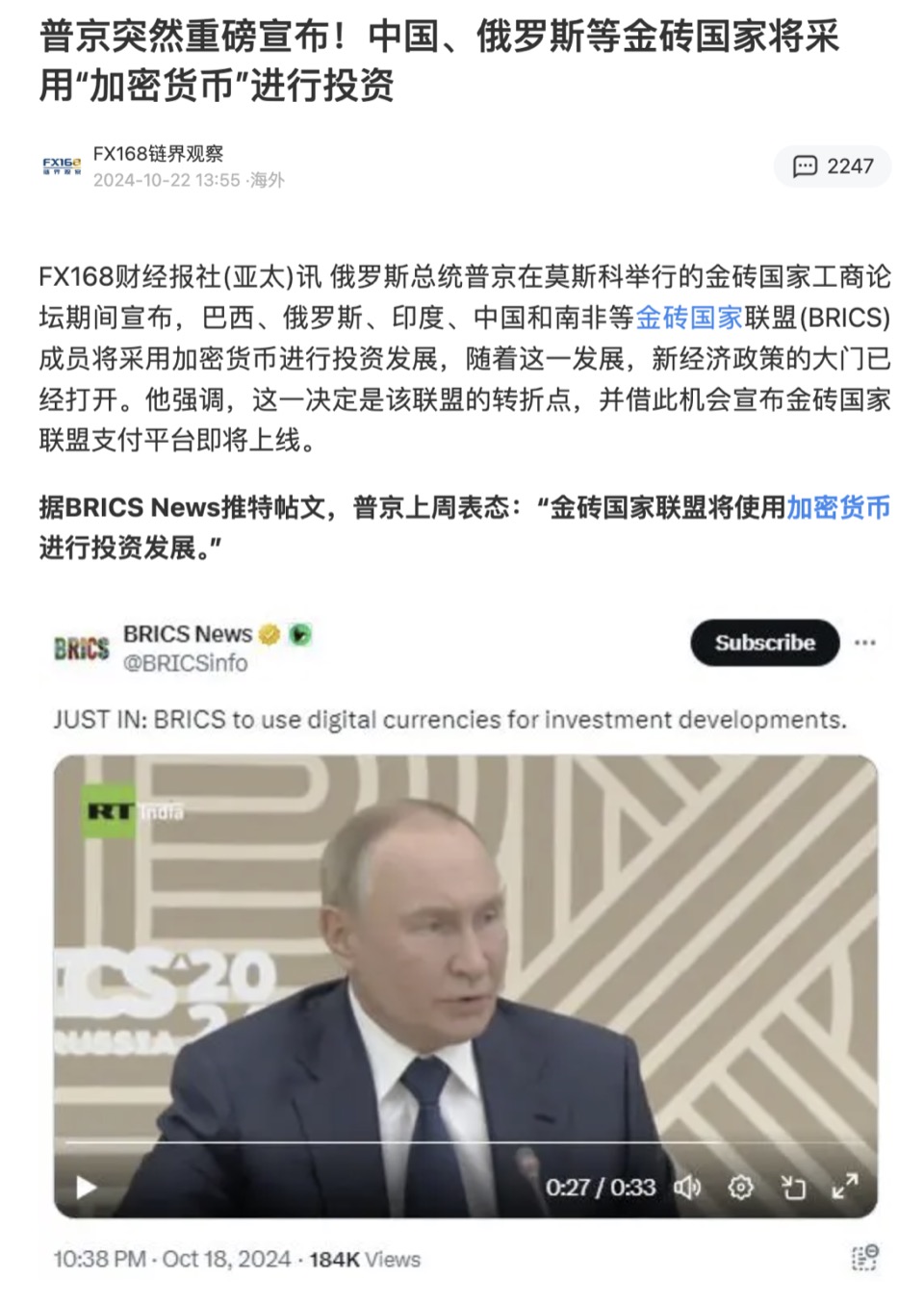
In his speech, Putin stated that the BRICS alliance is committed to reducing its reliance on the traditional US dollar system by establishing a more independent and reliable financial network through crypto assets and blockchain-based payment systems. This declaration is not merely a superficial technological innovation but also a new move in geopolitical maneuvering. In the global economic landscape, the US dollar has long played a dominant role, and the current moves by the BRICS nations clearly aim to secure greater voice and influence on the global financial stage.
Crypto Assets: Can They Truly Become a Powerful Tool for the BRICS Nations?
The "BRICS Payment Platform" mentioned by Putin is seen as an alternative to the SWIFT system. Globally, the SWIFT system dominates nearly all interbank payments and settlements, and its operations have been subject to strict control by the United States. Consequently, countries have had a "love-hate" relationship with it, especially against the backdrop of frequent global sanctions and economic conflicts, where the use of SWIFT has become increasingly politicized. The core objective for the BRICS nations in bypassing this system is to find a more neutral, secure, and effective alternative.
The decentralization, immutability, and transparency of blockchain technology make it a potential solution. However, this does not mean that crypto assets can easily replace existing settlement systems. A global payment network requires not only stability and technical support but also widespread acceptance and regulatory recognition. The current situations within the BRICS nations vary significantly. For instance, while China is a leader in blockchain technology, it maintains stringent regulation over crypto assets to strictly prevent capital outflows; India has repeatedly stated its intention to strictly restrict the use of crypto assets, even considering a complete ban. These divergences directly impact the practical implementation of the idea of "crypto asset settlement."
Putin's proposal is particularly closely related to the current state of trade between China and Russia. In recent years, the volume of trade between China and Russia has continued to rise, but bottlenecks in settlement issues have frequently arisen. Constrained by Western sanctions and the US dollar settlement system, Russia faces obstacles when using the traditional financial system for cross-border payments, forcing both China and Russia to seek new alternatives for trade settlement. Although the proportion of Renminbi usage in China-Russia trade has increased, the two countries' reliance on US dollar settlement remains evident.
Against this background, the demand for virtual assets as an intermediate settlement method is growing. Crypto assets can bypass traditional banking systems, enabling instant, low-cost cross-border payments through decentralization, thus becoming an effective solution. Therefore, the BRICS payment platform proposed by Putin is not only a macro-level "de-dollarization" strategy but also provides new ideas for resolving settlement difficulties faced by China, Russia, and other countries in actual trade.
For China, the adoption of crypto assets by the BRICS alliance will undoubtedly bring complex economic and policy implications. As a major economy within the BRICS, China has long implemented strict regulatory measures against virtual assets, prohibiting domestic enterprises and individuals from engaging in crypto asset transactions, with enforcement efforts continuously intensifying. The core of China's policy lies in controlling capital outflows, maintaining financial stability, and simultaneously promoting the development of Central Bank Digital Currencies (CBDCs). In this context, whether Putin's proposal will receive China's support remains questionable.
However, China has not completely rejected blockchain technology; instead, it is actively promoting the application of blockchain in areas such as supply chain finance and cross-border settlement. China is also seeking more opportunities for the implementation of blockchain technology through cooperation with countries along the "Belt and Road." Therefore, if the BRICS payment platform can provide a compliant and secure framework for cross-border settlement using blockchain technology, China is likely to participate to strengthen economic and trade cooperation with BRICS nations, but this does not imply a comprehensive opening of crypto asset trading.
Business Opportunities for Chinese Web3 Entrepreneurs
Although China's policies regarding crypto assets are becoming stricter, Chinese Web3 entrepreneurs can still discover new opportunities from this event.
First, cross-border applications of blockchain technology and compliance solutions will be key areas for future development. With the launch of the BRICS payment platform, new payment and settlement methods may provide more convenient services for Chinese cross-border e-commerce enterprises and supply chain finance companies, presenting an opportunity for blockchain technology firms. Entrepreneurs can focus on developing applications for cross-border payments, supply chain tracking, etc., leveraging the transparency and traceability of blockchain to improve trade efficiency.
Second, as attention to decentralized technology increases across various countries, the demand for compliance and technical standardization will also rise. Chinese Web3 entrepreneurs can develop technical tools for compliance reviews, such as identity verification and smart contract audits, to help enterprises operate legally under different legal frameworks.
Furthermore, infrastructure related to virtual assets, such as technical support for Decentralized Finance (DeFi) platforms, node maintenance, and cross-chain protocols, remains a direction worthy of attention for entrepreneurs. Although domestic trading is restricted, there is still significant space for technology exports, especially in scenarios involving cross-border payments and international trade among BRICS nations, where related technical services will become increasingly important.
Behind De-Dollarization: The Reshaping of Global Financial Powers
It is worth noting that Putin's remarks are not an isolated incident but a continuation of a series of policy actions by Russia in the field of crypto assets. Recently, the Russian Ministry of Finance passed a new law on digital financial assets, providing a legal basis for enterprises to use crypto assets for cross-border transactions. This move is undoubtedly aimed at circumventing international sanctions to ensure Russia's continued participation in international trade.
Meanwhile, the Central Bank of Russia has approved a pilot project allowing specific enterprises to use the digital ruble and other crypto assets for payments within a regulatory framework. These policy adjustments indicate that Russia has gradually relaxed its stance on crypto assets, moving from initial strict control to conditional openness. Behind this policy shift reflects Russia's demand for and reliance on decentralized technology in international trade and financial settlement.

More interestingly, Russia has announced cooperation with countries such as Iran to attempt launching a gold-backed stablecoin for settlement in the Middle East. These measures show that Russia hopes to break existing economic blockades through crypto assets and establish an independent payment network with more emerging market countries. This can perhaps be seen as a "prelude" to Putin's speech at the BRICS Forum, creating conditions for further promoting crypto asset cooperation within the alliance.
In fact, the "de-dollarization" advocated by Putin has long become a new trend in the global economy, especially after the United States frequently used financial sanctions as a political tool, prompting many countries to seek solutions to avoid US dollar risks. The launch of the BRICS payment platform aims not only for economic "de-dollarization" but, more importantly, challenges the global financial order. For a long time, the US dollar, as the primary settlement currency in international trade, has granted the United States immense financial hegemony. Once this status is threatened, the financial pressure exerted by the United States through the US dollar may become ineffective.
However, can crypto assets bear the heavy responsibility of "de-dollarization"? The answer may not be so simple. Even if the BRICS nations achieve breakthroughs in encrypted payments in the future, the resistance and inertia of the traditional financial system will persist. The monetary policy of the Federal Reserve, the international reserve status of the US dollar, and the global credit dependence on the US dollar all make the path of "de-dollarization" full of variables. Putin's plan may help the BRICS nations gain greater financial independence, but truly shaking the global dominance of the US dollar seems unrealistic, at least in the short term.
Conclusion: The "Crypto Dream" of the BRICS Nations
Putin's announcement has undoubtedly injected a shot of adrenaline into the crypto asset market. For the BRICS alliance to use crypto assets to counter US dollar hegemony, it requires not only technological innovation but also integration across multiple dimensions, including law, regulation, and market acceptance. For those concerned with global financial trends, this is merely the beginning of the "crypto dream" and a significant challenge to the existing financial system.
/ END.
Recommended Reading:
- Mankun Research: Bangkok Blockchain Week Opens—Why Do Web3 Entrepreneurs Love Going to Thailand?
- Alternative Paths for Compliant Crypto Payment Startups | Mankun Web3 Legal Education
*This article is an original work by Mankun Law Firm and represents only the personal views of the author. It does not constitute legal consultation or legal advice on specific matters. More Web3 practitioners are welcome to contribute articles or provide tips. For reprints and legal consultation, please contact customer service: MankunLawFirm.
Author of this article