
Can Everything Be Tokenized as Real-World Assets (RWA)?
As a key issue both domestically and globally, real-world assets (RWA) tokenization and cross-border RWA have naturally become indispensable themes during relevant events. Meanwhile, on a global scale, the tokenization of real-world assets (RWA) is increasingly becoming a significant area of innovation in asset management and capital markets. According to a paper by the global consulting firm Boston Consulting Group (BCG), assets under management in the RWA sector are projected to exceed USD 600 billion by 2030.

However, do you truly understand what RWA is? Do you genuinely grasp the implementation logic behind RWA?
Over the past two months, lawyers at Mankun Law Firm have observed that since AntChain collaborated with Longshine Technology Group to launch the first new energy charging station RWA project, which was successfully selected for the Hong Kong Ensemble Sandbox, RWA has been highly acclaimed both within and outside the industry. Nevertheless, there has been little clear discussion regarding specific implementation methods. Some projects even use the name of RWA as a pretext for issuing tokens, thereby perpetuating old models. Previously, lawyers at Mankun Law Firm authored articles titled “Web3 Lawyer: Low-Compliance RWA—Beware of Illegal Fundraising Risks” and “Web3 Lawyer: Which Projects Are More Suitable for RWA Financing?” analyzing the direction of RWA and highlighting legal risks; readers are encouraged to refer to these materials.
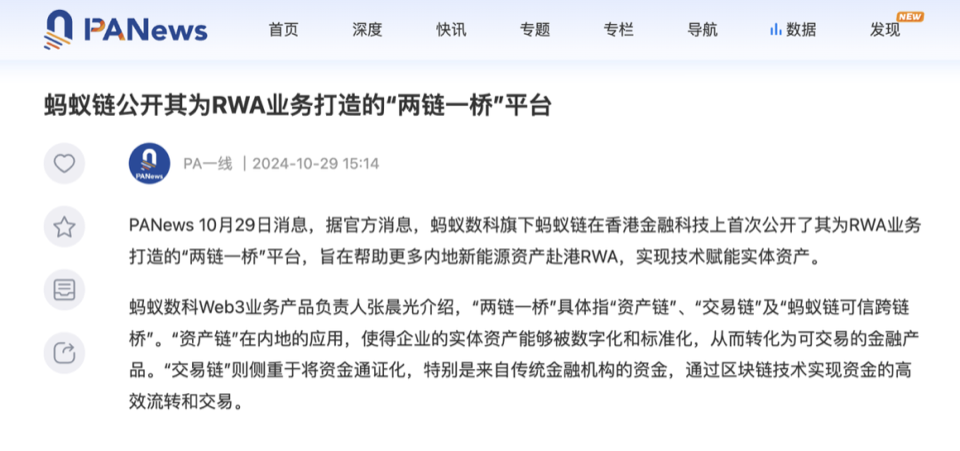
Ultimately, it is essential to understand the RWA model and its underlying value logic. Coincidentally, during this year’s Hong Kong Fintech Week, AntChain publicly unveiled its “Two Chains, One Bridge” platform, dedicated to facilitating the cross-border RWA implementation of domestic new energy assets. Based on the logic of AntChain’s RWA platform, lawyers at Mankun Law Firm will discuss whether domestic RWA can truly be applied universally—i.e., whether everything can indeed be tokenized as RWA.
AntDigital RWA
Synthesizing news related to AntChain, the “Two Chains, One Bridge” platform launched by AntChain includes:
1. Asset Chain
The Asset Chain is responsible fortokenizingphysical assets, converting them into tradable on-chain assets. This process begins bycollecting and verifying core asset information, such as the asset’s actual value, market conditions, and ownership status, ensuring authenticity and reliability. Upon completion of verification, asset information is uploaded to the blockchain, generating corresponding tokens. At this stage, the Asset Chain ensures that all tokenized assets meet standardized and structured requirements, enabling safe and efficient market circulation thereafter. Through this approach, the Asset Chain achieves a standardized conversion from assets to tokens, allowing traditional assets to integrate more conveniently into digitalized cross-border markets.
2. Trading Chain
The design of the Trading Chain not only effectively supports themarket-based circulationof tokenized assets but also significantly enhances the efficiency ofcapital raising. Tokenization on the Trading Chain allows global investors to participate in asset financing processes at any time, thereby providing new sources of liquidity beyond traditional financing channels. Furthermore, the Trading Chain features openness, supporting real-time trading and circulation among users, increasing secondary market activity, and making asset market pricing more transparent and reasonable.
3. AntChain Trusted Cross-Chain Bridge
Bridging the Asset Chain and the Trading Chain, it ensurescompliance and securityin data and asset flows between the two chains. In cross-border RWA applications, compliance is a focal concern for all parties, and AntChain’s Trusted Cross-Chain Bridge provides crucial support in this regard. The bridge not only ensures seamless connectivity between the mainland China Asset Chain and the Hong Kong Trading Chain but also employs multi-factor identity verification and data encryption technologies to ensure cross-border compliance of assets and funds. By leveraging blockchain technology for trustworthy data recording, the cross-chain bridge facilitates secure and compliant flows of funds and assets, providing robust regulatory safeguards for cross-border RWA.
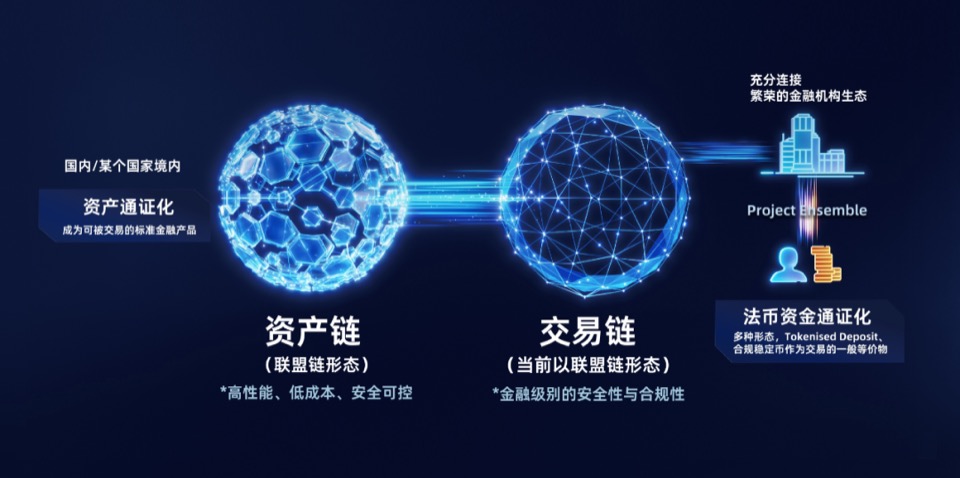
*Image source: Official materials from the AntChain website
With the infrastructure clarified, how should asset owners or fundraisers onboard onto the blockchain and proceed with tokenization? Through studying AntChain’s official examples and the Longshine New Energy Charging Station RWA project,
we summarize that conventional financing models generally consist of several stages:
- Asset Valuation: The fundraiser submits information on specific assets for evaluation, ensuring that the asset’s financial status and market value are certified by third-party or qualified valuation institutions;
- Tokenization: After asset valuation is completed, relevant financing information and valuation certificates are uploaded to the blockchain in digital form, and compliant tokens are created according to financing needs. These tokens are generated on the Asset Chain, and smart contracts establish financing targets and usage rules to ensure clarity of subsequent investors’ rights;
- Cross-Border Financing: Global users can purchase tokens on the Trading Chain, becoming investors in the asset. The Trading Chain supports token circulation and trading among users, enabling investors to obtain returns in the secondary market.
Meanwhile, the RWA reference cases displayed on AntChain’s official website present another novel RWA model—Financing in Cross-Border Commerce. Suppose Buyer A in Hong Kong purchases goods from Seller B in mainland China but lacks short-term working capital and cannot obtain bank loans. In such a scenario, A can utilize the RWA model for rapid financing. The specific process is as follows:
- Bill of Lading Valuation: Buyer A submits a financing request to Hong Kong-based third-party authoritative financial institution C. Seller B assists A in providing corresponding electronic bills of lading, ensuring their authenticity. Financial institution C conducts valuation based on the bill information, laying the foundation for subsequent tokenization and financing processes.
- Tokenization: Upon completion of valuation, C uploads the bill information and valuation results to the blockchain and creates compliant tokens. C utilizes smart contracts to set usage rules for the tokens, including principal-and-interest structures, repayment terms, and settlement conditions, ensuring compliance and transparency of the financing transaction.
- Financing Disbursement: Global users can purchase these tokens on the Trading Chain, thereby financing the order. The financing proceeds are transferred directly into Seller B’s account without passing through Buyer A, while C holds the bill of lading to ensure smooth transaction execution.
- Principal and Interest Repayment and Delivery: According to the repayment schedule stipulated in the smart contract, Buyer A must pay principal and interest to C on time. After A completes the payment, C delivers the bill of lading to A, who can then complete the goods delivery using this document. Simultaneously, C distributes financing returns to participating users in accordance with the contract provisions.
Through the “Two Chains, One Bridge” platform, AntChain provides an efficient and secure solution for the RWA sector, enabling standardized and digitalized circulation of traditional assets in cross-border scenarios. This model creates new possibilities for cross-border financing of domestic assets and offers investors digital investment avenues in physical assets. As demand for RWA continues to grow, this platform will undoubtedly promote further implementation of RWA, providing technical support and feasibility demonstrations for next-stage practical applications.
However, despite the widespread acclaim for the RWA concept, we must ask: Are all assets suitable for RWA? Against the backdrop of numerous projects claiming the RWA label, we need to explore the applicable boundaries of RWA, identify which assets truly possess tokenization value and feasibility, and clarify the actual implementation logic of RWA. This is a key question that RWA, as an innovative tool, must address and answer.
Can Everything Be Tokenized as Real-World Assets (RWA)?
Using AntChain’s “Two Chains, One Bridge” platform case as a reference, lawyers at Mankun Law Firm have distilled several key characteristics of compliant RWA in the market, hoping to provide effective judgment criteria and references for the practical implementation of RWA.
1. Value Foundation
Literally understood, the value source of RWA is real-world assets. Therefore,the prerequisite for compliant RWA is that the asset has a genuine physical or financial basis, rather than fictitious or intangible value. The new energy charging station project on the AntChain platform serves as a typical example, where clear physical assets serve as anchors, providing a realistic foundation for subsequent value assessment and tokenization. For RWA, all tokenized value must be based on real assets—whether real estate, equipment, or debt—with explicit asset backing to ensure the authenticity and reliability of tokens.
2. Value Generation
From AntChain’s introductions and reference cases, during the RWA implementation process,asset values require assessment, typically conducted by third-party authoritative institutions to ensure market trust and compliance. Assessments require comprehensive analysis of the asset’s current market value, future revenue potential, and risk profile. For instance, in AntChain’s case, the assessment data for new energy charging stations were certified, allowing investors to clearly understand potential returns and risks. This implies that in RWA tokenization,the authenticity and verifiability of data are crucial, ensuring that investors can make decisions based on transparent information.
3. Market Demand and Liquidity
CompliantRWA requiresa certain level of market demandto support liquidity after tokenization. Consider an asset with no market demand: even if highly valued, if users do not accept the tokenized version, financing cannot be achieved, nor can market circulation occur. Only assets meeting market demand can ensure broad market recognition post-tokenization, thereby safeguarding value realization.
4. Legal Compliance and Cross-Border Applicability
Assets in compliant RWA must meet regulatory requirements, especially in cross-border scenarios. In AntChain’s underlying architecture, whether in tokenization or cross-chain bridge design, emphasis is placed on ensuring compliance of assets between mainland China and Hong Kong. Additionally, since RWA often involves cross-border elements, this entails not only domestic and international compliance of assets but also compliance requirements regarding data transparency and information disclosure, ensuring the legitimate rights and interests of investors across different jurisdictions.
5. Stability of Long-Term Returns
In the RWA process,expected long-term returns on assets are a significant factor in investor decision-making. Taking new energy charging stations as an example, their stable rental or usage fee income provides investors with clear return expectations. Other types of RWA assets similarly need to exhibit stable and sustainable revenue characteristics to enhance attractiveness to investors, thereby promoting the market development of RWA assets. Assets with high volatility or lacking long-term returns may adversely affect their market performance after tokenization.
Returning to the initial question: Can everything be tokenized as RWA? Based on the above characteristics, the answer is clearly:NO。
Summary by Lawyers at Mankun Law Firm
Through analysis of AntChain’s “Two Chains, One Bridge” platform, we can see the tremendous potential of RWA as an innovative financial instrument, while also recognizing its practical limitations in applicability. RWA is not suitable for all assets; successful RWA projects must possess anchoring in real assets, transparent and authoritative value assessments, support from market demand, guarantees of legal compliance, and stable long-term returns. These elements are not only the foundation of RWA tokenization but also important prerequisites for protecting investor rights and ensuring the long-term value of projects.
Amid the rapid development of RWA, we must maintain a clear understanding, distinguishing assets that truly meet qualifying conditions and preventing projects from abusing the RWA concept for non-compliant financing. In the future, RWA will play a more significant role in cross-border finance and asset management, while market maturity and regulatory improvement will be key to RWA truly empowering the real economy.
/ END.
Recommended Reading:
- Is Charging Fees for Training People to Invest in Virtual Currencies a Legitimate Business? | Mankun Web3 Legal Education
- Comprehensive Guide: How to Establish a Cryptocurrency Fund in Hong Kong? | Mankun Web3 Legal Education
*This article is an original work by Mankun Law Firm and represents solely the personal views of the author(s). It does not constitute legal consultation or legal advice on specific matters. We welcome contributions and insights from more Web3 practitioners. For reprint permissions and legal consultations, please contact customer service: MankunLawFirm.