

A couple of days ago, while discussing China’s cross-border investment regulation with friends in mainland government departments, my counterpart raised a very direct question:Following the restrictions imposed on cross-border brokerages such as Futu, Tiger Brokers, and Longbridge, will on-chain U.S. stocks available on crypto asset exchanges become a new channel for capital outflows from mainland China?
The regulatory authorities have demonstrated keen insight.
In recent years, many mainland users accessed Hong Kong and U.S. stock markets through cross-border brokerage platforms such as Futu, Tiger Brokers, and Longbridge. However, this favorable situation was short-lived. On May 22, 2026, the China Securities Regulatory Commission (CSRC) disclosed that it had initiated investigations and issued prior notices of administrative penalties against relevant entities of Tiger Brokers, Futu Securities, and Longbridge Securities for their illegal cross-border business activities. On the same day, the CSRC and seven other departments released a rectification plan, bringing under regulatory scrutiny activities by overseas institutions conducted within mainland China, including marketing and solicitation, account opening, processing of trading instructions, fund transfers, customer service, software operations, and traffic diversion via self-media channels.
The administrative penalties have yielded significant results. As of June 12, the penalized overseas brokerages have largely begun to implement regulatory requirements and ceased providing “securities investment services to existing clientsin mainland China.” Please pay close attention to the wording and sequence of this statement; if you are a mainland user of any of these three brokerages, you should be able to understand its true implications.
The lesson from Yu the Great’s flood control teaches us that, in some cases, channeling flows may be more effective than blocking them.Tightening regulations on traditional channels does not mean that the demand for investing in U.S. stocks will disappear. For some mainland investors, stocks such as NVIDIA, Tesla, and Apple, as well as Nasdaq ETFs (exchange-traded funds), are not merely distant ticker symbols but represent a means through which they understand global asset allocation, exchange rate risks, and financial security. With the old channels no longer available, they will naturally seek new entry points.
For crypto asset exchanges, this undoubtedly represents a windfall of wealth and business opportunities.
Futu Securities has found its successors.
According to disclosures by Binance, the world’s largest virtual asset exchange, its equity trading products have generated a total trading volume exceeding USD 3 billion and assets under management (AUM) surpassing USD 1 billion since their launch on June 1, 2026, with average daily net inflows of approximately USD 42 million. Approximately one in every seven page visitors registers an account, and nearly 90% of these newly registered users ultimately execute trades.
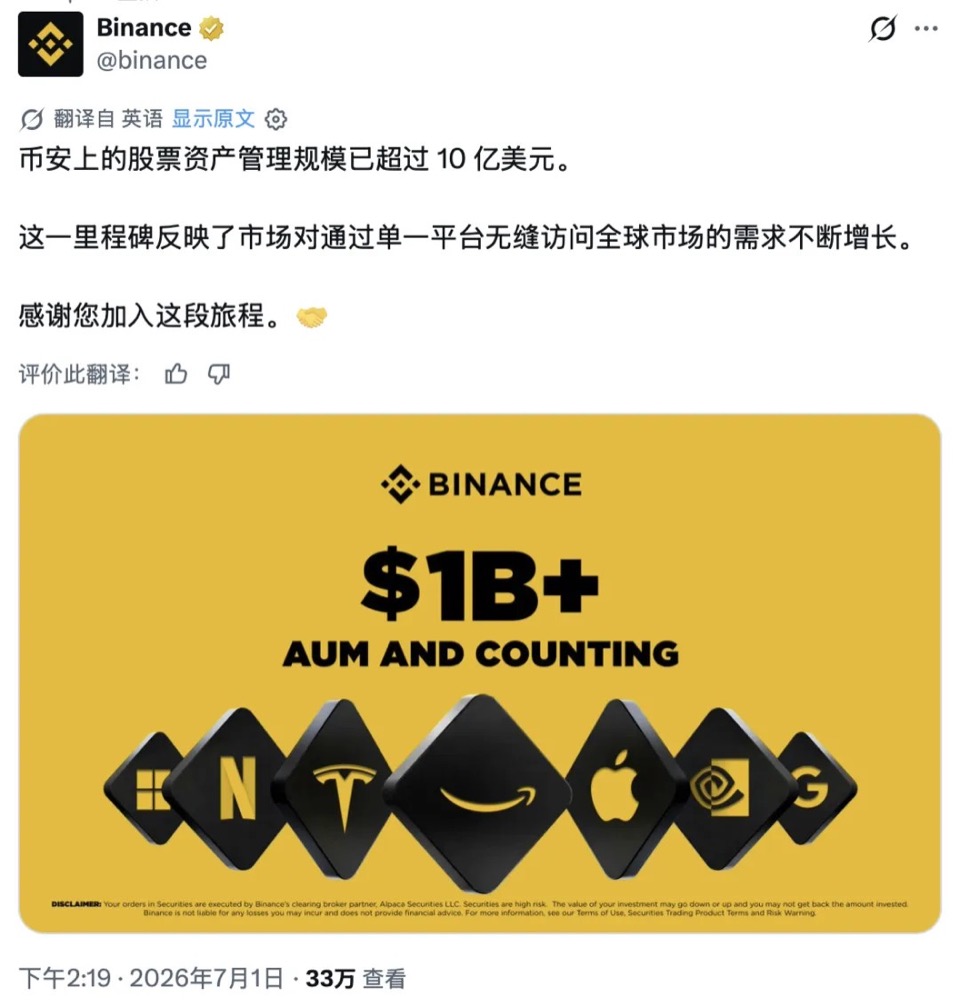
Binance has publicly stated that its AUM for equity products has exceeded USD 1 billion.
The rapid growth of on-chain U.S. equities is not driven by the novelty of the concept, but rather by its optimization of the previously cumbersome process for cross-border investment in securities-related assets, making it exceptionally seamless.
Based on relevant data disclosed by Binance, only approximately 11% of adults worldwide hold brokerage accounts. Although U.S. stocks account for roughly half of the global equity market capitalization, overseas investors hold only about 18% of this amount. Approximately 73% of equity trading users on Binance originate from emerging markets. This suggests that on-chain U.S. equities may not be targeting mature investors already accustomed to using platforms such as Interactive Brokers or Futu, but rather the large number of users previously excluded due to the limited service reach of traditional brokerages.
A user who already holds USDT or USDC and has completed know-your-customer (KYC) verification on an exchange no longer needs to open an overseas brokerage account, wait for bank deposits or withdrawals, or closely monitor U.S. stock trading hours. They simply need to navigate to the “Stocks” section within the exchange or connect to an on-chain equity protocol via their wallet to access trading interfaces for U.S. stocks and ETFs.
Some exchanges have even begun supporting securities position transfers. This means that users who no longer wish to use traditional brokerage products can transfer their existing stock holdings into the crypto exchange ecosystem. Through authorization and minting mechanisms, these holdings can be converted into equity tokens, enabling 24/7 trading, collateralized lending, or participation in decentralized finance (DeFi) scenarios.
Crypto exchanges previously competed for trading volumes in cryptocurrencies, derivatives, wealth management products, and new project listings,but now they are competing for users’ global asset accounts.Stablecoins, U.S. stocks, ETFs, gold, U.S. Treasury bonds, Bitcoin, and Ethereum can all be integrated into a single interface.
What users see is an asset management entry point, whereas regulators perceive an increasingly complex cross-border investment pathway that is difficult to identify under traditional securities account frameworks.
Several Models for On-Chain U.S. Equities
It should be noted that although various on-chain U.S. equity products in the market are described similarly, the solutions offered by different platforms are not uniform.
The first category is the brokerage gateway model.For example, the U.S. stock and ETF trading gateways mentioned in certain exchange announcements essentially connect the exchange’s front end to traditional securities infrastructure behind the scenes. Users see a stock trading entry point within their crypto accounts, but order execution, clearing, settlement, and custody still rely on broker-dealers, clearing firms, and the custodial system.
The key feature of this model is not whether the stocks are on-chain, but rather that the crypto exchange embeds traditional brokerage capabilities into its user interface.
The second category is the on-chain token model.Represented by products such as bStocks and xStocks, these offerings typically emphasize 1:1 backing by underlying stocks, proof of reserves, on-chain transfers, and self-custody via wallets. They are more akin to converting U.S. stock exposure into tradable on-chain instruments. While users see stock tickers on the interface, what investors actually hold is often not the shares of the listed company itself, but certificates or tokens issued by an offshore issuing entity.
The third category is the distribution network model.Platforms such as OKX and MEXC integrate with on-chain asset issuers like Ondo, with the exchanges primarily serving as gateways, providing liquidity, and packaging the user experience. What ultimately determines investor rights remains the offering documents, redemption arrangements, restrictions on eligible users, and platform terms.
What users see is a trading pair, while the backend may involve tokenized securities, tracking certificates, or merely some form of price exposure.
The fourth category is the contract-based exposure model.Coinbase has launched perpetual stock contracts for eligible users outside the United States, settled in USDC, whereby users trade synthetic exposure to U.S. stock prices. This is further removed from “holding stocks”; it is more akin to transforming U.S. stock prices into a new type of instrument on the exchange that allows for long and short positions, leverage, and the accrual of funding rates.
Viewing these approaches side by side provides a clearer picture:

Product Pathways for On-Chain U.S. Stocks
Although the approaches differ, the outcomes converge: they are all migrating demand for U.S. equities from traditional securities markets into the usage patterns of crypto exchanges, stablecoin accounts, and on-chain wallets. For clarity, Attorney Hong Lin below uses a certain exchange’s on-chain U.S. equity product as an example to explain the industry’s current realities.
The Case of a Certain Exchange
First, consider the stock-trading entry point of the certain exchange.
According to disclosures by the certain exchange, its stock-trading product launched on June 1, 2026, enabling users to access more than 7,000 U.S. stocks and ETFs directly within the exchange’s app and to settle transactions using stablecoins.
This is not the traditional experience of “downloading another broker app”; rather, it places U.S. equities alongside the crypto accounts that users already employ. Users’ USDT, USDC, BNB, and crypto assets reside within a single ecosystem, and the stock-trading entry point is integrated within that same ecosystem.
From a legal-structure perspective, this approach does not involve the certain exchange directly providing securities custody.Materials from the certain exchange clearly state that Nest Trading Limited, acting as an introducing broker, routes securities orders to the clearing broker Alpaca Securities LLC, which handles execution, clearing, settlement, and custody; the certain exchange itself does not process or custody user securities.
This arrangement appears “presentable” because it does not entirely discard traditional securities infrastructure, but instead positions brokerage and clearing capabilities in the backend.
However, from the perspective of Chinese regulators, the issue lies precisely here.On the front end, users see the certain exchange, use stablecoins, and access the service through their exchange accounts; product promotions and community discussions are also likely to occur within a crypto context. As for who executes, clears, and custodies in the backend, ordinary users may not truly care. If regulators continue to identify services solely based on whether “overseas broker apps are conducting business toward mainland China,” they will overlook such securities services repackaged through exchange interfaces.
Next, consider bStocks.
According to an announcement issued by the certain exchange on June 11, 2026, bStocks are issued by BTECH Holdings Limited, an affiliate of the certain exchange group. The announcement positions bStocks as certificates representing specific financial instruments, rather than as shares of the relevant listed companies themselves.
Each unit of bStocks is backed 1:1 by U.S. stocks held by a regulated custodian, tradable on the spot market 24 hours a day, redeemable 1:1 between the underlying stocks and bStocks, supported by publicly verifiable proof of reserves, and withdrawable to compatible BNB Smart Chain wallets for self-custody.
The legal boundaries of bStocks cannot be overlooked. Binance announced that bStocks are the first tokenized securities included in the official listing approved by the Financial Services Regulatory Authority (FSRA) of the Abu Dhabi Global Market (ADGM), issued pursuant to an FSRA-approved prospectus, and traded on recognized investment trading platforms. ADGM refers to the Abu Dhabi Global Market.
The announcement further emphasizes that bStocks are not stocks or shares, and holders do not thereby directly own the stocks or shares of the relevant listed companies; the product is offered only in secondary markets to eligible users within permitted jurisdictions, is not offered within the United States or to U.S. persons, and is not publicly offered outside the ADGM.
This is what makes tokenized securities particularly interesting.They come with a compliance framework, meticulously detailing the issuing entity, prospectus, eligible users, jurisdictional restrictions, risk disclosures, and product terms.
However, for regulators in mainland China, the primary concern is not whether restrictions are stated in documents, but whether the product effectively circumvents these restrictions in practice. For instance, a mainland user might purchase USDT through over-the-counter (OTC) channels, enter an exchange, access the U.S. stock trading interface for bStocks, follow Chinese community tutorials to complete the purchase, and even withdraw the tokens to an on-chain wallet to continue participating in decentralized finance (DeFi). The boundaries set forth in documents do not always align with actual usage pathways in the real world.
Notably, bStocks were subsequently integrated into Binance Convert’s recurring investment scenarios. According to the product description, eligible users can set up recurring investments in bStocks, starting from as low as the equivalent of 0.01 USDC, automatically purchasing supported bStocks at user-defined intervals.
This design advances on-chain U.S. equities from “trading when desired” to “continuous investment akin to mutual fund systematic investment plans.” If 24-hour trading addresses trading hours, fractional shares and low thresholds address entry barriers, then recurring investments address the issue of continuous allocation. It transforms on-chain U.S. equities from merely a new trading pair into an entry point capable of long-term accommodating users’ savings and asset allocation habits.
Binance expresses strong confidence in the market outlook for on-chain U.S. equities. Binance Research predicts that by 2031, crypto exchanges and similar platforms could channel $2 trillion in incremental capital into global stock markets and bring in 300 million new investors; at the current growth rate, Binance’s own assets under management in stock trading may exceed $10 billion by the end of 2026.
What are the regulatory challenges in mainland China?
Why do on-chain U.S. equities pose difficulties for mainland Chinese regulators?
From the perspective of Chinese regulators, the key concern is whether non-compliant funds are flowing into overseas capital markets through new product entry points. Although this pathway has historically been ambiguous, regulators at least knew where to focus their scrutiny: banks, cross-border securities firms, tax information exchange mechanisms, and domestic promotion and service chains targeting users.
In simple terms, there were previously three relatively clear gateways.
The first gateway is banks.When users purchase foreign exchange, remit funds, or deposit and withdraw capital, transaction records are retained in their bank accounts, allowing for the identification of fund purposes, counterparties, and unusual frequencies. At the regulatory and law enforcement levels, domestic banks typically cooperate with inquiries, asset freezes, payment suspensions, and the retrieval of transaction records. This constitutes the most critical infrastructure for traditional fund supervision.
The second gateway is securities firms.To trade Hong Kong or U.S. stocks, users generally need to open securities accounts, providing identity and tax information, and generating records of trading instructions, asset balances, and customer service interactions. Even for overseas securities firms, if they engage in account-opening links, marketing solicitation, Chinese-language customer service, processing of trading instructions, or servicing of existing customers within mainland China, regulators can determine whether they are conducting illegal cross-border business operations based on these activities.
The third gateway is the Common Reporting Standard (CRS),which refers to the Automatic Exchange of Information (AEOI) on financial accounts for tax purposes. While it is not omnipotent, and not all overseas accounts are visible in real time to Chinese regulatory authorities, the identities of Chinese tax residents, account balances, and certain income information within traditional banking, securities, and certain financial account systems may theoretically be exchanged back to China through the CRS mechanism. In other words, even if traditional cross-border securities investment takes a circuitous route, regulatory and tax authorities still have opportunities to observe certain traces at the account level.
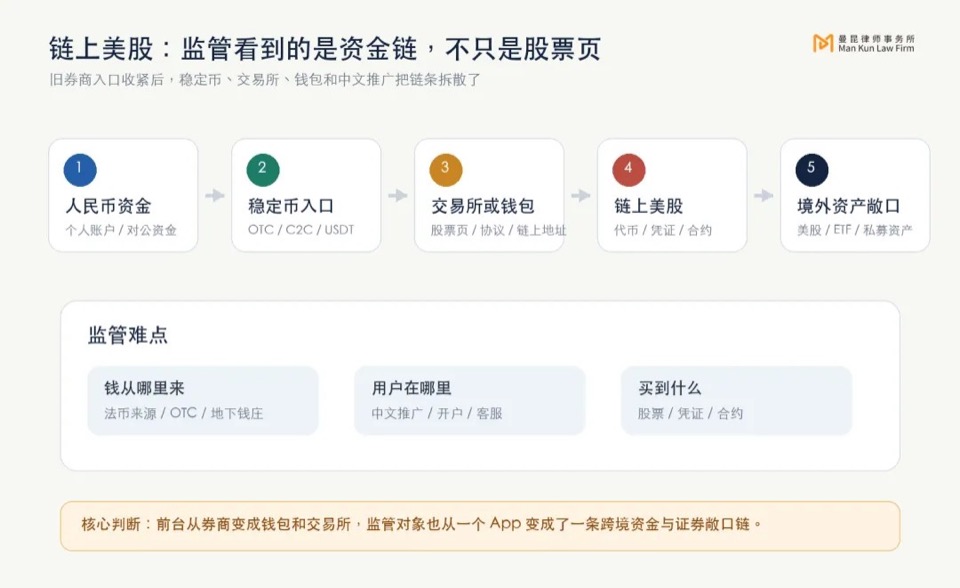
The issue with on-chain U.S. stocks is that it does not merely shift from one channel to another, but rather dismantles these three gateways.
Renminbi is first converted into USDT, USDC, or other stablecoins through over-the-counter (OTC), customer-to-customer (C2C), or other off-exchange methods. From the banking perspective, this may appear merely as transfers between domestic individuals, or as a series of fund flows that do not directly point to securities investment. Once stablecoins enter overseas exchanges or on-chain wallets, subsequent actions no longer pass through the traditional banking account system.
Subsequently, what users purchase on offshore exchanges may be access points for stock trading, tokenized securities, tracking certificates, or stock contracts. For users, this represents "one-click purchase of U.S. stocks"; however, for Chinese regulators, the chain that could previously be pieced together through bank fund usage, securities account details, trading instructions, and CRS information exchange is suddenly broken in the middle.
The chain of on-chain U.S. stocks from the perspective of Chinese regulation can be understood as illustrated in the following diagram:
The first challenge is the weakening of banks’ ability to trace the source of funds.
In the past, regulators overseeing cross-border securities investment could follow the trail through foreign-exchange purchases at banks, cross-border remittances, securities accounts, and broker channels. Today, funds may first be converted into stablecoins within mainland China and then transferred to overseas exchanges or wallets. While banks can observe the initial stage, they may not know that the funds ultimately result in exposure to NVIDIA, Tesla, or Nasdaq ETFs.
A more troublesome issue is that over-the-counter (OTC) stablecoin transactions are often commingled with fraud-related funds, underground banking operations, and illegal payment-settlement schemes. Regulators are no longer pursuing a single, clear cross-border remittance, but rather the correspondence among a chain comprising “domestic transfers, stablecoin transfers, exchange accounts, on-chain addresses, and securities exposures.” Responsibility may exist at each segment, yet no single institution naturally possesses visibility over the entire chain.
The second challenge is that the Common Reporting Standard (CRS) framework for tax information exchange is no longer sufficient.
Within traditional financial accounts, users’ bank accounts, securities accounts, account balances, and investment returns may fall within the scope of CRS information exchange. Even if real-time blocking is not feasible, post-hoc tracking clues regarding tax and asset information may still emerge.
However, when on-chain U.S. equity transactions occur through offshore crypto exchange accounts or on-chain wallets, the situation becomes far more complex. Users may hold exchange account balances, stablecoins, tokenized stocks, contractual rights, or certain offshore instruments. These holdings may not be automatically incorporated into the CRS information-exchange chain accessible to Chinese authorities in the same manner as traditional bank and broker financial accounts.
This creates a tangible regulatory gap: under the traditional broker channel, what users purchase, where their accounts are held, their balances, and their returns can, in theory, still be observed through financial account information exchange and tax reporting systems; whereas under the offshore exchange channel, users may already hold exposure to overseas equities, while mainland regulators may fail to timely detect such exposure through existing mechanisms such as CRS.
The third challenge is that investigative assistance and law-enforcement cooperation are no longer as controllable as in the banking system.
Within the domestic banking system, regulatory authorities, public security organs, and tax authorities have relatively mature mechanisms for requesting transaction records, investigating accounts, and freezing funds. Banks know precisely whom they are dealing with and understand the consequences of non-compliance.
Offshore exchanges, by contrast, differ significantly. An exchange may be registered in an offshore jurisdiction, state in its product documentation that it does not serve restricted jurisdictions, and may not explicitly acknowledge serving mainland Chinese users on its front end. If mainland regulators seek to obtain information on a user’s equity exposure, stablecoin flows, on-chain withdrawal addresses, dollar-cost averaging records, and redemption records at such an exchange, whether, how quickly, and to what extent such data can be obtained will depend on the jurisdiction in which the platform is located, the platform’s compliance posture, and the efficiency of cross-border law-enforcement cooperation.
This poses a substantial impact on Chinese regulation. In the past, regulators faced a combination of “domestic banks + overseas brokers + CRS”; today, they may confront a combination of “domestic OTC trading + stablecoins + offshore exchanges + on-chain wallets + tokenized stocks.” The former at least involved relatively clear accounts and identifiable counterparts for investigative assistance, whereas the latter disperses fund flows, asset flows, and information flows across multiple distinct systems.
This is precisely why on-chain U.S. equities present a genuine headache for mainland regulators. It is not merely the addition of another investment instrument; rather, it replaces the bank, broker, and CRS information chains that regulators could previously leverage with a new chain composed of stablecoins, offshore exchanges, and on-chain addresses.
Regulatory oversight is not entirely invisible; however, the costs of detection, the difficulty of identification, and the scope of investigative cooperation have all been significantly extended.
Friendly Reminder from Mankun Law Firm
For investors, do not rush to treat on-chain U.S. stocks as a substitute for Futu. While you pay real money in stablecoins, what you receive back may not be genuine shares.
First, examine the exchange itself.When overseas exchanges claim compliance, they typically mean that they hold licenses, are registered, make disclosures, or have compliance arrangements in certain overseas jurisdictions. This does not mean they are permitted to provide securities investment services to residents of mainland China.
In particular, some smaller exchanges lack mature asset custody arrangements, clear issuance documentation, and sufficient liquidity. In the event of delisting, suspension of redemptions, or market-making interruptions, users may find it difficult even to identify the party responsible. For ordinary investors, the smaller the platform, the more prominent the high-yield promotions, and the greater the emphasis on “availability for domestic purchase,” the more such platforms should be avoided.
Second, review your own fiat on-ramp and off-ramp pathways.Previously, purchasing stocks through cross-border brokerages was cumbersome, but users generally did not need to repeatedly buy and sell cryptocurrencies in customer-to-customer (C2C) markets. On-chain U.S. stocks are different: many users must first convert renminbi into USDT and then transfer the stablecoins into an exchange or wallet.
During this process, if you encounter funds involved in fraud, illegal payment-settlement schemes, or underground banking, your bank card may be frozen at a minimum, and at worst you could become entangled in criminal risks such as money laundering or aiding information network criminal activities. Many people believe they are merely buying U.S. stocks, yet they may inadvertently participate in cross-border gray-and-black-market fund-laundering networks.
Third, consider exactly what you are purchasing.As previously stated, stock-token solutions vary across exchanges. Some connect with clearing brokers, others issue tracking certificates through offshore entities, some provide synthetic exposure, and others may merely maintain internal ledger entries. The fact that NVIDIA or Tesla appears on the interface does not mean you necessarily own shares in these companies. You must ascertain who holds the underlying assets, who provides custody, who can effect redemptions, and, when regional restrictions change, which documents govern your rights and against whom you may assert claims.
For entrepreneurs working on the tokenization of U.S. stocks or securities assets, the truly worthwhile endeavor is not to help users bypass brokerages.
If a team’s business model involves providing account-opening links, operating rebate-based affiliate programs, offering community tutorials, and guiding fiat onboarding in the Chinese-language market—even employing conversion tactics such as “If Futu is unavailable, come here,” “New methods for buying U.S. stocks from mainland China,” or “One-click purchase of NVIDIA shares with USDT”—it is approaching the sensitive red lines of regulatory scrutiny.
Regardless of whether it is labeled as real-world assets (RWA) tokenization, stock tokenization, or the on-chain integration of global assets, engaging in the sale of securities-related assets, assisting with fiat on- and off-ramping, facilitating platform account openings, or guiding trading activities for users in mainland China carries significant risk. The viable path lies in developing products within overseas compliance frameworks, building infrastructure under clear licensing regimes, investor suitability requirements, asset custody arrangements, disclosure obligations, and anti-money laundering standards.
On-chain U.S. equities will not disappear due to regulatory concerns. Issues such as account-opening experiences, trading hours, fractional share trading, cross-border settlement, and stablecoin payments represent genuine challenges with commercial value. However, from the perspective of Chinese regulators, this is not merely a matter of exchanges adding a stock-trading page; rather, it may give rise to new issues concerning cross-border securities investment demand and irregular cross-border capital flows.
While greater turbulence may drive up prices, for investors in mainland China and service providers in the Chinese-language market, the more pressing questions are: who ultimately owns the asset, where the risks lie, and who will bear the ultimate liability.
Author
Liu Honglin, Founder of Mankun Law Firm. Mr. Liu serves as a member of the Youth Work Committee, the Information Technology Committee, and the Legal Technology Committee of the Shanghai Bar Association. With ten years of experience in law and internet entrepreneurship, he previously served as Vice President of a legal technology company under Tencent’s strategic investments and as Legal Manager for a private equity fund at a listed company. He specializes in devising practical, actionable solutions from the perspectives of business models and legal practice, thereby maximizing commercial interests for clients.
About Mankun
Established in 2015, Mankun Law Firm is a boutique law firm dedicated to serving Web3 and the next-generation internet, with deep expertise in emerging economic sectors such as blockchain, artificial intelligence, and fintech.
Headquartered in Shanghai, the firm maintains branch offices in Hong Kong, Shenzhen, and Silicon Valley. Its core team comprises professionals from renowned law firms, judicial authorities, technology companies, and digital asset institutions. Leveraging unique multidimensional perspectives spanning law, industry, and regulation, the firm provides high-quality legal services that combine depth in China with global breadth.
Drawing on a profound understanding of emerging economic sectors, continuous research into regulatory policies, and extensive practical experience, the Mankun team excels in providing comprehensive legal services from the perspectives of business models and legal practice. These services cater to clients in Web3 blockchain, artificial intelligence (AI), encrypted payment systems (PayFi), decentralized finance (DeFi), real-world assets (RWA) tokenization, NFT digital collectibles, and crypto funds. Service offerings include business structure design, project financing and investment, operational compliance, commercial dispute resolution, establishment of anti-money laundering (AML) compliance systems, coordination with global law enforcement investigations, digital asset tracing and recovery, criminal risk prevention, and criminal defense.