

If you are located in mainland China and use a bank card issued in mainland China, do not treat the C2C trading feature on crypto exchanges as a normal channel for cashing out.
With respect to bank card freezes resulting from cashing out of crypto assets, Attorney Hong Lin has previously authored numerous articles. We had assumed that sufficient risk warnings had been provided; however, friends have recently approached us for consultation: their crypto assets are held on an exchange, and they wish to convert them into RMB. Since the platform offers a C2C trading feature, why would their bank cards still be frozen after selecting a verified merchant with competitive pricing and fast payment receipt?
This question stems from a widespread misunderstanding of C2C trading on crypto exchanges.
Many users assume that completing transactions “within the exchange interface,” dealing with “platform-verified merchants,” and having “recorded orders” ensures safety. However, the actual problem often lies not in the crypto assets sold, but in the funds deposited into your bank account.
In short: If you are located in mainland China and use a bank card issued in mainland China, do not treat the C2C trading feature on crypto exchanges as a normal channel for cashing out.
C2C trading is the aspect most likely to have its risks underestimated by ordinary users. It may appear to be merely a button within the exchange, but in reality it constitutes an RMB transfer between you and a stranger. While the exchange may escrow the crypto assets, display merchant verification, and provide order pages and chat records, the RMB side ultimately involves funds transferred by the counterparty into your bank account.
The core issue is this: while you can confirm that the crypto assets you sell are clean and held in your own account, it is difficult to verify the source of the funds transferred to you by the counterparty.
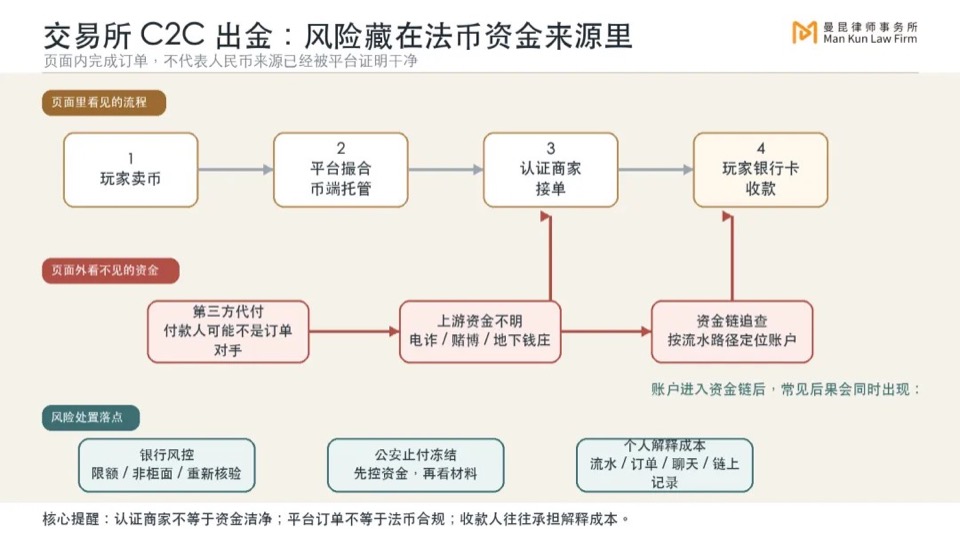
Risk Chain in C2C Cash-Out on Crypto Exchanges
C2C Trading Is Not Operated by the Exchange
A primary misconception among many users regarding C2C trading on exchanges is treating it as the exchange’s own cashier function. They assume that users sell crypto assets to the exchange, which then transfers RMB to the users, with a major platform providing backing, thereby implying lower risk compared to over-the-counter (OTC) transactions outside the platform.
This is not the case. In most C2C transactions, the platform facilitates advertisement display, order matching, crypto asset escrow, and dispute resolution. While crypto assets circulate within the platform, RMB typically circulates outside the platform via bank cards, payment accounts, or other fiat currency payment instruments. The funds you receive are not the platform’s proprietary funds, but rather transfers from the counterparty purchasing the crypto assets or their designated payer.
Consequently, the risk in C2C trading is not merely whether “the exchange will abscond,” but rather whether “the fiat currency you receive can withstand scrutiny under anti-fraud, anti-money laundering, and judicial fund-tracing investigations.” Within the regulatory context of mainland China, business activities involving the exchange of fiat currency for virtual assets, as well as providing information intermediary and pricing services for virtual asset transactions, are strictly prohibited as virtual asset-related business activities. Financial institutions and non-bank payment institutions are also required not to provide services such as account opening, fund transfers, or clearing and settlement for virtual asset-related business activities.
Therefore, for players in mainland China, C2C has never been a "normal exchange window" recognized by regulators. It is more akin to integrating an external and unfamiliar flow of funds outside the platform into the exchange interface.
Platform-verified merchants are not safe
From the perspective of criminal syndicates, one of the greatest attractions of virtual assets is the ability to fragment, convert, and facilitate cross-platform movement of proceeds from telecom fraud, online gambling, illegal fundraising, and underground banking, and then complete deposits and withdrawals through different accounts. When ordinary users sell crypto assets and receive payment, they may not know these individuals or be aware of what occurred with the prior layer of funds, but their bank cards may inadvertently intercept a segment of such funds.
The most troublesome aspect here is that when public security organs and the banking system examine the chain of funds, they do not first ask whether you are a seasoned participant in the crypto space, nor do they first determine whether you are subjectively acting in bad faith. What they see first is this: after a victim was defrauded, the money flowed from Account A to Account B, and then to Account C, with one of the transactions ending up in your account. As long as your account is part of this chain, measures such as stop-payment orders, asset freezes, and restrictions on non-counter transactions may be implemented immediately.
In accordance with the requirements of the Anti-Telecom Network Fraud Law, banking financial institutions and non-bank payment institutions must strengthen monitoring of bank accounts, payment accounts, and payment settlement services. For abnormal accounts and suspicious transactions, they may take measures such as verifying transaction details, re-verifying identities, delaying payment settlements, and restricting or suspending relevant businesses. Public security organs, in conjunction with relevant departments, shall establish systems for immediate inquiry into case-involved funds, emergency stop-payment orders, rapid freezing, timely unfreezing, and fund restitution.
The judicial interpretation on criminal cases of money laundering issued in 2024 by the Supreme People's Court and the Supreme People's Procuratorate further advanced this issue. The interpretation clarifies that transferring or converting criminal proceeds and their gains through "virtual asset" transactions or financial asset exchanges can be recognized as one of the methods of money laundering. The judicial interpretation also states that determining whether a person "knew or should have known" requires a comprehensive assessment based on factors such as the information they accessed, the funds they handled, the type and amount of funds, the methods of transfer and conversion, trading behaviors, abnormalities in fund accounts, professional experience, and relationships with upstream criminals.
In other words, not everyone whose bank card is frozen will constitute a crime. However, if the trading pattern itself is abnormal—characterized by high frequency, large amounts, complex counterparties, or obviously unreasonable prices—or if you have long been collecting payments on behalf of others, acting as an agent for buying and selling, or earning spreads, the matter ceases to be merely a simple case of "having a bank card frozen."
Many people may say, "I dealt with platform-verified merchants; the exchange has already conducted audits, so why should I worry?"
Verification only indicates that the platform has conducted certain identity or transaction capability reviews under its own rules; it does not guarantee that the upstream source of the RMB funds is clean. More realistically, some merchants themselves may merely be nodes within a funding network. The money paid to you today may come from legitimate users buying crypto assets, from third-party payment accounts, or even from fraud-related funds that have just been fragmented.
Ordinary users find it difficult to penetrate this opacity. What you can see includes the counterparty's nickname, order volume, positive rating, payment screenshots, and customer service records. In contrast, judicial authorities and bank risk control systems see the transfer paths between accounts, the duration of fund retention, transaction frequency, risk labels associated with counterparties, and information from victims' reports. The worlds seen by both sides are entirely different.
There is another easily overlooked detail in exchange C2C transactions: in many orders, the payer may not be consistent with the platform-verified real-name identity, the trading counterparty, or the person chatting. Some merchants may claim "payment by company finance," "payment via a family member's account," or "payment through a third-party channel." To expedite the transaction, users often accept such payments. However, once there is an issue with these funds, you will be in a very passive position when providing explanations. It becomes difficult to clarify why an unknown third party transferred money to you, why the remarks did not match the transaction, and why your bank card received multiple payments from unknown sources within a short period.
Such issues are not minor matters for banks and public security organs. They directly relate to whether your account is classified as an abnormal account and whether the materials provided can form a complete and credible chain of transactions during subsequent explanations.
A frozen bank card is no minor matter
Some participants treat card freezes as a routine occurrence in the crypto circle: if a card is frozen, they simply seek to have it unfrozen by providing explanations. This mindset is dangerous.
Restrictions on a bank card may appear to be merely an account issue, but in reality they can affect many aspects of your daily life. If cards used for salary deposits, mortgage payments, corporate collections, or joint family accounts are all linked to the same risk event, the cost of resolution can escalate rapidly. Banks may require you to appear at a branch counter to explain the circumstances, while public security organs may require you to submit transaction records, chat logs, platform orders, on-chain transfer vouchers, and explanations of the source of funds. Some freezes are imposed by public security authorities in other jurisdictions, resulting in longer communication cycles and differing documentary standards.
More troublingly, you will often encounter an awkward dilemma when attempting to provide explanations: you wish to prove that the transaction was merely proceeds from selling virtual assets, yet under mainland regulatory documents, the exchange between fiat currency and virtual assets is not a business scenario encouraged or normally serviced by financial institutions. While you may be able to explain that you did not participate in fraud, engage in money laundering, or knowingly receive stolen proceeds, it is difficult to characterize such transactions as ordinary civil receipts entirely free of risk.
If the transactions are occasional, small in amount, and supported by complete evidence, the subsequent outcome may involve lifting account restrictions, returning funds, or continued cooperation with investigations. However, if the trading becomes long-term or professionalized, or if you continue to trade despite knowing that the counterparty’s funds are abnormal, the matter may enter into more complex discussions of criminal liability.
The first common risk is the crime of aiding information network criminal activities. It typically arises in upstream crimes such as telecommunications and online fraud, where an individual, knowing that another person may be committing cybercrimes, provides bank cards, payment accounts, QR codes for receiving payments, or exchange accounts, or assists in collecting funds, transferring money, or withdrawing cash. For ordinary users, the greatest danger lies not in occasionally selling crypto assets, but in lending their bank cards or exchange accounts to others, or long-term collecting funds, exchanging currencies, and transferring funds out in accordance with others’ instructions, in return for so-called labor fees or channel fees.
The second risk is the crime of concealing or disguising criminal proceeds and the yields thereof. In essence, once funds from upstream crimes have been received, certain individuals assist in transferring, converting, splitting, or cashing out these funds, helping transform “dirty money” into assets that are harder to trace. If you continue to trade despite facing obviously abnormal prices, third-party payments on your behalf, frequent small-amount splits, or payments from unfamiliar accounts in multiple locations, or even actively assist others in converting RMB into virtual assets, your risk exposure will increase significantly.
The third risk is the crime of money laundering. The 2024 Judicial Interpretation on Money Laundering issued by the Supreme People’s Court and the Supreme People’s Procuratorate has explicitly included the transfer and conversion of criminal proceeds and their yields through “virtual asset” transactions and financial asset exchanges. This does not mean that ordinary participants automatically commit money laundering by selling virtual assets; however, if the type of upstream crime, fund pathways, transaction frequency, counterparty identities, price anomalies, and your professional experience are considered together, and they suffice to demonstrate that you knew or should have known that the funds were problematic, the consequences can become severe.
Another easily overlooked scenario involves individuals turning C2C cash-out operations into a stable business by long-term organizing buying and selling, acting as intermediaries for collections and payments, matching transactions between strangers, and profiting from exchange rate spreads, handling fees, or channel fees. In such cases, the discussion extends beyond the freezing of a single card and may implicate illegal business operations, assistance in transferring criminal funds, or even joint criminal liability with upstream and downstream participants. Many individuals believed before the fact that they were merely “arbitraging in the crypto circle,” but from the perspective of law enforcement agencies, they may already constitute nodes for fund conversion between RMB and virtual assets.
What Participants Should Avoid
If you are an ordinary individual, the safest course of action is to avoid using C2C services within exchanges to cash out to mainland bank cards. In particular, do not frequently or in large amounts receive transfers from strangers, do not accept transfers where the payer differs from the counterparty listed in the order, do not accept obviously anomalous buyers solely for better exchange rates, do not use the accounts of family members, friends, employees, or companies to receive funds on your behalf, and do not lend your bank cards, payment accounts, or exchange accounts to others.
You must strictly avoid engaging in activities such as “assisting others with cash-outs,” “acting as an intermediary for collections and payments,” participating in illegal payment-settlement schemes, or “earning spreads through arbitrage.” Many individuals initially believe they are merely helping friends handle virtual assets or earning small channel fees, only to later discover that they have served as bank account and virtual asset conversion nodes within a fund chain designed by others.
If an account has already encountered issues, the immediate response should not be to delete records, fabricate explanations, or seek improper influence. The correct approach is to comprehensively preserve platform orders, chat logs, payer information, bank card statements, on-chain transfer records, and a timeline of transactions. First, determine whether the issue stems from bank risk control, anti-fraud payment suspension, or judicial freezing, and then submit materials as required by the bank or the investigating authorities. For cases involving substantial amounts, multiple accounts, cross-regional freezes, or where investigative interviews have already been conducted, it is advisable to engage legal counsel at an early stage to clarify the facts and organize evidence.
For individuals who are genuinely residing, working, or conducting business overseas, it is recommended to use transaction and payment channels that are permitted under local laws and subject to regulatory oversight. Efforts should be made to conduct receipts and payments through accounts held in one’s own name, and to retain documentation related to taxation, salary, investments, transactions, and sources of funds.
The current state of the crypto assets industry is aptly described as a “dark forest.” Therefore, the best way to protect oneself is to refrain from trusting strangers. When you encounter difficulties during the fiat off-ramping process, illicit and gray-market actors will not provide explanations on your behalf, exchanges will not unfreeze your bank cards for you, and verified merchants will not certify that every sum of money is clean. Ultimately, it is you who must face the banks, public security organs, and the impact on your daily life.
Author
Liu Honglin, Founder of Mankun Law Firm. Member of the Young Lawyers Working Committee of the Shanghai Bar Association, Member of the Informatization Work Committee of the Shanghai Bar Association, and Member of the Legal Technology Committee of the Shanghai Bar Association. Attorney Liu Honglin possesses ten years of experience in law and internet entrepreneurship. He previously served as Vice President of a legal technology company under Tencent’s strategic investment portfolio and as Legal Manager of a private equity fund at a listed company. He specializes in proposing practical, actionable solutions for cases from the perspectives of business models and legal practice, thereby maximizing commercial benefits for clients.
About Mankun
Mankun Law Firm was established in 2015. It is a boutique law firm dedicated to serving Web3 and the next-generation internet, with deep expertise in emerging economic sectors such as blockchain, artificial intelligence, and tech finance.
Headquartered in Shanghai, the firm maintains branch offices in Hong Kong, Shenzhen, Silicon Valley, and other locations. Its core team members come from renowned law firms, judicial authorities, technology companies, and digital asset institutions. Leveraging a unique multi-dimensional perspective encompassing “law, industry, and regulation,” the firm provides high-quality legal services that combine depth in China with global breadth.
Based on a profound understanding of emerging economic sectors, continuous attention to and research on regulatory policies, and extensive practical experience, the Mankun team excels in providing comprehensive legal services from the perspectives of business models and legal practice. These services cater to clients in emerging sectors such as Web3 blockchain, artificial intelligence (AI), encrypted payment (PayFi), decentralized finance (DeFi), tokenization of real-world assets (RWA), NFT digital collectibles, and crypto funds. The services include business structure design, project financing and investment, operational compliance, commercial dispute resolution, construction of anti-money laundering (AML) compliance systems, collaboration with global law enforcement investigations, digital asset tracing and recovery, criminal risk prevention and control, and criminal defense.