

This article is an original work by Lawyer Shao Shiwei. It reflects solely the personal views of the author and does not constitute legal consultation or legal advice on any specific matter. For article reprints, legal consultations, or business exchanges, please add: sswls66.
This article was inspired by a recent criminal case handled by Lawyer Shao involving an introducer in a currency exchange transaction. However, to protect privacy, no specific details of the pending case will be disclosed. The purpose is merely to provide general legal education, hoping that more individuals will understand such scams and take preventive measures to avoid potential criminal liability.
Individuals seeking currency exchange services can generally be divided into two categories: those with legitimate needs, such as studying abroad, overseas travel, and cross-border trade; and those with illicit purposes, such as asset transfer and money laundering.
Due to China’s foreign exchange control regime, private currency exchange transactions, often pursued for reasons of “convenience” and “speed,” are unlawful yet prevalent in practice. Furthermore, Hong Kong’s financial system differs slightly from that of the mainland,Funds Credited ≠ Funds Cleared, which creates opportunities for fraudsters.
Author: Lawyer Shao Shiwei
01
Were the credited funds reversed by the counterparty?
In Hong Kong, bank checks are a common payment method, with a level of prevalence comparable to mobile payments in mainland China. Payments for utilities, salary disbursements, and down payments are routinely completed using checks in the Hong Kong region.
However, with check remittances, after the remitter initiates the transfer, the funds remain in a suspense account status. There is a 24-hour verification period between the crediting of the check and the final clearance of funds.
In other words, the payee will receive two separate SMS notifications from the bank:
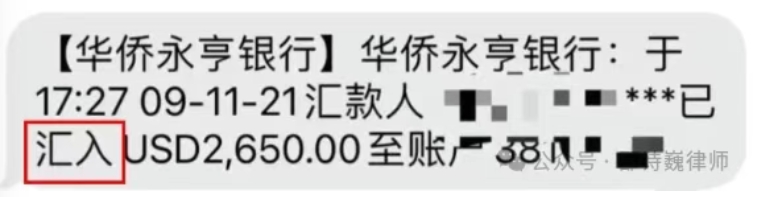
The first SMS states that funds have been “remitted.” This merely reflects a numerical entry in the payee’s account (also known as “booked” or “in suspense”), which the remitter may reverse within 24 hours;
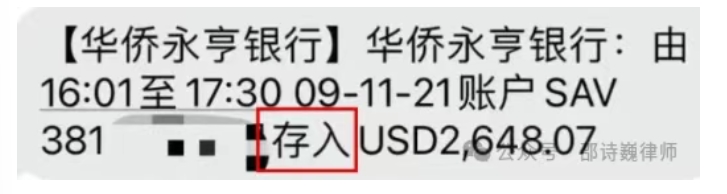
The second SMS states that funds have been “deposited.” At this point, the funds have truly cleared, and the remitter cannot reverse the transaction. The interval between the two SMS notifications exceeds 24 hours.
Even if the payer does not reverse the check, the check may fail to meet the bank’s conditions for cashing due to insufficient funds, signature mismatches, or other factors, resulting in non-clearance (commonly referred to as a “bounced check”). For example,Hong Kong accounts with HSBC, Bank of China, Wing Lung Bank, Nanyang Commercial Bank, Bank of East Asia, and Hang Seng Bank all support this operational mechanism.
Moreover, fraudsters prefer to scheduletransactions on Fridays, because banks are closed on weekends. By the time the victim realizes they have been defrauded on Monday, the fraudster has already vanished without a trace.
02
Introducer Convicted of Illegal Business Operations for Facilitating Currency Exchange
“Mirror” Foreign Exchange Transactionsare a common method of private currency exchange. In such arrangements, Party A in mainland China and Party B abroad conduct a transaction whereby Party A transfers RMB to a domestic bank account designated by Party B, and Party B transfers foreign currency to an overseas bank account designated by Party A. However, since Parties A and B seeking exchange services may not know each other beforehand, numerous intermediaries act as introducers to facilitate and match these transactions.
These introducers typically operate in professional fields involvingstudy-abroad consulting, immigration services, securities and finance, foreign currency exchange, insurance services, trusts, banking, and wealth planning. Due to the nature of their work, they have access to many high-net-worth client groups.
Consider a case adjudicated by a Chengdu court in 2020,Case No.: (2019) Chuan 01 Xing Zhong 1114.
Gao had long been engaged in study-abroad and immigration services. Zhao, a financial consultant in Australia working for Gao, stated that his client Jason had a customer wishing to exchange USD 9 million for RMB and asked whether Gao had any clients interested in exchanging RMB for USD. Gao then contacted Wu, a real estate agent and friend in Australia. Wu subsequently contacted his client Xiong via WeChat. After Xiong agreed, Wu sent Xiong’s contact information to Gao.
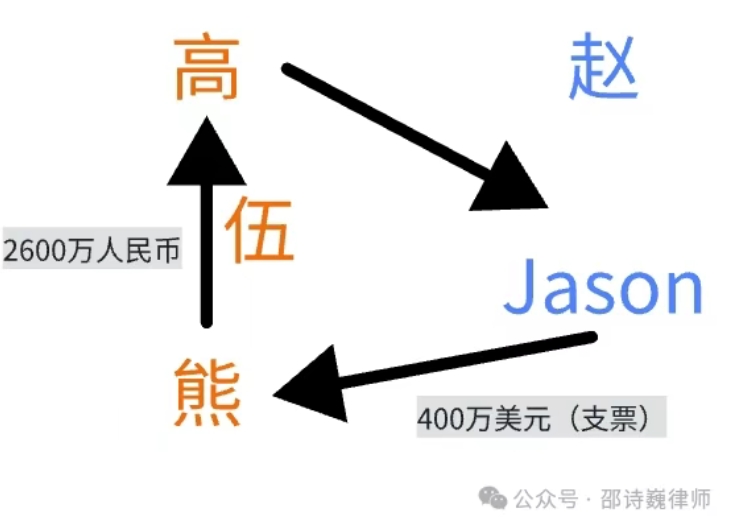
Xiong sent Gao a screenshot showing a balance of RMB 150 million in a China Construction Bank account, while Jason sent Gao a screenshot showing a balance of USD 8.5 million in a Hong Kong Shanghai Banking Corporation (hereinafter “HSBC”) account. The parties then proceeded to discuss the details of the currency exchange.
The transaction process was as follows:
Jason deposited checks totaling USD 4 million into Xiong’s HSBC account and sent Gao screenshots of the HSBC transaction notices. Based on the exchange rate provided by the counterparty, Xiong transferred the corresponding RMB 26 million to the bank account provided by Jason to Gao. After deducting a facilitation fee of RMB 600,000 for arranging the transaction, Gao transferred the remaining amount to Jason.
The case came to light when Xiong discovered that the checks had been returned by the bank and reported the incident to the police. Gao was arrested andfully refundedthe RMB 600,000 facilitation fee. Following trials at both the first and second instances, the court sentenced Gao tofive years’ imprisonment and imposed a fine of RMB 600,000.
03
Legal Analysis
Under applicable laws,private buying and selling of foreign exchange, disguised buying and selling of foreign exchange, speculative trading (buying low and selling high) of foreign exchange, or illegal introduction of foreign exchange transactionsconstitute administrative violations. However, regarding the crime of illegal business operations under Criminal Law, only “speculative trading of foreign exchange or disguised buying and selling of foreign exchange” is explicitly stipulated as criminal conduct. The law does not expressly provide that “introducing foreign exchange transactions” constitutes a criminal offense.speculative tradingof foreign exchange ordisguised buying and sellingof foreign exchange and other illegal foreign exchange trading activities”, but does not explicitly state that “introducing foreign exchange transactions” also constitutes a criminal offense.
Therefore, in practice, when introducers are detained on suspicion of illegal business operations, many defense counsel argue that “since the law does not explicitly prescribe it, the act of introduction does not constitute a crime.” This was one of the key defense points raised by Gao’s lawyer in this case.
Regarding whether introducing foreign exchange transactions constitutes the crime of illegal business operations, Lawyer Shao has provided a detailed legal explanation in the previously published article “Acquaintance Introduces Currency Exchange: ‘Intermediary’ Convicted as Principal Offender and Sentenced to Eight Years—Is It Unjust? Do Not Introduce Others to Buy or Sell Foreign Exchange, Beware of Being Convicted of Illegal Business Operations! (Part I),” and thus will not repeat the analysis here.
Typically, courts reason that intermediaries objectively establish a trading platform for buyers and sellers of foreign exchange (outside state-prescribed foreign exchange trading venues). Therefore, the intermediary’s conduct is not merely “introducing transactions” but constitutes “disguised buying and selling.”
04
Concluding Remarks
Private currency exchange is inherently unlawful. Although introducing others to exchange currency is not explicitly defined as a criminal offense under statutory provisions, if the transaction volume exceeds RMB 5 million or the introducer receives benefits exceeding RMB 100,000, the criminal risk for the introducer becomes extremely high. Even if the primary transaction facilitated by the introducer is successfully completed without immediate detection, instruments such as the check transfers involved in this case present risks that are difficult to guard against.
What about thefraudster in the aforementioned case? Were they held accountable?Based on the content of the judgment, it appears they were not.
The court held: Regarding appellant Gao Rui’s argument that criminal liability was not pursued against the parties to the foreign exchange transaction. Upon review, since the originalprosecuting authority did not bring charges against anyone other than Gao Rui in this case, this Courtmakes no determinationon whether the parties to the foreign exchange transaction other than Gao Rui committed crimes. This ground of appeal is untenable and is rejected. (Excerpted from the original judgment)

Recommended Reading
What Are the Potential Risks for Foreign Trade Merchants Using USDT Virtual Currency for Receipts?