

As we know, virtual currency addresses are composed of the characters 0–9, A–Z and a–z in random order. They are difficult to memorize, and in practice are usually copied directly when needed.
Address generation is based on cryptographic principles and is performed by computer programs. Under blockchain encryption principles, it is relatively easy to generate a virtual currency address from a set of mnemonic words or a key, but it is extremely difficult to derive the key from the address.
This is of course underpinned by the asymmetric encryption principles of blockchain, which also safeguard the security of cryptocurrencies.
Cryptography is certainly not what we will discuss today; what we will discuss is patterned addresses (baozi hao).
What is a patterned address?
Think about what a premium number is in the real world: typically mobile phone numbers or bank card numbers ending in sequences such as 8888 or 9999. Such numbers are also known as patterned numbers. In the eyes of ordinary people, the entities using such numbers are generally regarded as highly capable.
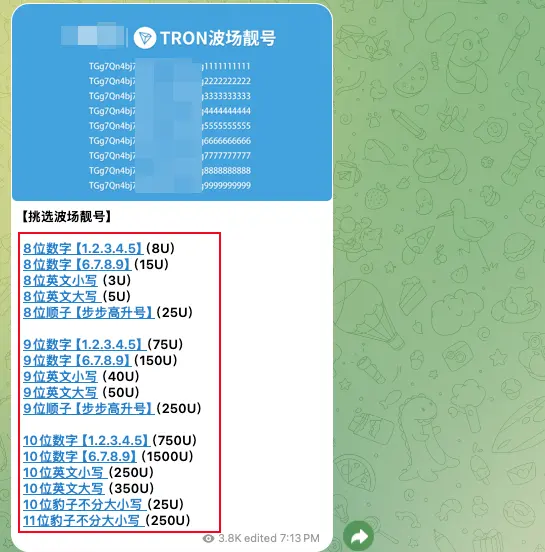
Similarly, the more 8s, 9s or consecutive identical digits appear at the end of a number, the easier it is to remember, and correspondingly such numbers are rarer and harder to obtain; therefore, the owner of such a number is perceived as more capable. In plain terms, such patterned numbers in the real world carry prestige and trustworthiness; they represent a kind of capability that can be seen at a glance, and using them to conduct business allows customers to see that capability immediately. A similar situation has emerged in the crypto world: for example, an address such as 0xaab......88888888 is a patterned address. However, even if one knows such an address, one cannot know the private key controlling that address and cannot control such an address. Because cryptocurrency addresses are generated on the basis of cryptographic principles, and the decentralized nature of blockchain means that obtaining a patterned address is impossible by demonstrating capability to, or bidding through, a centralized institution. But where there is capability, the problem can ultimately be solved: since the private key cannot be cracked by reverse derivation, one can obtain a large number of private keys to find the patterned address one wants. This practice is called "address mining." For patterned addresses with fewer than 6 identical trailing digits, a program can mine several in about 1 minute with a few clicks. For 7 digits, it is roughly one every 5 minutes. Basically, a home computer can meet the need. But each additional identical trailing digit increases the difficulty exponentially. A 9-digit patterned address requires on average 8 days of mining with an RTX 4090 graphics card to produce one. And for designated auspicious numbers for Chinese people such as 6, 8 and 9, it may take several months to mine one. Each additional identical digit increases mining difficulty by nearly 60 times, so when buying a patterned address, each additional identical digit basically corresponds to a price difference of about 10 times.
Who uses patterned addresses?
As stated above, obtaining such patterned addresses requires stronger computing power. Without computing power, one can also buy one directly to save time; either way, the more repeated trailing digits the address has, the greater the cost.
As for how to protect the security of one's virtual currency after buying an address whose private key is also known to others, that is a separate topic we can discuss another time. So who exactly needs this kind of capability that can be seen at a glance, to impress customers and win trust? Certainly those who need to make frequent transfers and do business on-chain. Since the TRON chain emerged, its cheap and high-speed transfers quickly captured the market. But transfers require energy and bandwidth; if you do not have them, that is fine—the market will solve everything. As a result, many businesses renting out energy and bandwidth emerged on the market, and with them came demand for high-frequency use of virtual currency addresses. Therefore, many bosses in the energy and bandwidth business, in order to show off their prestige, began using patterned trailing numbers.
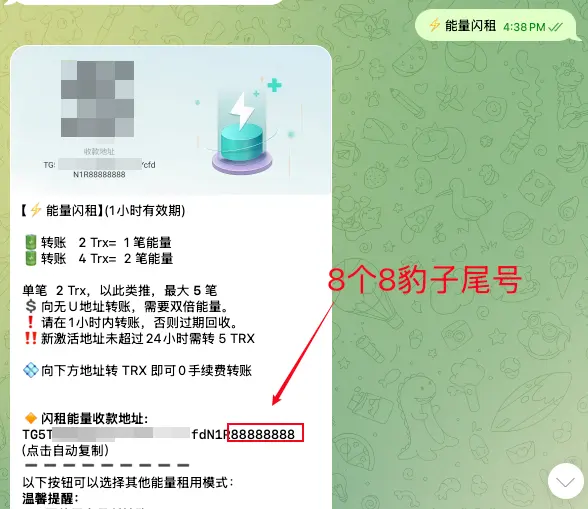
Therefore, any user with a need for large volumes of frequent transfers is a potential user of such patterned addresses, especially criminals who use virtual currencies for money laundering and fraud. How should patterned addresses be handled and characterized in criminal cases?
Recently, the author handled a case involving fraud through a leopard-number address.
Victim A is a business owner engaged in foreign trade, and suspect B is a part-time OTC dealer. A and B frequently exchanged coins for US dollars through the TRON chain. One day, A transferred several hundred thousand USDT to B. After B received the transfer, without conducting a small-amount test, B immediately transferred the entire amount of USDT to a leopard-tail address (with the last eight digits being "7"), and told A that because B had transferred to the wrong address when sending to the "upstream," the USDT could not be returned, and B also did not acknowledge the legitimacy of this debt. The key to the issue is that the transfer was made to an address with obvious characteristics. As an OTC dealer, B has a stronger duty of care and could not have been unaware that such an address belongs to a special account. Merely using a wrong-address transfer as a pretext carries a strong suspicion of collusion with the holder of that address. In addition, verification showed that the address was not one that had never been activated; it was an address with long-term frequent transfers, first activated in 2022. Therefore, with respect to the frequently active leopard-number address, after the author explained this point to the police, the police determined that B was highly suspected of fraud. Thus, when transacting with leopard-number addresses of this kind, the actor must exercise a stronger duty of care; at the very least, claiming after a problem arises that one did not know this type of address and transferred to the wrong address carries very strong suspicion. Based on the foregoing explanation, this kind of leopard-number address has strong commercial value and will also be used in certain illegal-business cases to corroborate evidence.

