

Earn commissions by referring users? This carries risks
Special Disclaimer: This article is an original work by Attorney Shao Shiwei and reflects only the author’s personal views. It does not constitute legal advice or a legal opinion on any specific matter. For article reprints, legal consultations, or professional exchanges, please add: sswls66.
To expand their user base and increase market share, virtual asset trading platforms commonly adopt various marketing and promotional strategies, such as launching commission rebate programs, airdrop reward schemes, and community-based marketing campaigns, with the aim of boosting platform trading volume.
These incentives attract numerous crypto-community key opinion leaders (KOLs), signal providers, and even ordinary users to help platforms acquire new users and drive traffic. On one hand, referrers can receive varying levels of rewards set by the platform; on the other hand, the platform gains more users, creating a situation often described as “mutually beneficial.”
However, it is well known that regulatory authorities in China maintain a strict regulatory stance toward virtual asset trading. Does referring new users to exchanges therefore entail legal risks?
By Attorney Shao Shiwei
01
Confusion Among Crypto-Community Users
Based on daily consultations with users, Attorney Shao has observed that many participants in the crypto community are generally uncertain about the scope of China’s regulatory framework for virtual assets—specifically, which activities are permissible and which are prohibited.
Although crypto-community users are aware that domestic policy takes a negative view of virtual asset trading, they also know that China has not prohibited individuals from investing in or trading virtual assets, and they recognize the value of virtual assets as virtual commodities. In practice, however, many people place their referral links on social media platforms or in online communities to earn commissions, participate in airdrop farming, trade tokens, or engage in derivatives trading. Because “everyone is doing it,” there is a common perception that such activities are likely fine; yet lingering concerns persist, prompting users to seek legal counsel.
Attorneys can understand this confusion. To date, relatively few regulatory policies specifically addressing virtual assets have been issued in China, and those that exist primarily take the form of notices, initiatives, or advisories, which lack binding legal force. Moreover, the language used in these instruments is often vague and does not specify whether particular conduct is permitted or, if prohibited, which legal provisions it violates.
02
Common “Benefit-Hunting” Scenarios in the Crypto Community
Virtual asset trading platforms employ various user-acquisition incentive measures to attract new users, including:
Registration Rewards: By inviting friends to register, the referrer may receive a monetary reward. Referral methods primarily include referral links, invitation codes, and sharing promotional posters.
High-Rate Commission Rebate Programs: Some exchanges have launched commission rebate programs with rates as high as 40%, allowing both the referrer and the referred user to share trading commission rebates.
Demo Funds for Futures Trading: To encourage novice users to try futures trading, some exchanges offer new-user rewards in the form of demo funds for futures contracts, thereby lowering the barrier for users to attempt such transactions.
……
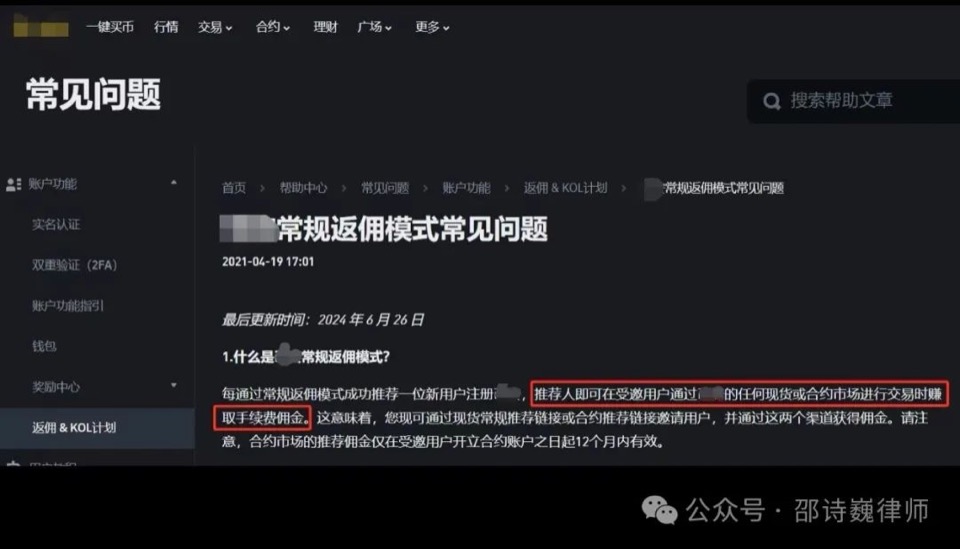
(Examples of Common Exchange Commission Rebate Systems)
Common scenarios include cryptocurrency key opinion leaders (KOLs) placing exchange registration links beneath their videos or on their Twitter homepages to invite new users to register. After adding users as friends, “copy-trading mentors” share cryptocurrency market news and updates in WeChat groups or Telegram groups, while simultaneously sharing exchange registration links.


In his daily practice, Attorney Shao also encounters similar inquiries. For instance, a user previously asked whether it would be permissible to collaborate with school principals by using students’ personal information to register accounts on foreign virtual asset exchanges, paying the principals a cooperation fee based on the number of registrations. The user stated that the purposes of this arrangement were, on one hand, to obtain commission rebates from the exchanges in the future, and on the other hand, to engage in “airdrop hunting.” The user asked whether such conduct is allowed.
Thus, for ordinary users, when faced with attractive user-acquisition incentive mechanisms offered by exchanges,does sending one’s exclusive referral link to other users in order to obtain relevant rewards entail legal risks?
03
Legal Risks of Receiving Trading Commission Rebates for User Acquisition
Some legal practitioners take the view that, provided you do not recruit others to engage in futures trading, there is generally no issue; if you do proceed, it is advisable to promote larger, well-known exchanges and avoid obscure or disreputable platforms. Attorney Shao considers this statement imprecise and potentially misleading to users.
In addition to the prevalent legal risk that facilitating copy-trading in futures contracts may constitute the crime of operating a casino (➡️ “Copy-Trading in Crypto Futures: Angel or Devil?” and “Does Operating a Virtual Asset Exchange Constitute the Crime of Operating a Casino?”), user acquisition for exchanges may also involve offenses such as the crime of illegally utilizing information networks (hereinafter referred to as the “Non-Information Network Crime”) and fraud.
For example, in the fraud case (2020) Yu 0105 Xing Chu No. 361, the court held that Li, Sun, and others gained the victims’ trust by providing fabricated profit screenshots, falsely represented that the platform made it easy to earn money, deceived the victims into trading on a certain digital currency trading platform, and thereby fraudulently obtained the transaction fees rebated by the platform. Due to space constraints, this article will not elaborate on fraud-related issues; instead, we examine a case involving the Non-Information Network Crime [Case No.: (2020) E 1022 Xing Chu No. 277].
From August to November 2019, after learning about a certain virtual currency exchange, He Mou hired personnel to add others on WeChat. By promoting high returns, sending performance reports, and providing exemplary cases, they induced others to invest funds in the exchange for cryptocurrency trading and leveraged trading, thereby collecting handling fees. The court held that He Mou and others deceived individuals into maliciously speculating on virtual commodities such as Bitcoin, Litecoin, and Ripple, obtaining high returns therefrom and defrauding others of their money. The court ruled that He Mou and others committed the crime of illegally using information networks and were sentenced to eleven months of fixed-term imprisonment.
[Commentary by Attorney Shao]
This case is an example wherethe defendants were convicted of the crime of illegally using information networks for obtaining registration rebates and trading rebates from the exchange.Although this judgment has taken legal effect, I believe there are still many issues with this case. Briefly stated, two points are as follows:
(1) First, the court rendered a negative evaluation of He Mou’s two acts: recruiting users for cryptocurrency trading (spot trading) and leveraged trading. According to legal provisions, the crime of illegally using information networks applies to establishing websites or groups used to carry out illegal or criminal activities, or publishing information related to illegal or criminal activities. Furthermore, the “illegal or criminal activities” referenced in this crime must conform to the types of conduct specified in the Specific Provisions of the Criminal Law.
If the court considered that leveraged trading involves leveraging small capital for large gains, creating a possibility of loss for users, and thus determined that gambling was involved in this case, we believe that while such a view is controversial, it allows for some discussion. However, the court’s final determination that the act of recruiting new users for cryptocurrency trading constitutes the crime of illegally using information networks lacks any basis in the Specific Provisions of the Criminal Law.
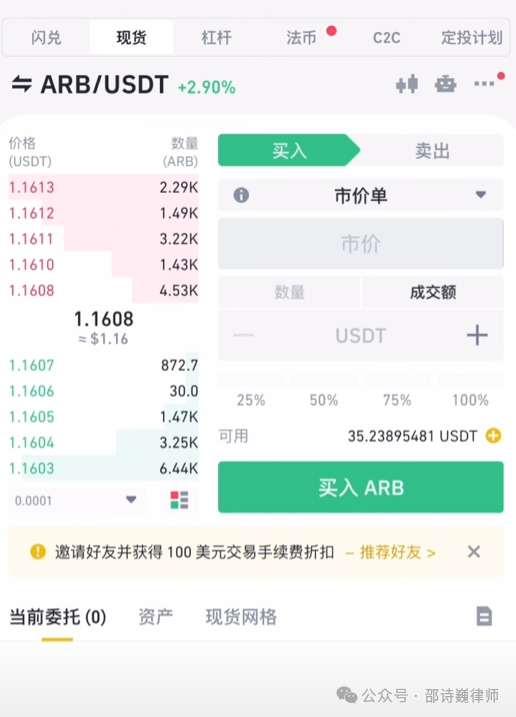
We can only speculate that the court equated the losses suffered by users from cryptocurrency trading with fraud committed by He Mou and others, thereby convicting them of the crime of illegally using information networks. However, this crime essentially criminalizes preparatory acts. If recruiting new users to earn rebates is deemed equivalent to fraud, why was this case not directly characterized as the crime of fraud?
(2) Second, the court held that He Mou encouraged victims to engage in leveraged trading with higher multiples, collected handling fees therefrom,and illegally profited from forced liquidations after customers incurred losses.This assertion is also problematic.
Referring to the following explanation of leveraged trading on the official website of Binance Exchange, it can be seen that forced liquidation occurs due to the margin system established by the exchange. If adverse market changes occur and a trader’s account fails to meet the minimum margin requirements set by the system, the system will automatically execute a forced liquidation.
If a trader establishes a long leveraged position, the system will issue a margin call when prices plummet. A margin call is issued when the trader must fund the margin account to meet minimum margin trading requirements. If the trader fails to provide funds, the held assets will be automatically liquidated to cover the financial loss. Generally, this occurs when the total value of all assets in the margin account (also known as the "liquidation margin") falls below the total margin amount prescribed by the specific trading platform or broker.
(Introduction from the official Binance website)
Therefore, forced liquidation is a systemic mechanism and is unrelated to He Mou and others. The commission rebate rate set by the system for referrers depends on the amount invested by investors into the platform, not on whether investors are subject to forced liquidation. Furthermore, referrers do not wish for investors to be forcibly liquidated; they prefer that investors trade more frequently, thereby generating higher fee/commission rebate income for the referrers.
04
Concluding Remarks
The "924 Notice" issued in 2021 stated that "business activities related to virtual currencies constitute illegal financial activities." However, the extended interpretation thereof only mentioned prohibiting acting as a central counterparty for buying and selling virtual currencies, and providing pricing or information intermediary services for virtual currencies.
The Notice also stated that "overseas virtual currency exchanges providing services to residents within China via the internet also constitute illegal financial activities," restricting entities such as domestic staff of exchanges from providing marketing, payment settlement, technical support, and other services for virtual currency-related businesses. As a user, does the act of recruiting new users for an exchange to earn commissions constitute "marketing"? This appears to leave room for interpretation. However, it is clear that, in terms of legal effect, the 924 Notice is merely a notice and not a statutory provision.
Therefore, if someone asks me whether there is risk in recruiting new users for an exchange to earn commissions, I can only say that there is risk. But if one insists on asking for the specific legal basis, I can only state that there is currently no clear legal basis.
Nevertheless, given that relevant cases exist in judicial practice, this article is provided as a risk warning.

Recommended Reading
What are the legal risks for crypto KOLs promoting projects for project sponsors?
Does operating a virtual currency exchange constitute the crime of opening a casino?
Crypto Futures Copy Trading Promises to Make You Rich: Angel or Devil?