
On the night of July 27, Moonshot AI released the full weights of Kimi K3 on Hugging Face and GitHub. The next morning, headlines across the board uniformly read "Moonshot AI fully open-sources Kimi K3."
If you are building an AI product, or have a project on hand that you want to move off its API bill, you will probably line up two things in the coming days: have your technical colleagues assess whether your own machines can run it, and have your business colleagues calculate how much cost can be saved. Both are right, but neither is the first thing. The first thing is to open the file in the repository called LICENSE, because it determines whether those assessments mean anything. What Moonshot AI released this time is not a "use it however you like" authorization, but a self-drafted license with five clauses. One of those clauses singles out companies with annual revenue above RMB 100 million for separate treatment.
What is actually open is two batches of things, with different legal treatment
The official announcement states: "Today is Kimi K3 Open Day. We are releasing the model weights and technical report for Kimi K3, and open-sourcing the key infrastructure technologies that support Kimi K3 model training: MoonEP, FlashKDA and AgentEnv."
For the model, the wording used is "release the model weights." Only for those three training infrastructure items are the words "open-source" used. Further on, the section heading is "Why we choose to open," the body refers to itself as an "open-weight model," and the model card on Hugging Face also says open-weight, not open source.
This is not wordplay. Upon verification, the three repositories MoonEP, FlashKDA and AgentENV all use the standard MIT license: four sentences, zero conditions, just retain the copyright notice. Kimi K3 itself uses the Kimi K3 License, drafted and independently named by Moonshot AI. Two boxes were brought out on the same day: one labeled "take it freely," the other labeled "take it freely, but if you open a shop and resell it, come find me to sign first." The media wrote up both boxes together as "given away for free."
Incidentally, "open source" is not a legal term under Chinese law; it has no definition and no legal effect.The only thing that can bind you and protect you is the specific license text。
What this license gives, and what it reserves
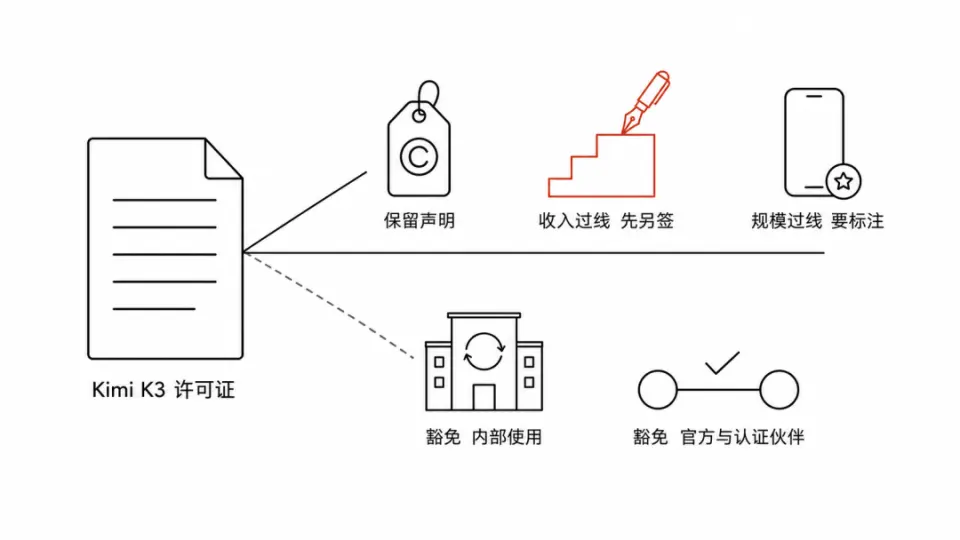
First, the part given is broader than many people think. The license lists the licensed subject matter item by item at the outset: model weights, parameters, configuration files, inference and training code, and accompanying documentation; it then grants the rights to use, copy, modify, distribute, sublicense and sell, as well as to run, deploy, fine-tune and create derivative works. Commercial use is permitted, modifying and then keeping it closed-source is permitted, selling to customers is permitted, and transferring and sublicensing downstream is also permitted. There is neither the GPL-style viral requirement that modifications must be open-sourced together, nor the list of use restrictions commonly found in self-drafted agreements such as those of Llama, Qwen or Tencent Hunyuan: no prohibition on military use, no territorial exclusions, and no gated application set up on Hugging Face. The K2 version still followed software-era wording ("software and accompanying documentation files"), so whether weights count as "software" required interpretation. K3 writes weights and parameters directly into the licensed subject matter, which is a not insignificant improvement.
Only three things are reserved. Clause 1 adds a new sentence beyond the old rules: all copies and substantial portions must retain the copyright notice and license notice, immediately followed by "the licensee's use of this software must comply with applicable laws and regulations." The latter half was not in K2.It turns compliance with the law from an existing statutory obligation into, at the same time, a contractual obligation owed to Moonshot AIIf a product is penalized for a violation, in addition to the regulatory penalty, there is in theory also a separate breach-of-contract claim that an upstream party may assert.
Article 3 is an old clause under a new name: if a product exceeds 100 million monthly active users or USD 20 million in monthly revenue, Kimi K3 must be prominently displayed on the interface. The K2 series changed only this one clause from beginning to end, and the original text states it plainly: "The only part we modified is..." (Incidentally, to correct a widely circulated claim: the K2 license does not contain any clause such as "synthetic data is not protected by this license"; I compared both versions of the original text word by word, and K3 does not add one either.)
The genuinely new element is in Article 2.
Of the three conditions retained, Article 2 is entirely new
"Model as a Service" means giving a third party access to language model inference or fine-tuning (e.g., via API) in a manner that allows such third party to exercise meaningful control over the inputs, parameters, or training data. This does not include (a) end-user products with model capabilities solely embedded within specific features or harnesses, or (b) mere relaying of requests to models hosted by others.
If the Licensee or any of its affiliates operates a Model as a Service business, and the aggregate revenue of the Licensee and its affiliates exceeds 20 million US dollars (or the equivalent in other currencies) in total over any consecutive 12 months, the Licensee must enter into a separate agreement with Moonshot AI before using the Software or its derivative works for any commercial purpose.
In plain terms: if you or your affiliates are in the "model-as-a-service" business, and your revenue together with that of your affiliates exceeds USD 20 million in any consecutive twelve-month period, then before using this model or its derivatives for any commercial purpose, you must first sign a separate agreement with Moonshot AI.
Three details are easy to miss, and each one moves in a stricter direction. First, what counts as "model-as-a-service" turns on whether a third party has substantive control over the inputs, parameters or training data. Under the exclusions the clause itself sets out, an end product that embeds model capabilities into a specific function does not count, and merely forwarding requests to a model hosted by someone else does not count either. So ordinary SaaS products, intelligent customer service and AIGC tools will generally not trigger it, whereas API platforms and model-hosting platforms that are open to the public and let customers adjust parameters and fine-tune themselves are very likely to trigger it. Second, the USD 20 million is not the revenue of that service; it is "the total revenue of the licensee and its affiliates." A company with total revenue of around RMB 150 million falls within this clause as long as it has one publicly open model-service line; for the Chinese market, this threshold is not high. Third, the obligation is to sign "beforehand"; the original text uses before. Continuing commercial use without signing after the trigger has been met already constitutes a breach, and it cannot be smoothed over by signing retroactively.
Reading Articles 2 and 3 side by side, the design intent becomes clear. In the K2 era, the requirement for major players was merely "put my name on the interface," which was after the fact and symbolic. With Article 2 added in K3, for cloud providers that free-ride by reselling model capabilities, it becomes ex ante and requires sitting down to negotiate. For the first time, a leading Chinese model developer has turned "you take my weights and run a resale business"into an explicitly priced commercial condition。
What concerns me more is another change that is rarely mentioned but matters most to downstream enterprises. The K2 disclaimer said "this software is provided as is," while K3 changed it to "this software and any of its outputs and results are provided as is." If something goes wrong with what the model produces, such as infringement or fabrication, the risk is expressly left on the user's side at the contract level. This direction is consistent with Chinese law itself: the content-producer responsibility imposed on service providers by the Interim Measures for the Administration of Generative Artificial Intelligence Services could never be shifted away through an upstream license in the first place.
Three conditions and two exemptions in the license
Why a document no one has signed can bind you
The question laypeople ask most often is: I downloaded a file from the internet without clicking "I agree" or affixing a seal, so why should that LICENSE count?
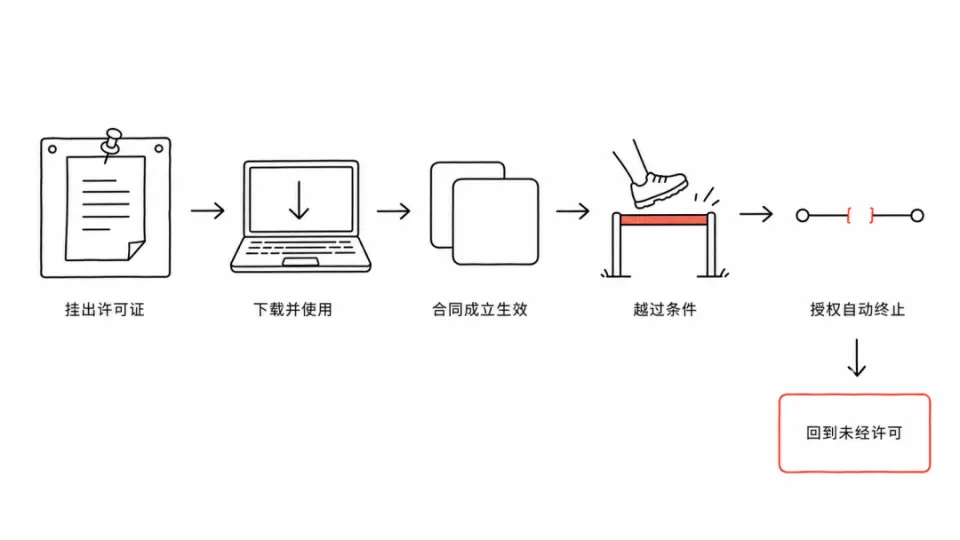
Under PRC law, it counts. The first step: a license is not a declaration; it is a public offer. When the rights holder posts it together with the weights and the code, that amounts to an offer made to the public at large; the moment you download, deploy, fine-tune or distribute it, you accept by conduct, and the contract is formed and takes effect at that point, with no separate signed document required.
Article 471: Parties may conclude a contract by means of offer and acceptance or by other means.
The second step is the critical one. The phrase "subject to the following conditions" in the body of the license is construed under PRC law as the attachment of a condition subsequent.
Article 158: A civil juristic act may be subject to conditions, unless the nature of the act does not permit conditions. A civil juristic act subject to a condition precedent takes effect when the condition is fulfilled. A civil juristic act subject to a condition subsequent ceases to be effective when the condition is fulfilled.
Its effect occurs automatically; Moonshot AI need not send you a notice or a lawyer's letter, or even be aware of the matter. Once a condition is breached, the license ceases to be effective on the spot, and every act of reproduction, deployment and distribution you perform thereafter loses its source of rights. It is like a discount voucher stating that it is valid only for dine-in at this store: if you use it on a food-delivery platform, the consequence is not merely that "the voucher has become invalid"; rather, you never obtained the discount conferred by the voucher in the first place. The only difference is that the effect of the voucher concerns a single meal, whereas the effect of the license concerns every call on your product line.
Chinese courts have already ruled on this logic. In the series of Robox cases, the Guangzhou Intellectual Property Court, in (2019) Yue 73 Zhi Min Chu No. 207, held that GPLv3 is contractual in nature and constitutes a standardized copyright agreement concluded between the licensor and the user; the conditions of use stipulated in the license are the conditions subsequent attached to the agreement, and once the user breaches them, the authorization terminates automatically, and subsequent acts constitute infringement because they have lost their source of rights. The second instance of that case is the Supreme People's Court (2021) Zui Gao Fa Zhi Min Zhong No. 2063, which was included in the Supreme People's Court's Top 10 Intellectual Property Cases in China for 2021.
So will these self-drafted conditions of Moonshot AI be invalid for "running counter to the spirit of open source"? No. There is a subtle distinction here: in the same Robox case, what the court rejected was the practice of unilaterally layering commercial-use restrictions on top of another party's standardized open-source license, which amounts to borrowing GPL's shell while privately adding conditions that GPL does not permit. By contrast, the Supreme People's Court (2021) Zui Gao Fa Zhi Min Zhong No. 1547 recognized a company's self-drafted software open-source license agreement, holding that even if licensing restrictions are present therein, they are not automatically invalid. The Kimi K3 License falls into the latter category: drafted from scratch, independently named, and not marketed under the MIT banner. The basis for the validity of its Articles 2 and 3 is solid.
Following this line of reasoning, there is a deeper mismatch. Whether model weights can be protected by copyright is a question on which no effective judgment in China has yet given an affirmative answer. The country's first case concerning the unauthorized use of another's model structure and parameters (Beijing Intellectual Property Court (2023) Jing 73 Min Zhong Nos. 3802 and 3803) held that optimizing model structure and parameters is an act of creating a generative tool and does not constitute creation in the sense of copyright law, and the case was ultimately decided under Article 2 of the Anti-Unfair Competition Law. This mismatch carries a layer of meaning for each side. Users should not expect that "the weights are not copyrighted, so the license cannot reach me",binding force derives from contract; whether the subject matter can be protected by copyright is a separate matterIf Moonshot AI genuinely seeks to enforce its rights, it has a complete copyright chain at the code level, whereas at the weight level the position is less stable; the more realistic combination is breach of contract plus unfair competition.
The license: from public offer to automatic termination of authorization
Once the conditions are crossed, the consequences fall into several tiers
The first tier is breach of contract and civil tort, which is where the vast majority of situations fall. Once the authorization is extinguished because the conditions have been fulfilled, acts of copying, distributing, or disseminating through information networks without permission fall under Article 53 of the Copyright Law.
Article 53 Where any of the following infringing acts is committed, the civil liability provided for in Article 52 of this Law shall be borne as the case may be; if the infringing act also harms the public interest, the copyright administration department shall order the infringing act to cease, issue a warning, confiscate the illegal gains, and confiscate and harmlessly destroy the infringing copies as well as the materials, tools, equipment, etc. mainly used to make the infringing copies; if the illegal business turnover is 50,000 yuan or more, a fine of not less than one time but not more than five times the illegal business turnover may also be imposed; if there is no illegal business turnover, the illegal business turnover is difficult to calculate, or it is less than 50,000 yuan, a fine of not more than 250,000 yuan may also be imposed; if a crime is constituted, criminal liability shall be pursued in accordance with the law:
(1) copying, distributing, performing, screening, broadcasting, compiling, or disseminating to the public through information networks his works without the permission of the copyright owner, except as otherwise provided in this Law;
This article also conceals a risk that is easily overlooked. Many teams casually delete the copyright notice and license notice when packaging and distributing, usually on the grounds that it "looks unprofessional." However, the line of text on a work indicating who the rights holder is and how it may be used has a legal name: rights management information. Deliberately deleting it is itself an infringing act enumerated in Item 7 of Article 53.
The second tier is criminal, and the boundary must be stated accurately; there is no need to frighten oneself. The judicial interpretation on intellectual property crimes issued by the Supreme People's Court and the Supreme People's Procuratorate, effective April 26, 2025, clarifies one point:
Article 11 Where an act infringing copyright or rights related to copyright is committed without obtaining authorization from the copyright owner, the producer of sound recordings or video recordings, or the performer, or by forging or altering authorization license documents, or by exceeding the scope of the authorization license, it shall be determined as "without the permission of the copyright owner," "without the permission of the producer of sound recordings or video recordings," or "without the permission of the performer" as provided in Article 217 of the Criminal Law.
"Exceeding the scope of the authorization license" and "never having obtained authorization" are placed side by side. Holding a valid license does not, as a matter of course, keep criminal assessment at bay. Article 13 of the same interpretation sets the threshold for the crime of copyright infringement at illegal gains of 30,000 yuan or more; circumstances such as illegal business turnover of 50,000 yuan or more or 500 or more copies are "other serious circumstances."
However, Article 217 of the Criminal Law also requires "for the purpose of profit," so this path is in fact quite narrow in open-source scenarios. Typical overstepping under a permissive license is failing to retain notices or crossing the scale threshold without signing a separate agreement; the illegal gains from such conduct are difficult to attribute directly to the causation of "copyright infringement." There is only one genuinely realistic criminal path: stripping attribution clean and distributing weights or code for consideration on a large scale. The vast majority of companies seriously building products will not reach that point.
Three types of companies and the actions each should take
Startup teams building products, especially those whose total revenue is still far from USD 20 million, can rest assured: neither Articles 2 nor 3 is triggered, and the internal-use exemption in Article 4 also applies. Only one thing needs to be done: honestly retain those two lines of notice in the distributed materials, and register them repository by repository in the license ledger. The K3 weights and code fall under the Kimi K3 License, while MoonEP, FlashKDA, and AgentENV fall under MIT; do not record them as a single entry for "this open-sourcing."
Companies that already have scale need to keep a close eye on two numbers and one criterion: whether the twelve-month revenue after consolidation of affiliates reaches USD 20 million, whether product monthly active users reach 100 million, and whether their own business counts as "model-as-a-service." The test is whether customers have substantive control over inputs, parameters, or training data, not how the product is named. If the result is close to or has already reached the threshold, negotiations for a separate agreement should not cover only license fees; the liability boundaries in Article 5, especially the recourse path in the event of output infringement, should also be negotiated.
Service providers engaged in private deployment should pay attention to the monthly active user criterion in Article 3. When deploying one instance each for multiple customers, there is room in interpretation for aggregating user counts, yet the terms do not set out aggregation rules for affiliates or multiple instances. This gap should be agreed in advance in procurement and delivery agreements rather than waiting for the other party to ask. For individual developers and researchers, the license poses almost no obstacle; Article 4 excludes entirely internal use that does not provide the software, outputs, and their underlying capabilities to third parties, and the real threshold lies in the size of the weights and the progress of adaptation to inference frameworks.
One final boundary point, so that this is not read as a clean bill of health. A license only addresses "whether the model may be used"; it does not address "whether it may be provided externally," and still less does it address "who pays if something goes wrong." Whether filing is required, whether a security assessment must be passed, and whether generated content must be labeled are a separate set of public-law obligations, none of which is exempted by this license. Each of the three layers follows its own path,passing one layer does not mean passing the other two。
Final remarks
What is worth remembering this time is not the figure of 2.8 trillion. Moonshot AI's own wording is in fact quite restrained: it speaks of releasing weights for the model, and speaks of open source only for the infrastructure. It is those who relay the news who conflate the two into one. Before downloading, read the LICENSE first: five clauses, ten minutes.
If your product uses open-weight models and you are unsure how the license terms apply to your own business, you can bring a specific scenario to discuss: whether it is internal research and development or external provision, whether parameters are made available to customers, and how the scope of affiliates is calculated. Once these three questions are settled, the conclusion is basically settled as well.
Reference sources
- Moonshot AI official WeChat public account announcement "Kimi K3 Open Day," July 27, 2026
- Official text of the Kimi K3 License (MoonshotAI/Kimi-K3 code repository, Hugging Face moonshotai/Kimi-K3 model card)
- Official text of the Kimi K2 and Kimi K2.5 Modified MIT License (MoonshotAI code repository)
- License files of the three repositories MoonEP, FlashKDA, and AgentENV (GitHub)
- Kimi K3 technical blog and technical report (Moonshot AI official)
- Civil Code of the People's Republic of China
- Copyright Law of the People's Republic of China (2020 Amendment)
- Criminal Law of the People's Republic of China
- Interpretation of the Supreme People's Court and the Supreme People's Procuratorate on Several Issues Concerning the Application of Law in the Handling of Criminal Cases of Intellectual Property Infringement (Fa Shi [2025] No. 5)
- Guangzhou Intellectual Property Court, Civil Judgment (2019) Yue 73 Zhi Min Chu No. 207
- Supreme People's Court, Civil Judgments (2021) Zui Gao Fa Zhi Min Zhong No. 2063 and (2021) Zui Gao Fa Zhi Min Zhong No. 1547
- Beijing Intellectual Property Court, Civil Judgments (2023) Jing 73 Min Zhong No. 3802 and (2023) Jing 73 Min Zhong No. 3803
- Shaoshupai, "Pai Morning Brief: Moonshot AI Open-Sources the Kimi K3 Model and More"
Author:Lyu Yinghui, a lawyer at Mankun Law Firm (Shenzhen). A graduate of China University of Political Science and Law, he has worked in the legal industry for nearly a decade and previously worked at a court in Shenzhen. He focuses on legal services for the new-generation economy and has extensive practical experience and deep insights in fields such as Web3 and artificial intelligence. His account on all platforms is "Lao Lyu Talks New Money"; you are welcome to follow it.

