Adequate regulation, controllable costs, flexible structures, and a tax-friendly regime
The Cayman Islands: More Than Just a "Haven for Company Incorporation"
In the minds of many, the Cayman Islands are merely an offshore jurisdiction for incorporation—a paradise for funds, special purpose vehicles (SPVs), and family trusts.
However, over the past two years, this small Caribbean island has quietly undergone a significant transformation, emerging as a new frontier for the regulation of virtual assets.
The Cayman Islands Monetary Authority (CIMA) introduced the Virtual Asset Service Providers Act (VASP Act) in 2020. By April 2025, the new regulatory framework will be fully upgraded, as follows:
- "Custody" and "trading platform" activities will be formally subject to a licensing regime;
- Other lighter-touch activities, such as advisory services, matching services, and issuance support, will require only registration.
In other words, it has achieved a "tiered management" approach in its regulatory logic:
Ensuring that regulation is adequate without overwhelming entrepreneurs.
Who Should Seriously Consider a Cayman VASP License?
There are three types of enterprises that I often advise to prioritize the Cayman Islands when considering license applications:
The first category comprises companies seeking to establish global payment acquisition channels or over-the-counter (OTC) trading channels.
They wish to avoid the complex approval processes associated with Hong Kong’s Type 1 license/virtual asset (VA) dealing, and do not want to be constrained by Singapore’s Digital Payment Token (DPT) licensing requirements, which entail significant capital commitments, local actual control, and restrictions on public promotion.
They require a “regulated status” that is understandable to international banks and recognizable by audit firms, but without prohibitive startup costs.
The second category comprises teams engaged in real-world assets (RWA), stablecoins, and asset tokenization.
Such teams typically already have underlying structures in place and merely lack a “compliance hub” to facilitate issuance and advisory services.
The Cayman Islands’ zero-tax regime and the flexibility of special purpose vehicles (SPVs) make it an ideal mid-tier platform for such projects.
The third category consists of enterprises that already have group structures and are preparing for financing or expanding international cooperation.
When negotiating with banks, venture capital firms, and auditors, stating “we are a Cayman-registered Virtual Asset Service Provider (VASP) under CIMA supervision”
is often more readily understood and accepted than saying “we are applying for a DPT license.”
Why is it considered “cost-effective”?
Because it strikes a balance between “being trusted” and “being affordable.”
First, regarding regulation:
The Cayman Islands is a member of the Financial Action Task Force (FATF), and its regulatory language and framework are fully aligned with common law jurisdictions. However, unlike Singapore, it does not impose layered approvals; unlike the United States, it does not require navigating regulations across 50 states; and unlike Dubai, it does not routinely mandate on-site personnel, local entities, or technical demonstrations.
Consider the costs:
For a standard VASP registration project, under a reasonable structure, the timeline from establishment to completion of filing is typically 6–12 weeks; the entire process is conducted primarily in English, with mature document templates. Whether for new startup teams or international groups that already hold MSB or CASP licenses, this represents an investment that can be quickly absorbed.
Finally, the scalability of the license:
The regulatory philosophy of the Cayman Islands is“register first, upgrade later”: you may commence business operations under registered status, and apply for a License when your scale expands and activities involve custody or matching. This approach is highly favorable for teams seeking to test the market or gradually build their systems.
Viewing it alongside other jurisdictions
Many ask: Does the Cayman Islands truly offer advantages compared to other mainstream licensing regimes?
I have provided clients with the following comparison:
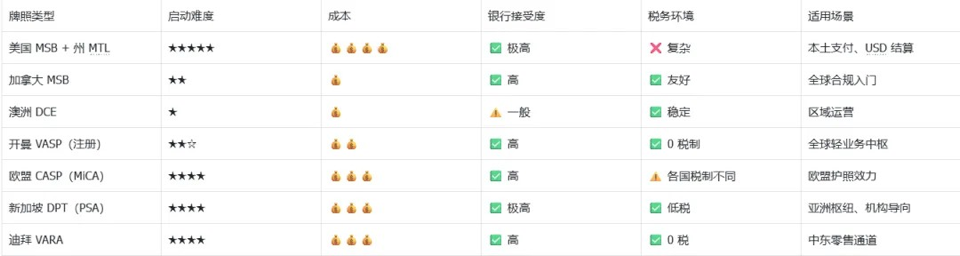
In summary:
The Cayman VASP regime sits at “the upper bound of light-touch regulation and the lower bound of heavy-handed regulation”—it commands institutional trust without imposing an excessive burden.
From a “compliance shell” to a “compliance hub”
For many global Web3 companies, a Cayman VASP is no longer merely a "shell," but an institutional hub.
It can serve as a mirror image of Canadian MSBs, U.S. MSBs, EU CASPs, Singapore DPTs, and Dubai VARAs:
- enabling the group to maintain a unified regulatory identity internationally;
- allowing banks, auditors, and partners to readily understand the compliance framework;
- providing projects with a foundational compliance logic for fundraising, token issuance, and the implementation of real-world assets (RWA).
This is why, over the past six months, an increasing number of crypto payment, RWA, stablecoin, and asset tokenization teams
have begun to include "Cayman VASP" in their compliance portfolios:
- http://Blockchain.com(Cayman entities) have publicly disclosed that they have completed VASP registration in the Cayman Islands.
- http://Crypto.comThe Cayman entities within the group are also listed on CIMA's regulatory register.
- Multiple OTC/payment institutions are marked as "Cayman VASP registered entities" in third-party databases (such as B2C2 Overseas Ltd, among others).
These cases demonstrate that the Cayman VASP status has been adopted by the market and recognized by banks and financial institutions, rather than being merely a "theoretical license."
Conclusion
In the Web3 landscape, a “license” is by no means a panacea; however, a regulatory status that is understood, verifiable, and usable for interfacing with banks and institutions carries substantial significance in fundraising, payment channels, audits, and collaborations. If you are considering establishing or iterating your compliance structure, consider adding “Cayman VASP” to your “next steps” list: it may represent an overlooked, cost-effective breakthrough for compliance.
A Cayman VASP registration is not the “most stringent” license, but it is often the most cost-efficient regulatory status: it enables institutions to “understand and trust” your framework while preserving the structural advantages of low taxation, flexibility, and rapid capital turnover; when you move toward custody or platform services, it can be seamlessly elevated to a licensing regime. In a cycle of tightening regulation and rising costs, this is precisely the “high-value piece of the puzzle” that many teams overlook.
Mankun Law Firm has long studied licensing regimes in mainstream crypto jurisdictions, including Hong Kong, Singapore, the European Union, Dubai, Canada, and the United States, helping clients build truly sustainable, bankable, and implementable global compliance frameworks through structural thinking, legal logic, and practical experience. If you are evaluating your group’s compliance pathway, we welcome the opportunity to discuss—perhaps the “license” you truly need lies in the Cayman Islands.