

True globalization is not about being accessible to everyone, but about being used in compliance with the law.
Introduction
Over the past two years, crypto payments have gradually evolved from a niche concept into a global trend.
They take various forms:
-
Stablecoin payments (settled in USDT/USDC)
-
Crypto debit cards (commonly known as U-Cards)
-
Cross-border crypto salary disbursements
-
On/Off-ramp gateways (crypto ⇄ fiat)
-
Crypto versions of Stripe or PayPal
The commonality among these projects is:Using crypto assets to address the slowness and high costs of cross-border payments.
However, unlike pure trading platforms, crypto payments directly interact with fund flows, bank cards, bank accounts, and fiat clearing systems.
It is not "DeFi," but a hybrid of semi-financial and semi-technological elements.
Therefore, all "geographic risks" are amplified here.
Many teams, while excited about license structures, product experience, and transaction volume growth, overlook a seemingly technical question—who can use it?
This is not a matter of market choice, but a baseline for compliance.
Why must certain countries and regions be excluded?
1. Because every country safeguards its own "payment sovereignty"
Legally, crypto payments are often regarded as "e-money issuance," "money transfer services," or "payment clearing activities."
This means that as long as your system allows local residents to deposit, withdraw, or spend crypto assets, it may trigger local regulatory licensing requirements.
For example:
-
United States:Registration as an MSB plus a Money Transmitter License (MTL) is required.
-
European Union:Authorization as a CASP under MiCA is required, and a local entity must be established in the member state.
-
Singapore:Regulated under the Payment Services Act, involving MPI and DPT licenses.
-
Hong Kong:An MSO license or the upcoming VA Dealing and Stablecoin Issuance licenses are required.
If you do not hold these licenses but allow local users to utilize your crypto payment functions,
regulatory authorities will directly deem it as "operating payment business without authorization within that jurisdiction."
2. Because the international sanctions regime operates on a principle of collective liability
Once the system allows users from sanctioned regions such as Iran, North Korea, or Syria to register or trade, regardless of whether you are registered in the BVI or Estonia,
as long as the international clearing system (banks, VISA, Mastercard, SWIFT) is used, it may be considered sanction evasion.
The consequence of being blacklisted is not merely a fine, but the cessation of financial life:
-
Bank accounts are frozen;
-
Card issuance channels are immediately suspended;
-
Clearing funds cannot be settled;
-
Sponsor banks terminate cooperation.
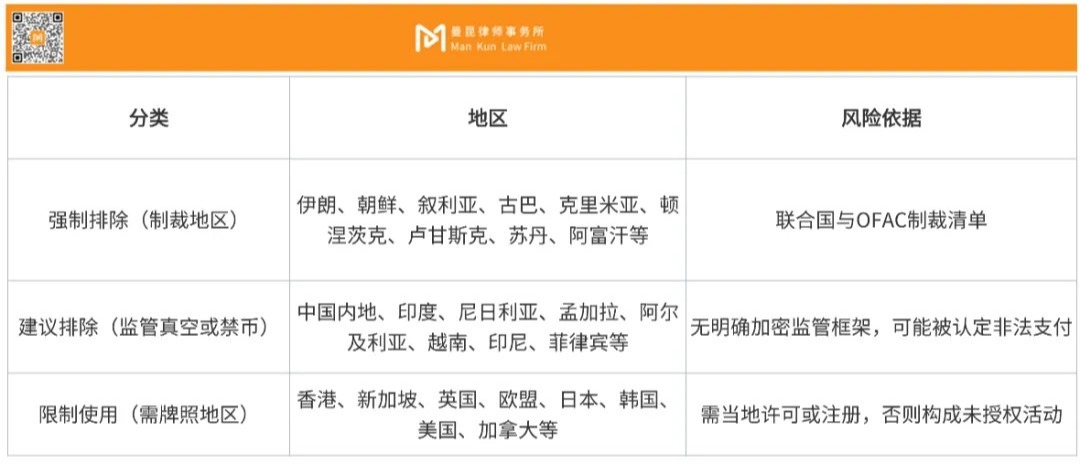
Practical recommendations:The system should implement a "triple filter":
1. IP blocking: GeoIP identification of access sources;
2. KYC nationality verification: ID card/passport country;
3. Cross-verification of residence: Utility bills or bank statements.
This is not a formality, but a condition for survival.
How do institutions in the market handle this?
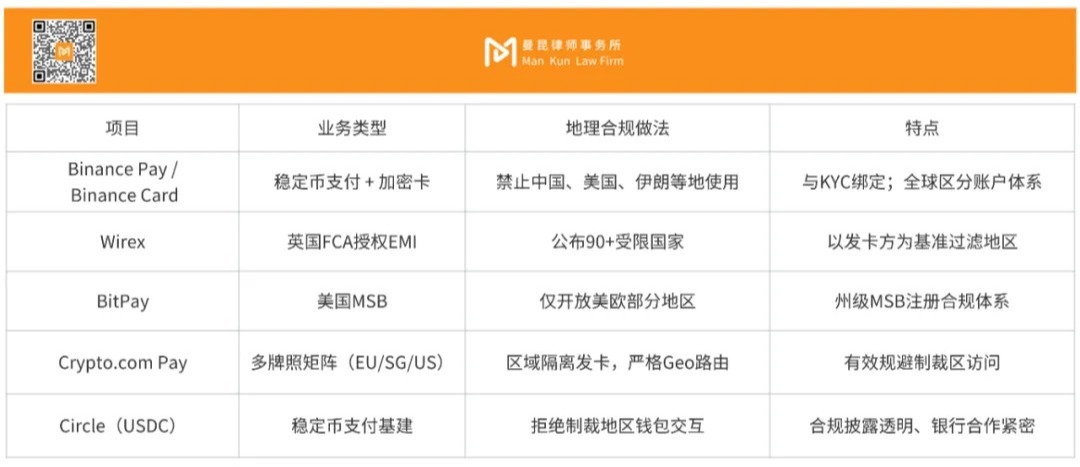
The commonality among these companies:"Segment first, expand later."
It is not about using a single license to cover the world, but using multiple licenses and entities to isolate risks in different regions.
The core logic of crypto payments is "regulatory geographic isolation."
Counterexamples: The cost of lacking geographic isolation
Paxful (peer-to-peer payment platform)
-
Reason: Failure to effectively block users from Iran and Russia;
-
Consequence: Investigation by US regulatory authorities; founder announced suspension of operations.
Bitzlato
-
Reason: Allowing users from Russia and sanctioned regions to trade.
-
Consequence: Sued by the US Department of Justice as a money laundering platform; assets frozen.
-
A certain U-Card type project
-
Model: Hong Kong MSO + overseas card issuance API, but without IP blocking;
-
Consequence: Sponsor bank discovered transactions from users in high-risk regions, resulting in the freezing of the clearing account and immediate halt of the project.
In summary:
Crypto payments without geographic compliance are not innovative products, but "non-compliant financial services."
Legal perspective: How to build a compliance firewall
1. Formulate formal policy documents
-
"Restricted Jurisdictions Policy"
-
"Customer Acceptance Policy"
-
"Geo-IP Blocking and Verification Process"
2. Implement a four-layer screening mechanism
-
Nationality verification (KYC)
-
Residence verification (Proof of Address)
-
Login device IP & GPS detection
-
Tracking of card issuance or payment paths
3. Strengthen partner due diligence
Card issuers, sponsor banks, and custodians all require that there be no clients from sanctioned regions.
→ Include "compliance warranty clauses" and "ongoing screening obligations" in cooperation agreements.
4. Dynamic update mechanism
Regularly synchronize with official lists from OFAC / FATF / EU / UN,
and establish an internal schedule for updating lists (quarterly updates are recommended).
Conclusion: The true competitiveness of crypto payments lies in "sustainable compliance"
In the crypto payment sector, technological barriers are not high; compliance barriers are the moat. No matter how fast you can process payments, regulators can freeze you even faster; the more countries you serve, the steeper the risk curve becomes.
True globalization is not about being accessible to everyone, but about being used in compliance with the law.
Geographic exclusion is not abandoning the market, but preserving the lifeline. In the world of crypto payments, the projects that survive are not necessarily the fastest runners, but those that best understand the boundaries of risk control.
