

A Guide for Web3 Entrepreneurs to Avoid Being Exploited
Introduction
In addition to the everyday operational challenges faced by traditional internet entrepreneurs, Web3 entrepreneurs face an additional "Hard Mode" challenge: token issuance.
To the uninformed public, the highlight for a Web3 project team is getting listed on an exchange, as it somewhat resembles becoming a "publicly listed company." However, the bittersweet reality of this process is likely understood only by those directly involved.
As Web3 entrepreneurs issuing tokens, you must not only guard against the risk of being deemed by regulatory authorities as illegally issuing securities and ensure compliance through measures such as establishing overseas project structures and foundations, but also beware of the significant pitfall of being exploited by the exchanges listing your tokens.
It is an industry convention that meme coins list on decentralized exchanges (DEXs), while serious projects list on centralized exchanges (CEXs). Cryptocurrency exchanges have become the preferred choice for many entrepreneurs issuing tokens, as listing confers prestige. However, unbeknownst to many, most cryptocurrency exchanges are merely makeshift operations, plagued by various bugs and human risks common to startups. The most common issue is that internal exchange employees may manipulate token prices through fake trading volumes to exploit both project teams and retail investors, making it difficult to guard against such practices.
Attorney Liu Honglin of Mankun Law Firm will share insights into the "Dark Forest Laws" of the cryptocurrency exchange ecosystem based on his observations. This article aims to provide psychological reassurance and practical preventive advice for Web3 entrepreneurs preparing to list on exchanges.
Common Exploitative Tactics Used by Exchanges
Contrary to the perception among mainland Chinese peers that listing on the A-share market is extremely difficult, listing on a cryptocurrency exchange is generally not particularly challenging for Web3 project teams. As long as you have the financial capacity to pay sufficient listing fees, you can essentially navigate mainstream exchanges with ease.
Procedurally, first, the Web3 project team must liaise with the exchange's listing team, complete and submit a listing application, provide the project whitepaper, and introduce the project's objectives, technical solutions, team background, market analysis, and tokenomics model. Second, the project must provide test results and security audit reports, as well as a legal opinion issued by professional lawyers to confirm the legality and compliance of the token.
Regarding costs, Web3 project teams typically need to pay listing fees, which vary by exchange and range from tens of thousands to hundreds of thousands of US dollars. Additionally, fees for legal opinions and technical audits must be paid, ranging from several thousand to tens of thousands of US dollars, depending on the complexity of the services and the provider's fee schedule. Beyond basic listing fees, exchanges often devise various pretexts to extract additional funds from Web3 project teams. For example, they may require the project team to provide a certain amount of tokens as market-making collateral to ensure liquidity in the crypto market and incentivize the exchange to provide a favorable market environment. They may also require airdrops or conduct marketing campaigns to reward holders of the exchange's platform tokens upon listing.
Do you think these explicit charges constitute the entirety of a cryptocurrency exchange's revenue? No, there are also covert expropriations.
The primary reason is that CEXs, which trade these decentralized cryptocurrencies, are themselves purely centralized companies. Those familiar with large centralized corporations know that issues such as data opacity, internal personnel manipulation, and conflicts of interest are inherent. As centralized platforms, exchanges possess vast amounts of trading data and user information, granting them strong market manipulation capabilities. Below are some common market manipulation tactics; arguably, there is always one that can exploit you.
1. Fabricating Fake Trading Volumes:"Excellent" exchanges do not exploit only project teams; they choose to exploit retail investors as well. The most common method is for internal exchange employees or affiliated parties to create fake trading volumes through massive buy and sell orders, attracting more retail investors to enter the market, thereby manipulating token prices. This behavior is commonly referred to as "wash trading" or "volume spoofing." A report previously released by the Blockchain Transparency Institute (BTI) indicated that over 80% of the trading volume among the top 25 global exchanges was fabricated through fake trading volumes. The report pointed out that the actual trading volume of certain exchanges was less than 1% of their reported volume. Shortly after the report's release, the head of a leading exchange reposted and commented: "This is the most accurate and profound ranking of crypto exchanges I have ever seen."

2. Data Manipulation:Operating under the principle of "my turf, my rules," exchanges can use backend permissions to directly modify trading data for specific projects, affecting the market performance of tokens. For example, they may manipulate key indicators such as candlestick charts and trading volumes to mislead investor decisions. Such operations are often conducted during periods of high market volatility to create false market impressions and induce investors to follow the manipulated trends. Recently, Attorney Honglin observed a newly listed project whose price was manipulated by a cryptocurrency exchange, showing abnormal data for several consecutive days. Many investors suspected that this was caused by internal trading and data manipulation within the exchange.
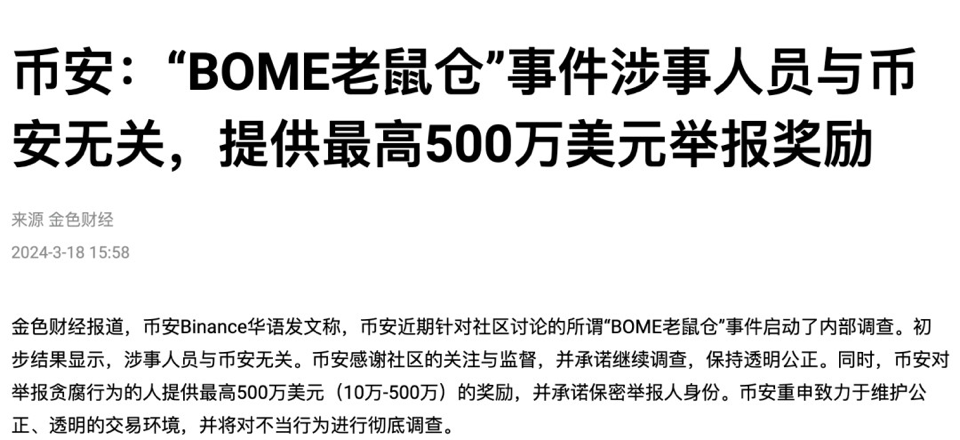
3. Insider Trading:Insider trading involves using undisclosed market information to obtain illegal profits. Exchange employees or affiliated parties profit substantially by trading in advance based on prior knowledge of significant market movements. For example, they may buy or sell relevant tokens before a new token is listed or before a major announcement is released. Earlier this year, in the BOME (Book of Meme) project, which achieved the fastest listing on a certain major exchange, media outlets suspected that exchange employees engaged in insider trading. Before the exchange issued a statement, an account withdrew SOL worth approximately USD 2.3 million from the exchange platform and purchased 314 million BOME at a price of USD 0.0074. After BOME was listed on the exchange, its price surged by over 1500%. The exchange subsequently launched an internal investigation, stating that it was unrelated to internal employees.
4. High-Frequency Trading and Arbitrage:Many exchanges operate their own trading teams or engage market-making service providers. They utilize high-frequency trading technology to execute trades at the millisecond level, capturing tiny price differences to accumulate arbitrage profits. High-frequency trading typically employs complex algorithms and high-performance computing equipment to complete a large number of transactions in an extremely short time. In 2017, an exchange garnered widespread attention due to a flash crash involving Ethereum (ETH). At that time, the price of Ethereum plummeted from USD 319 to USD 0.10 within seconds before rapidly rebounding. Subsequent investigations revealed that this was caused by high-frequency trading algorithms triggering massive sell and buy orders during severe market volatility, leading to extreme price fluctuations.
How Should Entrepreneurs Respond?
For adults seeking to survive, reflecting on one's own shortcomings when problems arise is a prudent strategy. Since external factors are beyond our control, entrepreneurs must exercise greater caution. In response to the aforementioned risks, Attorney Honglin offers the following recommendations:
1. Choose Reputable Exchanges:When selecting an exchange, prioritize those with good reputations and transparent operations, avoiding emerging or obscure platforms. It is advisable for entrepreneurs to assess an exchange's reputation by reviewing public audit reports, user reviews, and ratings from third-party evaluation agencies. Additionally, communicate with other project teams to understand their actual experiences and feedback on different exchanges. Simultaneously, avoid listing tokens on only one exchange for trading, as this makes it easier for that exchange to engage in black-box operations and price manipulation.
2. Sign Detailed Listing Agreements:When signing a listing agreement with an exchange, clearly define the rights and obligations of both parties, particularly clauses regarding data transparency and operational compliance, to safeguard your interests. The agreement should include prohibitions against behaviors such as fabricating trading volumes and manipulating data, along with corresponding liabilities for breach of contract. Additionally, require the exchange to provide regular trading data reports to facilitate independent audits by the project team.
3. Monitor Market Dynamics in Real Time:Utilize professional market analysis tools to monitor the market performance of tokens in real time, promptly identify abnormal trading activities, and take appropriate measures. It is recommended that entrepreneurs use multiple independent data sources for cross-verification to avoid relying on data from a single platform. Furthermore, consider engaging third-party monitoring services to provide 24/7 market surveillance and risk alerts.
4. Engage Legal Counsel:The importance of a competent legal compliance advisory team is no less than that of a market maker, a point many token-issuing project teams fail to recognize. A pragmatic recommendation is that once you prepare to issue tokens, you must engage lawyers with experience in the blockchain and cryptocurrency fields to provide professional services. Professional legal counsel specializing in the crypto industry can assist in handling legal matters related to exchanges, ensuring that all operations comply with legal requirements. They can participate in the drafting and review of listing agreements before listing, helping to identify potential legal risks, and can take timely legal action when issues arise. More importantly, they can provide strategic advice on various unexpected incidents after listing, thereby mitigating unnecessary public relations crises.
5. Community Building and User Education:He who wins the community wins the world. Every successful Web3 project is backed by a solid user base. Enhancing community cohesion and shaping user investment preferences through online and offline events, educational content, and interactive exchanges is standard practice. During bullish markets, community members will naturally praise the project's success. However, during bearish markets, it is common for the community to react with anger, personal attacks, and threats to report the project to authorities for rights protection. Therefore, Attorney Honglin often earnestly advises Web3 entrepreneurs to avoid making overly absolute statements in community channels, as these can become pitfalls later. In the event of sudden incidents, such as exploitation by an exchange or market maker, it is recommended to promptly synchronize event information on official media accounts to prevent user panic.
Conclusion
Overall, there are indeed many seasoned predators eager to extract money from Web3 entrepreneurs. For entrepreneurs, in addition to facing legal and regulatory risks in different countries and regions, it is crucial to beware of pitfalls set by commercial partners such as cryptocurrency exchanges and market-making service providers. We hope this article clarifies the obstacles that centralized cryptocurrency exchanges may place in the entrepreneurial process, helping you recognize these risks and approach token issuance and trading with greater caution and preparation. The entrepreneurial journey is inherently challenging; may you all avoid these pitfalls and embrace greater opportunities and development.
About the Author
Liu Honglin, Founder of Mankun Law Firm. Member of the Youth Work Committee of the Shanghai Lawyers Association, Member of the Information Technology Work Committee of the Shanghai Lawyers Association, and Member of the Legal Technology Committee of the Shanghai Lawyers Association. Attorney Liu Honglin has 10 years of experience in law and internet entrepreneurship. He previously served as Vice President of a legal tech company under Tencent's strategic investment division and as Legal Manager for a private equity fund at a listed company. He specializes in proposing actionable, practical solutions for cases from the perspectives of business models and legal practice, maximizing commercial benefits for clients.
About Mankun
Established in 2015, Mankun Law Firm is a boutique law firm in China focusing on the new Web3.0 economy and deeply rooted in the blockchain industry. The Mankun team possesses unique and diverse industry backgrounds, with members hailing from renowned legal service institutions, national judicial organs, internet technology companies, crypto asset institutions, and blockchain industry think tanks.
Based on a profound understanding of the new economy, continuous attention to and research on policies and regulations, and extensive practical experience, the Mankun team excels in providing comprehensive legal services from the perspectives of business models and legal practice. These services include business structure design, project financing, transaction planning, operational compliance, resolution of complex civil and commercial disputes, prevention and control of criminal risks, and criminal defense for new economy enterprises in sectors such as Web3.0, blockchain, AI, NFTs, digital collectibles, crypto funds, crypto payments, DeFi, real-world assets (RWA), and GameFi.
Mankun Law Firm is headquartered in Shanghai, with branch offices in Hong Kong (China), Silicon Valley (USA), Shenzhen, Hangzhou, Zhengzhou, Chengdu, and other locations. To meet the global compliance development needs of Web3.0 industry clients, Mankun has established local offices in major global crypto-financial cities and selected local professional blockchain service partners, providing clients with professional legal and compliance services characterized by global breadth and Chinese depth.