
Last year, when Hong Kong's stablecoin sector was at its busiest, RD Technologies was one of the most favored contenders. This year, it announced a new stablecoin cooperation plan.
The name, however, is: U.S. dollar stablecoin.
According to the latest announcement, this stablecoin, called RDUSD, will be issued by Anchorage Digital Bank N.A. in the United States and is planned to be deployed on HSK Chain, which is under HashKey. The Hong Kong company will be responsible for the brand and application ecosystem, while the U.S. bank will be responsible for issuance, reserves, minting and redemption.
Reading this, I think that many of the stories told last year around a Hong Kong dollar stablecoin have in fact already been answered. Everyone expected Hong Kong to use this opportunity to grow its own on-chain currency network, but what arrived was a leading Hong Kong contender going to a U.S. bank to issue U.S. dollars.
Of course, Hong Kong dollar stablecoins are already being worked on. HSBC's RedCoin was launched in October this year, and Anchorpoint Financial, in which Standard Chartered participates, has already brought the Hong Kong dollar stablecoin HKDAP to the stage of serving enterprises and professional investors.
Understanding "failure" as not a single coin having been issued is obviously inconsistent with the facts.
What I mean by failure is the expectation of last year: that once Hong Kong legislated and issued licenses, the Hong Kong dollar would readily become an important settlement currency in the crypto world, and Hong Kong would thereby gain new financial dominance.
Looking at it again today, the distance between these matters is far greater than was imagined at the time.
RD Technologies can of course pursue both Hong Kong dollar and U.S. dollar arrangements at the same time. But its latest step has given me a more concrete sense of Hong Kong's "wanting yet fearing" state in the crypto assets field.
A favored contender has gone to do U.S. dollars
There were ample reasons why RD Technologies was favored at the time. Its subsidiary RD Innovation Technology entered the Hong Kong Monetary Authority's first stablecoin issuer sandbox in 2024, and the product it prepared to test was the Hong Kong dollar stablecoin HKDR. By July 2025, the group also announced the completion of approximately US$40 million in financing, continuing to bet on Hong Kong's compliant stablecoin infrastructure.
From the sandbox and financing to the Hong Kong dollar product, this path looked quite complete. That is why seeing it announce RDUSD today makes one feel somewhat rueful.
The RDUSD cooperation structure is in fact quite clear. Anchorage is the first federally chartered digital asset bank in the United States and, in this product, assumes core responsibilities such as issuance, reserves and redemption; Yuanbi expands customers and use cases, while HashKey plans to provide early liquidity. HSK Chain is an Ethereum Layer 2 network oriented toward institutional business, that is, a blockchain layer built on Ethereum that handles transactions and applications.
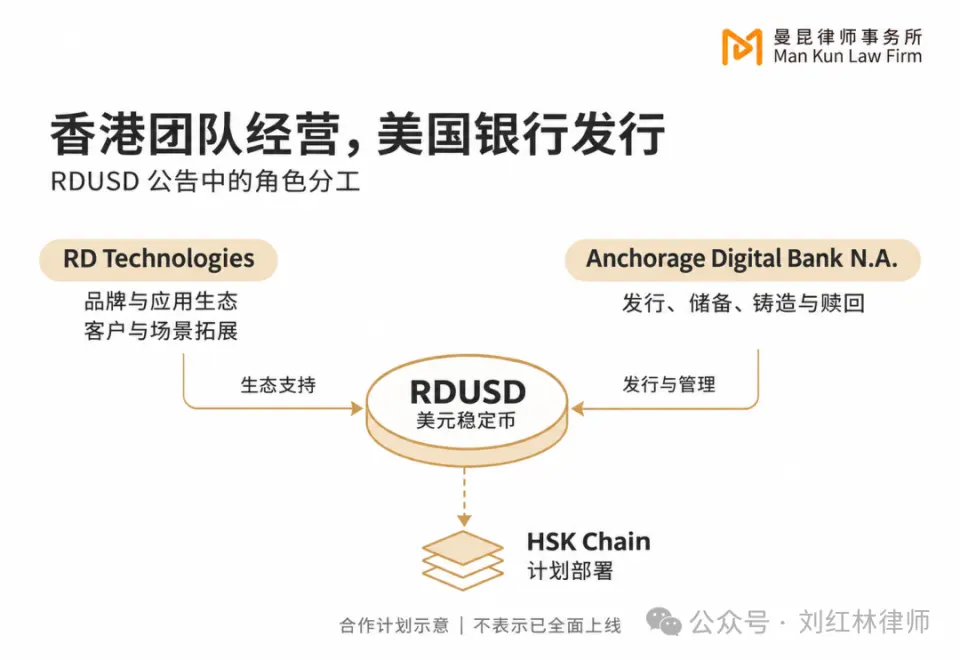
The division of roles in the RDUSD announcement. An illustration of the cooperation plan; it does not yet represent a full launch.
The company operates in Hong Kong, and the chain also has a Hong Kong team background, but what users hold is a US dollar stablecoin, and the entity responsible for issuance and redemption behind it is a US bank. Yuanbi's announcement also makes clear that RDUSD is not a stablecoin issued under a licence from the Hong Kong Monetary Authority and is offered in Hong Kong only to professional investors. US issuance credentials did not incidentally become a Hong Kong retail passport.
This arrangement may be very pragmatic for Yuanbi: an institution is already available to provide a full suite of issuance services, allowing it to focus its efforts on customers and business.
Moreover, this is not the choice of Yuanbi alone.
USDGO, the US dollar stablecoin launched in February this year by the Hong Kong-listed company OSL, is likewise issued by Anchorage, with OSL handling brand operations and distribution. According to data disclosed by OSL at the end of August, USDGO's circulating scale has already exceeded USD 1.2 billion, rather than being a business that exists only at a launch event.
Official press image published by OSL for USDGO. Source: OSL.
OSL also participated in the distribution of the Hong Kong dollar stablecoin HKDAP. Companies are under no obligation to pledge allegiance between the Hong Kong dollar and the US dollar; they operate whatever their customers need. It is precisely this normal commercial choice that illustrates the point better than any industry slogan.
I do not think these companies have done anything wrong. On the contrary, the more pragmatic they are, the more they remind us that a Hong Kong company building a stablecoin business and the Hong Kong dollar stablecoin building a global business are two different things.
The Hong Kong dollar's problem is not just regulation
In much of last year's discussion, there was a rather clever imagining of the Hong Kong dollar stablecoin: the Hong Kong dollar is already pegged to the US dollar, and Hong Kong has mature financial regulation, so once it is built, it can have both the stability of the US dollar and Hong Kong's own characteristics.
Hong Kong's linked exchange rate system keeps the Hong Kong dollar against the US dollar within a range of 7.75 to 7.85. But an exchange rate link does not mean the payment networks are connected. A Hong Kong dollar stablecoin will not automatically inherit the US dollar's quotation conventions, liquidity and overseas acceptance merely because it is closely linked to the US dollar.
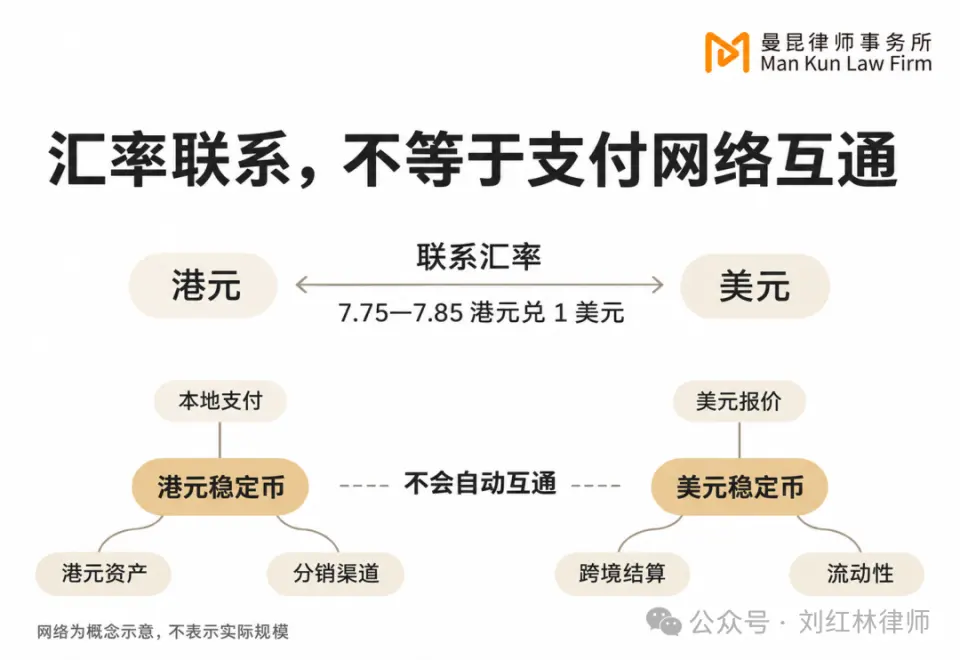
The linked exchange rate and the payment network are two separate layers. The network is a conceptual illustration and does not represent actual scale.
This is also where I think many people oversimplify stablecoins. Building the coin itself is not necessarily the hardest part technically. What is hard is why people would be willing to keep their money in it over the long term, and why there would be enough counterparties willing to keep using it.
If a Hong Kong dollar stablecoin mainly serves local payments in Hong Kong, users must be persuaded to change their habits even though they can already make transfers and scan QR codes. If it is to go overseas, it must contend with the existing demand for the US dollar. Both paths are viable, but neither will suddenly become easy just because a licence has been obtained.
So I also do not agree with attributing today's outcome entirely to "Hong Kong regulation being too strict." Even if several more licences were issued tomorrow, overseas customers would not switch to Hong Kong dollar settlement because of that.
The market difficulties that the Hong Kong dollar has always faced cannot all be shifted onto the regulators.
In choosing the US dollar, RD Technologies and OSL were drawn both by the advantages of the US dollar itself and by the appeal of ready-made issuance services. The uncomfortable part for Hong Kong is this: the Hong Kong dollar network, which still needs to catch up, must compete with these mature conditions for the same pool of companies' time and resources.
What exactly is Hong Kong worried about?
Hong Kong wants to develop crypto assets, and its legislation and investment in this area over the years are real. But after reading the specific rules, my impression is that Hong Kong very much wants the business that new finance brings, while remaining deeply wary of what will happen once new finance truly expands.
Such wariness naturally has practical grounds.
Behind a stablecoin is money that customers have paid in. If reserves are insufficient, users run, and redemptions stop, the ones who ultimately bear the losses are specific individuals. Requiring issuers to manage reserves properly, segregate assets and verify customer identity are all things that should be done.
But one distinction must be made clear: containing the risks of issuers and permanently confining the entire market to a small number of institutions and a small number of uses do not produce the same commercial results.
Hong Kong's Stablecoins Ordinance took effect in August 2025. By April this year, of the first batch of 36 applicants, two had obtained licences, namely HSBC and Standard Chartered's joint venture Anchorpoint Financial. The HKMA also stated clearly at the time that the threshold would remain high and that even if more licences were issued, the overall number would still be very limited.
From a regulator's perspective, this is easy to understand. A banking background, financial strength and mature risk controls all make people feel more reassured. But if, after a new financial company invests, it finds that the most realistic way out is to procure issuance services from existing institutions, then what this regime ultimately cultivates may mainly be new product lines for traditional financial institutions.
This is a different choice from allowing more enterprises to compete under clear rules. What I care about is whether Hong Kong is willing to leave enough space for the latter.
Anchorpoint Financial's HKDAP is already on a public chain, but according to its published arrangements, wallets must complete verification and whitelisting procedures, and transfers to unverified wallets will be rejected. HSBC RedCoin, by contrast, first uses PayMe to handle transfers and merchant payments. Such products have their value and clear risk-control considerations, but to grow a broad on-chain usage network from them, the issues of access, distribution and cross-institutional collaboration still need to be resolved.
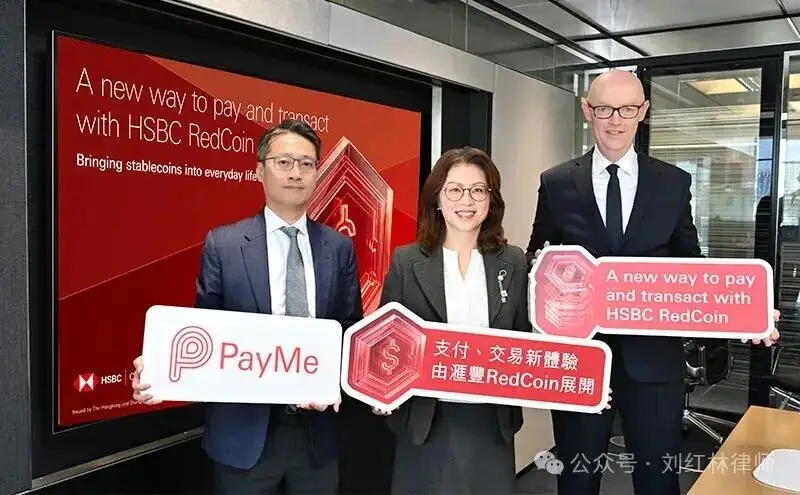
At the HSBC RedCoin launch event, October 2026. Source: HSBC.
Another layer of difficulty for Hong Kong comes from its relationship with the mainland. Many people who are optimistic about Hong Kong actually have mainland enterprises, users and funds in mind. But Hong Kong permitting a certain business does not mean the mainland also permits it. A Hong Kong licence is even less likely to incidentally resolve the problems of mainland clients purchasing coins, making exchanges and transferring funds across borders.
To think of mainland demand as a market that Hong Kong stablecoins can access at any time is itself a misjudgment.
In February this year, a new notice from eight mainland departments continued to make clear that virtual currency-related business activities within the mainland are strictly prohibited in all cases, and that overseas entities may not unlawfully provide related services to the mainland. Stablecoins have not automatically obtained a channel for conducting business in the mainland simply because of Hong Kong legislation.
As a result, Hong Kong stands in an awkward position: the local market is limited, the mainland market, on which the greatest hopes are most easily placed, has clear boundaries, and going international requires competing with the US dollar network.
The more cautious the policy, the more enterprises must first find a profitable outlet.
When I say "want it yet fear it", I mean this outcome. Hong Kong wants the growth brought by the crypto industry, and also hopes that business will always remain within a scope that is easy to see clearly and easy to control. But for a usage network to expand, it must necessarily connect more institutions and more markets, and will also expose problems that did not exist during the pilot stage. If every expansion requires waiting anew, the market will choose another path on behalf of enterprises.
For whom is Hong Kong creating incremental growth?
Looking at the First Digital matter a little more broadly, there is another change I find more worthy of vigilance: as crypto assets have developed to this day, the US dollar has not lost its position because of the emergence of blockchain; instead, it has gained an additional set of circulation tools.
In the past, a company seeking to operate cross-border US dollar business often had to coordinate banks, payment channels and accounts itself. Now, US institutions can package stablecoin issuance, reserves and redemption as services, which businesses elsewhere can plug into and then use their own customers, brands and channels to expand their markets.
The collaboration between RD and OSL has already made this division of labor quite intuitive. The Hong Kong team understands Asian customers, is willing to pursue cross-border payments, and is willing to invest in on-chain applications; the US bank provides the critical issuance infrastructure. The Hong Kong company can earn money, and the US dollar network expands accordingly. These two things can absolutely happen at the same time.
After the GENIUS Act, the payment stablecoin legislation, was signed last year, the goals publicly discussed by the US Department of the Treasury included consolidating the dollar's status, expanding the reach of the dollar economy, and increasing demand for US Treasury securities.
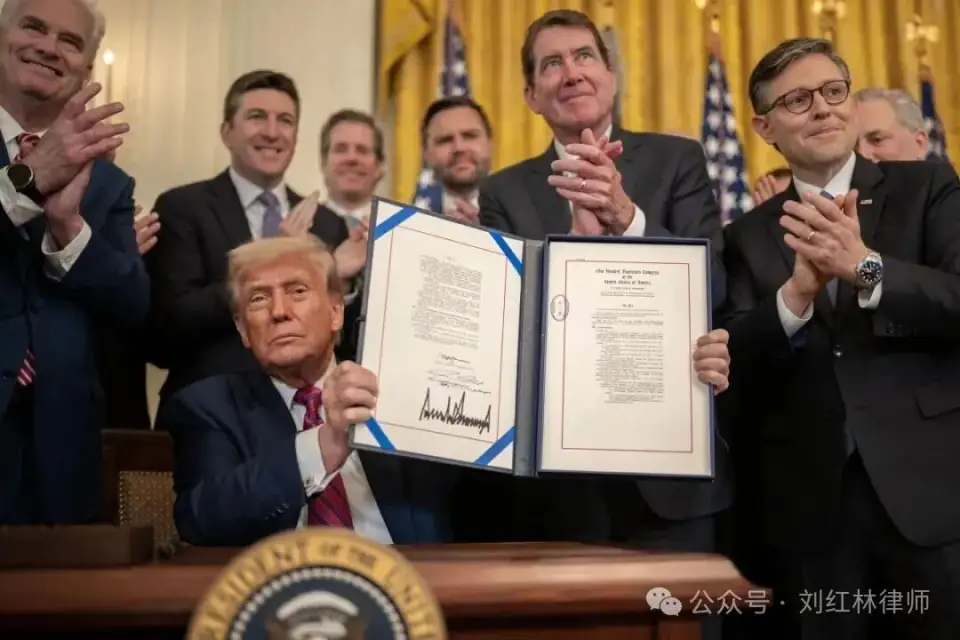
July 18, 2025, at the signing of the GENIUS Act. Source: The White House / Daniel Torok.
They do not treat stablecoins merely as a fintech product.
This does not mean the United States is letting risks go unchecked. It likewise requires reserves, anti-money laundering and sanctions compliance. The difference is that, from these publicly stated policy goals and the collaborations that have already occurred, we can see a direction: letting more commercial institutions expand the use of the US dollar, while bringing key relationships such as issuance and reserves within its own system.
Hong Kong has always been an international financial center, and operating US dollar business has never been something to be ashamed of. We cannot conclude that Hong Kong gains nothing simply because a coin is pegged to the US dollar.
But if our original expectation for a Hong Kong dollar stablecoin was to give Hong Kong a more proactive position in the next generation of financial networks, then we cannot look only at where a company is registered.
The RDUSD plan has already written out part of the answer. Hong Kong enterprises expand applications, while a US bank undertakes issuance and redemption. This collaboration can succeed, and Hong Kong can benefit from it, but it will not automatically grow into Hong Kong's own Hong Kong dollar monetary network.
In my view, what Hong Kong most needs to confront seriously now is the difference between these two kinds of success.
If the goal is to be a service center for global digital finance, then cross-border services should be done well, and enterprises should be allowed to operate within clear boundaries. If there is still a hope for the Hong Kong dollar stablecoin to have a greater position, then use cases and institutional arrangements sufficient to sustain ongoing market investment must be put forward.
One cannot hope that enterprises will build a network for the Hong Kong dollar while at the same time making them wait for a long time in a limited space.
I still hope Hong Kong succeeds in building HKD stablecoins. But the expectation from last year that legislation, licensing and market enthusiasm alone would be enough to ride the momentum and win the next round of financial competition should now be put to rest.
When the most promising HKD stablecoin contender begins to seriously operate in US dollars, the question Hong Kong needs to answer already goes beyond how many more licences to issue. Businesses will keep moving forward. If what remains in the end is a Hong Kong team, a US issuer and an ever-expanding US dollar network, then it should no longer be called a victory for HKD stablecoins.
