
On July 15, 2026, the German Commission for Licensing and Supervision (ZAK) issued an administrative ruling: Google AI Overviews and Perplexity violated Article 109 of the German Interstate Media Treaty. The ruling is immediately enforceable, and the two companies have one month to appeal.
This news was only circulated in China's AI circles as a piece of gossip, but it deserves far more attention than that.
For Chinese large-model companies that are currently or preparing to expand into Europe, whether DeepSeek, Qwen, and Kimi, which operate API or ToC businesses, or the overseas versions of various AI assistants and AI search services, ZAK has done one thing this time: it has torn open a corner of the "DSA liability shield" that everyone previously assumed they could enjoy by default.
The gap torn in the shield is the newly added cost.
How the accounts were calculated before
First, let us set out the hidden costs of Chinese AI large models expanding into Europe.
The core chain of a large-model overseas business is simple: model training, cloud deployment, API sales or apps directly reaching users, use by European users, and settlement in euros. It does not look complicated, but in practice the European market is more expensive than the North American market in two respects: first, the GDPR data compliance cost, which has been there since 2018; second, the tiered obligation cost under the EU AI Act, which has been implemented in phases since August 2024. A rough industry estimate is that a mid-sized AI company expanding into Europe invests approximately 5% to 10% of its European revenue each year in compliance in these two areas (estimate).
Beyond these two items, there was originally another default assumption supporting everyone's books: liability for AI output content could be covered by the "platform liability exemption" under the Digital Services Act (DSA). After all, your AI is processing and distributing third-party content on the internet. This default made the risk exposure of AI output relatively vague, and also led many companies to write this item as "low" when assessing the European market.
Germany is now telling you: this default does not hold.
Item one: AI output equals your own content
ZAK held that the DSA rule that "platforms distributing third-party content may be exempt from liability" does not apply to AI-generated answers. The reason is direct: AI output is regarded as the "provider's own content," rather than redistributed third-party material.
Another matter echoes this judgment. A Munich court recently reached a similar conclusion in a civil case, holding that AI-generated text is an "independent, entirely new, and substantive" statement, and Google was held liable for false statements. Google said it would appeal, but the judicial path has already aligned with the administrative ruling.
For businesses, this means: previously you could say, "I am merely relaying internet content," and shift blame to the content source if something went wrong. That is no longer possible. If a user asks your model a question and the model fabricates something—for example, describing a living person as dead, or confusing one company's product with another's—a European user can file a claim directly against your European representative. This is not platform liability; it is content-provider liability, equivalent to your being regulated as a media outlet.
For companies that purely provide API output and serve only B2B developers, this provision is relatively moderate. This is because your direct customers become the primary bearers of liability—they are the ones applying AI output in their own products. But for companies offering ToC products, especially AI search and AI chat assistants, you are the "content provider" under the ZAK's formulation, and there is no intermediary layer to pass liability down to.
The second charge: not just the content itself, but how you rank it
The second point on which Google was challenged is more granular than the first. AI Overviews occupy the prime position above search results, pushing traditional news links downward. The ZAK says this constitutes "prohibited discrimination," compounded by a breach of transparency rules.
The impact of this provision is broader than the first. This is because it governs not "what your model says," but "how your product ranks others' content below"
Any product that aggregates, links to, or quotes third-party content in AI output must confront this issue. If your model excerpts content from Media Outlet A to answer a question without linking back to Media Outlet A, or links back but places the link far down the page, then under the ZAK's formulation, this constitutes discrimination against news media sources.
There is an awkward figure here: Pew Research says that only about 1% of AI Overviews users click on source links. In other words, users leave once they feel their question has been answered; even moving links upward would not change the traffic predicament of news media. But regulators do not look at this figure; regulators look at form: whether you enable users to find sources, and whether you transparently disclose ranking logic. The "Preferred Sources" feature Google later introduced was viewed by regulators as a fig leaf, because almost no users would actually maintain a list of their own sources.
For Chinese large-model companies expanding overseas, the operational cost of this provision is: when a product launches in Europe, if it includes AI search, AI summaries, or AI Q&A, it must have a complete set of "source disclosure + ranking transparency" interfaces and explanatory documents. This cannot be glossed over by adding a line of small gray disclaimer text at the bottom of the page; it must be source labeling visible in the primary visual presentation, plus an underlying ranking-algorithm explanation that can be produced for regulators.
The third charge: procedural costs that cannot be avoided
This is the lowest-hanging compliance obligation. The ZAK currently identifies two main issues with Perplexity: first, the absence of a designated representative in Germany; second, a lack of transparency disclosure.
What does a designated representative in Germany mean? It means you must either establish your own entity in Germany or engage a professional compliance agency, with costs ranging from approximately EUR 30,000 to 80,000 per year (estimate, by reference to the price range for GDPR representatives in the industry).
That is just one country. Companies doing business in the European market actually face 27 member states. In the past, most member states allowed a single representative to be shared through the EU representative system, but territorial requirements at the media-law level are now emerging, and whether the shared representative system can cover this layer remains unsettled. The prudent approach is to prepare separately on a country-by-country basis.
Transparency disclosure is yet another layer: how the model works, what the training data is, and what the content-ranking logic is must all be explained to users. Moreover, it cannot be a copy-paste of English terms; German regulators require a German-language version, and other Member States operate by analogy.
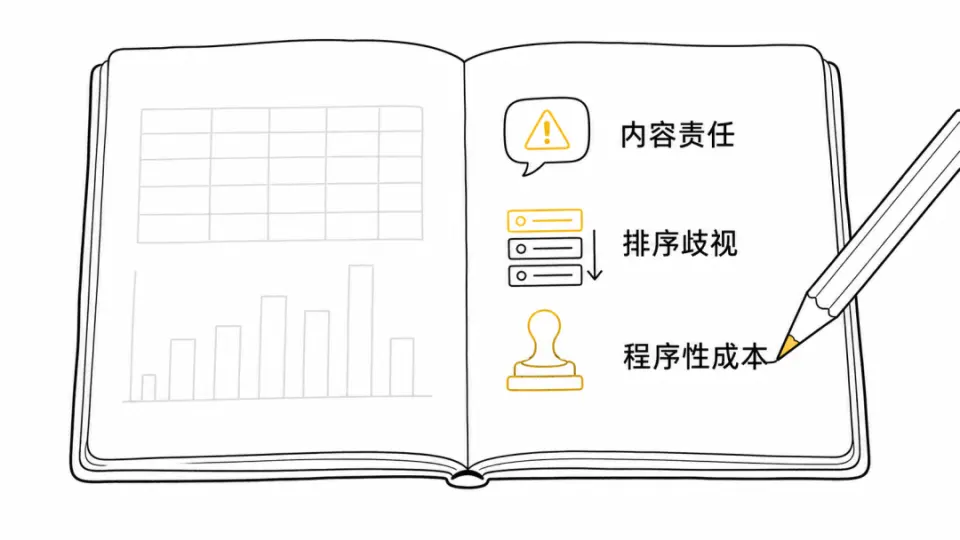
Three new accounts
This is merely one newly erected front line
To understand the weight of this ruling, it must be viewed against the entire regulatory map that Chinese AI companies going overseas to Europe must face.
The first is the EU-level AI Act, which has taken effect in phases since August 2024 and focuses on risk tiers and obligations for general-purpose artificial intelligence (GPAI).
The second is the GEMA v. OpenAI case in Germany under the copyright path, which proceeds on copyright infringement; both training data and output reproduction can be challenged.
The third is the type of civil tort judgment rendered by the Munich court, which proceeds on ordinary reputation rights and false-statement grounds.
The fourth is this ZAK media-law path, which proceeds under the Interstate Media Treaty.
These four are not alternatives to one another; they are cumulative. If a Chinese large-model company runs into trouble in Germany, it may be hit on all four fronts at once: copyright liability, tort liability, content responsibility, and media-law obligations all fall on it. What ZAK has done this time is to erect the fourth front line as well.
German regulatory enforcement has historically been among the strictest in the EU, as the GDPR era already demonstrated once. After Germany takes the first step, France, the Netherlands, and Italy will most likely follow with similar media-law paths; this is the normal rhythm of regulation among EU Member States. The window is closing.
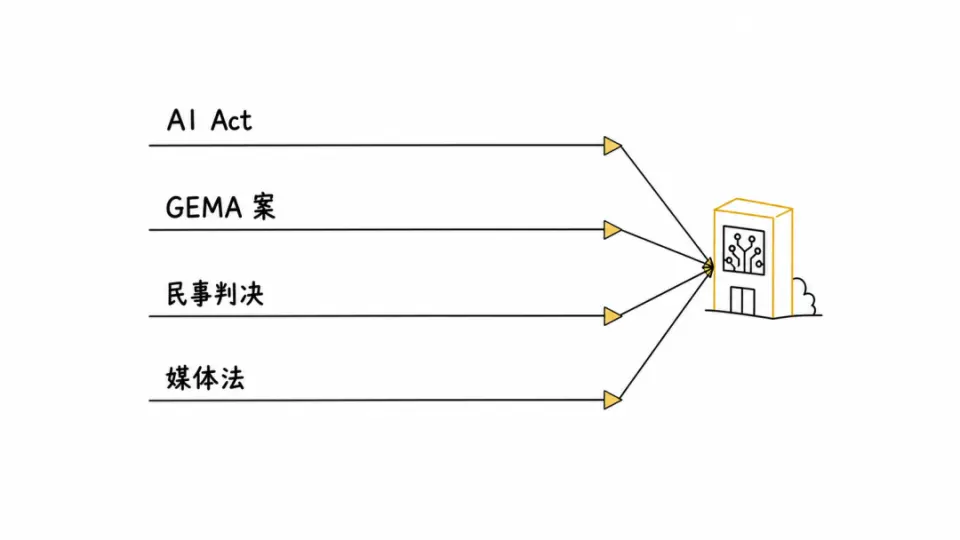
Four fronts converge
By audience: who should recalculate their accounts
Companies offering APIs or B2B services, such as DeepSeek, Tongyi Qianwen, and Zhipu GLM. Pressure is not significant for the time being. Your direct customers are B2B developers, who integrate your models into their own products, and they are the primary bearers of liability. But two things require attention: first, the contract must clearly set out the allocation of liability for AI outputs, and European customers will begin to require these clauses; second, once your model is used in Europe in scenarios involving serious violations and reaches the GPAI threshold under the AI Act, you will be directly bound by the AI Act and cannot avoid it. On current estimates, the additional compliance cost is approximately EUR 200,000 to 500,000 per year (estimate), which is bearable.
Companies offering AI search or consumer-facing chat assistants, such as Kimi, Metaso, and the overseas version of Doubao. These are directly hit. You are a "content provider" within the ZAK framework, and every point on which Google and Perplexity have been challenged applies to you without exception. Product design must be redone: how source disclosure is displayed, how ranking logic is explained, how erroneous content is promptly corrected, and how complaints from German users are handled all require corresponding mechanisms. The additional compliance cost for this tier is approximately EUR 500,000 to 1,500,000 per year, and will rise further as other Member States follow suit. Consumer-facing products with high gross margins can withstand this; those with gross margins below 30% should seriously consider whether entering the European market is worthwhile, especially subscription-based products priced below EUR 20 per month.
Companies operating AI aggregation or intermediary platforms, such as Poe and multi-model entry points. Their position is more delicate. ZAK also brings in the concept of "media intermediary": any entity that "determines whether content can be found through the selection and arrangement of links" must be transparent. This definition fits AI aggregation platforms almost perfectly. This category requires a careful legal characterization analysis, and may require restructuring product logic, or postponing European market expansion until the pace of follow-on action by other Member States becomes clearer.
Signals to watch: If the company is still at an early stage and Europe accounts for less than 10% of revenue, do not rush into restructuring; it is enough to get response mechanisms running and observe the pace of follow-on action by other Member States. Once the revenue share reaches 30%, the overall return on investment in Europe should be recalculated.
Final item: making this cost concrete and actionable
The preceding sections have broken down the costs. Here we break them down one level further, so that management can see exactly how much is involved.
Tier one, certain compliance costs: if you do not do this, you are in violation:
- Designated representative in Germany, EUR 30,000 to 80,000 per year
- German-language transparency disclosure documentation, including algorithm explanations, training data explanations, and ranking logic explanations; a one-time investment starting at EUR 50,000 to 150,000, followed by annual maintenance of EUR 20,000 to 50,000
- German user complaint response mechanism, starting at EUR 100,000 to 200,000 per year
- Source disclosure and ranking interface restructuring, a one-time EUR 200,000 to 500,000, only for AI search and AI chat products
These are the visible additions that go directly into fixed costs.
Tier two: probabilistic compensable risks, with expected cost calculated as the probability of occurrence multiplied by the cost of a single occurrence:
- Defamation or misrepresentation litigation arising from erroneous AI output: damages in a single case generally fall within the range of EUR 5,000 to 50,000 under the general range for German civil cases, with the specific probability depending on the product's user volume and content sensitivity
- Administrative complaints filed by media organizations alleging "ranking discrimination": cooperation with each investigation plus legal fees is approximately EUR 100,000 to 300,000
- General administrative penalties: for violations related to Section 109 of the Interstate Media Treaty, the maximum fine may reach EUR 500,000 per violation
For a ToC product with 100,000-level active users in Germany, the annual expected cost at this tier is roughly estimated at EUR 200,000 to 400,000 (estimate). Business owners who have operated in the European market for some time generally accept this item as an operating cost, provided that the product's gross margin is sufficient to bear it. Two specific actions to reduce this tier: first, add the "source labeling + disclaimer + one-click correction" trio at the AI output layer; second, in European market contract terms, pass output liability down the chain layer by layer, especially in B2B cooperation contracts.
Tier three: risks that money cannot solve. The current German ruling does not touch this tier; it follows an administrative plus civil path, not a criminal path. However, two directions warrant attention: first, when models err in sensitive areas in Europe such as minor protection, racial hate speech, or terrorist content, the criminal provisions of German criminal law and media protection regulations will be triggered; second, if the high-risk provisions of the EU-level AI Act are triggered (scenarios such as biometric identification, critical infrastructure, and judicial decision assistance), the maximum fine is the higher of 7% of global annual revenue or EUR 35 million. For the vast majority of Chinese AI companies expanding overseas, these two figures represent penalties at the level of wiping out the business. Therefore, even though this German ruling itself does not reach tier three, the scenario admission strategy for product lines must also be tightened accordingly.
On its face, this German ruling targets Google and Perplexity, but in reality it draws a new line for all AI large-model service providers in the European market. Chinese companies expanding overseas were already calculating their GDPR exposure, their AI Act exposure, and their GEMA exposure; now they must add another item: media law exposure.
This is not intended to scare anyone away. European AI users' willingness to pay is among the highest in the world, and companies willing to enter are necessarily pursuing high gross margins. The only issue is this: calculate the accounts clearly before entering, and after entering, build compliance capabilities as a moat rather than treating them as a drag. After all, when France, Italy, and the Netherlands follow suit, companies that have already done their compliance work will obtain access to the European market a year earlier than companies that scramble only at the last minute.
Those with legal needs related to AI expansion into Europe are welcome to speak with the author.
Author of this article:Lü Yinghui, a lawyer at Mankun (Shenzhen) Law Firm. A graduate of China University of Political Science and Law, with nearly ten years of deep experience in the legal industry and prior work at a Shenzhen court. Focused on legal services in the new-generation economy, with extensive practical experience and deep insight in fields such as Web3 and artificial intelligence. Account across all platforms: Lao Lü Talks New Money; followers are welcome.

