
Microsoft spent USD 2.5 billion to place 6,000 engineers inside client companies. Domestic vendors have long been doing the same thing, and job postings for 'on-site delivery' and 'FDE' roles are everywhere on recruitment websites. This article seeks to make one point clear: in China, what trips you up first in the FDE business is not technology but labor law, and the three places where it trips you up happen to be its three most valuable selling points.
On July 2, Microsoft announced the establishment of Microsoft Frontier Company, committing USD 2.5 billion and deploying 6,000 engineers to be stationed directly inside enterprise clients to help them embed AI into their core operations. Two days earlier, Amazon had just announced a similar USD 1 billion program; a month before that, OpenAI and Anthropic each launched projects to place engineers inside major clients.
In Silicon Valley, this approach has a name: Forward Deployed Engineer, abbreviated FDE. The core move can be stated in one sentence: instead of selling you a software package and leaving you to figure it out yourself, the vendor sends its own people into your company to sit with your team, build the system, get it running and keep tuning it. Palantir has run government and large-enterprise business on this model for over a decade, and now the entire AI industry is copying it.
Interestingly, Microsoft itself wants to distance itself from the label. Althoff, the CEO responsible for commercial business, took care to say in the announcement that this 'goes beyond so-called forward-deployed engineering.' Peers were not persuaded, and media headlines uniformly framed it as FDE.
In China, there is no need to wait for Microsoft. On recruitment websites, Volcano Engine's 'large-model delivery engineer' roles offer RMB 30,000 to 50,000 per month at 15 months' pay; Tencent Cloud's 'AI frontline deployment engineer FDE' explicitly states 'deep involvement in top-tier clients' business scenarios' and 'acceptance of travel and on-site deployment'; Unisound is recruiting people for 'on-site delivery for government-enterprise, government-affairs and state-owned-enterprise privatization projects'; and even an industrial software company in Tangshan has posted an 'AI delivery engineer FDE' position at RMB 8,000 to 16,000 per month, requiring a master's degree, for on-site work at manufacturing enterprises.
The numbers explain why this business has suddenly become popular. According to CCID Consulting, on-premises deployment already accounted for 63% of China's large-model market in 2026; in a Cheung Kong Graduate School of Business survey, AI penetration among real-economy enterprises was only 10%, and nearly 80% of enterprises that have not adopted AI are stuck on the same problem: the scenarios are not applicable. The success rate of remote delivery is below 43%, while on-site deployment raises that figure above 85%.
Translated into business terms: clients have money, data and scenarios, but cannot implement them on their own; whoever can send people on site to get AI running will capture this payment for 'certainty.' What FDE sells is not software but certainty.
The problem also lies in that sentence. Selling software is governed by contract law; selling people, even if you call it 'services,' will sooner or later run into labor law. And China's labor law has a dedicated set of rules for 'sending people to work inside someone else's company' that is far stricter than most entrepreneurs imagine.
The way this business charges is inherently close to labor dispatch
Let us lay out the economics first. In the industry, the human-resource quotation for domestic AI engineers is roughly RMB 20,000 to 50,000 per person-month; a standard privatization on-site project runs 25 to 30 days, with hardware billed separately, and costs RMB 500,000 to 1.5 million for a mid-sized enterprise. The vendor's real source of profit is people: the person-month rate for an engineer minus his salary leaves the gross margin.
This determines that FDE and a SaaS software product are two different businesses. SaaS sells licenses, with marginal costs approaching zero, and the client buys a product. FDE sells engineers' time, and the client buys 'how much work this person did at my company.'
Among the five layers of computing power, cloud, models, tools and applications, FDE sits in the bottom application-delivery layer, earning service fees paid by end clients for 'AI implementation.' This layer has a low barrier to entry and fast cash flow, but it has an attribute the other layers do not: both its costs and its deliverables are people.
Whenever the core of a business is “my people work on your premises, at your pace, for you,” it falls into the specific category under the Labor Contract Law: labor dispatch. The category FDE wants to occupy should be a different one: labor outsourcing. Putting a business in the wrong category carries a fine.
Outsourcing and dispatch differ by just one thing: “who manages the people.”
Labor outsourcing and labor dispatch receive vastly different legal treatment, yet in practice the boundary between them is especially easy to blur.
The distinction can actually be stated in one sentence: outsourcing means Party B independently completes a piece of work and delivers a result, and Party A recognizes only the result and does not manage the people; dispatch means Party B sends people over, Party A directs and manages them, and Party B only handles payroll and social insurance contributions. The former governs matters; the latter governs people.
When determining which type a contract actually is, what do courts look at? One lawyer compiled statistics on 28 such judgments, and the conclusion is blunt: the manner of employment management is the primary criterion, with a review rate of 100%—all 28 judgments without exception used it as the yardstick. Among the 12 cases found to be “fake outsourcing, real dispatch,” the courts in every case found that the outsourcing party was directly managing the people.
A ready example: a machinery company in Jiangsu signed a “Service Outsourcing Contract” with a staffing company. Worker Zhu was assigned to work at the machinery company the day after joining the staffing company; daily attendance, scheduling, and management were all decided by the machinery company, and wages were calculated by the hour and then forwarded by the staffing company. After Zhu suffered a work injury and litigated, the court pointed out in one sentence: although the contract was called outsourcing, in practice the worker was used under dispatch, constituting labor dispatch, and the machinery company, as the user entity, bore joint and several liability. The second instance upheld the ruling.
A final judgment by the Beijing No. 3 Intermediate People's Court in May 2025 was even more direct. A food processing worker was “outsourced” to sign a contract with a logistics company, but the person actually worked at a network technology company's store and was directly managed by the store. The court found that the network technology company was engaged in “fake outsourcing, real dispatch” and ordered it and the logistics company to jointly pay back wages. The No. 3 Intermediate Court later named names in a batch of cases in the supermarket and delivery industries: these enterprises “blur the boundary between outsourcing and dispatch and often use the name of ‘cooperation’ to evade dispatch liability.”
Remember the three words “who manages the people.” Below you will see that each of FDE's three proudest selling points pushes the matter of “managing people” into the client's hands.
Three selling points, three landmines
FDE's sales pitch boils down to three sentences: we embed in your team, we accompany you through iterations over the long term, and we go deep into your core processes. Each of these three sentences sells well. Under Chinese labor law, these three sentences correspond precisely to the three review factors courts use to distinguish outsourcing from dispatch.
The first sentence, “embed in your team,” collides with employment management.
In genuine outsourcing, the engineers of Party B on site take instructions only from Party B's project manager. FDE's selling point, however, is working side by side: engineers sit at the client's workstations, attend the client's morning meetings, are pulled into the client's project groups, and follow the client's schedules. The deeper the embedding, the better the sales pitch, and the more the client's direct instructions to engineers resemble managing its own employees. As mentioned earlier, employment management is the courts' primary criterion, and 100% of the judgments look at it. The more you embed engineers to look like the client's people, the more likely they will legally be counted as the client's people.
The second sentence, "long-term iteration alongside you," collides with the temporary nature requirement.
Article 66 of the Labor Contract Law draws three lines for labor dispatch, known in the trade as the "three characteristics": temporary, auxiliary, and substitutive. Only positions falling into these three categories may use dispatch. The temporary characteristic is defined rigidly: it refers to positions whose duration does not exceed six months. Yet the commercial value of FDE is built on "not being a one-off transaction": continuous iteration, long-term accompaniment, and allowing the client's AI capabilities to compound and grow over time—a phrase used by both Microsoft and domestic vendors. On-site engagements stretching from half a year to two or three years are the selling point of this business, and they also happen to trample the "temporary" line to pieces.
The "auxiliary" characteristic in the same article is even more troublesome; it refers to non-core positions that provide services to the main business. What does FDE transform? The client's core business processes. The closer to the core, the further from "auxiliary." Among the three characteristics, FDE satisfies none.
The third sentence, "we staff a team for you by person-month," collides with the settlement method.
The settlement method is the third factor courts examine. Genuine outsourcing charges by result—by workload, by project package, by acceptance milestones. The 28-case study contains a hard finding: in every case where the contract stipulated settlement methods such as "workload" or "service fee package," not a single one was found to be disguised outsourcing. Conversely, where settlement was by headcount or by work hours, the risk spikes sharply.
And what is FDE's industry pricing? RMB 20,000 to 50,000 per person-month. Per person-month means per headcount. The basis on which you charge is equivalent to admitting in the contract yourself: what I sell is people, not results.
Three selling points, three landmines. Their convergence is no coincidence. Precisely because the essence of the FDE business is "embedding people into the client long-term to do core work," and that is the textbook definition of labor dispatch. The more sexily FDE pitches its model, the more evidence it hands over for a finding of "disguised outsourcing amounting to labor dispatch."
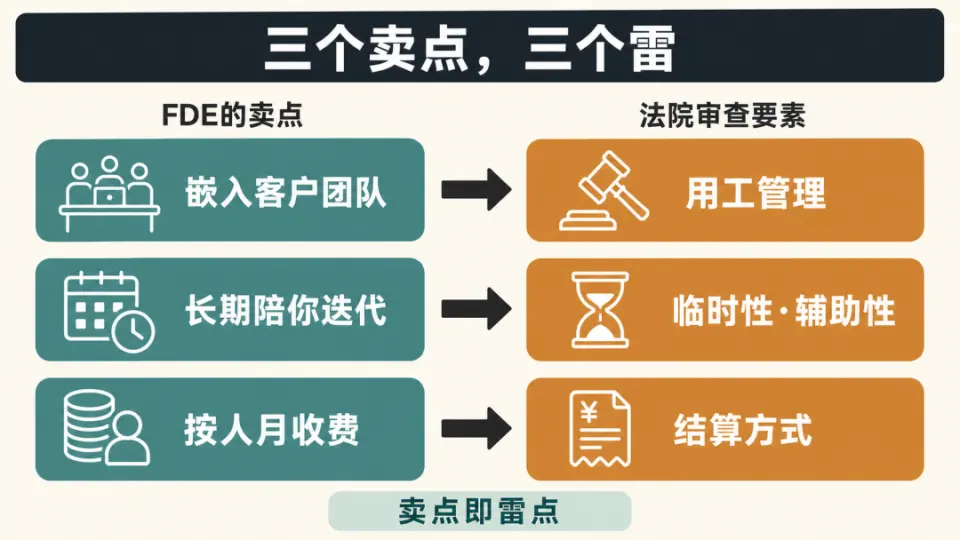
Three selling points correspond to three factors of court review
Disguised outsourcing amounting to labor dispatch brings a cascade of trouble
Once an FDE contract is found to be "disguised outsourcing amounting to labor dispatch," the bills that follow come in a chain.
First, qualifications. Engaging in labor dispatch requires an administrative license; Article 57 of the Labor Contract Law specifies registered capital of no less than RMB 2 million and that the business must be operated with a license. The vast majority of domestic large-model vendors and system integrators do not hold a dispatch license. Operating dispatch without a license is itself unlawful, and Article 92 provides for confiscation of illegal gains plus a fine.
Next, the ratio. Article 4 of the Interim Provisions on Labor Dispatch sets a hard 10% red line: the number of dispatched workers used by a employing unit may not exceed 10% of total employment. For an enterprise with several hundred employees, hiring dozens of "on-site engineers" to remain long-term in core departments easily breaches this line.
Next is joint and several liability. This is where Party A—the enterprise that procures FDE—is most prone to misjudgment. Many clients sign contracts with the mindset of 'if something goes wrong, we go after Party B,' but once the arrangement is characterized as dispatch, the user enterprise and the employer must bear liability jointly: unpaid wages, work-related injuries, and social insurance—none of these can be escaped. In the two cases involving the machinery company and the network technology company mentioned earlier, it was Party A that was held jointly and severally liable in both.
The most extreme tier is a de facto labor relationship. If the client exercises complete, dominant day-to-day management over the engineer, a court can look past the contract and directly find that the engineer is the client's employee. The Supreme People's Court's Guiding Cases No. 237 and No. 238 establish exactly this rule: it does not matter what agreement you signed; what matters is whether there is 'dominant labor management' in the actual employment. If it truly reaches this point, the client must make up social insurance for the engineer, calculate continuous years of service, and pay economic compensation.
Risk is not evenly distributed. Large companies like Microsoft, Tencent, and ByteDance dispatch high-salaried engineers earning 30,000 to 50,000 yuan per month; these people rarely turn around and sue the client, so the probability of a blow-up is relatively low. The truly dangerous categories are two: one is small and medium-sized integrators that dispatch on-site engineers at monthly salaries of 8,000 to 16,000 yuan to manufacturing clients—if these engineers encounter problems with work-related injuries, unpaid wages, or social insurance, they will go to arbitration; the other is Party A that has procured such services and habitually treats on-site engineers as its own people. The former faces penalties for unlicensed operation; the latter bears joint and several debt.
Four things to make outsourcing 'genuine'
#Can this FDE business be done in compliance? Yes. The difference lies in whether you make it 'genuine outsourcing' or let it slide into 'disguised outsourcing.' Four actions, all in the same direction: transform 'selling people' into 'selling results.'
Take management authority back to Party B. The engineer is at the client's site, but there is only one point of contact: Party B's own project manager. The client raises requirements and accepts deliverables, but does not directly assign work to the engineer, track attendance, or set up group chats to give orders. Sales pitches can continue to say 'embedded,' but the on-site management relationship must be Party B managing Party B's people.
Change the settlement basis to results. Even if internal accounting is by person-month, the external contract must be written as settlement by workload, by delivery milestones, and by acceptance standards. This clause is almost the most effective talisman in judgments; in that research, not a single case settled by results failed.
Do not position the role as core business or indefinite. In the contract and delivery description, write the scope as a project with clear start and end points and an acceptance endpoint, rather than 'long-term on-site support.' Continuous iteration is possible, using rolling project contracts phase by phase, rather than a single indefinite on-site agreement.
Keep a qualification in reserve. Either the contractor itself obtains a labor dispatch license as a backstop, or fully structure the delivery as project contracting—choose one of the two paths, and do not hang in the middle.
Bring it down to the people.
Vendors with a standardized delivery methodology and the ability to break an AI implementation project into a series of acceptable deliverables are in the most comfortable tier of this business. Transform 'selling people' into 'selling outcomes,' and you solve two things at once: legal risk goes down and commercial barriers go up, because being able to deliver by outcomes is itself a capability.
Vendors that are currently quoting externally by headcount and whose engineers have long been immersed at client sites should not rush to expand scale. Straightening out the settlement basis and on-site management relationship is more important than signing two more deals. Every additional on-site contract with vague wording you sign now is another mine buried.
Small firms that seek to copy Microsoft's rhetoric of 'putting engineers inside the client' while lacking any staffing-dispatch qualification and acquiescing in the client directly managing personnel should not force their way into this business for the time being. What you sell is not only a service but also a latent exposure to joint and several liability; a moderately sophisticated in-house legal team on the client side will show you the door after a single glance at your contract.
A final word on the law. The most likely places for mines to be buried in an FDE contract are never the technical clauses but two inconspicuous spots: the on-site management clause and the settlement method clause. The former determines whose instructions the engineers follow; the latter determines whether you are selling people or results. The wording of these two spots directly determines whether the entire contract is outsourcing or staffing dispatch, and directly determines on whose account the bill lands when something goes wrong. I have recently reviewed several such on-site delivery contracts: although all are 'on-site', some are written cleanly as outsourcing, while others are riddled throughout with evidence handed to the other side of staffing dispatch. Those in this business should, before signing, scrutinize at least these two clauses. Anyone unsure may talk with me.

