
A cross-border payment platform is preparing to enter the European market.
It wants overseas customers to pay with stablecoins; the platform would receive the assets, complete the conversion, and ultimately settle euros into the bank accounts of European merchants. On the product interface, this entire process may amount to a single "Pay with Stablecoin" button.
However, once the project actually begins designing the transaction chain, several questions quickly arise: who may receive the customer's USDC? Who has the authority to custody or transfer stablecoins? What authorization is required to convert stablecoins into euros? If a merchant wants a collection account, who is to provide it? And who is responsible for the final fiat settlement—a CASP, a PI, or an EMI?
Thus, what appears to be a simple stablecoin payment product may simultaneously involve MiCA and EU payment services regulation.
There is no unified "CASP + PI + EMI three-license package" for stablecoin payments in Europe. What a project actually needs is to determine, on a business-function basis, who is to undertake the digital asset services, the payment services, and the e-money business respectively.
For early-stage teams, it is not necessarily required to hold all licenses themselves; however, if the division of roles among the various entities is not clearly designed, the entire payment chain may still contain regulatory gaps even if all counterparties are already licensed.
01 CASP, PI and EMI are not the same type of license
When many projects choose a European license, they place CASP, PI and EMI side by side in a comparison table, attempting to determine which one "has the most functions" and which one "offers the best value for money."
But these three types of regulatory status were never designed to address the same question.
CASP: the regulatory status for crypto-asset services.
Under MiCA, a CASP is a Crypto-Asset Service Provider, whose business mainly centers on services such as the custody and administration of client crypto assets, the exchange of crypto assets, the execution of orders, and the transfer of crypto assets.
For a stablecoin payment platform, if the enterprise actually controls customer wallets and carries out stablecoin conversion or transfer on behalf of customers, it is necessary to further assess whether these activities fall within the scope of CASP regulation and which specific service permissions are required.
PI: Resolving the regulatory status of payment services.
PI means Payment Institution. Payment services under PSD2 include distinct activities such as execution of payment transactions, money remittance, issuance of payment instruments, and merchant acquiring.
For example, if a project needs to execute euro payments for enterprises, settle fiat currency to merchants, or provide other payment services falling within the PSD2 definition, it may need the participation of a PI or another payment service provider with the corresponding qualifications.
However, a PI is not a license for crypto asset custody or exchange, nor does it automatically confer the qualification to issue electronic money.
EMI: Resolving electronic money issuance and related payment services.
EMI means Electronic Money Institution. Unlike a PI, an EMI may issue electronic money within the permitted scope and provide related payment services in accordance with law.
However, two concepts still need to be distinguished here: first, electronic money in the traditional account system; second, electronic money tokens under the MiCA framework, namely EMTs (E-Money Tokens).
Under Article 48 of MiCA, issuers that issue EMTs to the public in the EU or seek admission to trading of EMTs are in principle required to have the status of a credit institution or an electronic money institution and to satisfy the other conditions set out in MiCA.However, the fact that a project uses stablecoins already issued by a third party for payments does not mean that the project itself is also issuing EMTs, still less that it must separately obtain an EMI license in order to use stablecoins.
Therefore, the three concepts can first be understood in one sentence:
CASP concerns crypto asset services, PI concerns payment services, and EMI concerns electronic money issuance and related payment capabilities.
The real question is not which one to choose, but determining which services a given payment actually triggers.
02 Breaking down a stablecoin payment makes the licensing boundaries clear
Suppose a European merchant wishes to accept stablecoin payments from an overseas enterprise but ultimately receives euros.
A project can first break the transaction down into five stages.
Step one: the customer initiates payment. The customer uses its own wallet to transfer a stablecoin that meets the applicable EU regulatory requirements to a collection address designated by the platform. If the platform merely displays payment instructions, its regulatory character differs from a scenario in which the platform actually receives and controls customer assets.
Step two: the stablecoin enters the relevant wallet. If the platform or a cooperating institution controls private keys on behalf of the customer, manages assets, or bears an obligation to return them, it is necessary to determine whether MiCA custody and administration services are involved.
Step three: the platform completes the asset transfer or exchange. If a licensed institution transfers stablecoins on behalf of the customer, or exchanges stablecoins into euros, the corresponding activity must be further matched against the specific scope of the CASP authorization. Under different business models, it is also necessary to distinguish whether the institution acts as counterparty using its own capital to effect the exchange, or executes orders on behalf of the customer.
Step four: fiat currency enters the payment system. When euros enter a payment account, or the platform begins to execute fiat currency transfers, remittances and settlement for the merchant, it is necessary to further determine whether the relevant institution holds the corresponding PSD2 payment services qualification.
Step five: the merchant ultimately receives the funds. At this point, the merchant may have had no contact with the blockchain at all and sees only an ordinary euro credit.
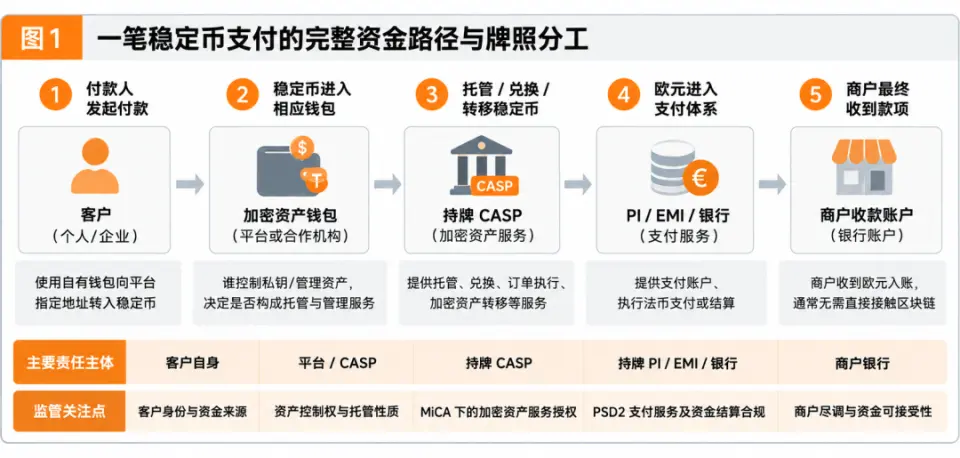
What truly requires attention is that these five stages are not necessarily completed by five companies, nor must they necessarily be undertaken independently by a single group.
A project may have a CASP handle crypto assets and then cooperate with a PI or EMI to complete payment; alternatively, the same institution may obtain the multiple regulatory qualifications required and undertake several stages.
Before determining the number of licenses, it is first necessary to determine the number of business activities and the service boundaries.
03 After 2026, why are CASP and payment licenses more likely to overlap?
In the past, some projects took the view that as long as a transaction occurs on-chain, even where stablecoins are used to make payments to third parties, only MiCA needs to be considered.
However, EU regulators have made clear that this understanding is incomplete.
In June 2025, the European Banking Authority (EBA) published a No-Action Letter addressing the regulatory interface between MiCA and PSD2, expressly explaining the issue that certain e-money token services simultaneously have the characteristics of payment services.
According to the EBA's view, where a CASP transfers EMTs on behalf of a client, the relevant activity may simultaneously constitute a payment service under PSD2. Where a CASP provides a custodial wallet in the client's name and that wallet allows the client to send and receive EMTs to and from third parties, payment account and payment service regulation may also be engaged.
Conversely, engaging solely in the exchange between crypto assets and funds, or between different crypto assets, as defined in MiCA, will not automatically be treated as a PSD2 payment service merely because the transaction involves EMTs.
This distinction is very important.
Because for a stablecoin platform, "helping clients exchange stablecoins" and "using stablecoins on behalf of clients to make payments to others" may be two different regulatory issues.
On 2 March 2026, the transitional period previously set by the EBA came to an end. In February 2026, the EBA also published a follow-up opinion requiring national competent authorities to decide, based on whether an undertaking has already obtained payment service authorisation, whether it has submitted an application and other specific conditions, whether the relevant EMT payment services may continue to be provided. For institutions that meet specific conditions and whose applications are still under review, arrangements exist for continuing to operate in accordance with the regulatory opinion; institutions that do not meet the conditions should cease the relevant services and properly handle client relationships.
Therefore, it cannot simply be understood that "from 2 March, CASPs must in all cases simultaneously obtain a PI", nor that "as long as a PI application has been submitted, operations may continue indefinitely".
What truly needs to be assessed is which EMT service provided by the platform simultaneously has payment characteristics, and whether the corresponding payment authorisation or cooperation structure has been implemented.
There is also an exception that is easily overlooked: Article 60 of MiCA permits certain authorised financial institutions, after satisfying the prescribed requirements and completing notification, to provide specified crypto-asset services. For example, an EMI may, under the prescribed conditions, in respect of itsown issued EMTsProvide custody, management and transfer services. This does not mean that an EMI may, without further assessment, custody or exchange all third-party stablecoins on the market.
Therefore, CASPs and PIs/EMIs may need to be combined, but the combination must not simply be a matter of writing several licence names into the same document.
04 What structures can generally be considered for European stablecoin payments?
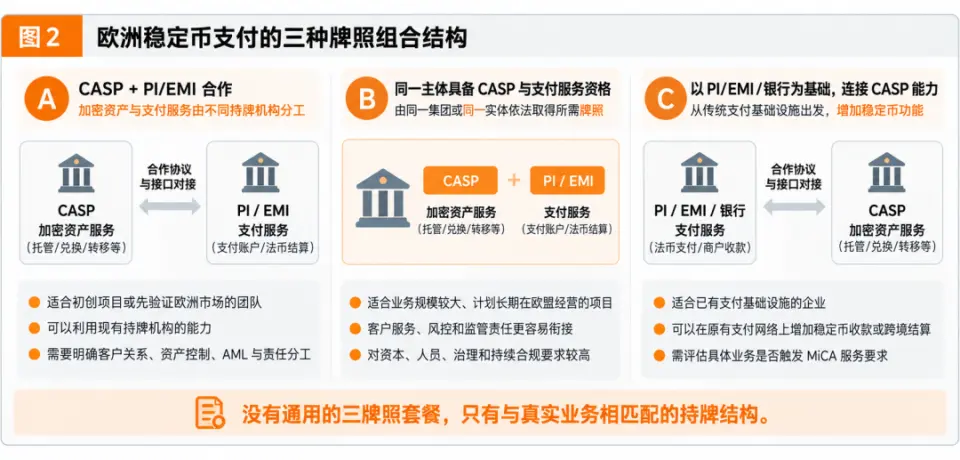
From the perspective of project implementation, I would recommend first considering three structures rather than going directly to obtaining application quotations for three licences.
The first: a CASP handles crypto assets, while a PI or EMI handles payments.
This is a relatively easy-to-understand division of functions. Custody, exchange and related transfers of crypto assets are undertaken by a CASP with the corresponding qualifications, while euro payment accounts, fiat remittances or merchant settlement are handled by a PI, EMI or bank with the corresponding service qualifications.
For start-up projects or teams wishing first to validate the European market, the advantage of this approach is that it can leverage the capabilities of existing licensed institutions and avoid building a complete regulatory system on their own from day one.
However, the project still needs to resolve issues such as with whom the client contracts, who controls the assets, which party executes payment instructions, and who bears AML and refund responsibilities. In particular, where EMT transfers are involved, the fact that the on-chain segment is handled by a CASP does not mean that potentially concurrently applicable payment services regulation can be ignored.
The second: the same entity holds both CASP and payment services qualifications.
If the project already has a relatively mature business scale and wishes to operate stablecoin payments in the EU over the long term, it may consider having the same entity lawfully obtain the required crypto-asset and payment services qualifications.
The potential advantage of this model is that customer service, risk management and regulatory responsibilities are more easily connected within the same entity, reducing some cross-institutional coordination costs.
However, it correspondingly increases the requirements for capital, personnel, governance, systems and ongoing compliance, and does not mean that "a company with two licences automatically covers all functions". Different businesses must still separately comply with the corresponding regulatory requirements.
Third option: build on a PI, EMI or bank and connect to specific CASP capabilities.
If the project is originally a traditional payment institution and wishes to add stablecoin collection or cross-border settlement, it can start from its existing payment infrastructure and entrust digital asset custody, exchange and other functions to qualifying CASPs.
This approach is more suitable for enterprises that already have European accounts and payment networks but lack crypto asset service capabilities.
If the project involves issuing its own EMT, or using the specific notification mechanism for financial institutions under Article 60 of MiCA, the relevant qualifications and scope of business still need to be assessed separately.
05 A step that comes before the licence combination: first confirm whether the stablecoin itself can be used
This is an issue that European stablecoin payment projects must address as a priority in 2026.
On 8 October 2026, ESMA published a supervisory opinion on crypto asset services relating to ARTs and EMTs that do not meet MiCA requirements, expressly requiring CASPs authorised under MiCA to cease providing services involving such non-compliant stablecoins to EU clients.
This regulatory requirement is not limited to exchange listings or buy and sell functions; it also covers custody, exchange, order execution, transfer of crypto assets and various other services. As for existing risk exposures, ESMA also requires regulators to urge firms to remediate in accordance with the arrangements set out in the opinion.
This means that if a crypto payment project intends to carry out stablecoin collection or settlement in the EU, the first question is no longer:
"Which CASP should we apply for?"
but rather:
"Do the stablecoins we intend to support meet the applicable requirements of MiCA?"
Issuers, authorization status, legal nature and the services offered may differ among stablecoins. Even if a project does not itself issue stablecoins, it must verify whether the relevant tokens can lawfully be included within the scope of services offered to EU clients.
Therefore, a stablecoin cannot be regarded as directly usable for all EU business merely because it has a large trading volume, good liquidity and widespread international use.
For an actual project, the choice of currency has already become a regulatory issue that precedes licence design.
06 All three licences have been found, so why might the business still fail to operate?
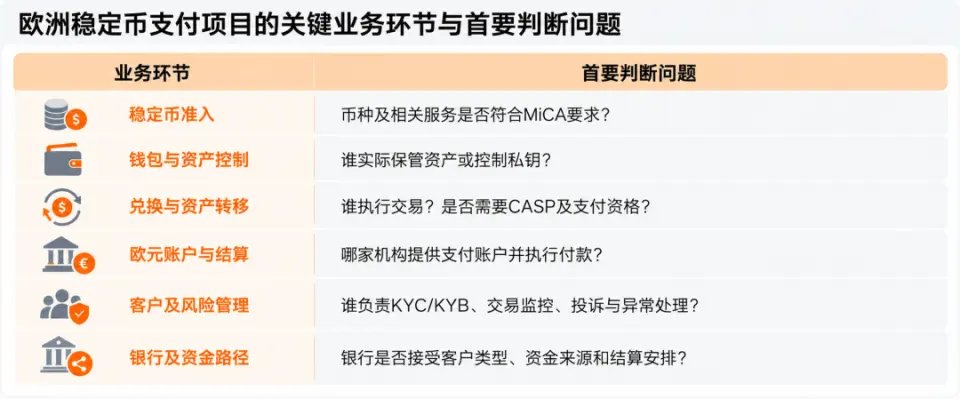
A project may simultaneously find CASP, PI and EMI partners, but this does not mean that the entire funds chain can necessarily be completed.
For example, a CASP may be able to receive and exchange stablecoins, but the bank opening the final fiat settlement account does not accept certain sources of funds; a PI may be able to execute euro payments, but has not approved the merchant category and client regions relating to the project; an EMI may be able to provide electronic money and payment services, but the cooperation agreement does not cover a certain cross-border settlement structure actually arranged by the project.
These issues are difficult to identify from the names of the licences alone.
A more realistic approach to review is to place the client, the assets and the funds on a single process chart and answer several questions at the same time.
At the same time, on-chain transfers may also need to satisfy the EU Regulation on Information Accompanying Transfers of Funds and Certain Crypto-Assets and the relevant EBA Travel Rule requirements. For transactions involving multiple CASPs, payment institutions or self-hosted addresses, information on both parties to the transaction, sanctions screening, handling of exceptions and allocation of responsibilities all need to be arranged in advance.
Therefore, the real implementation difficulties of stablecoin payments usually arise at the interfaces between licences.
Compliance of a single link on its own does not automatically prove that the entire payment chain is compliant.
07 Which projects should hold their own licences, and which are better suited to cooperating first?
For startup teams still validating the European market, if the product involves only limited stablecoin collection or settlement functions and the relevant services can genuinely be performed by an existing licensed institution, then prioritizing an assessment of the cooperation model is usually more practical.
The precondition, however, is that the project itself does not independently provide, outside the cooperation structure, services that require authorization, and that the licensed institution is not made to bear merely nominal "licence coverage."
If an enterprise already has a stable base of European corporate clients, plans to control client relationships, wallets, exchange, payments and merchant settlement over the long term, and wishes to expand product functions, then it is necessary to further assess the need to hold its own CASP or payment service qualification, or to establish a long-term regulatory structure through different entities within the group.
For enterprises with an existing traditional PI/EMI business foundation, they should first clarify whether the newly added stablecoin functions genuinely trigger MiCA service requirements, and then decide whether to adopt third-party CASP cooperation, lawfully expand their regulatory qualifications, or adjust the product and fund flows.
The order of assessment should always be:
business functions → regulatory characterization → allocation of functions among entities → licensing pathway → banking and fund implementation.
Rather than first registering three companies and then separately looking for licences that can be applied for.
08 How We Typically Support Such Projects
For teams preparing to launch European stablecoin payments, the first step is usually not to decide directly whether to apply for a CASP, PI or EMI licence, but first to fully reconstruct the business process.
The project needs to clarify the jurisdictions of payers and payees, the type of stablecoin, the wallet control method, the client contractual relationship, the exchange mechanism, the fiat currency account and the final settlement arrangements, and to determine which functions constitute MiCA crypto-asset services, which may fall within the scope of PSD2 payment services, and whether EMT issuance or other financial regulation is also involved.
At this stage, it is possible to produce the "Compliance Diagnostic Opinion on the European Stablecoin Payment Business Model," the "Analysis of the Applicability of CASP and PSD2 Services," and the "Product Function and Regulatory Identity Matrix," clarifying what capabilities the project requires and whether any cooperating institution is already able to provide them lawfully.
Subsequently, around the choice of EU home Member State, the allocation of functions among licensed entities and the design of fund flows, it is possible to produce the "CASP and PI/EMI Synergistic Architecture Plan," the "On-Chain and Off-Chain Fund Flow Chart," the "Analysis of Client Asset Control and Segregation," and the "Group Function and Regulatory Responsibility Matrix," ensuring that client relationships, asset flows and compliance responsibilities among different entities can be matched up.
For projects that have already entered the implementation stage, it is also necessary to prepare, in light of the actual access standards of banks and payment partners, explanations of the source of funds, analyses of customer regions and transaction types, AML/KYC/KYT and Travel Rule policies, verification of the licensing coverage of partners, and institutional due diligence materials, and to further implement contractual, regulatory reporting and ongoing compliance arrangements.
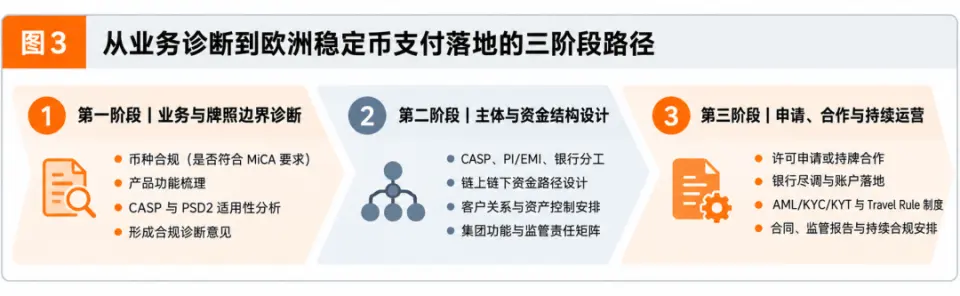
What Mankun hopes to address is not merely which licenses a project should obtain, but how crypto asset services, fiat currency payments and bank cooperation can operate under one clear business structure.
Conclusion: The key to European stablecoin payments is not obtaining all three licenses
Returning to the initial question: for European stablecoin payments, how exactly should CASP, PI and EMI be structured together?
The answer is not that every project needs to obtain all three licenses separately.
If a platform primarily undertakes the custody, exchange or transfer of crypto assets, it needs to assess the relevant service authorizations under MiCA; if it further provides customers with payment accounts, executes fiat currency payments or provides EMT-related payment services, it also needs to determine the regulatory requirements under PSD2; if a project issues EMTs itself, it must separately consider the eligibility of the issuing entity and the relevant obligations under MiCA.
These functions may lawfully be undertaken by the same entity, or may be performed collaboratively by different licensed institutions after a clear division of responsibilities.
However, whichever path is chosen, it will ultimately be necessary to ensure consistency among customer contracts, asset control, the flow of funds, the scope of licensing and regulatory responsibility.
What stablecoin payments truly require is not placing the three licenses of CASP, PI and EMI side by side, but ensuring that every step of a transfer of funds from on-chain to a bank account is the responsibility of the correct entity.
Only then is there a compliant payment architecture that can genuinely support operations in the European market.
Next article | Global Crypto Payment Compliance Map · Advanced Series ⑫
Why can't crypto payment projects open a bank account even after obtaining a license?
In the next article, we will continue to discuss a more practical hurdle in the implementation of stablecoin payments: why a project may still be refused account opening by a bank even after it has obtained a CASP, MSB or other regulatory status, and which business and fund risks the bank actually reviews.

