
Over the past year or so, robots have truly stepped off the exhibition floor. They enter factories to tighten screws and move goods on production lines, enter hospitals to provide rehabilitation and assist in surgery, enter shopping malls to dance and greet customers, and have also begun to enter homes to accompany the elderly and children. In Shanghai, nearly one hundred robots have entered factories in an organized manner, and mass-production orders at several companies are booked out to the ten-thousand-unit level. The question of whether they can be built is basically settled.
The real bottleneck has shifted to a different question: being built does not mean being fit to take up a post.
On April 17 of this year, PICC Property and Casualty paid out RMB 5,976.87. The insured incident involved a rented robot that accidentally tipped over during use, damaging its camera and components. The amount is not large, but this is the first insurance claim paid out nationwide for an embodied intelligent robot. For the first time, it moved from policy design to an actual claims scenario. And this payout covered only the simplest scenario, namely the robot damaging itself by falling over. The harder questions lie ahead: if a robot hits a person, records footage it should not have recorded, or provides an incorrect rehabilitation plan, who bears liability?
Rules and standards have also been rolled out intensively over the past year or so. In February this year, the Ministry of Industry and Information Technology issued the Standard System for Humanoid Robots and Embodied Intelligence (2026 Edition), which links underlying technologies, core components, complete machines, scenario applications, and safety and ethics into a single system. Just a few days ago, on July 15, the Interim Measures for the Administration of Anthropomorphic Interactive Services Based on Artificial Intelligence, issued by the Cyberspace Administration of China and four other departments, officially came into effect, directly regulating the type of robots that chat with you and form emotional bonds.
To put it plainly: robots entering different doors must clear different hurdles. Entering a factory, what matters is safety and who pays when something goes wrong; entering a hospital, what matters is approval, which is the highest wall of all; entering a home, what matters is privacy and relationship safety. The following explains this door by door.
The first door: entering the factory: safety standards matter, and so does who pays if someone is hit
Industrial robots do not talk about feelings with you; they are there to work. The first hurdle they must clear is the safety of the product itself.
This hurdle is a whole set of certificates of conformity: electronic products listed in the catalogue must obtain 3C certification and bear the CCC mark; products with wireless functions such as Wi-Fi, Bluetooth, and 5G must obtain type approval for radio transmission equipment (known in the industry as SRRC); and depending on the product type, an industrial product production license may also be required. Without this set of items, a robot cannot even get onto the procurement list of a legitimate factory. These are the visible thresholds; with enough money and time, they can be cleared.
What is truly difficult is the second hurdle: when a robot injures someone, who bears the cost. Legally, this is clearly divided into three entirely different situations.
The first is a slip of the hand by the operator, for example, directing the robot to do work it should not do; this is handled as ordinary tort and the operator bears liability.
The second is a defect in the robot itself, where a fault arises in design, manufacturing, or algorithms; this constitutes product liability, borne by the producer. Note that this is a strict liability under which compensation is owed regardless of whether you were at fault:
Article 1,202 of the Civil Code: Where a product defect causes harm to another person, the producer shall bear tort liability.
The third scenario involves injury to customers in public places such as shopping malls, restaurants, and nursing homes, where the safety-protection obligations of the operator of the public place come to the fore first. If you put a robot in a store to greet customers, you must bear ultimate responsibility for the harm it may cause.
The difficulty is that a robot is a "software-hardware integrated" thing. When something actually goes wrong, it is often hard to distinguish whether it was a mechanical failure of the hardware or a judgment error in the software algorithm. More subtly, in current judicial practice, hardware is treated as a "product" and product liability applies, while software is often characterized as a "service" and not a product (the Hangzhou Internet Court's case at the end of last year involving harm caused by an AI "hallucination" expressly characterized generative AI as a service rather than a product). This gap between software and hardware makes "who pays" more convoluted. The significance of the first insurance claim lies precisely here: before liability is fully sorted out, the industry first uses insurance—namely, insurance for loss of the robot itself plus third-party liability insurance—to cover "who pays if it breaks and who pays if it hits someone."
To get through the factory gate, robot makers should first complete safety certification before the product leaves the factory; more importantly, they should think ahead about "who pays if it hits someone." A product defect is strict liability that the producer cannot shake off, so liability should be clearly allocated in contracts and insurance as early as possible.
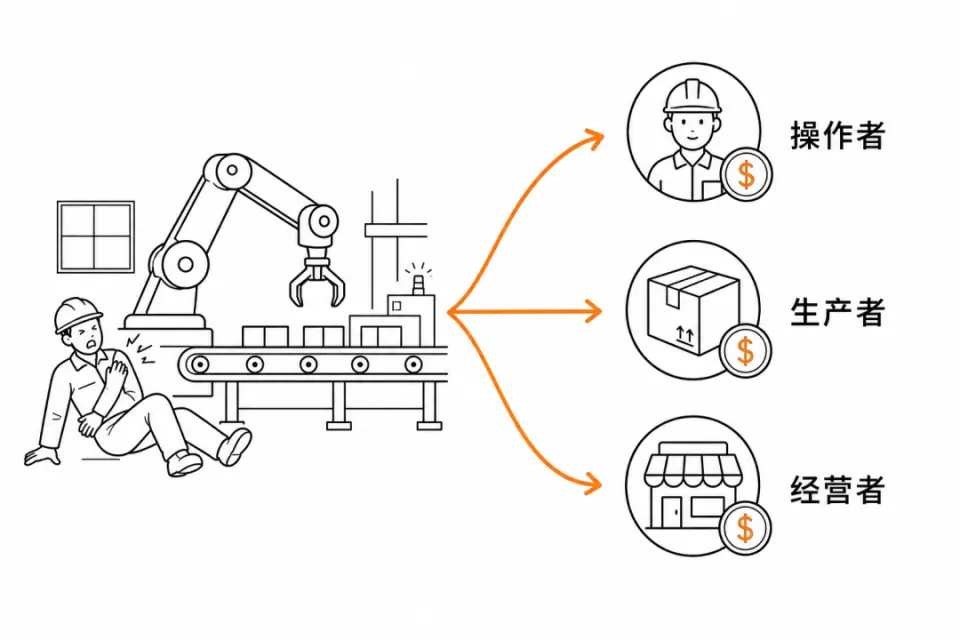
Who pays when a robot injures someone: the three liability lines of operator, producer, and business operator
The second gate · Entering the hospital: approval is the highest wall
Robots that enter hospitals, whether surgical robots or rehabilitation robots, are not "electronic products" in the eyes of the law; they are "medical devices." Moreover, the law is unequivocal: medical devices include even the "computer software required" for them. That is, it is not only the robotic arm; the software running inside it may itself also need to be regulated as a medical device.
Medical devices are divided into three classes according to risk level: Class I is low risk, Class II is moderate, and Class III is relatively high. Rehabilitation, diagnostic, and surgical robots connected with AI basically fall into Class II or Class III. The class they fall into directly determines how high this wall is:
Article 13 of the Regulations on the Supervision and Administration of Medical Devices: Class I medical devices are subject to product filing administration, while Class II and Class III medical devices are subject to product registration administration.
The registrant or filer of a medical device shall strengthen quality management throughout the medical device lifecycle and bear liability in accordance with the law for the safety and effectiveness of the medical device throughout the entire process of development, production, operation, and use.
The two terms "filing" and "registration" are worlds apart. Filing is registration for the record; registration requires real, rigorous review. Obtaining a Class II registration certificate often takes three to four years and millions in investment, going through a full set of tests including clinical evaluation, electromagnetic compatibility, and biocompatibility. For Class III, the risk is higher, and clinical trials may only be conducted after approval by the National Medical Products Administration, passing ethical review, and obtaining written informed consent from each subject. Fourier's M2 upper-limb rehabilitation robot achieved a "grand slam" of medical device registrations in China, the United States, Europe, and Australia. This kind of qualification is a wall that others cannot climb over even with three or four years.
This wall often blocks not technology but time. For technology companies like Xiaomi and DJI that want to cross over into robotics, if they truly want their products to enter hospitals, the hard part is not making the robot nimble, but how to endure the three or four years to obtain the certificate. Therefore, in the medical robot industry, one must follow medical robot safety standards (such as YY 9706.278—2023) from the first day of design, rather than turning back to supplement certification after the product is finished. This certificate cannot be made up later.
As for actual medical accidents in hospitals, the compensation path is also different from ordinary products: it follows the medical damage framework, and if the hospital is at fault, the hospital bears liability; if the device itself is defective, the patient may seek compensation from either the hospital or the producer, and the hospital may seek recovery after paying first.
Once a company enters the hospital market, what matters for founders is being early: the earlier it designs to medical-device standards and the earlier it joins the queue for certification, the fewer detours it will take.
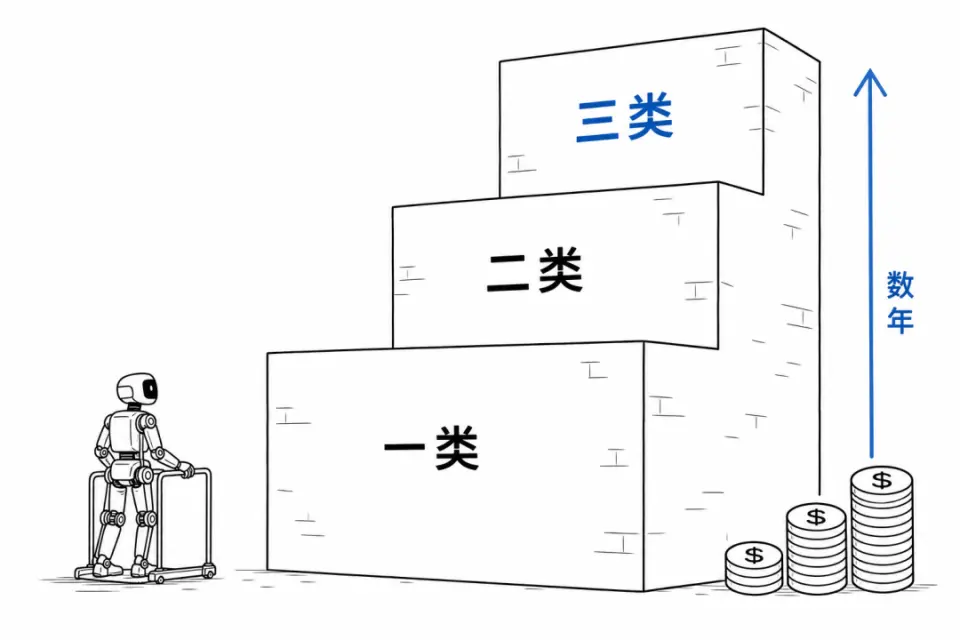
The medical-device approval wall: Class I filing, Class II and Class III registration — the higher the class, the harder and more expensive it becomes
The third door — entering the home: privacy and "relationship safety" are what matter, and the new rules have just taken effect
For companion robots, elderly-care robots and children's companion toys that enter the home, the trouble is not that they are physically strong; it is that they are "always present and always listening," and that people develop feelings for them.
On July 15, the Interim Measures for the Administration of AI Anthropomorphic Interactive Services issued by the Cyberspace Administration of China and four other departments formally took real effect. What they regulate is not "the AI saying one wrong sentence" but "how AI works its way into your emotional life." The regulatory logic has been upgraded from the past focus on "content safety" to "relationship safety."
Is the robot in your home covered by these Measures? The key is whether it provides "continuous emotional interaction":
Article 2 of the Interim Measures for the Administration of AI Anthropomorphic Interactive Services: These Measures apply to the provision, by means of artificial intelligence technology, of continuous emotional interaction services to the public within the territory of the People's Republic of China that simulate the personality traits, thought patterns and communication styles of natural persons (hereinafter referred to as anthropomorphic interactive services).
The emotional interaction services referred to in the preceding paragraph include interactive services such as emotional care, companionship and support provided in the form of text, images, audio, video and other forms.
These Measures do not apply to the provision of services such as intelligent customer service, knowledge Q&A, work assistants, learning and education, and scientific research where continuous emotional interaction is not involved.
Robots that merely check the weather, merely answer questions or merely do work are not covered. But as long as a robot chats with you over the long term, comforts you, and becomes a "friend" or "family member" to you, the company operating it will most likely be deemed a service provider and must comply with these Measures. Household robots that "form feelings" — such as elderly-care companions and children's companions — fall squarely within the line.
Once within the line, there are three hard red lines.
First, your data cannot be casually used for training. The personal matters you tell the robot and what your living room looks like are all "interaction data"; they must be encrypted and cannot be casually given to third parties; you have the right to copy your chat records and the right to delete them. In particular, for content that constitutes sensitive personal information — such as your psychological state, emotional experiences and health status — if a company wants to use it to train models, it must specifically display a pop-up and ask you separately, and only if you click to consent does it count; a "consent" buried in a user agreement tens of thousands of words long does not count:
Article 16 of the Interim Measures for the Administration of Anthropomorphic Interactive Services with Artificial Intelligence: Providers of anthropomorphic interactive services shall implement data property rights and other systems in accordance with the law, and adopt measures such as data encryption and access control to protect the security of user interaction data.
Unless otherwise provided by law or the rights holder has given explicit consent, providers of anthropomorphic interactive services shall not provide user interaction data to third parties.
Providers of anthropomorphic interactive services shall provide users with options to copy, delete and otherwise handle interaction data, and users may choose to copy, delete and otherwise handle historical interaction data such as chat records.
Unless otherwise provided by laws or administrative regulations or the user has given separate consent, providers of anthropomorphic interactive services shall not use interaction data that constitutes users' sensitive personal information for model training.
Second, the elderly and children must not be led astray. The Measures expressly provide that virtual intimate relationship services such as "virtual companions" and "virtual relatives" shall not be provided to minors; providing other anthropomorphic interactions to children under the age of fourteen requires the guardian's approval first; and products must have a minor mode that allows parents to receive risk alerts, block specific roles and restrict top-ups. For the elderly, risks must be indicated in a conspicuous manner and their requests for help must be responded to promptly.
Third, addiction must not be induced, still less may money be extracted through "empathy." The Measures prohibit companies from treating "replacing real social interaction and inducing addictive dependence" as a product goal; where a user's emotions are found to be extreme, for example showing thoughts of self-harm, or where the user is about to make a large transfer, timely intervention is required and the user's guardian or emergency contact must be contacted; and where use continues for a full two hours, the user must be reminded to pay attention to the duration of use. Put plainly, the robot must not, on the one hand, charm you into being unable to do without it while, on the other hand, luring you into paying out money time and again.
There is another, more recent concern, called "presence." A robot standing in your living room or your parents' bedroom, continuously sensing and continuously recording, collects data through this "always present" manner, which is entirely different from a mobile app occasionally popping up a window to request a permission. It may, without your full knowledge, record the most private spaces of your home bit by bit, and the current Personal Information Protection Law has no dedicated detailed rules that can yet address this new type of collection model.
One more point: if this home robot not only chats as a companion but also performs health monitoring and gives medication advice, then Article 31 of the Measures is clear that it must simultaneously comply with the rules on health and hygiene, and it has stepped back through the door of medical devices.
As for the cost of violations, it must be viewed at two levels. The penalties under the Measures themselves are not heavy: a warning, circulated criticism, an order to correct, suspension or termination of services, and a fine of 10,000 to 100,000 yuan; only where a violation truly endangers human life or health and has caused harmful consequences is the fine 100,000 to 200,000 yuan. But if the same conduct simultaneously violates the Personal Information Protection Law (for example, misuse of sensitive data), the fine there can reach five percent of the previous year's turnover, or 50 million yuan. That is the real bulk of it.
To enter the door of the family, product makers must build data compliance, anti-addiction and crisis intervention directly into the design, rather than waiting for regulators to come knocking and patching things up afterwards.
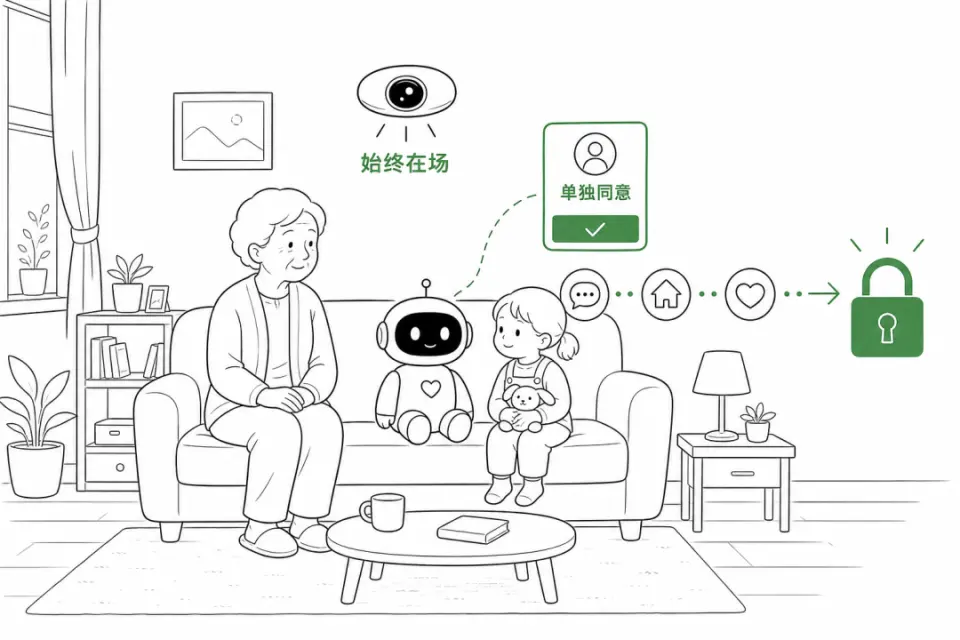
Data red lines for home companion robots: interaction data must be encrypted, separate consent is required for using sensitive information for training, and always-present collection warrants vigilance
So what should robot makers do?
Define the scenario first, then work backward to determine which certificates are required. This is the most cost-effective and time-efficient sequence; conversely, if you keep your head down and build first and only supplement certificates afterward, you will often end up stuck on a single piece of certification.
For entry into factories, have safety certifications fully in place before leaving the factory—not one of the 3C, SRRC, and similar certifications can be omitted. For entry into hospitals, follow medical device standards from the very first day of design, and allow yourself enough time—three to four years—to obtain certification; this time cost cannot be avoided. For entry into homes, the easiest areas to stumble in are data compliance and the several “relationship safety” issues; move them upstream into the design phase as early as possible, and do not wait until regulators come knocking before going back to patch things up.
If the product is also intended to go overseas, add another layer: the EU’s GDPR and China’s cross-border data transfer assessment are real additional costs and must be factored into the budget in advance.
There is one more thing that is easily overlooked: before liability is fully clarified, obtain the insurance that should be in place as early as possible—property damage insurance plus third-party liability insurance. Do not wait until someone is actually injured to discover that you are the only one providing the ultimate backstop.
Closing Remarks
In this wave of robotics, technology ran far ahead early on, and the law has been filling the gaps intensively over the past year or so. Being able to build is a test of engineering; whether you can enter the market and enter it steadily is a test of whether you have truly mastered the rules of these three gates. Being able to build is a skill; being able to enter and stand firm is what shows true capability. Whoever treats compliance as part of design first will avoid three to four years of detours.
At this point, if you happen to be working on embodied robots and are unsure which gates your particular model must pass through, we have organized the above into an “Embodied Robot Compliance Checkup”: based on the scenario you intend to enter—factory, hospital, home, or overseas—we first conduct a red-line review of the product, clearly list which certificates must be obtained, which sets of standards to design against, and how data and liability clauses should be drafted, so that compliance is moved upstream into the design phase and you do not end up stuck on a single piece of certification only after the product is finished. If you need this, contact me at the end of this article to discuss.
Reference Sources
- Interim Measures for the Administration of Anthropomorphic Interactive Services Based on Artificial Intelligence (Order No. 21 of the Cyberspace Administration of China, the National Development and Reform Commission, the Ministry of Industry and Information Technology, the Ministry of Public Security, and the State Administration for Market Regulation, effective July 15, 2026)
- Regulations on the Supervision and Administration of Medical Devices (Order No. 739 of the State Council, effective June 1, 2021)
- Tort Liability Part of the Civil Code of the People’s Republic of China (provisions relating to product liability and medical damage liability)
- Ministry of Industry and Information Technology, Standard System for Humanoid Robots and Embodied Intelligence (2026 Edition)
- People's Daily Online, Sina Finance, and 21st Century Business Herald: China's first insurance claim for an embodied intelligent robot (RMB 5,976.87 paid out)
- TechWalker and aibangbots: Fourier Intelligence's rehabilitation robot registrations in China, the United States, Europe and Australia, and its NMPA Class II registration pathway
Author of this article:Lyu Yinghui, a lawyer at Mankun (Shenzhen) Law Firm. A graduate of China University of Political Science and Law, with nearly ten years of deep involvement in the legal industry and prior experience working at a court in Shenzhen. Focused on legal services in the new-generation economy, with extensive practical experience and deep insights in fields such as Web3 and artificial intelligence. Account across all platforms: Lao Lyu Talks New Money; you are welcome to follow.

