
At the end of January 2026, Suzhou Jiuwu Intelligent Technology submitted a prospectus to the Hong Kong Stock Exchange, with CICC and Citi as joint sponsors. In a sector where eight out of ten companies are losing money, it is one of the very few companies already profitable, with net profit of RMB 32.63 million in 2024.
By way of comparison, AgiBot, which is likewise targeting industrial scenarios, saw revenue exceed RMB 1.05 billion in 2025 and shipments rank first globally, yet it remains loss-making. Humanoid robots that can box and do somersaults have grabbed all the attention, with valuations running into tens of billions of yuan, but the company that has actually turned a profit is this unassuming "porter" company.
This contains an easily overlooked judgment: in this wave of enthusiasm for embodied intelligence, the first to make money are not those who build robot bodies, but those who put robots to work on factory production lines.
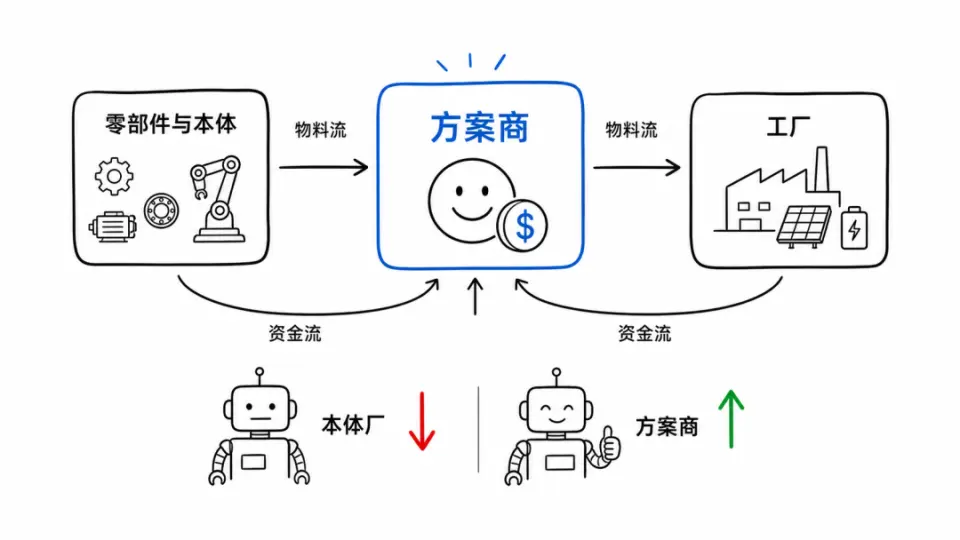
It does not sell robots; it sells a complete solution that "lets robots move materials for you"
First, let us be clear about what Jiuwu actually does. More than 90% of its revenue does not come from selling robot bodies, but from "full-lifecycle robot solutions": for a specific process on a factory production line, it conducts preliminary assessment, system design, delivery and deployment, and then later-stage operations and maintenance, charging by project rather than selling hardware by unit. In 2024, solutions accounted for 96% of revenue.
In one sentence, it takes the material handling and flow between different processes in a factory and hands it over to robots.
Take photovoltaics as an example. From polysilicon, crystal pulling and wafering to cell manufacturing and module encapsulation, almost every process is subject to constraints of high temperature, heavy loads, fragility and stringent cleanliness. Ingots, wafers and cells are large, heavy and extremely sensitive to contamination, and must flow between multiple processes at high frequency and with stability. Manual handling in such workshops is both a safety hazard and a bottleneck for yield and efficiency.
What Jiuwu does is break down, one by one, the form of the semi-finished product at each process, the equipment interfaces and the process status, and then customize and deploy the corresponding robots: automatic crystal-taking robots and heavy-load ingot transfer robots at the crystal-pulling stage, basket robots to manage carrier flow between processes, and BIN box robots at the final process to interface with the packaging line. These robots must also connect directly to the factory's existing manufacturing execution system (MES), becoming the "connection nodes" between processes.
Having first proven this capability centered on "material flow" in photovoltaics, Jiuwu then replicated it in lithium batteries, semiconductors and optical modules. During the track record period, it cumulatively delivered more than 11,000 robots to 156 customers, of which 48 are listed companies or their subsidiaries, with a major-customer retention rate of 72.7%, above the industry average.
In one sentence, what it sells is not robots, but engineering capability that "understands your process and can embed robots into it." This also explains the awkward position of the body manufacturers. Unitree is the most profitable company in the entire industry, with net profit excluding non-recurring items of RMB 600 million in 2025, but its money comes mainly from quadruped robot dogs for the consumer and education markets; revenue from humanoid robots actually used in industrial scenarios is only RMB 15.7 million, less than 1.4%. Being able to build the best body does not mean being able to get onto a factory production line.
The numbers show: gross margin is climbing, but this is a business that "pays out first"
Looking at revenue, Jiuwu has been moving fast in recent years. From 2023 to 2024, revenue grew from RMB 207 million to RMB 366 million, up 76.9% year on year; in the first nine months of 2025 it reached RMB 410 million, still up 70.8% year on year. Incidentally, let us correct a claim that has been circulating: some people take the RMB 410 million for the first nine months and compare it with the RMB 366 million for the full prior year to conclude that "growth has fallen to only 12%." That directly subtracts nine months from twelve months, which is the wrong basis; the real year-on-year figure is around 70%.
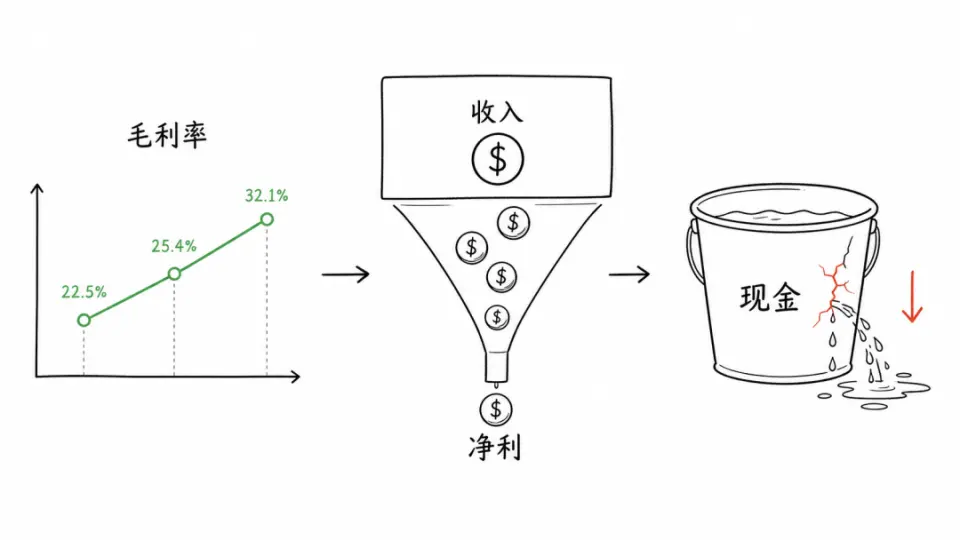
More critically, the gross margin has been climbing steadily: 22.5%, 25.4%, 32.1%. This is Jiuwu's brightest curve.
However, when the profit is broken down, this profitability is not an easy one; it looks more like it has been "squeezed" out. Over the same period, the expense ratio was compressed from 32.6% all the way down to 18.6%, of which R&D spending as a share of revenue was compressed from 22% to 11%. In other words, a considerable part of the gross margin improvement comes from diluting fixed costs after revenue doubled, rather than from a structural decline in procurement costs or labor efficiency. Its gross margin remains lower than peers: Canonop's six-axis welding robots are at 30% to 35%, and Standard Robots achieved 38.8% in 2024.
Therefore, the claim in the topic selection that "there is still 10 percentage points of room in gross margin" must be questioned. As a solutions provider whose main body is largely outsourced and which earns money through system integration and software, its costs are boxed in by upstream quotations for motors, reducers, and sensors; 32% is already close to the ceiling of this integration business. To go higher, there is only one path: move upstream to self-develop the main body to compress procurement costs, but that is another, heavier business.
The economics of a single deal are even more straightforward. In 2024, an average project had revenue of about RMB 5.4 million, containing about 64 robots, with revenue per robot stable at around RMB 88,000 year-round. In 2025, the average customer price rose to RMB 8.54 million per project, relying on installing more robots per order, not on raising the price per unit. A large order of RMB 8.5 million ultimately yields net profit of about RMB 500,000; the company's cumulative net profit over three years of RMB 67.24 million was ground out one order at a time.
What truly requires close attention is cash. In 2024, Jiuwu's book net profit was RMB 32.64 million, while operating cash flow in the same year was a net outflow of RMB 150 million. Inventory was as high as RMB 822 million, 2.2 times that year's revenue; accounts receivable as a share of revenue remained between 46% and 70% year-round; as of September 2025, cash on the books was only RMB 68.49 million. Inventory turnover days once exceeded 1,000 days, meaning that from preparing materials for a project to recovering cash, one to two years or even longer must be tied up.
This is not an operational misstep, but a structural feature of this business: long project cycles, uncertain acceptance timing, and customers that are large manufacturers with strong bargaining power on payment terms. Translated into language entrants can understand: you must first pay more than RMB 5 million out of your own pocket to install equipment into the customer's production line, then wait for acceptance, then wait for payment according to the payment terms; the money for the one to two years in between must be advanced by you.
The Ledger
Moat and Window Period: Why the First to Make Money Are the Solutions Providers
Returning to the initial judgment: when charging into the same industrial sector, the main-body manufacturers are still losing money while the solutions providers are profitable first. On what basis?
On the basis of that layer of capability to "get into the production line and understand that process." The barrier of a factory production line is not in main-body performance but in the dirty work: the equipment interfaces, yield constraints, and acceptance standards of each process are tacit experience ground out bit by bit by stepping through project after project; they are not in textbooks, and standardized main bodies cannot replace them. Main bodies can be bought; process access cannot. Agibot ranks first globally in shipments yet is still losing money, and Unitree has built its main body to the extreme yet cannot enter factories; this in turn confirms the gold content of Jiuwu's 5.9% market share (first in the clean energy field).
In the short term, main bodies becoming cheaper is actually a tailwind for Jiuwu. Unitree has already cut the price of humanoid robots to RMB 85,000 and pressed quadruped robots below RMB 10,000. When main-body prices fall, the share of material costs in a solution declines; the gross margin on the same project looks better, and the solution is easier to sell. Jiuwu's true moat has never been "technology," but "customization plus service," the know-how of thoroughly mastering a certain process, plus customer binding and operations and maintenance stickiness.
Here an honest footnote must also be left. The repeatedly emphasized 72.7% retention rate contains a component of shareholder binding. Jiuwu's second-largest shareholder is Dai Jun, the actual controller of Robotech, a ChiNext photovoltaic automation equipment company, with a 13.36% stake, while 95.3% of Jiuwu's revenue comes from clean energy; how much of this comes from related-party customers is not broken out in the prospectus. Therefore, part of the retention rate is "aligned interests," not entirely "irreplaceability." When looking at this business, do not treat all customers bought by shareholders as a moat won by capability.
The direction remains clear. In the embodied intelligence pie, the original equipment manufacturers are competing on hardware and burning cash, while solution providers are stuck in the "general contractor" position between customers and hardware, and they are best positioned to be the first to prove out a viable business model. This is also why Sequoia Capital and the actual controller of Robotechnik are betting on Jiuwu: in a track where 80% of companies are losing money, an industrial deployment sample that is already profitable and can be cashed out through an IPO is extremely scarce.
Industry chain
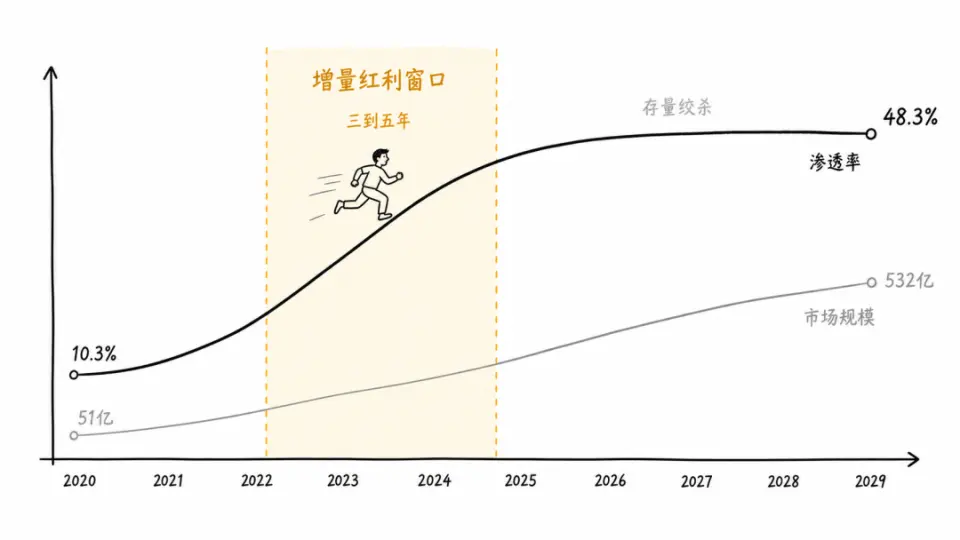
Now let us look at the ceiling and timing of this business. The entire "embodied industrial robot solutions" market was worth RMB 5.1 billion in 2024 and is projected to reach RMB 53.2 billion by 2029, implying a compound growth rate of nearly 60% over these five years (note that this is a forecast; the historical growth rate from 2020 to 2024 was 41.5%, so do not treat the forecast as already realized). Extrapolating statically from Jiuwu's current 5.9% share, this would correspond to revenue of approximately RMB 3.1 billion in five years, or RMB 5 to 6 billion if it optimistically reaches a 10% share. This is a market worth tens of billions that can produce a niche champion but not a platform giant; the ceiling is visible on the financial statements.
The good news is that we are still in the incremental growth phase. Penetration in this scenario was only 10.3% in 2020 and is projected to rise to 48.3% by 2029. In other words, nearly 80% of production lines have not yet adopted embodied robot solutions. The tenfold growth of the market from RMB 5.1 billion to RMB 53.2 billion will come overwhelmingly from "from zero to one" new installations, replacing manual labor and expanding the pie, rather than taking orders from established integrators. Competition is not intense and average order values are still holding up (the increase from RMB 5.4 million to RMB 8.54 million between 2024 and 2025 is evidence of this), and this window will likely last another three to five years. Once penetration passes 50%, the growth logic will shift to cutthroat competition in the existing market, gross margins will be squeezed back to the industry average of around 20%, and entering at that point would be a completely different business with a completely different risk profile.
Window
One point I would like to remind investors reading this article: Sequoia's bet and your entry are two different calculations. Capital earns money from equity appreciation and IPO exits: invest, wait for the profitability story to lift the valuation, then sell the equity at listing and exit, a one-time, multiple-based return. Those who operate this business, however, earn operating income: several million per order, funding advanced for several years, a 30% gross margin, and they also have to handle operations and maintenance and bear payment terms. In the same company, Jiuwu, what capital sees is exitable equity, while what an entrant must swallow is an operating entity that requires years of advanced funding and has customers concentrated in a single industry. Do not take Sequoia's optimism as a direct signal that you should enter.
Who else still has a chance in this business?
Those with the best chances are people who have already done automation in some type of factory production line and hold three things at the same time: process know-how for a specific procedure, an existing customer willing to let you onto its production line, and cash or financing capacity sufficient to support RMB 30 million-level advanced funding. You already naturally possess all three real barriers of this business; moving into solutions is monetizing existing resources, not starting from scratch. This is exactly the path Jiuwu has proven, and for such system integrators, it is a ready-made template.
Teams that can only buy original equipment and do integration, but have not yet exclusively mastered a specific procedure and do not have a first major customer should not rush. What you lack is not ability; it is an entry ticket. Those major manufacturers that prioritize yield above all else will not casually hand over production lines to a new player without a track record. You can wait for a specific signal before acting: the first major manufacturer order willing to sign and let you onto its production line, even if it is a non-profitable showcase order; or finding an industrial shareholder or channel partner that can give you access to production lines.
For entrepreneurs who want to use a small team and an asset-light model to cross over into "new blue oceans" such as healthcare, agriculture and catering for a gamble, I suggest caution. There is a popular prediction that by avoiding the red ocean of solar and lithium batteries and moving into new scenarios, a dozen or so "small Jiuwus" with annual revenue exceeding RMB 100 million will emerge in 2026. It sounds tempting, but for a small team, entering a new scenario means simultaneously giving up the three pillars on which Jiuwu relies to make money: process know-how drops to zero (crystal-pulling experience is useless for farming), there is no major customer willing to advance funds, the average order value may not support a heavy-asset model, and the demand itself has not yet been validated. If you really must enter, only enter scenarios with adjacent processes, for example moving from solar to lithium batteries; do not cross species. That line about "a dozen or so companies exceeding RMB 100 million" is a story told to capital, not a calculation for a small team.
The legal cost
The good news is that this business currently sits in a comfortable window of "policy encouragement and regulatory white space." In June 2026, the Ministry of Industry and Information Technology and the State-owned Assets Supervision and Administration Commission jointly launched a special action for real-world training of humanoid robots and embodied intelligence, explicitly encouraging "humanoid robots as a service," pay-per-use and operating leases; policy is pushing, not restricting. The industry's first standard system for humanoid robots and embodied intelligence was only released in March 2026, safety technical specifications are still being introduced one after another, and regulation as a whole has not yet taken shape.
What needs to be factored into the accounts in advance are several costs that can be resolved by spending money, mainly arising in the areas of contracts and the allocation of liability.
The first is the tripartite allocation of accident liability. Once a robot has an accident on a factory production line, injuring a worker or damaging production-line equipment, liability must be clearly allocated among the solution provider, the hardware manufacturer and the factory. At present there is no unified standard for loss assessment or allocation of liability, and most robot accidents can only be determined on a case-by-case basis under the Civil Code: where the accident is caused by operator error, the employer bears liability under Article 1191; where the product itself is defective, the manufacturer bears liability; where multiple causes lead to a single result, liability is shared according to the proportion of fault or may even be joint and several. If these matters are not clearly set out in the delivery contract in advance, once an accident occurs the parties will be mired in disputes. The country's first embodied-intelligence robot insurance claim was settled only in April this year, with RMB 5,976 paid out for a robot that accidentally tipped over; although that occurred in a rental performance scenario, the signal it sends is clear: liability for and loss assessment of robot accidents are becoming an unavoidable issue for the entire industry. Industrial scenarios are more controllable than open performance scenarios, but only on the premise that the boundaries of liability are locked down in the contract.
The second is data ownership. In the course of customizing solutions for factories and connecting to MES, solution providers accumulate a large amount of the factory's process data and production-line data. Whether such data belongs to the factory or to the solution provider, and whether the solution provider may use it to train models and reuse it for other customers, must be firmly fixed in the delivery terms. No one currently addresses this point, but it is both a source of disputes and the solution provider's most valuable asset in the future; agreeing on it early puts one in a stronger position.
The third is payment terms and acceptance. As calculated above, the biggest risk in this business lies in cash flow, and the crux of cash flow lies in the acceptance clauses: how the acceptance standards are set, how many installments the payment is divided into, and what happens in the event of delay. If a single clause is not clearly drafted, millions may sit on the books and cannot be recovered.
Viewed in isolation, none of these risks is fatal; they are all costs that can be resolved by spending money and amending contracts, and they can simply be factored into the project quotation without being deterred. But putting them into the contract up front is an entirely different kind of cost from post-hoc wrangling and passively bearing the losses. Those with relevant contractual and legal needs are welcome to talk with the author.

