In 2026, local government debt resolution has entered a critical and complex phase. The traditional“borrowing new funds to repay old debts”approach is becoming increasingly constrained, while the high costs of non-standardized financing are placing significant pressure on local state-owned enterprises.
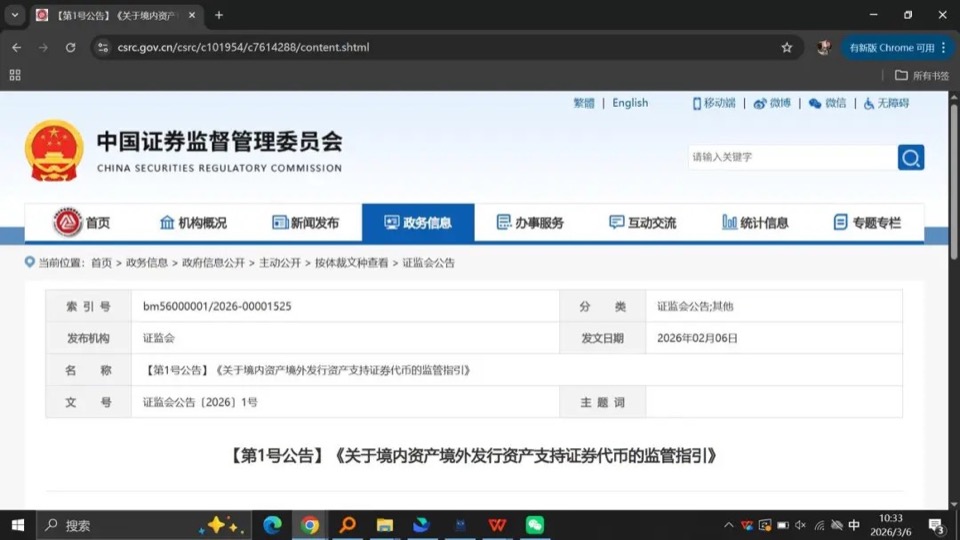
Fortunately, in February 2026, eight ministries and commissions, jointly with the China Securities Regulatory Commission (CSRC), issuednew regulations, which for the first time opened a compliance channel for domestic assets to undergo real-world assets (RWA) digital issuance in overseas markets.
This not only signifies a breakthrough in fintech within the field of asset securitization, but is also regarded by the market as a strategic tool tailored by the state to help local governments revitalize existing assets and access low-cost overseas capital.
This article will specifically analyze, from the perspectives of commercial logic and legal compliance, how tolegally and compliantly convert illiquid assets within the LGFV system into circulating capital in the Hong Kong capital market.
The “Three Major Hurdles” Currently Facing LGFV Debt Resolution
Although the central government has allocated quotas for the replacement of implicit debt, the truly challenging issue for LGFV transformation remains the resolution of the large-scale “operational debt.”
Currently, urban investment platforms are generally constrained bythe “triple barriers”:
The first barrier is the pain point of costs—interest expenses are eroding profits. To maintain an unbroken funding chain, many platforms have had to rely on high-cost non-standardized financing instruments, such as trust plans and leasing arrangements, with annualized rates of 8%–12%. As a result, the revenues generated by underlying physical projects fail to cover even the financing interest, causing the debt burden to snowball.
The second barrier is the pain point of channels—assets are held but cannot be monetized. Urban investment platforms actually possess substantial high-quality assets, such as water treatment plants, toll roads and bridges, and industrial parks. However, these assets either lack complete historical title confirmation procedures or have long operated without independent operating entities. From the perspective of traditional banks, they become “idle assets” that cannot be pledged as collateral.
The third barrier is the pain point of thresholds—while public REITs are advantageous, they offer no immediate relief for urgent needs. The thresholds for issuing public REITs are excessively high: underlying assets typically require a scale of more than RMB 1 billion, compliance review is comparable in rigor to an A-share listing, and the entire process can take one to two years, failing to address pressing short-term funding needs.
In the face of these triple challenges, urban investment platforms must move beyond traditional indirect financing paradigms, leverage the latest national policy window, and turn their attention to the more flexible cross-border capital markets to seek incremental funding that can truly alleviate liquidity constraints.
Policy Breakthrough—What Are Real-World Assets (RWA)? Why Is Now the Optimal Window?
1. Looking Beyond the Technical Facade: The Commercial and Legal Essence of RWA
Setting aside obscure technical jargon, RWA can be succinctly described as an “overseas mini-REITs” model, or “cross-border asset securitization based on digital credentials.”
Its operational logic is straightforward: legally segregate the underlying assets held by local government financing vehicles (LGFVs) that generate stable cash flows—such as the toll rights of a water treatment plant for the next five years. These future receivables are then discounted, pooled, and structured into compliant digital instruments, which are ultimately offered to global professional investors on strictly regulated exchanges in Hong Kong.
2. Clear Benefits Released by the Dual-Track Regulatory Framework
For local decision-makers, compliance always takes precedence when pursuing financial innovation.
On February 6, 2026, regulators issued two documents on the same day, clearly delineating the regulatory pathway:
On one hand, “closing the back door.” The People’s Bank of China and seven other ministries and commissions jointly issued the Notice on Further Preventing and Disposing of Risks Related to Virtual Currencies (Yin Fa [2026] No. 42), cracking down severely on illegal virtual currency speculation within mainland China. The stance is unequivocal: diverting resources from the real economy to speculative virtual activities will not be tolerated.
On the other hand, “opening the front door.” The China Securities Regulatory Commission (CSRC) simultaneously released the Regulatory Guidelines on the Overseas Issuance of Asset-Backed Security Tokens by Domestic Assets ([2026] No. 1), formally greenlighting compliant business activities.
This combination of tightening and easing sends an unmistakable signal: speculative virtual activities will be firmly suppressed, while financing backed by real assets is encouraged. Provided that high-quality domestic physical assets complete prior filing with the CSRC, they may proceed to Hong Kong to conduct cross-border financing through digital means.
Crunching the Numbers: Why Real-World Assets (RWA) Are a “Silver Bullet” for Debt Resolution?
Ultimately, the core driver for LGFVs issuing RWA in Hong Kong can be summarized in one sentence:Replace expensive debt with cheaper capital.Let us examine three sets of comparative data to clarify the economics:
- First, consider the cost:
Domestic non-standardized financing, with annualized interest rates generally at8%—12%, where the interest costs are prohibitively high; whereas why can real-world assets (RWA) issuances in Hong Kong achieve rates as low as4%—6%Because they tap into global capital pools, where capital is cheaper, directly halving financial expenses.
- Consider the entry thresholds:
For domestic bond issuances or REITs, the underlying assets typically require a value of over RMB 1 billion, and must also havecomplete and flawless documentationRWA structures are far more flexible, allowing initiation with RMB 300–500 million, and showinga certain degree of tolerancefor historical title confirmation issues—meaning that the “mid-sized” assets held by local government financing vehicles finally have an opportunity to be revitalized.
- Finally, consider the speed:
Traditional domestic financing approvals taking one to two years are considered fast, which fails to address urgent liquidity needs; for RWA, provided all materials are complete, theoretically within20 business daysCompletion of filing enables issuance—for urban construction investment vehicles (chengtou) in urgent need of working capital, this timeline is squarely at the “emergency relief” level.
Consider a practical example:
Suppose a chengtou platform raises foreign currency equivalent to RMB 500 million through real-world assets (RWA) in Hong Kong and uses the proceeds to directly refinance high-interest non-standard debt within mainland China carrying an annualized interest rate of 10%.
How much could the enterprise save annually from this inflow and outflow?RMB 20 million to RMB 25 million。
This is not merely paper gains; it represents tangible savings in financial expenses, directly reflected in the current year’s income statement. For chengtou entities currently under significant pressure, this constitutes the “cash flow remedy” most needed for debt resolution.
Professional risk control baseline—how to build an absolutely secure compliance firewall?
In cross-border financing, state-owned asset security and data compliance are two red lines that must not be crossed. As professional advisors, we have pre-established three “firewalls” within this structure to ensure that all operations remain strictly within prescribed boundaries:
First firewall: Separation of ownership and income rights to prevent “loss of state-owned assets”
What we offer for sale is not the underlying assets themselves, but the right to receive income generated by those assets over a specified future period. In other words, the roads remain yours, the land remains yours, and you retain full control over day-to-day operations; offshore investors are entitled only to receive payments and cannot touch your core asset base. State-owned control remains 100% intact.
Second firewall: “Privacy-preserving computation” as gatekeeper to safeguard the “cross-border data transfer” baseline
Financing requires disclosure of operational information to investors, but personal privacy data must never leave the jurisdiction. We will strictly comply with the Data Security Law by employing “privacy-preserving computation” techniques to de-identify data, ensuring that offshore parties can view only encrypted aggregated reports (such as total transaction volumes) without access to individual-level details. Meanwhile, a law firm will issue a specialized Cross-Border Data Transfer Assessment Report, providing clear, documented assurance of compliance.
Third Layer: Penetrative Closed-Loop Supervision and Full-Process Transparency
The entire process operates with full transparency:
- Onshore Component: Select only high-quality assets capable of generating independent cash flows, and strictly avoid any exposure to implicit debt. Prior to project initiation, complete the filing procedures with the China Securities Regulatory Commission (CSRC).
- Offshore Component: Collaborate exclusively with duly licensed institutions regulated by the Securities and Futures Commission (SFC) of Hong Kong, implement comprehensive anti-money laundering reviews without omission, and offer products solely to compliant institutional investors.
- Funding Component: Foreign currency raised through fundraising shall be converted into RMB and repatriated through dedicated accounts administered by the State Administration of Foreign Exchange (SAFE). The funds shall operate under a closed-loop mechanism throughout the entire process, and every unit of currency shall be used exclusively for refinancing existing high-interest debt, ensuring earmarked use of funds.
Only when these three lines of defense are firmly established can "idle assets" be effectively revitalized and converted into "low-cost liquid capital."
Practical Implementation Roadmap: A Five-Step Guide to Execution
To translate macro-level policies into actionable execution plans, we have outlined a standardized implementation pathway:
Step 1: Asset Screening.
Prioritize small- to medium-scale assets with stable cash flows and relatively clear ownership rights (such as water utility fee collection rights, public parking lot operations, and industrial park rental income), with an initial scale of RMB 300–500 million.
Step 2: Structural Restructuring.
Establish a special purpose vehicle (SPV) to segregate the underlying assets from the parent urban construction and investment company; where appropriate, introduce a provincial-level guarantee group to provide credit enhancement, thereby further reducing the issuance interest rate.
Step 3: Compliance Filing.
A professional law firm shall issue a legal opinion, and an application for filing under “Document No. 1” shall be submitted to the China Securities Regulatory Commission (CSRC). If the process proceeds smoothly, cross-border issuance approval will be obtained in accordance with regulations within approximately 20 business days.
Step 4: Issuance in Hong Kong.
In collaboration with licensed financial institutions in Hong Kong, confirm the rights to asset yields and generate compliant digital certificates for offering to global capital. Simultaneously employ foreign exchange swap instruments to hedge exchange rate risks.
Step 5: Foreign Exchange Settlement and Debt Resolution.
The raised funds shall be converted into RMB and transferred into designated supervised accounts within mainland China, to be immediately used to refinance high-interest debts of urban construction and investment companies, thereby achieving a substantive closed-loop process for cost reduction and efficiency improvement.
Conclusion: Seize the “First-Mover” Dividend and Establish a Benchmark for Debt Resolution Achievements
Looking back at every policy window period in the capital markets, jurisdictions that act first often capture the largest “first-mover dividend” and the most abundant financial support.
At present, with the “CSRC Document No. 1has been implemented, the blue ocean for cross-border real-world assets (RWA) has only just begun to open up.
We recommend that local governments and urban investment and development platforms take early action:Select a high-quality asset with stable cash flows and moderate scale to pilot the process first.Once the compliance pathway is established, low-cost overseas capital can be brought in to refinance high-interest legacy debt. This will not only address immediate liquidity pressures but also establish a benchmark for "digital financial innovation" achievements in this critical battle to resolve debt.
Author
Zhao Xuan, Partner at Mankun Law Firm. Mr. Zhao graduated from the Law School of Tsinghua University and has represented clients in hundreds of complex commercial litigation and arbitration cases before courts at all levels, including the Supreme People's Court, and major commercial arbitration institutions in Beijing, Shanghai, and other regions. Mr. Zhao has handled numerous legal matters involving internet companies, AI startups, and Web3 industry companies, covering areas including but not limited to corporate structuring, investment and financing, dispute resolution, and emerging legal issues.
Rao Weitong, Senior Lawyer at Mankun Law Firm. Ms. Rao graduated from East China University of Political Science and Law. From 2016 to 2017, she worked as a foreign-related trademark agent, providing legal services to clients from Germany, the United States, Japan, and other countries. As a practicing lawyer, she specializes in labor and employment compliance and dispute resolution, legal matters for foreign-related enterprises, and legal services for employment in the blockchain industry. Ms. Rao has handled thousands of labor disputes, including multiple collective labor disputes, large-value construction engineering disputes, and maritime commercial cases.
About Mankun
Mankun Law Firm was established in 2015 and is a boutique law firm in China specializing in the Web3.0 new economy and deeply engaged in the blockchain industry. The Mankun team members possess unique and diverse industry backgrounds, hailing from renowned legal service providers, state judicial organs, internet technology companies, crypto asset institutions, and blockchain industry think tanks.
Drawing on a deep understanding of the new economy, sustained attention to and research on policies and regulations, and extensive practical experience, the Mankun Law Firm team is adept at providing comprehensive legal services to enterprises in the new economy sectors—including Web3, blockchain, AI, NFTs, digital collectibles, crypto funds, crypto payments, decentralized finance (DeFi), real-world assets (RWA), and GameFi—from the perspectives of business models and legal practice. These services cover business structure design, project financing and investment, transaction planning, operational compliance, resolution of complex civil and commercial disputes, prevention and control of criminal risks, and criminal defense.
Mankun Law Firm is headquartered in Shanghai and maintains branch offices in Hong Kong (China), Silicon Valley (United States), Shenzhen, Hangzhou, Zhengzhou, and Chengdu. In response to the global compliance development needs of Web3 industry clients, Mankun has established local offices in major global crypto-financial cities and carefully selected local professional blockchain service partners, thereby delivering legal and compliance services with both global breadth and China-specific depth.