In March 2025, a procurement notice was posted in Foshan: a hospital affiliated with Southern Medical University intended to carry out localized deployment of DeepSeek, with a budget of RMB 500,000. At the same time, a certain railway central hospital also posted a tender, likewise with a budget of RMB 500,000. Looking further, the privatization deployment project of the big data application development administration bureau of a certain district in Chongqing had a maximum price cap of RMB 1.34 million.
These tenders share a common awkwardness: the core of what they procure, namely the DeepSeek model itself, is open source and can be downloaded free of charge by anyone. Not a single cent of the several hundred thousand to over one million yuan paid by the clients was spent on the model.
So where is the money made, and is it worth taking on as a dedicated business? That is the account this article sets out to calculate.
What is sold is not the free model, but a system capable of passing acceptance
Let us first make this business clear. System integrators deliver a complete private deployment system to hospitals, governments and enterprises handling sensitive data: selecting servers according to the client's concurrency and scenarios, installing the open-source DeepSeek within the client's intranet, building a knowledge base, configuring permissions and logs, carrying out security hardening, connecting to the hospital's HIS and PACS systems, then passing acceptance according to the functions and concurrency indicators in the contract, collecting the project payment, and thereafter converting to annual operation and maintenance fees.
What is sold has never been the model, but the ability to take a free model and turn it into a system that can pass acceptance and operate over the long term.
Hospitals are willing to pay for this system for compelling reasons. A hospital's information flow is full of patient data; for privacy and data security reasons, such data can only run within the intranet and cannot draw on external cloud computing power. To use a large model, servers must be installed on-site for localized deployment. In an interview with Jianwen Consulting, a medical informatization professional put the significance of DeepSeek directly: on the premise of comparable reasoning capability, its cost can be reduced to one-tenth, or even one-twentieth, of that of OpenAI and Claude. Only when costs collapsed to this extent did localized deployment of large models by hospitals first become possible.
The demand is real. From 2025 to date, more than a thousand hospitals across the country have publicly announced completion of localized DeepSeek deployment. According to EO Intelligence, the market size of AI large models in the medical field exceeded RMB 1.1 billion in 2025.
It looks like a business standing at the forefront of a trend. But to judge whether it is worth doing, one must turn the account around and see how the money is divided within this system.
Hardware takes sixty to eighty percent; the model line is zero
Among all the materials, only one project disclosed itemized pricing: the localized deployment of a certain municipal people's hospital, with a budget of RMB 290,000, of which the maximum price cap for hardware was RMB 240,000 and the maximum price cap for software was RMB 50,000. Hardware accounted for 83%, software for 17%, and the model line was zero.
This is not an isolated case; it is the skeleton of this business. A server capable of running DeepSeek R1 32B, equipped with two to four graphics cards, has a market reference price of RMB 79,000 to RMB 85,000. Going higher, a certain top-tier hospital on the eastern coast deployed the full 671B version, spending RMB 3 million on H100 graphics cards alone. Hardware is the only hard, irreducible cost in this business.
I broke down and calculated a certain ministry's tender of RMB 215,310 item by item. What it requires is an R1 32B model, at least 16 concurrent sessions, task monitoring, an intranet web page, speech-to-text, image text recognition and a multi-terminal interface, to be delivered within three months. The model is RMB 0; hardware, estimated at an entry-level configuration, is RMB 60,000 to 80,000; and the remaining RMB 100,000 or so is three months of an engineer's working hours to stitch these functions together and get them to pass the acceptance metrics. A rough calculation puts the gross margin at about 20 to 30 percent, and that is still at the maximum price cap; in an actual bid, one would have to concede further. In this order, what the integrator is actually selling is working hours.
The economics of large orders look quite different. Yicai reported an even sharper figure: for a RMB 5 million medical large-model all-in-one machine, the hardware side, Huawei, takes roughly RMB 4 million, and the remaining RMB 1 million is the software. A provincial government hospital in a certain province plans to invest RMB 4.5 million to build an agent application platform, requiring a knowledge base, training on historical data, multimodality and imaging-assisted diagnosis and treatment; reckoning on hardware accounting for 60 to 70 percent, servers and computing power alone consume the bulk, and the software plus services that the integrator actually pockets amount to just over RMB 1 million.
This business therefore yields a counterintuitive conclusion: large orders do not have a higher profit rate than small ones; they are merely larger in absolute amount and carry heavier responsibility. Small orders sell working hours; large orders sell procurement qualifications plus assumption of responsibility, that is, I have the qualifications to buy this pile of cards on the hospital's behalf and dare to sign the acceptance form. In both kinds of orders, the model is RMB 0.
This also explains why some players are quietly pursuing volume. Jianwen Consulting mentioned that an internet healthcare company with a relatively large business volume charges RMB 600,000 per hospital, has already served several dozen hospitals, and within a short time reached revenue on the order of RMB 10 million. What it earns is not a technology premium but the scale of repeating a standardized job several dozen times.
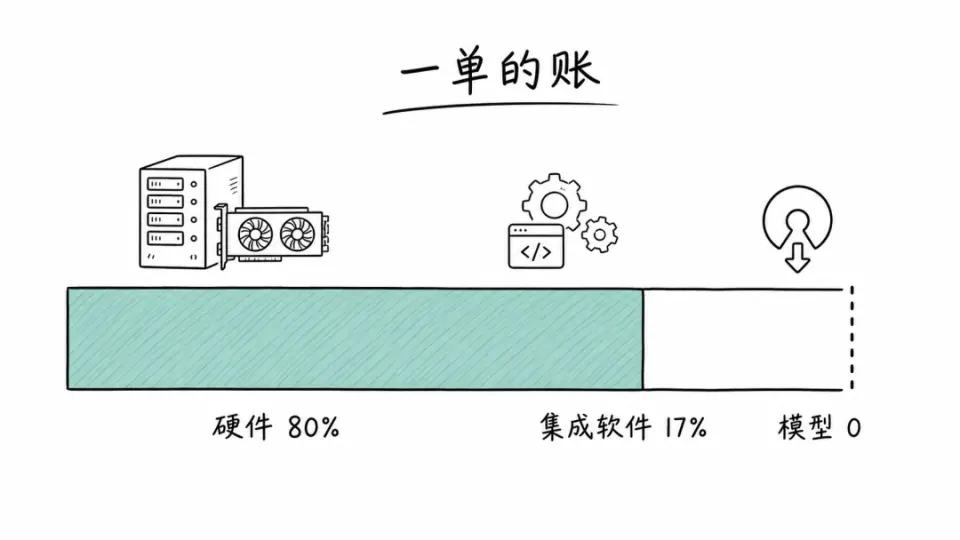
The economics of one order: hardware accounts for 80 percent, and the model line is zero
When the barrier to entry is so low that anyone can do it, the moat becomes a problem
In the same Jianwen Consulting interview, industry figure Song Kun put it plainly: doing local deployment of large models for hospitals does not have a particularly high barrier to entry, and traditional medical informatization service companies can all do it. He added a more pointed remark: most so-called local deployment amounts to opening an interface in the hospital's HIS system that lets you converse with DeepSeek, which is no different in experience from opening a web page remotely to use DeepSeek. Liu Bin, who makes AI software for hospitals, was even more direct: many people think that as long as you install a DeepSeek large model, you can sell hardware.
Installing a model is a zero-barrier action, so it cannot be a moat. The real barriers sit at both ends of the chain. At the entry end, tenders require computer system integration or software development qualifications and a domestically registered legal person, and this threshold shuts out individual developers who can only call APIs; they cannot even get in to register. At the payment end, one must sign acceptance against hard metrics such as 16 concurrent sessions and also take on long-term responsibility for maintenance at about 8 percent of hardware cost per year, and if something goes wrong, there must be a domestic entity to hold accountable.
If the moat is taken apart and quality-checked item by item, not much remains. Building knowledge bases, configuring permissions and connecting to HIS are technical tasks that all-in-one machine vendors are writing into factory templates; system integration qualifications can be bought or used under another's name; the only things that truly cannot be copied are existing customer relationships and local operations and maintenance willing to assume responsibility. And this is precisely the most tiring and least valuable part.
What is more troublesome is that integrators are being squeezed from both above and below. Upstream, vendors such as iFlytek, Ant and Shunyuan package software and hardware into out-of-the-box all-in-one machines; a head of the information department at a Grade 3A hospital described it as a customized, reduced-configuration computing power server, with the manual integration work absorbed into the box. Downstream, government orders are increasingly taken whole by central state-owned enterprises. A RMB 1.34 million project in a certain district of Chongqing was ultimately won by a branch of China Telecom at RMB 1.3392 million, only 0.06 percent below the maximum price cap, taken at almost par. There is no price competition here; winning depends on qualifications and resources, not on who understands models better.
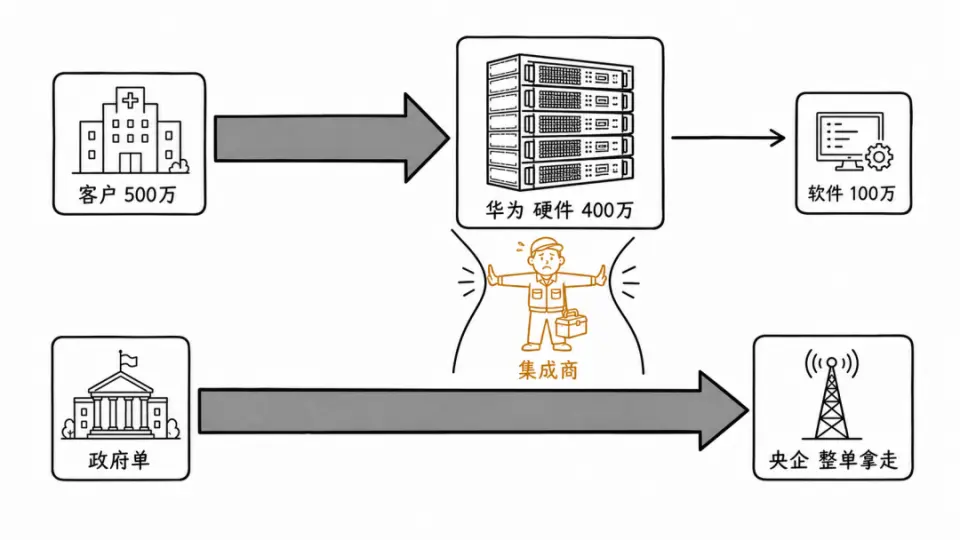
How the money in one order is split: hardware vendors and central state-owned enterprises take the bulk, and integrators are squeezed thin from both ends
There is another layer that is easily overlooked: those who are most energetically hyping this business today are earning from a different set of accounts. All-in-one machine vendors and graphics card vendors pocket their money on the day of delivery and do not have to worry about whether it can be used afterward; course sellers earn the tuition of those who think that installing DeepSeek means they can sell hardware; local governments want the achievement figures announced in the thousands, and announcement is fulfillment. All of them have certain returns that are realized once the sale is made and then they walk away, whereas the integrator's returns are delayed and begin only after the sale, and it must also backstop results and operations and maintenance. Mistaking others' shipment heat for one's own order book is the most common misreading in this business.
Over a thousand have made official announcements, but many units are bought and left to gather dust
Demand is both real and fake, and this is a line that must be drawn clearly before taking on any order.
The signals of genuine hard demand are clear: hospitals are being pushed by data security requirements onto internal networks, and such clients will pay real money for passing acceptance, long-term operations and maintenance, and integration with dozens or even hundreds of in-hospital systems. The signals of fake demand are equally clear. In interviews by Yicai, multiple practitioners were highly consistent: only a small portion of hospitals are actually spending money, while most are watching and waiting; many hospitals that bought all-in-one machines cannot put them to use and simply set them aside to gather dust. The information department director mentioned earlier, who deployed the full 671B version, said that in trials the results were rather poor, with piles of errors, and doctors dare not use it; at present it is mainly used to write administrative documents.
This means that among those over a thousand official announcements, a considerable portion represents revenue destined to gather dust. For integrators, the correct move is to take on the difficult orders that involve deep integration, heavy responsibility, and clients pushed onto internal networks by compliance requirements, and to avoid the standard orders where functions are standardized, all-in-one machines can substitute, and clients are only chasing KPIs. On the latter type of order, all you can do is compete on price, with gross margins squeezed to twenty percent while still having to fight state-owned enterprises.
Will model iteration wipe out this business outright? The answer is no, but it will reduce its dimensionality. The next generation of more GPU-efficient open-source models, more mature all-in-one machines, and cloud providers' one-click privatization will together hit the delivery and integration segment of configuring hardware, installing models, and building knowledge bases, which is where integrators earn one-off project fees. But there are two things model iteration cannot touch: one is acceptance responsibility, since hospitals need a domestic legal entity to sign and bear responsibility so that accountability can be pursued if something goes wrong, and no matter how strong the model becomes, it will not bear responsibility for clinical misdiagnosis on the hospital's behalf; the other is operations and maintenance annuities, since each new generation of models requires re-tuning the knowledge base and re-integrating, which in fact creates new operations and maintenance demand.
So the contract structure should be thought through now: stop quoting based on the ability to install models, and shift the structure from being mainly project fees to low-price delivery plus multi-year locked-in maintenance plus a responsibility premium. In this business, the only revenue that model iteration cannot kill is that 8% operations and maintenance annuity and that acceptance signature.
Who can still capture dividends in this space?
Regional integrators who already hold government and enterprise clients, have system integration qualifications, and have local operations and maintenance teams will find this business an easy win. That is because its thresholds, namely qualifications, a domestic legal entity, in-hospital resources, willingness to sign acceptance, and year-round operations and maintenance, are exactly the stock assets you have long built up. Add one large-model delivery line, and the marginal investment is merely one or two AI engineers at two to three hundred thousand yuan a year, which can match unit prices of 500,000 yuan for a certain hospital, starting at 668,000 yuan for a certain neurological hospital, and reaching up to 4.5 million yuan in a certain province, with a quick payback.
Those who only want to resell all-in-one machines for a margin should watch and wait, not rush to commit heavily. On a 5 million yuan order, Huawei takes 4 million, and all you can touch is the thin layer locked down by hardware manufacturers. The signal worth waiting for is specific: the emergence of affordable domestic computing power that can bypass Huawei and Inspur and bring down the hardware share of sixty to seventy percent, which is when your margin as a porter will have room. Until then, you are merely an intermediary advancing funds for manufacturers.
Individual developers who only know how to call APIs should stay away from this business. The most fatal point is that you cannot even register for a tender, since without a domestic legal entity and qualifications you are blocked at the entry stage. What you know happens to be that zero-yuan link in the model chain. If you truly want to capture this wave of dividends, the correct posture is to pass your client leads to qualified integrator friends for a referral fee, or do application outsourcing for them, rather than stepping into the arena under your own name.
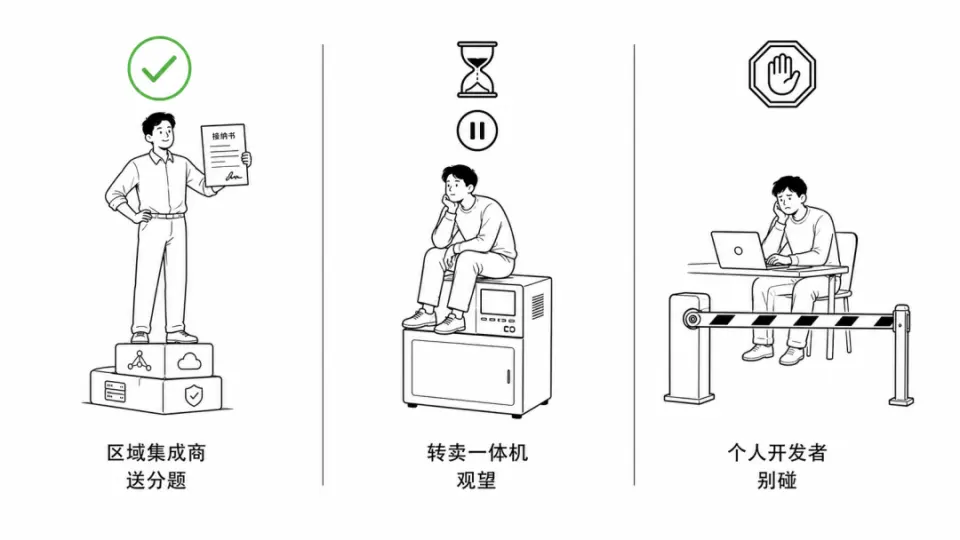
Three types of players: regional integrators have an easy win, all-in-one resellers should watch and wait, individual developers should stay away
How big this business can ultimately become is now clear. The total market is in the billion-yuan range, but hardware and all-in-one machines take the lion's share, and the implementation services that integrators can truly capture are more on the order of one to three hundred million yuan. It is an operating business driven by cash flow, not an equity story driven by fundraising; revenue is project fees settled one order at a time, the moat is qualifications and resources, and it cannot grow into a platform valuation. Becoming a small regional giant that holds its territory is its ceiling.
Finally, let us calculate the legal costs.
This business currently stands within a not insignificant regulatory gap. There are not many pitfalls, but each one must be converted into money and factored in.
The first gap is the widest. Article 2 of the Interim Measures for the Administration of Generative Artificial Intelligence Services states clearly that it regulates the provision of generative services to the public within China; where industry institutions develop and apply such services without providing them to the public, these Measures do not apply. Privatized deployments by hospitals and governments involve internal use with data not leaving the domain, and thus basically sit at the edge of its coverage. The pitfall here is not to casually turn an internal system into a public entrance—for example, directly connecting an in-hospital model to a patient-facing internet hospital dialogue window; that step crosses from internal use into a public service requiring filing.
The second is medical device qualification. Applications such as AI imaging-assisted diagnosis and assisted decision-making that are to enter clinical use are managed as Class III medical devices and require a registration certificate from the National Medical Products Administration, with approval taking years; whereas administrative and research-assistance functions such as knowledge bases, speech-to-text, OCR, medical record quality control, and pre-consultation triage and guidance fall outside this checkpoint. The world's first Class III certificate based on a large model was only issued in May 2026, which shows how long this road is. Before taking on imaging-assisted diagnosis and treatment projects, first confirm whether the client or product party holds a certificate; do not deliver diagnostic functions without a certificate for clinical use—this is a line that must certainly be observed.
The third is data authorization. This can be resolved by paying compensation and is a risk that can be treated as an operating cost. When customer medical data enters a knowledge base or is used for fine-tuning, it constitutes sensitive personal information, and separate consent must be obtained under the Personal Information Protection Law. Such disputes are mostly civil compensation matters and are often treated in the industry as an operating cost, but by fixing in the contract the three points of the scope of authorization, whether it is open to the public, and whether diagnostic functions enter clinical use, and by clearly delineating the boundary between acceptance responsibility and operations and maintenance responsibility, this cost can basically be reduced to zero.
The direction of regulation is a soft landing, not a shutdown. It will only continue to raise the compliance costs of filing, multi-level protection, registration certificates, and data authorization, gradually forcing the profits of this business away from exploiting loopholes and toward assuming responsibility and operations and maintenance. For qualified integrators willing to assume responsibility, this is instead a good thing: when the threshold rises, those who achieve compliance first will eat the market of those who comply later.
If you have legal needs related to compliance or contracts, you are welcome to talk with the author.
Author of this article:Lü Yinghui, a lawyer at Shanghai Mankun (Shenzhen) Law Firm. Graduated from China University of Political Science and Law, with nearly ten years of deep experience in the legal industry, and formerly worked at a court in Shenzhen. Focuses on legal services in the new-generation economy, with rich practical experience and profound insights in fields such as Web3 and artificial intelligence. All-platform account: Lao Lü Talks New Money; you are welcome to follow.