“Your bank card statement shows over RMB 30 million in transaction volume.”
In cases involving USDT, OTC trading, illegal payment-settlement schemes, or virtual currency funds, when parties first hear this figure, they readily interpret it as meaning something else: that their “case-related amount” is over RMB 30 million, and that subsequent conviction and sentencing will revolve around this RMB 30 million.
However, in criminal cases, these two figures cannot be directly equated.
For someone who has long bought and sold USDT, the same principal may circulate repeatedly among bank cards, trading platforms, and wallets. RMB 200,000 in principal is used to buy USDT on a given day; after the USDT is sold, the funds return to the bank card, and trading continues the next day. After one month, the cumulative inflows and outflows shown on the bank card may well reach several million yuan. If there are also transfers between the person's own accounts, refunds, funds returned via the original route after failed transactions, as well as normal salary, business income, and transfers from friends, the figures ultimately appearing in the bank statement will be further magnified.
This is not to say that large transaction volumes carry no risk. On the contrary, unusually frequent large-value fund transfers may themselves be important leads for bank risk management, public security authorities' investigations, and assessment of a person's actual business model. However, once the matter enters the stage of determining criminal liability, it is still necessary to ask further: what is the nature of each portion of these funds, which of them genuinely correspond to the criminal facts under investigation, and specifically which part the party participated in.
Only after these questions are answered can the figures in the bank statement possibly be further converted into amounts in a criminal case.
I. First distinguish several “amounts” that are easily conflated
In coin-related cases, concepts such as account transaction volume, case-related amount, criminal amount, payment-settlement amount, and illegal gains often appear at the same time. They all appear to answer “how much money,” but their legal functions are not the same.
Account transaction volume describes how much fund movement has occurred in a bank card, payment account, or wallet within a certain period; it may include both lawful and anomalous transactions, and may repeatedly record multiple circulations of the same principal. The so-called case-related amount is more a description, in the course of case investigation, of the scope of funds connected to specific facts; however, the fact that a sum of funds falls within the scope of case investigation does not mean that it will ultimately all be counted toward a particular person's criminal liability.
When it comes to specific charges, the object of proof for the amount will continue to change.Cases of assisting information network criminal activities may involve facts such as funds flowing into accounts and payment settlement; cases of concealing or disguising criminal proceeds require further confirmation of which property constitutes proceeds of the upstream crime and its returns; money laundering cases focus on the criminal proceeds and their returns involved in the money laundering conduct actually carried out by the actor. Illegal gains are yet another concept, usually referring to the benefits actually obtained by the actor through illegal or criminal activities, and they often differ greatly from the total historical transaction volume of an account.
Therefore, an account with cumulative transaction volume of RMB 30 million can at least show that the scale of fund activity in this account is relatively large; however, to further reach the conclusion that “this person committed RMB 30 million in crimes,” a large number of factual and legal determinations are still missing in between.
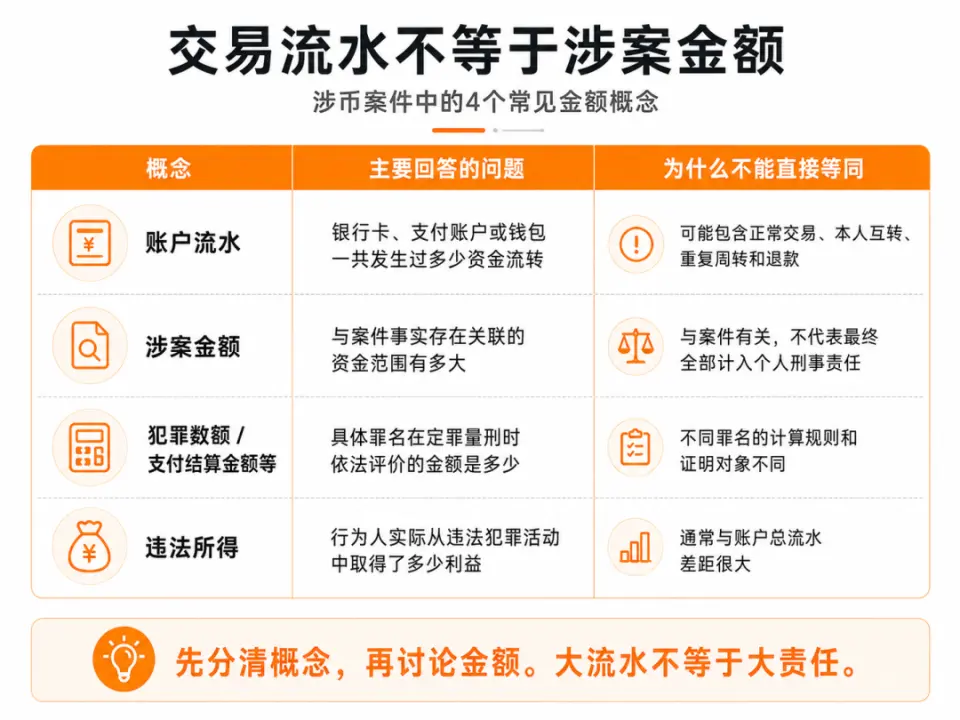
In cases involving USDT,OTCand coin-related funds, transaction records can serve as important evidence for determining transaction patterns and subjective knowledge, but the records themselves cannot, divorced from the specific transaction facts, independently establish criminal liability.
II. Why are coin-related transactions particularly prone to showing "very large transaction volumes"?
The reason virtual currency transactions most easily inflate transaction volumes is that the velocity of fund turnover is far higher than in many traditional transactions.
Suppose a U merchant has only RMB 200,000 in principal. Each time a purchase of U and a sale of U is completed, the funds return to the bank card and are then put into the next transaction. If several turnovers are completed in a single day, RMB 200,000 in principal may generate over RMB 1 million in fund flows in bank records; after such transactions continue for several months, even if the principal actually occupied over the long term remains only a few hundred thousand yuan, the cumulative bank card transaction volume may still reach tens of millions.
In addition, the pooling of funds between one's own accounts also increases the apparent transaction volume. When Card A transfers to Card B, and Card B is then used to purchase USDT, the banking system records these fund movements separately, but in economic substance it may always be the same sum of money. Refunds after failed transactions, and repurchases of coins after selling them, may also cause the same funds to appear repeatedly at different points in time.
Coin-related cases present another more peculiar problem, namely the simultaneous existence of RMB accounts and on-chain wallets. If RMB 100,000 is first used to purchase USDT, and the corresponding USDT then appears in on-chain transaction records, the banking side and the on-chain side are in fact describing two stages of the same transaction. If the correspondence among the RMB order, exchange records, wallet address and TxID is not first established, and the figures on both sides are merely mechanically added together, double counting readily occurs.
At the same time, a bank card used over the long term is often not used solely for virtual currency transactions; it may also contain salary, business income, transfers from family members or other normal payments. Even if the case ultimately confirms that some of the funds are anomalous, this does not permit the reverse inference that the entire historical transaction volume of the account constitutes criminal funds.
Therefore, the "large transaction volume" in coin-related cases is often the starting point of a fund map, not the final answer.
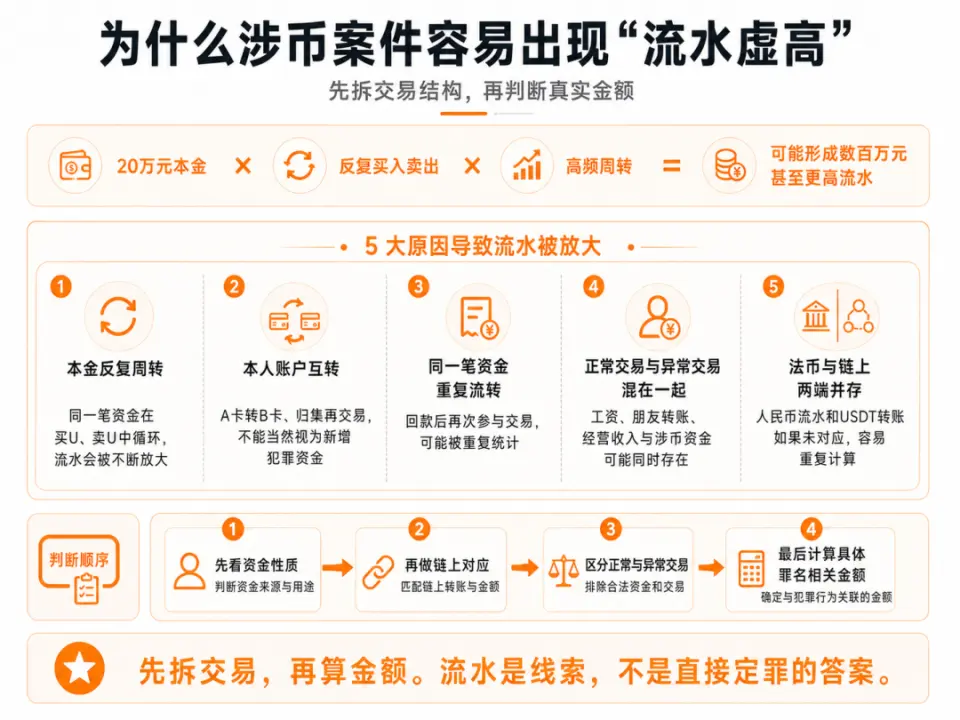
The truly effective order of assessment should be to first break down the transaction structure, then establish the correspondence between on-chain and off-chain records, distinguish normal funds from anomalous funds, and finally determine, according to the specific charge, which amounts can enter criminal law evaluation. Transaction records can tell investigators that "the money passed through here," but they do not automatically answer "what kind of money this is."
III. In cases of the crime of assisting information network criminal activities, reaching a certain scale of transaction volume is also not an automatic formula for conviction
In July 2025, the Supreme People's Court, the Supreme People's Procuratorate and the Ministry of Public Security jointly issued the Opinions on Several Issues Concerning the Handling of Criminal Cases Such as the Crime of Assisting Information Network Criminal Activities, further clarifying the standards for determining the crime of assisting information network criminal activities.
It provides that, in specified circumstances such as selling or leasing three or more of one's own bank accounts or payment accounts where the funds flowing into those accounts exceed RMB 300,000, such circumstances may serve as one of the grounds for determining that the circumstances are 'serious.' The rule, however, immediately goes on to emphasize that, in order to determine on the basis of the relevant circumstances that an actor has committed the crime of assisting information network criminal activities, it is first necessary to verify whether the amount of the inflowing funds that is suspected of being connected to the offense of the person being assisted meets the relevant threshold for establishing that offense.
This rule illustrates well the relationship between 'transaction volume' and 'criminal amount.'
That RMB 300,000 flows into an account is an important objective fact and may also trigger further criminal review, but it does not reduce criminal liability to the proposition that 'transaction volume exceeding RMB 300,000 equals establishment of the crime of assisting information network criminal activities.' The judicial authorities must still examine whether the actor knew that another person was using the information network to commit a crime, whether the actor actually provided bank cards, payment and settlement or other assistance, and what correspondence exists between the funds entering the account and the offense of the person being assisted.
The same logic applies to USDT transactions. If RMB 5 million flows into a person's account over six months, and that amount includes both normal transactions and transfers between the person's own accounts as well as funds that cannot be matched to any upstream offense, the entire RMB 5 million cannot be treated as criminal funds merely for ease of calculation. If, however, the counterparties are highly concentrated within a chain of illegal and criminal activity, the pattern of fund inflows and outflows is clearly abnormal, and the actor continues to assist in transferring funds and obtains abnormal benefits, then high-frequency, large-value transaction volume may likewise constitute important evidence for determining the actor's subjective knowledge and the nature of the conduct.
The question, therefore, has never been whether transaction volume is useful, but rather how far transaction volume can actually prove.
IV. If a case is characterized as concealment or disguise, the logic for assessing amounts changes again
Once the offense of concealing or disguising criminal proceeds or the proceeds of criminal proceeds is reached, the calculation method used in cases of assisting information network criminal activities can no longer be carried over.
The judicial interpretation issued by the Supreme People's Court and the Supreme People's Procuratorate, effective from August 26, 2025, further clarifies that determining the offense of concealing or disguising criminal proceeds or the proceeds of criminal proceeds shall be premised on the establishment of the facts of the upstream offense; 'criminal proceeds' means illicit money, illicit goods or other property interests obtained directly or indirectly through a crime. The judicial interpretation also specifically emphasizes that a comprehensive assessment should be made in light of factors such as the nature of the upstream offense, the upstream-downstream relationship, subjective culpability, the manner of conduct, the amount involved and the consequences of the crime, rather than mechanically convicting on the basis of a single amount.
This means that even if a wallet has cumulatively received 1 million USDT over its history, it cannot be determined solely on the basis of the wallet's total transaction volume that the person controlling the wallet bears liability for the offense of concealment or disguise in respect of all 1 million USDT.
It remains necessary to further break down the wallet's transaction volume: which USDT can be proven to originate from an upstream offense, when the party began to participate, which transactions the party actually controlled or operated, to what extent the party understood the abnormal nature of the funds, and which addresses and transactions can form a stable correspondence with the upstream case.
In the typical cases simultaneously released by the Supreme People's Court in 2025, there were also cases specifically concerning the use of virtual currency to commit concealment or disguise of criminal proceeds, which shows that virtual assets have become one of the fund-transfer methods of key concern in such cases; however, the ultimate criminal assessment is still based on the specific criminal proceeds, the fund-transfer conduct and subjective knowledge.
On-chain transaction volume is important, but on-chain transaction volume is likewise only evidence; it is not the offense itself.
V. In money laundering cases, the total bank card transaction volume cannot be directly applied to the amount threshold either
Money laundering cases also have their own amount assessment rules.
The 2024 judicial interpretation on money laundering issued by the Supreme People's Court and the Supreme People's Procuratorate provides that where the amount laundered is RMB 5 million or more and any of the following circumstances is also present—repeated money laundering, refusal to cooperate with the recovery of property and funds resulting in the inability to recover illicit money and property, losses of RMB 2.5 million or more, or other serious consequences—the conduct may be determined to constitute "serious circumstances" under Article 191 of the Criminal Law.
The RMB 5 million here refers to the amount involved in the money laundering conduct, not all funds that have ever passed through a particular bank card.
In determining whether the actor "knew or should have known," the judicial interpretation also requires a comprehensive assessment based on factors such as the type and amount of the criminal proceeds handled, the transfer method, abnormal account circumstances, occupational experience, and the relationship with the upstream offender. In other words, even where the scale of funds is large, the judicial authorities must still explain why the funds constitute proceeds of a specific upstream crime and why the actor was able to recognize that these funds were abnormal.
This is also why amount analysis in criminal cases involving crypto assets rarely consists merely of adding up bank statements again with a calculator. The real difficulty lies in first determining the legally relevant calculation object and then returning to the transaction records to reclassify them.
VI. What really needs to be done is to break a "large transaction volume" back down into individual transactions
If what you face is an account statement showing RMB 30 million in transactions, the genuinely valuable work is not fixating on the total of RMB 30 million, but answering anew why each sum of money appeared.
Transfers between the person's own accounts must be separately identified, and transactions with a demonstrable genuine business background must be distinguished from abnormal funds; original-route refunds, duplicate payments and repeated circulation need to be re-verified, while transactions using RMB to purchase USDT require further matching of orders, chat records, exchange records, wallet addresses and TxIDs.
For on-chain transactions, it is also not enough to count only the cumulative inflows and cumulative outflows of a single wallet. The blockchain can prove with relative clarity that, at a certain point in time, a certain quantity of USDT was transferred from address A to address B, but it cannot by itself tell us who controlled address A, why the transfer occurred, who actually issued the transaction instruction, or whether the controller knew the true source of the relevant assets.
Therefore, fund assessment in Web3 criminal cases inherently requires analyzing on-chain and off-chain information together. Bank statements explain how fiat currency moved, on-chain records explain how virtual assets moved, and chat records, account information, device records and counterparty information are responsible for explaining "who was in control, and why the funds moved in that way."
Missing any one of these layers may compress a complex transaction structure into a total figure that looks intimidating.
Lawyer Observation
In February 2026, the People's Bank of China and seven other departments issued the Notice on Further Preventing and Addressing Risks Associated with Virtual Currencies and Related Matters, further clarifying that, within China, exchange between legal tender and virtual currencies, exchange between virtual currencies, and related intermediary, pricing and other business activities constitute illegal financial activities, and continuing to strengthen the governance of illegal and criminal activities involving virtual currencies.
However, the characterization of a business under financial regulation and the question of whether a natural person ultimately commits a crime, what crime that is, and the amount for which that person bears criminal liability remain issues at different levels. Even if a business itself falls within a prohibited regulatory field, the elements of criminal law cannot be bypassed, and individual criminal liability cannot be determined directly on the basis of a bank's total transaction volume.
Therefore, when a crypto-related account shows a transaction volume of RMB 30 million, the most accurate understanding is neither that "RMB 30 million does not matter" nor that "RMB 30 million is the criminal amount."
It first means that the account has relatively large-scale fund activity that requires further investigation and explanation.
What truly determines the direction of the case next is whether these funds can be stably matched to specific criminal facts, which portion of the transactions the person actually participated in, what understanding the person had of the source of funds and the nature of the business, and, under the charge ultimately applied, which type of amount the law actually requires to be calculated.
A large transaction volume is not a ground for exemption from liability, nor should it become a shortcut to conviction that bypasses factual review. What truly needs to be calculated clearly in a crypto-related criminal case has never been how much money passed through the account in total, but how much of that money can be proven by evidence to be the portion for which this person should bear criminal liability.
/ END.
*This article is an original article of Mankun Law Firm and represents only the personal views of the author. It does not constitute legal consultation or legal advice on any specific matter. For reprinting and legal consultation, please add our customer service: mankunlawyer
Author of this Article