

Recently, the term "AI payments" has gained significant traction. However, the concept itself is rapidly evolving, and different observers often focus on different aspects. Some emphasize user experience enhancements, such as voice-activated ordering and automated payments, while others focus on integrating wallets with AI agents to enable payment capabilities. As certain projects begin to demonstrate real-world viability, the market is starting to recognize that the core of AI payments lies not merely in the act of "payment" itself, but inhow AI services are priced, traded, and settled。
Taking Nevermined as an example, it does not offer a standalone payment tool, but rather an infrastructure that enables AI services to be priced, charged, and settled. Its capabilities include billing, access control, real-time settlement, and compatibility with agent protocols such as MCP, A2A, x402, and AP2. The fundamental problem it seeks to solve is not "how to make payments," but ratherhow each instance of AI work can be immediately converted into revenue。
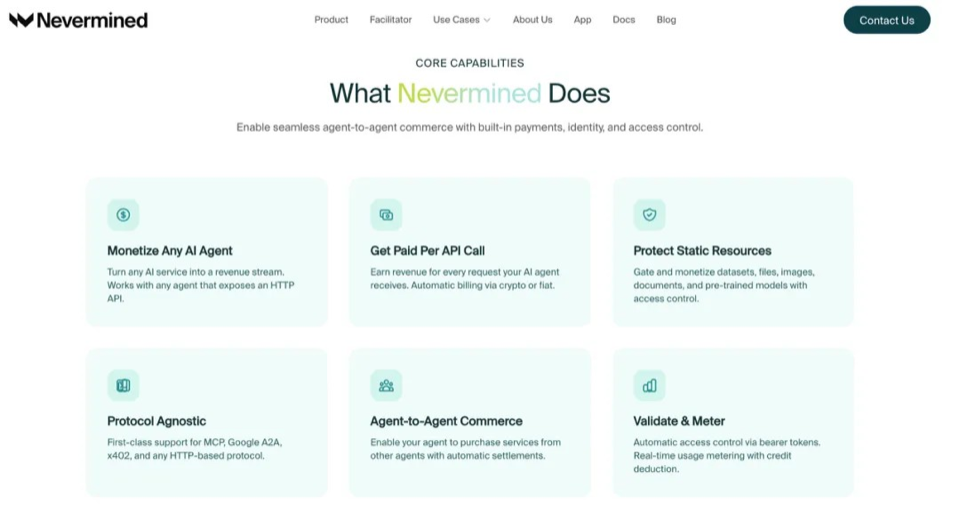
It sells not a wallet, but a charging system for AI services
Many payment products resemble cash registers, focusing primarily on collecting funds. Nevermined is different; it is more akin to installing a comprehensive charging system for AI services. Each time an AI service is invoked, the system can determine whether access should be granted, how much should be charged, how to record the deduction, and how to handle subsequent disputes.
While this may sound highly technical, it is not difficult to understand. Today, numerous AI products are operational, but few generate sustainable profits. The issue often lies not in their capabilities, but in their charging models. Traditional software can charge per account, annually, or via subscription packages, but AI agents often do not operate in this manner. A seemingly simple task may involve multiple model invocations, various tools, and several rounds of external services.Continuing to apply traditional software pricing models easily leads to price distortion.
Nevermined addresses precisely this step. It transforms invocations, which were previously hidden in the backend, into billable commercial actions.In the past, companies sold "software usage rights"; now, they are beginning to sell "each instance of machine labor."
Why this business model is gaining traction
AI payments are gaining practical significance not because the concept is new, but because the working methods of AI are forcing changes in charging models. Nevermined offers various models, such as pay-per-use, pay-for-results, and value-based pricing, essentially answering a very practical question: How should AI services actually be sold?
In the past, many AI products struggled to sell not due to lack of demand, but because customers were unclear about where their money was being spent. With monthly subscriptions, customers feared overpaying; with per-seat pricing, costs did not align with actual invocation volumes. This is particularly evident in agent scenarios, where a single conversation may involve dozens or even hundreds of micro-operations.If the charging logic does not closely follow the actual workflow of AI, commercialization will remain awkward.
Nevermined's solution is to transform actions such as invocations, results, and access into chargeable events, integrating billing, authorization, and settlement into a single pipeline. In this way, customers are no longer purchasing a vague "AI capability package," but rather discrete, transparent, and calculable services.The true value of AI payments lies not in enabling machines to make payments, but in ensuring that the work performed by machines can be accurately valued.
Another crucial aspect is that it has not locked itself into purely crypto-based payments. Public information indicates that it supports bank cards, stablecoins, crypto assets, and real-time bank transfers. This choice is significant because, to make AI payments a viable business, it must first allow customers to integrate seamlessly.The more open the payment channels, the more it resembles infrastructure; the higher the barriers, the more it resembles a toy for insiders.
It is no longer just a conceptual project
To determine whether such projects remain at the conceptual stage, one must look beyond their narratives and examine what is actually presented on their product pages. Public information about Nevermined shows that it has established partnerships with CrewAI、Olas、Naptha、Mother、Helicone platforms, aiming to provide payment and billing capabilities for next-generation agent transaction scenarios. On its official product page, it explicitly lists capabilities such as MCP tools, A2A services, x402 payments, as well as cards, stablecoins, and bank transfers as product features, rather than merely stating them as visionary goals.
Notably, there is publicly available cross-referenced information regarding its connection with Olas. Nevermined has stated thatValory when deploying payment and billing capabilities for the Olas AI agent marketplace, it leveraged Nevermined to reduce the deployment cycle from 6 weeks to 6 hours. Olas's public pages also mention marketplace integration with Nevermined, enabling agents to pay and get paid, and supporting real-time, dynamically priced agent-to-agent transactions.
This demonstrates at least one thing:Nevermined is not confined to the imagination of "future machines trading with each other"; it has already been deployed in practical scenarios.Of course, this does not imply that it has achieved massive revenue success. Public materials confirm that it has been productized, integrated into ecosystems, and entered real-world usage scenarios; however, specific revenue figures have not been publicly disclosed. This distinction must be clear.
The truly sensitive issue is not technology, but legal status
The most challenging aspect of AI payments is often not whether the technology can be developed, but rather the legal classification of the platform once it is operational.Many technical teams tend to overestimate the notion of "code neutrality," but regulators typically do not accept this argument.
Nevermined emphasizes traceability, auditability, real-time invoicing, and tamper-proof logs in its product descriptions. While these features enhance trust from a commercial perspective, they also raise regulatory questions.
If a platform merely provides billing logic, access control, and interface verification, with funds remaining under user control and payment authorization residing with the user or wallet, it resembles a technology service provider. However, once the platform begins to collect funds on behalf of others, distribute funds, perform unified settlements, custody funds, or deeply intervene in stablecoin transfers, its regulatory profile changes significantly.Regulators are less concerned with what you call yourself and more concerned with whether you are handling money on behalf of others.
This is the key difference between AI agent payments and ordinary software services. Previously, software platforms primarily sold tools; now, such platforms are encountering issues close to the core of payments, such as "billing," "authorization," "settlement," and "record-keeping." Taking a further step, issues of liability attribution arise: If an agent automatically invokes the wrong service, or makes an erroneous decision within the scope of authorization, who bears the loss? The user, the platform, the service provider, or the model itself?The smoother AI payments become, the clearer the backend liability boundaries must be defined.
What it truly changes is not just the method of payment, but the method of transaction
Viewing Nevermined merely as a new type of collection tool would underestimate its significance. Its true interest lies in its assumption of a future where:AI is not only used by humans, but also purchased, invoked, and employed by other AI systems.
Once this stage is reached, the transaction structure changes. Previously, a company sold software to individuals; now, one agent may invoke another;previously, a procurement corresponded to a contract; now, it may involve a series of automatically triggered small-value transactions; previously, payments required manual confirmation; now, payments may be automatically completed by systems within authorized limits.
What is truly being rewritten behind this is not just the cash register, but pricing methods, contract structures, risk control logic, and even the perspective from which payment regulation views these issues. Nevermined is certainly not the endgame, but it has at least brought a trend to the forefront:In the future, many businesses may not be negotiated between humans, but calculated, invoked, and settled between machines.
Understanding this point is far more important than simply focusing on the term "AI payments." Because in the next phase, what truly holds value may not be whose model chats better, but who can first streamline the chain of "machine labor – machine charging – machine settlement."The worth of observing AI payments lies not in whether it can order a cup of coffee on behalf of a person, but in whether it can truly transform machine labor into revenue units. Those who first master this process will be closer to the entrance of the next stage of AI commercialization.
Author of this article
Shao Jiadian, Partner at Mankun Law Firm (Shenzhen). Graduated from the National University of Singapore, he has served as a lawyer, head of compliance and risk control, and Vice President of Legal Affairs at prestigious law firms, a central state-owned enterprise's cross-border investment platform, and a multi-billion yuan fund of funds, among other institutions. He focuses on new economy sectors such as Web3.0 and excels at creatively providing clients with one-stop solutions for global architecture setup, license applications, project financing, real-world assets (RWA), and crypto fund establishment for Web3 projects.
About Mankun
Mankun Law Firm was established in 2015 and is a boutique law firm in China specializing in the Web3.0 new economy and deeply rooted in the blockchain industry. Members of the Mankun team possess unique and diverse industry backgrounds, hailing from renowned legal service institutions, national judicial organs, internet technology companies, crypto asset institutions, and blockchain industry think tanks.
Based on a profound understanding of the new economy sector, continuous attention to and research on policies and regulations, and extensive practical experience, the Mankun team is adept at providing comprehensive legal services from the perspectives of business models and legal practice. These services include business architecture design, project investment and financing, transaction planning, operational compliance, resolution of complex civil and commercial disputes, prevention and control of criminal risks, and criminal defense for new economy enterprises in Web3.0, blockchain, AI, NFTs, digital collectibles, crypto funds, crypto payments, DeFi, RWA, GameFi, and other sectors.
Mankun Law Firm is headquartered in Shanghai, with branch offices in Hong Kong (China), Silicon Valley (USA), Shenzhen, Hangzhou, Zhengzhou, Chengdu, and other locations. To meet the global compliance development needs of Web3.0 industry clients, Mankun has established local offices in major global crypto-financial cities and selected local professional blockchain service partners, providing clients with professional legal and compliance services characterized by global breadth and Chinese depth.