

Six Mainstream Models: A Comprehensive Guide to Selection
Introduction
As crypto assets evolve from simple trading activities to professional asset management, an increasing number of Web3 project teams, quantitative trading teams, and high-net-worth individuals are adopting fund structures to manage their crypto assets. In this process,the choice of legal structure for a fund is no longer a mere formality, but a fundamental decision that directly impacts risk segregation, tax treatment, and long-term compliance operations.
From a regulatory practice perspective, differences across jurisdictions in fund establishment regimes, regulatory requirements, and tax arrangements determine the investment strategies and investor bases suitable for each jurisdiction. Whether for multi-strategy quantitative trading, primary market investments, or family office asset allocation,there is no “optimal structure,” only a “suitable structure” that aligns with the business model.
This article deconstructs the six mainstream global crypto fund structures,analyzing their core mechanisms and applicable scenarios to provide reference for managers’ compliance planning.
Cayman SPC: An “Umbrella Company” Suitable for Parallel Multi-Strategy Operations
An SPC (Segregated Portfolio Company) is a corporate form in the Cayman Islands, characterized by the ability to establish multiple mutually independent investment portfolios (SPs) under a singlelegal entity.
- Core Mechanism: Risk Segregation
The assets and liabilities of each SP are legally segregated. For example, if Strategy A incurs losses, its creditors can only claim against Strategy A’s assets and cannot access the funds of Strategy B. This is crucial in the highly volatile crypto market, effectively preventing a failure in one strategy from dragging down the entire operation.
- Applicable Scenarios:
When a manager operates both high-risk and low-risk strategies simultaneously, an SPC allows forseparate accounting and non-interference among strategies. Additionally, if new products are to be launched, a new sub-fund can be established directly under the existing SPC without the need to register a new company, resulting in lower costs and faster execution.Suitable for teams looking to rapidly incubate new strategies.
Cayman ELP: A “Partnership Structure” Suitable for Primary Market Investments
Unlike the corporate structure of an SPC, an ELP is a partnership structure established under the Exempted Limited Partnership Act. It does not have independent legal personality but consists of a contractual relationship between a General Partner (GP) and Limited Partners (LPs).ELPs are widely used in the venture capital (VC) and private equity (PE) sectors.
- Core Mechanism: Clear Division of Roles
GP (General Partner)Responsible for managing funds and making investments, bearing unlimited liability (in practice, a limited company is often used as the GP to segregate risk);LP (Limited Partner)Provides capital only, does not participate in management, and has liability limited to their capital contribution.
- Applicable Scenarios:
Primary market investments involve complex profit distribution arrangements. Through the Limited Partnership Agreement, terms regarding how and when profits are distributed can be flexibly agreed upon. Furthermore,ELPs offer tax transparency, meaning no tax is levied at the fund level, and LP lists are not disclosed to the public, balancing tax efficiency with privacy protection.
BVI Approved Fund: An “Entry-Level Compliance Solution” for Small Teams
Forsmall-scale, early-stage teams, the British Virgin Islands (BVI) Approved Fund provides an option with low compliance thresholds and controllable costs.
- Core Mechanism: Notification-Based Regime with Simplified Oversight
Establishment is rapid, typically approved within two to three days after submission of materials. There is no mandatory requirement to appoint an auditor or a local custodian, significantly reducing operational costs.
- Applicable Scenarios
Suitable for teams managingassets under USD 10 million and still in the strategy validation phase. It allows for the establishment of a compliant entity at a lower cost to build a performance track record. The investor limit is 20, and the asset size cap is USD 100 million, making it suitable for fundraising within circles of acquaintances or communities.
Singapore VCC: An “Onshore Fund Structure” Balancing Compliance and Practical Implementation
The VCC (Variable Capital Company) is a fund structure introduced by Singapore, retaining the flexibility of offshore funds while having the regulatory endorsement of the Monetary Authority of Singapore (MAS).
- Core Mechanism: Umbrella Structure + Tax Incentives
VCCs also support multiple sub-funds with asset segregation. Most importantly, they allow applications for tax exemptions under Sections 13O/13U, where qualifying investment income is tax-exempt, and dividends are not subject to withholding tax.
- Applicable Scenarios
Suitable forteams wishing to set up offices in Singapore, obtain work visas, and establish family offices. It offers an internationally recognized compliant status while protecting investor privacy (shareholder registers are not public), making it attractive to capital seeking long-term stability.
Hong Kong LPF: A “Cross-Border Fund Channel” Connecting Asian Markets
The LPF (Limited Partnership Fund) is a localized fund structure in Hong Kong, modeled after the Cayman ELP. Registration and management are conducted in Hong Kong, governed by Hong Kong law.
- Core Mechanism: Localized Limited Partnership
Structurally similar to the Cayman ELP, but all legal matters and bank account opening communications are completed locally in Hong Kong, eliminating barriers related to time zones and language.
- Applicable Scenarios
If the teamis primarily based in Asia, the LPF offers convenience in liaising with lawyers, opening bank accounts, and daily maintenance.Additionally, under Hong Kong’s Unified Fund Exemption (UFE) regime, qualifying funds can enjoy profits tax exemption, creating a relatively favorable tax environment.
Hong Kong OFC: An “Open-Ended Fund Structure” Suitable for Public Offerings or ETF Issuance
The OFC (Open-ended Fund Company) is a corporate-type open-ended fund with independent legal personality, capable of flexibly handling investor subscriptions and redemptions.
- Core Mechanism: Variable Share Capital and Flexible Structure
OFCs can increase or decrease shares at any time based on subscription and redemption demands, breaking through the restrictions on capital reduction inherent in traditional companies. They can be used for private placements or apply for public offerings (subject to SFC approval).
- Applicable Scenarios:
The Hong Kong government offers reimbursement of up to 70% of establishment costs (capped at HKD 1 million per fund) to encourage OFC development, effectively lowering startup costs. Meanwhile, the OFC is currently one of the mainstream structures for issuing virtual asset ETFs and raising capital from the public in Hong Kong,suitable for high-liquidity trading strategies。
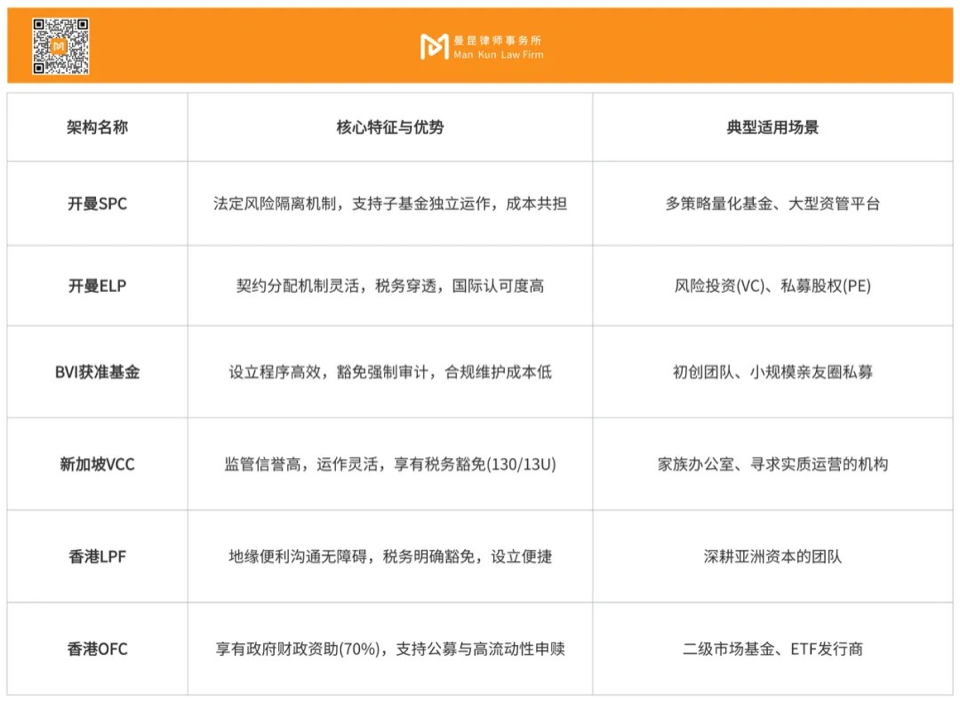
Overview of Core Features of the Six Structures
Based on the above analysis, the legal characteristics and applicable scenarios of the six mainstream fund structures are summarized as follows:
Conclusion
In the crypto asset sector, the question of fund structure is never “whether to establish one,” but rather “when to establish it and in what form”. Different legal structures correspond not only to how taxes are paid and how regulations are applied, but also to how risks are borne, how investors participate, and how future operational models are implemented.
The fund structures introduced in this article are not inherently good or bad;the key lies in whether they match your business model, investment strategy, and target investors. For managers who are already operating or plan to operate crypto assets in fund form, clarifying and finalizing structural issues early is itself an important form of risk control.
Authors of this Article
Zhang Qianwen, Senior Lawyer at Mankun Law Firm. Her practice areas include compliance for Web3 enterprise fintech, Web3 investment, mergers and acquisitions, strategic financing, and resolution of complex commercial disputes. Leveraging her interdisciplinary educational background, extensive cross-industry practical experience, and profound insights into the industry, she provides clients with one-stop legal solutions that are more commercially viable for the implementation of innovative businesses.
Cheng Chuying, Paralegal at Mankun Law Firm. Holds a Bachelor’s degree in Law (major) and Finance (minor) from Nanchang University, and a Master’s degree in International Financial Law from King’s College London. Deeply engaged in the Web3 field, focusing on cryptocurrency compliance, NFTs, and DeFi regulatory research. Committed to exploring rule construction and compliance pathways in the digital asset world from dual perspectives of law and finance.
About Mankun
Founded in 2015, Mankun Law Firm is a boutique law firm in China specializing in the Web3.0 new economy and deeply rooted in the blockchain industry. Members of the Mankun team possess unique and diverse industry backgrounds, hailing from renowned legal service institutions, national judicial organs, internet technology companies, crypto asset institutions, and blockchain industry think tanks.
Based on a profound understanding of the new economy, continuous attention to and research on policies and regulations, and rich practical experience, the Mankun team excels in providing comprehensive legal services from the perspectives of business models and legal practice. These services include business structure design, project financing, transaction planning, operational compliance, resolution of complex civil and commercial disputes, criminal risk prevention and control, and criminal defense for new economy enterprises in sectors such as Web3.0, blockchain, AI, NFTs, digital collectibles, crypto funds, crypto payments, DeFi, real-world assets (RWA), and GameFi.
Headquartered in Shanghai, Mankun Law Firm has branch offices in Hong Kong (China), Silicon Valley (USA), Shenzhen, Hangzhou, Zhengzhou, Chengdu, and other locations. To meet the global compliance development needs of Web3.0 industry clients, Mankun has established local offices in major global crypto-financial cities and selected local professional blockchain service partners, providing clients with professional legal and compliance services featuring global breadth and Chinese depth.