
Introduction
Where a token project party suspends redemption, an OTC desk is placed under investigation on suspicion of a crime, a borrower is suspected of illegal absorption of public deposits, or a wealth-management platform is suspected of fundraising fraud, victims are often trapped within criminal proceedings: they hold a case-filing notice, yet their asset losses cannot be recovered in a timely manner. This raises a question: apart from waiting for asset recovery and restitution in the criminal proceedings, can they bring a lawsuit in court themselves?
One view holds that once the public security authority files a case, civil channels are closed entirely; the other holds that criminal and civil proceedings do not interfere with each other, so a civil action may be brought at any time. Neither view is quite accurate: the former overlooks the existence of independent civil parties and independent legal relationships outside the criminal proceedings, while the latter overlooks the point of "the same facts."
What truly determines whether a separate action may be brought is whether the claims and the criminal facts on which the case was filed constitute "the same facts" in the legal sense.
I. The same facts are the starting point for the division of proceedings
(1) The same matter in everyday life is not necessarily the same facts in law
What we ordinarily call the same matter usually refers to the same investor, the same project, and the same payment. Once the matter enters judicial proceedings, however, what the judge must determine is not whether the facts of everyday life overlap, but whether the facts as legal elements overlap. Criminal law evaluates the defendant's conduct in obtaining property and the state of possession, whereas civil law evaluates contractual relationships, guarantee relationships, or tort relationships. Because the factual aspects examined differ, the conclusions may differ.
For example, where a project party is involved in a criminal case:
Where an investor transfers funds to the project party's account to subscribe for tokens and later claims restitution of the investment, this points to the same facts as the criminal case;
Where an investor entrusts funds to an agent to invest on the investor's behalf, and the agent, instead of investing in the project party as agreed, misappropriates the funds, the investor's claim against the agent for restitution does not involve the same facts as the criminal case;
Where a victim sues a third party that provided a joint and several guarantee for this investment, this does not involve the same facts.
(2) The four dimensions actually examined by the courts
1. Whether the defendant is the same entity, and whether the person sued is a criminal suspect or defendant in the criminal case;
2. Whether the scope of the funds involved overlaps with the amount of the crime as determined in the criminal case;
3. The basis of the claim: whether the claim is for return of contract price, for security liability, or for damages in tort;
4. Whether the factual findings in the civil case must depend on criminal case files that have not yet been formed.
The first three items determine whether the gateway to civil proceedings can be opened, while the fourth determines whether, once civil proceedings are commenced, they need to be stayed in the interim.
Among these four dimensions, so long as a key dimension falls within the scope already covered by the criminal case, the likelihood that the civil action will be barred increases.
(III) Scope of application of incidental civil actions
Many victims first consider whether they can bring an incidental civil action during the criminal trial and recover their investment funds and defrauded funds in one go. In fact, this route has a strict scope of application. The vast majority of cases involving token exit scams, illegal investment schemes, illegal fundraising, telecom fraud, contract fraud and similar property crimes of the misappropriation type do not fall within the scope of incidental civil actions.
The Interpretation of the Criminal Procedure Law provides that incidental civil actions accept claims for material losses suffered by victims as a result of their personal rights being infringed by a crime or their property being damaged by a criminal; where a defendant unlawfully possesses or disposes of a victim's property, the property shall be recovered or the defendant shall be ordered to make restitution, and where a victim brings an incidental civil action, the people's court shall not accept it.
In cases such as a token project party ceasing redemption, a platform exit scam, fundraising fraud or illegal absorption of public deposits, the perpetrator obtains and disposes of the victim's funds or tokens by deceptive means, which does not constitute damage to property; therefore, where an incidental civil action is brought seeking return of property in respect of principal, investment funds or loss of token value, the people's court shall not accept it.
The statutory remedy corresponding to such property crimes of the unlawful possession and disposal type is the system of recovery of illicit money and property and ordering restitution as provided in Article 64 of the Criminal Law. Recovery and ordering restitution are disposition measures within the criminal asset-recovery system; an incidental civil action itself proceeds together with and is attached to the criminal proceedings, but does not fall within the category of a separate action.
There are of course exceptions: where the criminal act simultaneously causes injury to the victim or damage to items, an incidental civil action may be brought in accordance with law in respect of the losses corresponding to the personal injury or property damage, but this does not cover claims for return of principal and investment funds.
II. Three paths are available to victims in such cases
A victim's options can be summarized as three paths, and which one is taken depends on who the defendant is and what the claim is.
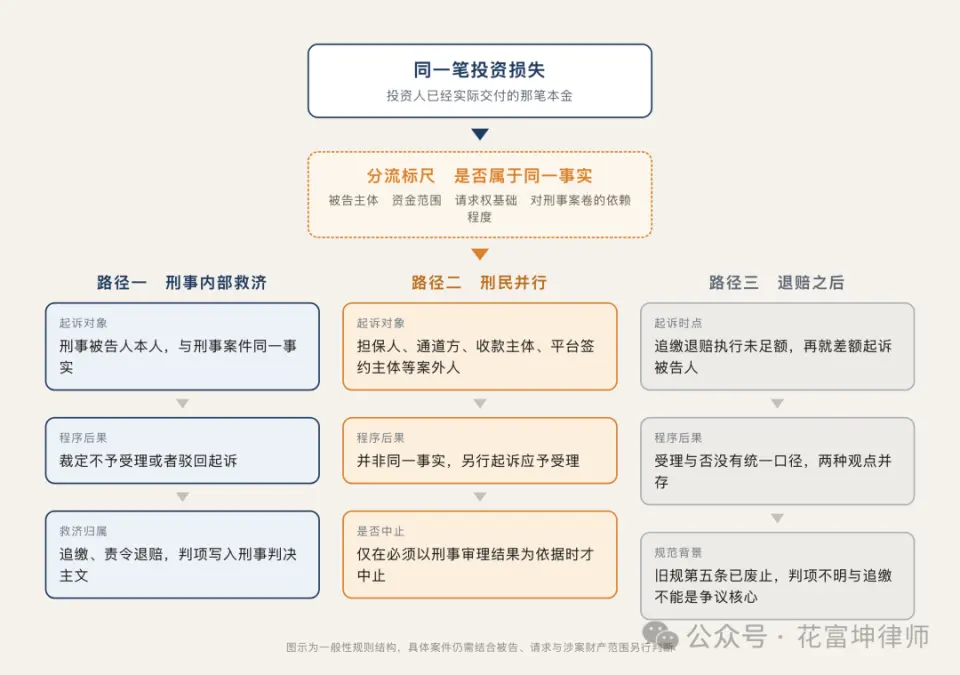
(1) Criminal recovery and restitution
This path is resolved within the criminal proceedings and is the most common. Where a victim files a civil action against a criminal defendant in the same facts seeking return of the same funds, the court generally will not accept the case or will dismiss the action. The remedy for these funds is instead undertaken through recovery and ordered restitution, with the ruling set out in the operative part of the criminal judgment; after the judgment takes effect, it proceeds to enforcement of the property-related portion of the criminal adjudication.
This path has three characteristics:
1. It is a measure for disposing of illegal gains implemented proactively by the judicial authorities and does not depend on the victim bringing a separate action;
2. The nature of the ruling is restitution of the victim's losses, not damages in the sense of civil liability, and therefore it does not give rise to derivative claims such as interest or liquidated damages;
3. Once the responsible property is insufficient to cover all debts, an order of priority must be applied.
Under Article 13 of the Provisions of the Supreme People's Court on Several Issues Concerning the Enforcement of the Property-Related Part of Criminal Adjudications, the order of satisfaction is: medical expenses in personal injury compensation, restitution of the victim's losses, other civil debts, fines, and confiscation of property; creditors who lawfully enjoy a priority right of satisfaction over the enforcement target are supported after medical expenses.
A victim's restitution claim has priority over ordinary civil debts but is subordinate to priority rights of satisfaction such as those of a bona fide mortgagee, which directly determines how much can be recovered in actual asset disposal.
(2) Parallel criminal and civil proceedings, with a separate action against a non-party
This means asserting liability against entities other than the criminal defendant, such as guarantors, channel parties entrusted with fund settlement, counterparties receiving payments in their own names, and the corporate entity that contracted externally for the project, all of which may become defendants.
Article 128 of the Minutes of the National Courts' Civil and Commercial Trial Work Conference (the "Jiumin Minutes") lists five categories of circumstances that should be tried separately, four of which are directly relevant to the content of this article:
where the debtor under the principal contract is suspected of a crime and the creditor requests the guarantor to bear civil liability;
where the act of a person concluding a contract in the name of a legal person, an unincorporated organization or another person is suspected of a crime and the counterparty requests that entity to bear civil liability;
where the performance of duties by a legal representative, responsible person or other staff member is suspected of a crime and the victim requests the legal person or unincorporated organization to bear civil liability;
where the victim requests an entity other than the person suspected of the criminal offense to bear civil liability.
The article further specifically notes at the end that, in practice, some courts still refuse to accept or dismiss the action in such circumstances, and this approach should be corrected.
In the crypto industry context, the conditions for applying this route are relatively clear, for example:
where the operating entity of a project developer is placed under case investigation, and investors file a separate action against an affiliated company that provided a guarantee for the investment;
where an individual OTC merchant is involved in a criminal case, and the victim asserts a claim for return against the entity that owns the collection account on the basis of its settlement obligation;
where staff of a custody service provider misappropriate and transfer assets without authorization, and the victim requests the service provider to bear entity liability.
If one is eager to recover the money, the first thought is often to sue the holder of the bank card that received the funds; in practice, once the nature of such funds is determined to be illicit proceeds, they point to the same set of facts as the criminal case, and at that point claims based on unjust enrichment or requests for return will mostly be dismissed.
(3) Whether a separate action may be brought for the shortfall remaining after restitution and compensation
This approach is disputed in practice: where a criminal judgment has already included a recovery or restitution order, and a shortfall remains after enforcement, and the victim files a separate civil action against the convicted defendant for the shortfall, the question is whether the court will accept the case at all.
This issue was once expressly addressed at the normative level. Article 5, paragraph 2 of the 2000 Provisions on Issues Concerning the Scope of Criminal Incidental Civil Actions provided that where recovery or restitution still cannot make up for the loss, and the victim files a separate civil action with the civil division of a people's court, the people's court may accept the case. However, that judicial interpretation was repealed on January 19, 2015 by the Supreme People's Court Decision on Repealing Certain Judicial Interpretations and Documents of a Judicial Interpretation Nature (Eleventh Batch).
Judicial decisions in practice likewise reflect two coexisting views:
One view holds that the criminal judgment already covers the victim's loss, that recovery and restitution orders may continue to be enforced at any time, and that re-entering civil litigation would cause duplicative evaluation and conflict between the criminal and civil judgments; on this view, such actions are not accepted at all.
The other view holds that where the criminal judgment itself is unclear, or where there is a shortfall between the amount actually enforced and the victim's actual loss that cannot be attributed to the same pool of property, the victim should be permitted to bring a separate action for the shortfall. This approach is reflected in certain typical cases, and its basis is usually the two specific situations of an unclear judgment and the impossibility of recovery.
The two views have not yet converged into a unified adjudicative standard, and victims cannot reasonably expect to obtain relief through civil litigation for the shortfall left by insufficient criminal restitution.
III. Limitations of Civil Remedies in Crypto Cases
Even where the conditions for parallel criminal and civil proceedings are met and the court permits a separate civil action, the adjudicative logic in disputes relating to the crypto sector differs significantly from that in traditional criminal-civil crossover cases involving property.
Under the Notice on Further Preventing and Addressing Risks Associated with Virtual Currency and Related Matters (Yin Fa [2026] No. 42), virtual currency does not have the same legal status as legal tender, and business activities relating to virtual currency constitute illegal financial activities. Arrangements including the exchange of legal tender for virtual currency, exchange between virtual currencies, token issuance and financing, and trading in financial products relating to virtual currency are strictly prohibited. The Notice further provides that where any unit or individual invests in virtual currency or related financial products in violation of public order and good morals, the relevant civil juristic act is void, and the resulting losses are borne by the investor.
In adjudication practice, transaction agreements such as those for tokens, USDT trading and OTC exchange are often held void, and some courts directly rule to dismiss the action on the ground that the relevant activities are not governed or protected by civil law.
Even where the case proceeds to substantive review, courts often do not recognize the validity of transactions asserted on the basis of tokens or USDT, nor claims for compensation calculated at real-time coin prices. They rarely uphold claims for the return of tokens or compensation at coin prices; instead, they either dismiss all claims or apportion the actual monetary loss in light of each party's fault.
This means that in crypto cases, even if the victim prevails in civil litigation, the relief actually obtainable is entirely different from that in ordinary private lending or contract disputes.
In summary
After the public security authorities open a case, whether the victim may separately bring a civil action depends primarily on the identity of the defendant sued, the substance of the claims, and whether the funds involved have already been brought within the scope of the criminal assessment of the offense:
Where the claim seeks the return of the same funds from the same criminal defendant, the court will generally not accept the case, and the remedy reverts to the criminal recovery and restitution procedures; however, where liability is asserted against a person outside the criminal case, the avenue of civil action remains available, and whether the proceedings should be stayed pending the outcome of the criminal case after acceptance must be determined separately in light of the facts of the individual case.
In particular, even where a dispute in the crypto space satisfies the conditions for parallel criminal and civil proceedings, this does not mean the claims will necessarily be fully upheld; they remain subject to special adjudicative rules concerning virtual currency regulation, the determination of contract validity, and the allocation of losses based on fault, and investors should hold reasonable expectations in this regard.

