

Understanding Crypto Fund Strategies, Logic, and Five-Year Performance
Introduction
Note Before Reading: This article is written from the perspective of international legal jurisdictions and does not target or apply to the legal environment of mainland China.
This year, I have increasingly heard traditional entrepreneurs ask one question:“I don’t understand the crypto market, but I want to know what crypto funds are all about.”
Some seek asset diversification; others aim to hedge against exchange rate fluctuations; still others simply feel that “institutions are starting to invest, so I can’t ignore it.”
But as soon as they open fund materials, business owners are immediately overwhelmed by various technical terms:
- Long Only ?
- Market Neutral ?
- Funding Rate ?
- Multi-Strategy ?
- Web3 VC ?
- CTA? Factor models?
More importantly:
What exactly are these strategies doing? Which ones are stable? Which ones have significant drawdowns? Who has actually made money over the past five years?
This article is written for you:
- Using straightforward language to explain how crypto funds are categorized
- What are the actual sources of profitability for each strategy?
- What are their respective advantages and disadvantages?
- What have been the actual performance trends over the past five years?
- How should entrepreneurs select crypto asset funds?
After reading this, you will basically be able to determine:
“Whether you are suitable for allocating to crypto asset funds, and which type is suitable for you.”
Why are an increasing number of traditional entrepreneurs beginning to consider crypto asset funds?
The reason is actually quite simple: crypto asset funds have evolved from a “speculators’ exclusive domain” into an institutional-recognized asset class. Three major trends are underway:
Trend 1: Global institutions are quietly increasing their crypto asset exposures
- BlackRock and Fidelity have launched Bitcoin and Ethereum ETFs
- JPMorgan Chase, Deutsche Bank, and others have begun to enhance crypto-related custody services
- Sovereign wealth funds, pension funds, and insurance capital have begun to allocate to digital assets
As institutional investors enter the market, the position of crypto assets has shifted. They are no longer considered unconventional or marginal practices, but have become part of alternative assets.
Trend 2: Crypto funds are far more professional than individual cryptocurrency trading
The crypto market is characterized by high volatility, 24/7 trading, complex derivatives, and rapid innovation.
However, for professional teams, this is not a problem but an opportunity:
- Clear trend signals → suitable for quantitative strategies
- Fragmented exchanges → arbitrage opportunities exist
- Perpetual contract mechanisms → funding rate income available
- Short innovation cycles → steep VC returns
- Transparent data → strategies are verifiable
Therefore, crypto funds can accomplish far more than ordinary investors.
Trend 3: Entrepreneurs’ asset allocation requires “new vehicles”
The real estate cycle is weakening, the A-share market experiences long-term volatility, Hong Kong stock valuations remain depressed, and while U.S. dollar assets offer high interest rates, their future remains uncertain.
Many business owners are now asking:
"Where will the incremental growth come from in the next five years?"
Crypto funds offer a new possibility:
- Offensive strategies (capturing trends)
- Defensive strategies (arbitrage)
- Betting on innovation (VC)
- The level of institutionalization is rapidly increasing
- Custody, auditability, and compliance are achievable
This is why crypto funds are becoming a new option for entrepreneurs' asset allocation.
Six Major Strategy Types of Crypto Funds
The following six categories represent the most widely used and entrepreneur-friendly classification framework in the industry today (based on Crypto Fund Research + Galaxy VisionTrack):
1. Discretionary Long-Only – Betting on cycles and capturing major trends
How to generate profits?
Purchase mainstream crypto assets (BTC, ETH, and leading altcoins), hold them for the long term, and add to positions on dips.
The core logic can be summarized in one sentence:
“Believe in the long-term appreciation of crypto assets and maintain your holdings.”
Advantages:
- Highest returns during bull markets
- Simple and transparent, with low costs
Disadvantages:
- Significant drawdowns during bear markets
- Requires a strong risk tolerance
Suitable for: Investors willing to bear volatility and focus on long-term trends.
2. Discretionary Long/Short Positions – Profit from both rising and falling markets; trading expertise is critical
How to generate profits?
Rely on the team’s market analysis:
- Bullish outlook → increase positions
- Bearish outlook → reduce positions or take short positions
- Event-driven strategies → capitalize on hot topics, airdrops, and upgrades
Simplified understanding: “Professional traders manage your positions.”
Advantages:
- Hedging is possible during market declines
- Lower volatility compared to long-only strategies
Disadvantages:
- Success heavily depends on the trading team
- Discernment capability is the core competitive advantage
Suitable for: those who wish to capture market opportunities but are unwilling to assume fully unhedged exposure.
3. Quantitative Directional Strategies (Quant) – Models Drive Decisions; Emotions Take a Back Seat
How does it generate profits?
Trading is executed using mathematical models:
- Trend-following CTA strategies
- Momentum strategies
- Multi-factor models
- Statistical signal indicators
You may understand this as:
“Automated trading that disregards news and avoids emotional speculation, operating strictly in accordance with the model.”
Advantages:
- Strong disciplinary adherence
- Strong performance when trends are clear
- Reduced human error
Disadvantages:
- Models may fail abruptly
- Sensitive to transaction costs
Suitable for: Investors seeking “more stable trend-based returns.”
4. Market Neutral / Arbitrage (Market Neutral / Arb) – One of the strategies with the lowest directional risk
How does it generate profits?
Construct amarket-neutralportfolio to capture spread and interest rate differentials.
Typical strategies:
- Funding Rate Arbitrage
- Spot–Perpetual Basis Arbitrage
- Cross-Exchange Spread
- Market Making
- On-Chain Low-Risk Yield Strategies
You may understand it as:
“A crypto version of a money market fund plus an arbitrage fund.”
Advantages:
- Lowest volatility
- Lowest risk
- Smallest drawdown
Disadvantages:
- Limited upside potential
- Risks lie with the counterparty (exchange) and on-chain technology
Suitable for: corporate idle funds and entrepreneurs seeking stable returns.
5. Crypto VC (Venture Capital / SAFT) – Betting on Innovation
How to Generate Returns?
Investing in early-stage Web3 projects, primarily through:
- Equity appreciation driven by project growth
- Token Generation Event (TGE)
- Exit via secondary market premium after token unlock
Similar to traditional venture capital, but with shorter cycles and higher volatility.
Advantages:
- A single successful project can cover all costs
- Grasp the future direction of the industry
Disadvantages:
- Low survival rate
- Long lock-up period
- Opaque valuation
Suitable for: Large capital seeking to bet on sectors and speculate on innovation.
6. Multi-Strategy – Combining several advantages
Simultaneously engaging in:
- Long-only strategies
- Quantitative strategies
- Arbitrage
- VC
- Event-driven strategies
Objective:
"Pursue comprehensive returns under controlled risks."
Advantages:
- Smaller drawdowns compared to long-only strategies
- Higher returns than arbitrage strategies
Disadvantages:
- Complex structure
- High demands on management capabilities
Suitable for: Entrepreneurs who are new to crypto funds and seek a stable market entry.
Summary: The advantages and disadvantages of the aforementioned strategies are summarized as follows:
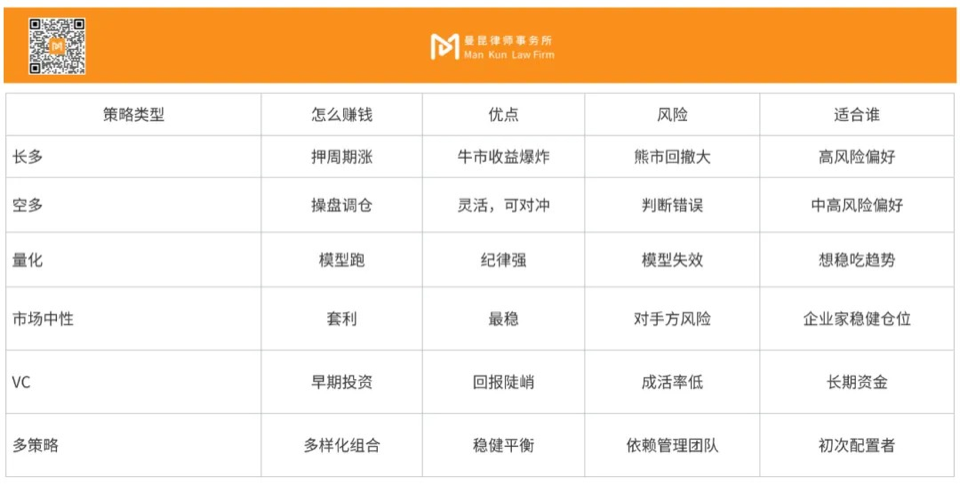
The Core Profit Logic of Crypto Funds
Why is the crypto market suitable for fund strategies? Because it has three structural characteristics not found in traditional markets:
1. Perpetual Contract Mechanism → Funding Rate Arbitrage Opportunities
Perpetual contracts are a structure unique to the crypto asset market.
Every eight hours, long and short positions must pay each other “interest” (the funding rate).
This means that:
“As long as the market is bullish, longs pay and shorts receive.”
Funds can therefore use:
- spot purchases
- perpetual short positions
to “lock in the price” and earn only the funding rate.
This constitutes one of the most stable sources of returns in crypto asset arbitrage.
2. Multi-Exchange Structure → Natural Price Discrepancy Opportunities
Due to:
- Proliferation of exchanges
- Fragmented liquidity
- Divergent aesthetics and preferences
- Lack of uniformity in stablecoin systems
Price discrepancies frequently arise between different exchanges.
Funds engage in the following through programmatic trading:
- Cross-exchange arbitrage
- Spot–futures arbitrage
- Futures–perpetual swap arbitrage
Such returns do not depend on “betting on direction,” but on “mathematics and speed.”
3. High volatility → trend-following strategies are more effective
In highly volatile markets:
- More pronounced trends
- Clearer signals
- Quantitative models have more robust data inputs
This is a key reason for the rise of crypto quantitative trading.
Performance of various strategies over the past five years
According to data from the VisionTrack Crypto Hedge Fund Indices, the annual returns for the four recorded strategy categories over the past five years are as follows:
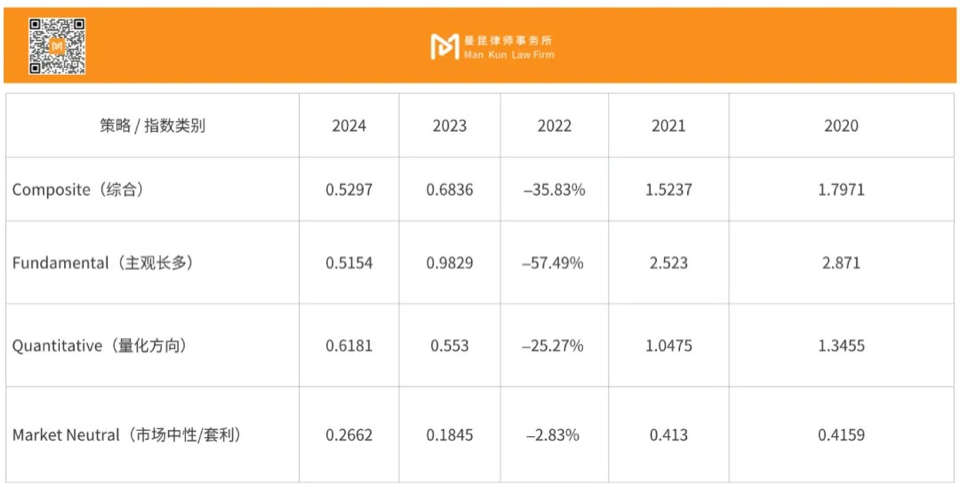
Based on a summary of trends in widely cited public indices within the industry, we summarize the returns for six strategy categories as follows:
1. Discretionary Long-Only: Sharpest Upside, Steepest Downside
- Bull markets: Best performance (e.g., 2017, 2020–2021, 2023)
- Bear markets: Largest drawdowns (e.g., 2018, 2022)
High elasticity, high volatility, high returns, and high risk.
2. Quantitative Directional: Medium-to-High Returns with Controllable Drawdowns
- Bull market: capturing trend exposure
- Bear market: model-driven position reductions to mitigate losses
Smoother equity curve, suitable for investors seeking “steady trend capture.”
3. Market-neutral arbitrage: the most robust strategy type
Overall characteristics:
- Annualized returns may not be high, but are stable
- Minimal drawdowns
- Suitable as a core portfolio holding or for corporate cash management
The industry’s historical trend is very clear:
“Stability, stability, stability.”
4. Crypto VC: extremely bifurcated returns
- Top-tier funds achieve remarkably high IRRs (by backing one or two superstar projects)
- Median fund performance is relatively mediocre.
- Long investment horizon, high risk, and high uncertainty.
Suitable for long-term capital; not suitable for short-term expectations.
5. Multi-strategy funds: the portfolio most readily accepted by entrepreneurs
Prudent, balanced, controllable, and suitable for entry-level allocation.
How should traditional entrepreneurs choose crypto asset funds?
Many business owners’ initial reaction is:“Which firm should I choose?”In fact, you should first ask yourself three questions:
1. Is this capital “disposable” or “needed for use”?
- Disposable capital → market-neutral, multi-strategy
- Intended for appreciation with tolerance for volatility → quantitative strategies, long-only
- Intending to bet on innovation → venture capital (VC)
The nature of the capital determines the strategy, not the other way around.
2. What level of volatility can you tolerate?
If a long-only fund has a maximum drawdown of -70%, can you accept that?
If not, then such strategies are not suitable for you.
3. What are you truly seeking: stability, balance, or high-growth potential?
Three paths:
- Stability: arbitrage/market-neutral strategies
- Balance: multi-strategy/quantitative strategies
- High-growth potential: discretionary long-only/venture capital (VC)
Clarify your objectives before selecting a fund.
Crypto asset funds are becoming the next generation of hedge funds
Today’s crypto market is no longer the wild west of 2018:
- There are ETFs
- There is custody
- There are audits
- There is regulation
- There are major institutions
- There is real-world industrial application
- There are mature strategy frameworks
Crypto funds do not represent speculation, but rather“an opportunity window for next-generation asset management strategies”Over the next five years, crypto funds will become increasingly important in entrepreneurs’ asset allocation frameworks. Not because they are mysterious, but because they have become mainstream. If you want to understand the crypto industry, you do not necessarily need to trade crypto assets yourself. You only need to understand:Who is using what strategies, and under what logic, to generate returns for you.
Still feeling uncertain and unsure about how to proceed?
If you have read this far, it indicates that you already have a foundational understanding of the strategic logic of crypto asset funds. However, the real challenge is not merely “grasping the concepts,” but rather:
- Which funds are worth investing in?
- Which strategies are suitable for the nature of your assets?
- Which “subtle clauses” in documents, structures, and fee arrangements may affect your future exit?
- Which risks are manageable, and which are structural risks?
- Which teams are truly institutionalized, and which are merely “retail operations cloaked in an institutional shell”?
There are no standard answers to these questions, yet they are directly related to the safety of your capital and the stability of your returns. I have observed the indecision of many entrepreneurs and have assisted numerous limited partners (LPs) in conducting fund due diligence, deconstructing structures, revising terms, and providing risk alerts. I have identified a pattern:
As long as you clarify the strategy, structure, and terms before investing, your experience with crypto asset funds will improve significantly.
If you are considering investing in a particular crypto asset fund, studying the strategic differences among several institutions, or seeking to prepare a professional legal/compliance due diligence report, you may contact me to further discuss your circumstances and requirements. Compliance structures, authenticity of strategies, operational transparency, fee terms, redemption mechanisms... these are all “hidden risks” that lawyers can help you filter out in advance.
You do not need to struggle through thick private placement memoranda (PPMs), supplements, and subscription agreements on your own; I can help you break down complex structures into key points that enable rapid decision-making.This allows you to invest with greater confidence and precision.If you have relevant needs, please feel free to contact me for discussion at any time.