

It is not a global passport, nor does it necessarily directly undertake front-end payment business, but it can serve as a compliance hub connecting digital asset services, multi-jurisdictional licenses and institutional due diligence.
On a group structure chart for a global crypto payment project, the easiest parts to arrange are usually the two ends: at the top, a holding entity can be established to handle equity, financing and group governance; at the bottom, US MSB, Canadian MSB, EU payment institutions or other local operating entities can be configured according to target markets to serve customers in different regions. What is truly difficult to arrange is often the middle layer.
This layer of entities must both undertake the group's core functions related to digital assets and be able to explain to banks, auditors, investors and partners: why the group handles virtual assets, how responsibilities are divided among the entities, who controls customer assets, and where responsibility for technology, brand, transactions and compliance respectively lies.
If all business is concentrated in a lightweight entity registered at an early stage, the original structure may soon be unable to support institutional due diligence as the project expands; but if the heaviest licenses are applied for in every market from the outset, not only are the costs high, but a business that is not yet mature may also bear unnecessary ongoing compliance burdens. It is precisely at this stage—where a light structure is no longer sufficient but heavy licensing is too early—that Cayman VASP has begun to enter the structuring plans of some global crypto payment, real-world assets (RWA), stablecoin and asset tokenization projects.
However, it should first be made clear that:
A "compliance hub" is not a license category prescribed by law, but rather a structural role that a Cayman VASP may assume within a group structure.
Cayman VASP is no longer the "simple registration" of the past
Some projects still understand Cayman VASP at an early stage, believing that as long as a Cayman company is established and a basic business plan and AML documents are submitted, a low-cost virtual asset compliance status can be obtained. This understanding is no longer complete.
According to the current public guidance of the Cayman Islands Monetary Authority (CIMA), Cayman VASP regulation entered its second phase on April 1, 2025. Institutions providing virtual asset custody services or operating virtual asset trading platforms need to apply for a formal VASP licence; existing registered institutions that actually carry out the above businesses also need to transition into the licensing regime in accordance with transitional arrangements. At the same time, other digital asset services falling within the VASP definition still need to complete registration, licensing or exemption procedures according to the nature of the business.
The scope of virtual asset services covered by Cayman law is not limited to exchanges and custody; it also includes exchange between virtual assets and fiat currency, exchange between different convertible virtual assets, transfer of virtual assets, and participation in the issuance or sale of virtual assets while providing related financial services. Whether a project ultimately follows the registration path or the licensing path cannot be determined solely by whether the company externally uses names such as "wallet", "payment" or "technology platform"; rather, it depends on whether it actually controls customer assets, operates a matching trading venue, or completes value transfers on behalf of customers.
After 2025, CIMA further strengthened prudential regulatory and governance requirements, including more complete organizational structures, fit-and-proper reviews of directors and senior management, cybersecurity, internal controls, reporting and ongoing supervisory requirements. For all registered or licensed VASPs, annual fees, regulatory reporting and AML/CFT/CPF obligations are also not mere formalities that can be ignored once the status is obtained.Therefore, when discussing Cayman VASP today, it cannot simply be understood as "an offshore license that is easy to obtain"; more accurately, it is a digital asset regulatory status that has gradually moved from a registration system into a complete supervisory system.
Why is it suitable for placement in the "middle layer" of a group structure?
The most realistic value of a Cayman VASP for global projects is not necessarily conducting business directly with end users in all countries, but rather helping the group establish a relatively clear digital asset function layer.
Suppose a stablecoin payment group operates simultaneously in North America, Europe and Asia. Fiat currency collection and payment, merchant settlement and local customer service in different regions may be undertaken respectively by locally licensed entities or partner institutions; however, the group still needs to determine which entity is responsible for digital asset exchange, on-chain transfers, wallet technology, liquidity arrangements, token-related services and group-level risk management.
If these functions are dispersed across multiple companies, or are undertaken over the long term by a technology company without a clear regulatory identity, banks and investors often find it difficult during due diligence to determine the group's true business boundaries. A Cayman VASP may instead serve as the group-level digital asset service entity, concentrating specific virtual asset functions into an entity regulated by CIMA that can be examined and explained.
This does not mean that all funds must enter the Cayman company, nor that all customer contracts must be signed by the Cayman entity; rather, through business layering, different entities assume different roles: the local payment entity handles fiat currency and the local market, the Cayman VASP handles digital asset functions consistent with its registration or licensing scope, and the holding entity handles equity and group governance.
From a structural design perspective, this arrangement may bring three benefits. First, the group's legal role is easier to explain. Second, digital asset risks can be layered separately from other business modules. Third, institutional due diligence will have a clearer entry point for materials.
Registration or licensing depends on what the project actually controls
When a project decides to use a Cayman VASP, the most common mistake is to first decide to "apply for a Cayman license" and then adjust the product description in reverse, hoping that all business can fall within the lower-cost registration pathway.
However, the current Cayman regime already clearly distinguishes registration from licensing. Virtual asset custody and virtual asset trading platforms are licensed activities; if a project actually safekeeps customer assets or controls the tools that enable customers to control virtual assets, or operates a platform that matches virtual assets with fiat currency or virtual assets with virtual assets on behalf of third parties, it needs to be assessed under the licensing regime.
For projects that mainly provide virtual asset transfer, exchange or issuance-related services but do not undertake licensed custody and trading platform functions, the registration pathway may apply, but judgment is still required based on the specific product, wallet control methods, order execution mechanisms and counterparty relationships. CIMA also expressly requires application materials to include a detailed business plan, transaction flow charts, blockchain addresses, group structure, cybersecurity policy, AML/CFT systems and outsourcing agreements; if business descriptions are inconsistent across different documents, policy content is too general or the organizational structure is unclear, the application may be required to be amended and may even be delayed as a result.
For example, if a project describes itself as a "non-custodial payment technology platform" but in fact the platform controls the collection wallet, determines the timing of exchange and transfers assets according to customer instructions, its actual business may differ significantly from pure technical services. Conversely, if a project only provides software interfaces, customers always control private keys, and exchange and settlement are independently completed by other licensed institutions, the virtual asset service functions it itself undertakes may be relatively limited.
Therefore, whether registration or licensing applies cannot be determined by changing the product name; it is necessary to return to three core questions: Does the platform control customer assets? Does the platform complete virtual asset transfers or exchanges on behalf of third parties? Does the platform operate a venue with matching and trade execution functions?
The "cost-effectiveness" of a Cayman VASP derives first from path matching, not from choosing the lightest application category.
What problems can a Cayman VASP not solve for a project?
A Cayman VASP can become an important part of a group structure, but it is not a pass that covers global business.
First, it does not automatically authorize a project to enter the markets of other countries or regions. Even if a project has obtained Cayman registration or a license, if it conducts regulated business with customers in the United States, the European Union, Hong Kong, Singapore or other regions, it still needs to assess local payment, money transmission, virtual asset, securities and marketing rules.
Second, it cannot guarantee bank account opening or access to payment channels. Banks will independently review a project's customer sources, target markets, transaction scale, fund paths, sanctions risk, customer asset protection and counterparties. A Cayman VASP can improve the explainability of a business structure, but it cannot replace a financial institution's own risk appetite and approval procedures.
Third, it cannot reasonably concentrate all group functions in a single entity. If a Cayman company externally claims to provide only digital asset technology or transfer services, but in fact also handles customer fiat currency, provides local merchant acquiring, operates yield products or actively solicits customers in specific markets, then the project may simultaneously trigger other jurisdictions and other types of financial regulation.
Finally, it is not an architectural shell that can be left unmaintained for the long term after acquisition. Whether a Cayman VASP can become a cost-effective structure depends not only on application costs, but also on whether the project truly has the capacity for ongoing maintenance and institutionalized operations.
Which projects are more suitable for considering a Cayman VASP?
The first category is projects that have already formed a multi-entity, multi-market structure and need to establish a group-level digital asset services entity.Such enterprises may already hold a US MSB, Canadian MSB or other regional license, but their digital asset functions remain dispersed, and the group structure lacks a regulatory node that can provide unified explanation and management.
The second category is crypto payment and asset tokenization projects preparing to serve institutional clients, funds, family offices or large merchants.Such counterparties usually conduct stricter due diligence on group structure, beneficial owners, customer assets, transaction processes and regulatory status, and relying solely on an ordinary offshore company is often insufficient to meet their explanatory needs.
The third category consists of projects that need to establish a long-term structure for financing, real-world assets (RWA), token issuance, or cross-border cooperation.Whether a Cayman entity is applicable must be determined in light of token attributes, issuance arrangements, investor locations, and group functions; however, its mature international corporate structuring environment often leads projects to include it in the overall plan for comparison.
However, if a project currently serves only one local market and its core issues are local fiat payment, merchant acquiring, or bank accounts, then a local payment license may take priority over a Cayman VASP. If a project merely hopes to obtain, at low cost, an "international license" that can be used for external promotion, but lacks genuine digital asset business, a governance team, and sustained compliance capabilities, Cayman may not necessarily be a suitable choice.
What can Mankun Law Firm deliver for projects?
The real difficulty in a Cayman VASP project is usually not filling out an application form, but unifying the group structure, product functions, fund flows, and application materials into a single coherent logic.
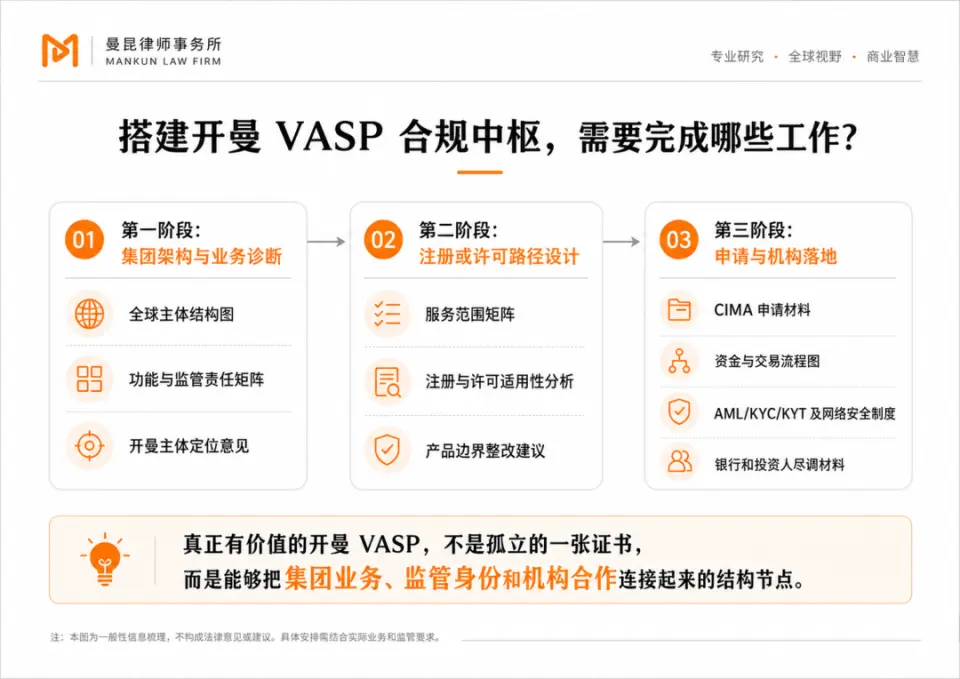
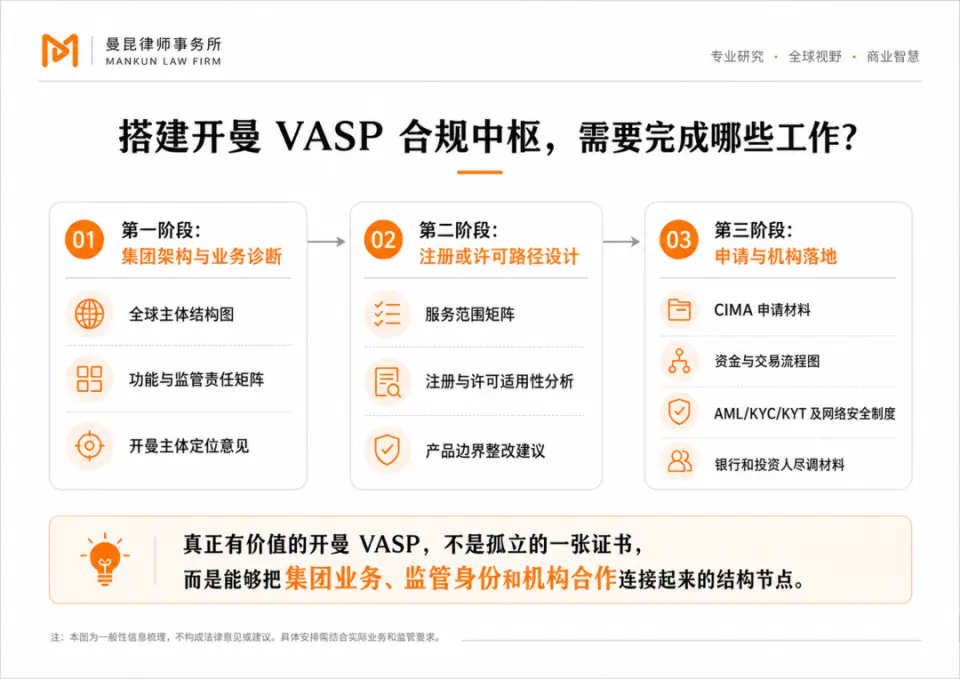
First, Mankun Law Firm can, based on the project's existing entities, target markets, customer types, digital asset service content, and future expansion plans, diagnose the role of the Cayman entity within the group and produce a Global Entity and License Structure Analysis, a Cayman VASP Business Model Compliance Diagnostic Opinion, and a Group Function and Regulatory Responsibility Matrix. The goal of this stage is to determine whether the project genuinely needs a Cayman VASP, and which functions the Cayman entity should and should not undertake.
Second, Mankun Law Firm can, based on how the product actually operates, classify virtual asset exchange, transfer, custody, trading platform, and issuance-related services, determine whether the project is suited for registration, licensing, or needs to adjust its business boundaries, and produce a Cayman VASP Registration and Licensing Applicability Analysis, a Proposed Service Scope Matrix, and Product Function Remediation Recommendations.
After the path is determined, Mankun Law Firm can also assist the project in preparing a group structure chart, transaction flow chart, on-chain and off-chain fund flows, customer asset control analysis, business plan, AML/KYC/KYT policies, cybersecurity policy, outsourcing management arrangements, and fitness and propriety review materials for directors and major shareholders.
For projects that need to simultaneously engage with banks, audit firms, investors, and other licensed counterparties, Mankun Law Firm can further build on the license materials to produce a Group Compliance Statement, a Bank and Institutional Due Diligence Materials Package, an Affiliate and Service Relationship Description, and a ongoing compliance calendar, so that the documents formed during the application stage can continue to serve account opening, financing, and institutional cooperation rather than being shelved after approval.
Conclusion: Cost-effectiveness is not about being cheap, but about a structure that can be reused over the long term
The reason some projects underestimate the Cayman VASP is that, unlike a local payment license, it does not directly correspond to a massive end market, nor, like a bank account, can it immediately solve payment collection and disbursement issues.
However, for projects that have entered the stage of globalization, multiple entities, and institutionalization, what is truly scarce is often not another operating company, but a regulatory node that can undertake digital asset functions, align with group governance, and be understood by banks, auditors, and investors.
Therefore, when assessing a Cayman VASP, a project should not ask only about application fees and timelines, but should further confirm: what function is the Cayman entity intended to perform within the group? Does the business require registration or a licence? Which clients and funds will enter this entity? How will it divide responsibilities with licensed entities in the United States, Canada, Europe or Asia? Can the application materials continue to be used for banking, financing and institutional due diligence?
The high cost-effectiveness of a Cayman VASP is not because it is the cheapest, but because a correctly designed structure can be used repeatedly in licence applications, group governance, institutional due diligence and global expansion.
In the next article, we will continue the discussion: Global Crypto Payment Compliance Map · Advanced Series ④ — VASP Licence Landscape: Where Exactly Should Crypto Companies Go to Obtain a Licence? Stay tuned.
Mankun Law Firm has long focused on new economy sectors such as Web3, crypto payments, stablecoins, real-world assets (RWA), AI going global and technology finance, and provides project parties, payment institutions, wallet and custody institutions, trading platforms, cross-border enterprises and investment institutions with comprehensive legal services including global licence planning, group structure and business model compliance assessment, fund path design, AML/KYC/KYT system development, bank and institutional due diligence support, regulatory communication, dispute resolution and criminal risk prevention and control.
/ END.
*This article is an original article of Mankun Law Firm and represents only the personal views of the author. It does not constitute legal consultation or legal advice on any specific matter. For reprinting and legal consultation, please add our customer service:mankunlawyer。

