
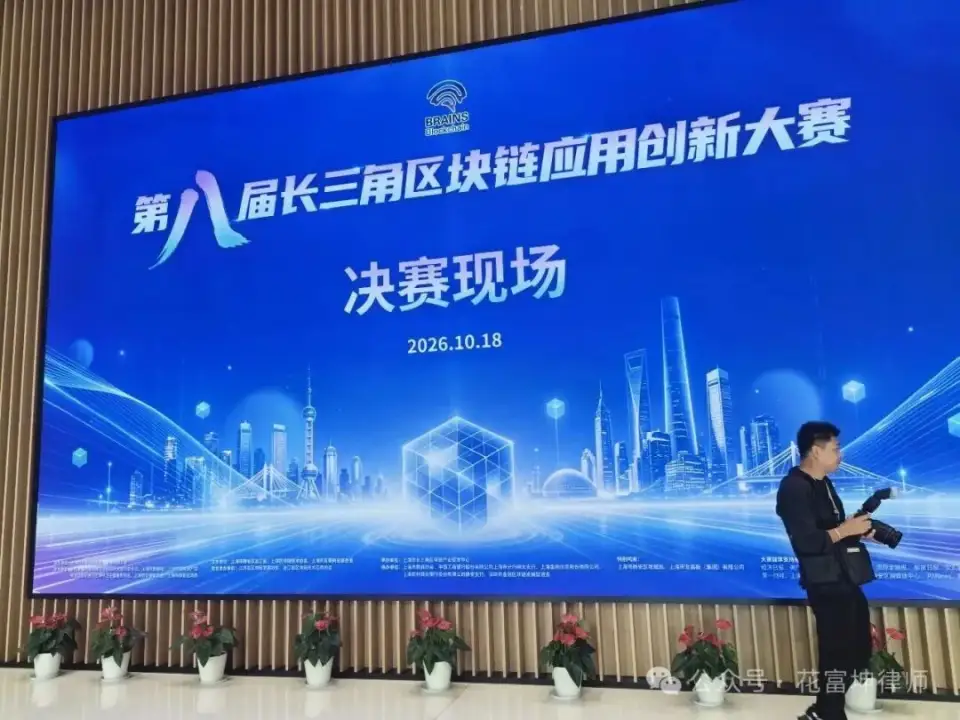
"This event reminded me of the days when I served as a judge at various startup competitions..."
Huage attended this event yesterday and was moved by it; let me share a few thoughts.
Because I have too many friends around me, including many lawyers and entrepreneurs, whose first reaction whenever blockchain is mentioned is virtual currency.
But blockchain is not the same as virtual currency!
This is also something I have mentioned when chatting with many friends: virtual currency is merely one business scenario within blockchain technology and the Web3 field.
The state encourages blockchain technological innovation and industrial implementation. The reason it currently adopts a prohibitive policy toward virtual currency is out of consideration for national financial security, and also to prevent the majority of ordinary people from being dragged into fundraising fraud schemes and losing everything.
But one should not overlook the payment conveniences that stablecoins bring to cross-border trade and the like; I will not elaborate on this point for now.
The state encourages and advances the digital transformation of all industries, which inevitably means that all industries will rapidly accumulate large amounts of data resources.
On this basis, all industries are also accelerating the implementation of AI, and the control, use, and flow of massive data will naturally create real demand for blockchain technology.
Data has gradually become a new factor of production. When data needs to flow and be shared among governments, enterprises, and medical institutions, everyone wants to unlock the value of data while also fearing data leaks, misuse, and unclear rights and responsibilities.
Blockchain can provide a trusted credential system that helps achieve data being "usable but not visible, controllable and traceable."
Then this kind of situation will no longer occur:
Suppose you are a professional photographer and you take a beautiful landscape photograph. While using this photograph in the ordinary course, you suddenly receive a summons: an image agency is suing you for infringement.
Only upon reviewing the other party's evidence do you discover that the photograph they rely on to assert rights and sell is precisely the one you yourself took. How awkward.
Major technology companies are now all deploying blockchain applications:
For example: records of migrant workers' employment and wage payments; circulation and tamper-proofing of investment bank confirmations; interoperability of underground space exploration data; quality records for airport terminal construction; emissions trading; trusted data spaces for chronic disease healthcare; and so on.
If blockchain could be used on a broad scale for recording migrant workers' employment records and wage payments, it would be much easier for civil litigation lawyers representing migrant workers in labor arbitration cases to obtain and present evidence.
At present, the most widely deployed industrial application in China is the consortium chain:
The focus of China's blockchain industry is on serving the real economy, government coordination, and trusted circulation of data elements, rather than token issuance and asset speculation.
Therefore, at this stage the consortium chain is unquestionably the main arena and a key direction of national deployment, with the most mature industrial ecosystem and the largest number of implemented cases.
A number of domestic blockchain technology foundations, such as ChainMaker, Xinghuo Blockchain Internet and BSN, have already been extensively deployed in scenarios including government affairs, taxation, judicial record-keeping, supply chains, cross-border trade and green rights trading, and are used by many ministries and commissions, central state-owned enterprises and local platforms.
However, blockchain is not a universal remedy.
The chain can only ensure that records after being uploaded to the chain cannot be tampered with, but it cannot automatically ensure that the original data entered onto the chain is itself authentic.
Therefore, verification of data sources and determination of ownership still cannot be separated from the standardization of real-world business processes and the support of legal provisions.
This path still requires continued exploration, but it must be taken, and it will certainly be taken.
Disclaimer: The content of this article is provided solely for general legal education and does not constitute any legal advice or legal consultation. Reading or forwarding this article does not create any attorney-client relationship. Individual legal issues are highly fact-specific; it is recommended that you obtain professional legal advice from a practicing lawyer regarding your specific circumstances.

