

Is it safe to cash out in Hong Kong?
Special Disclaimer: This article is an original work by Attorney Shao Shiwei. It reflects only the personal views of the author and does not constitute legal advice or a legal opinion on any specific matter. For article reprints, legal consultations, or professional exchanges, please add: sswls66.
“Safe fiat on-ramps and off-ramps” represent a challenge that crypto market participants, especially those in mainland China, cannot avoid. Under the current legal framework, how to avoid fraud, bank card freezes, and reduce friction costs are topics of concern to every crypto market participant. Attorneys at Mankun Law Firm also frequently hear friends discussing “how to safely conduct fiat on-ramps and off-ramps.” In the market, although answers vary widely, the operational methods generally fall into several categories:
- Cashing out through acquaintances or referrals
- In-person offline transactions
- Using USDT-backed cards (U Cards) or Virtual Credit Cards (VCCs)
Recently, with the opening of policies for virtual asset exchanges in the Hong Kong Special Administrative Region, attorneys at Mankun Law Firm have heard another answer:Going directly to Hong Kong to cash outAdditionally, while browsing online forums such as Binance Square, attorneys at Mankun Law Firm came across a rather “interesting” cash-out scheme, which we share here for informational purposes.
Using Hong Kong credit cards for spending in mainland China
According to the shared experience, crypto market participants seeking to cash out can do so by using Hong Kong credit cards. The general process involves applying for a Hong Kong credit card at a bank in Hong Kong and then making purchases in mainland China. According to the sharer’s experience, they have been using a Hong Kong credit card for over two years; such cards generally work without obstruction in mainland China and may also enjoy cashback rewards of 4%–6% or points redemption benefits offered by certain banks.
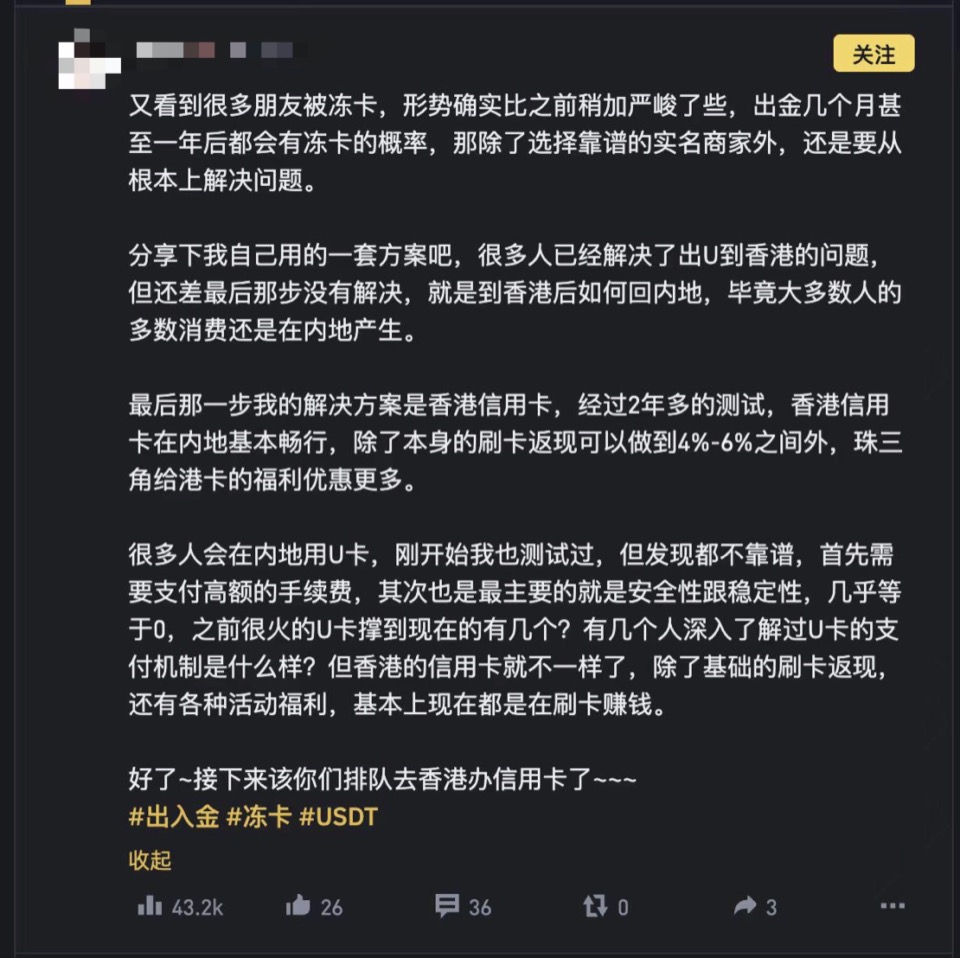
In practice, cardholders can use their Hong Kong credit cards for daily expenditures in mainland China, such as shopping and dining, and subsequently repay the credit card bill by selling virtual assets (such as USDT) in Hong Kong. Ideally, this cash-out method could meet most of the cash-out needs of mainland users:
- Reduce transaction friction costsThrough credit card cashback or discounts, players can reduce friction costs and improve capital efficiency.
- Evade fund regulatory issues.By making purchases with Hong Kong credit cards and repaying them in Hong Kong, individuals can evade certain mainland China regulations on large-scale capital flows, thereby reducing the risk of asset freezes or investigations.
- Relatively high level of securityAs Hong Kong has opened up virtual asset trading, crypto community participants generally believe that withdrawing funds through licensed virtual asset exchanges in Hong Kong not only alleviates concerns about withdrawal fraud but also reduces the risk of bank account freezes due to receipt of illicit funds.
Nevertheless, the core issue remains: For mainland China-based crypto community participants, is withdrawing funds in Hong Kong safe, and by extension, is this credit card usage method truly reliable?
Is withdrawing funds in Hong Kong safe?
Although the Securities and Futures Commission (SFC) of Hong Kong has implemented the latest virtual asset regulatory policies, allowing all licensed Virtual Asset Service Providers (VASPs) to legally provide virtual asset trading services to Hong Kong retail investors, it is important to note that the definition of "Hong Kong retail investors" is highly restrictive.
On one hand, according to the relevant regulations of the Hong Kong SFC, the services provided by licensed exchanges are primarily targeted atlocal residents holding Hong Kong Identity Cards or overseas individuals holding long-term visas,which means that mainland China residents cannot be directly classified as Hong Kong retail investors. In practice, even if mainland China residents can register on virtual asset exchanges, including OSL, HashKey Exchange, and HKVAX, they are currently unable to complete Know Your Customer (KYC) verification due to the stringent requirements.
On the other hand, mainland China maintains stringent regulatory oversight over virtual asset trading. The Notice on Further Preventing and Disposing of the Risks of Virtual Currency Trading and Speculation, issued in September 2021, explicitly prohibits residents of mainland China from participating in virtual currency transactions. Therefore, even if mainland residents are able to register and engage in virtual asset trading in Hong Kong through certain means, they may still be subject to the impact of policy changes, such as account freezes during the compliance processes of virtual asset exchanges, particularly where large-scale cross-border fund transfers are involved.
If you believe that you can cash out through unlicensed virtual asset exchanges, such as Bybit (mentioned earlier as being open to registration by Chinese residents), or through offline face-to-face transactions or introductions via acquaintances, user safety may be significantly compromised.
- First, in the event of a transaction dispute, users may lack legal protection.
- Second, such platforms or over-the-counter (OTC) traders may pose significant risks regarding transparency, fund security, and account privacy.
- Furthermore, there is a heightened susceptibility to involvement with funds from illicit or gray-market activities, which may draw the attention of regulatory authorities to your account and potentially trigger money laundering risks, thereby leading to more severe legal consequences.
If you have completed registration and passed know-your-customer (KYC) verification through certain means, you should also pay attention to compliance issues related to credit card usage.
Are Hong Kong credit cards reliable?
Based on the sharing and analysis above, Hong Kong credit cards can be used as a tool and channel for cashing out. However, you may not be aware that there are restrictions and compliance issues associated with using credit cards.
1 .Monitoring of frequent cross-border spending
Large-value and frequent cross-border spending may trigger risk monitoring by banks.
If mainland China-based crypto players rely on Hong Kong credit cards for their daily expenses, make large-value purchases in mainland China, or frequently use their credit cards within a short period, this may attract the attention of banks’ risk control departments. Credit card transaction monitoring mechanisms will identify such abnormal spending patterns and may trigger bank reviews or restrictive measures, such as requiring supplementary documentation regarding the purpose of the transactions.
You might think that applying for multiple credit cards could circumvent this issue. However, under the Foreign Exchange Administration Regulations and the Anti-Money Laundering Law of mainland China, the annual foreign exchange quota for each individual in mainland China is limited to USD 50,000. This means that if your total annual expenditure exceeds this limit, the credit card route will not be viable.
2. Review of the Source of Repayment Funds
Although repayment in Hong Kong dollars avoids the direct use of virtual assets, banks still impose compliance requirements on large-value repayments. Banks may trace the source of high-value repayments identified as abnormal to ensure the legitimacy of the funding source. If the source of funds is unclear or poses money-laundering risks, the bank may temporarily freeze the account or restrict transactions, and may require the cardholder to provide proof of the legitimacy of the funds.
Furthermore, during the tracing of repayment funds, if it is discovered that the USDT funding source involves Renminbi or other foreign currencies, forming a “fiat currency–USDT–Hong Kong dollar” chain, this may trigger foreign exchange violations and even expose the parties to criminal liability.
Summary by Mankun Lawyers
While using Hong Kong credit cards to cash out virtual assets may offer convenience to crypto participants in certain scenarios, the compliance implications of cross-border cash-out remain a significant concern amid increasingly stringent capital controls and anti-money laundering regulations. For mainland China-based crypto participants, the legal risks associated with virtual asset transactions and the strict monitoring of fund flows may at any time trigger asset freezes or legal investigations. When deciding whether to engage in virtual asset transactions or choosing any cash-out method, do not focus solely on immediate convenience while ignoring potential legal risks. A prudent strategy is to ensure legality and compliance, so as to avoid paying a high legal price due to momentary oversight.

/ END.
Recommended Reading:
- Mankun Lawyer Case Analysis: How Can Blockchain Projects Prevent the Risk of Illegally Absorbing Public Deposits? | Guide to Criminal Risk Prevention for Web3 Startups (Part 5)
- Mankun Web3 Research: Is Bitcoin (BTC) Mining Rising to National Strategy Status? Address Environmental Concerns First!
Author of this article | Lawyer Shao Shiwei