
On July 22, Amazon sent a notice to third-party sellers: if product images and A+ content contain photorealistic AI-generated persons, a specified metadata keyword must be written into the image file before upload; Amazon will use this to display a notice label to consumers on the product page. What triggered this notice is a New York State law that took effect on June 9.
If you sell goods on Amazon, or if you happen to run a tool company that produces AI-generated images for cross-border sellers, this rule has already entered your daily upload actions. It is not a distant news item; it is a condition for whether your images can be posted.
The timing is also coincidental. On August 2, the transparency obligations under Article 50 of the EU Artificial Intelligence Act begin to apply, and the California AI Transparency Act begins operating on the same day. In the eleven days from the 22nd of this month to the 2nd of next month, cross-border sellers' image-generation processes must simultaneously accommodate three sets of rules.
What exactly does the New York State law regulate
First, let us explain this law clearly; everything that follows grows out of it.
New York State Senate Bill 2025-S8420A amended Section 396-b of the General Business Law, was signed by Governor Hochul in December 2025, and took effect on June 9, 2026. The core obligation it adds is just one sentence: a person engaged in the business of selling goods or services, when producing an advertisement for commercial purposes, ifknowingthe advertisement contains a "synthetic performer," must conspicuously disclose this in the advertisement; the first violation carries a fine of USD 1,000, and subsequent violations carry a fine of USD 5,000.
For any foreign statutory provisions cited below, the official English original is listed first, followed by a Chinese translation. The translations are made by the author for understanding only, and the official text controls.
New York General Business Law Section 396-b(3)
Any person engaged in the business of dealing in any property or service who for any commercial purpose produces or creates an advertisement respecting any such property or service, in any medium or media in which such advertisement appears, shall conspicuously disclose in such advertisement that a synthetic performer is in such advertisement, where such person has actual knowledge. A violation of this subdivision shall result in a civil penalty of one thousand dollars for a first violation, and five thousand dollars for any subsequent violation.
Translation: Any person engaged in the business of selling goods or services who produces or creates an advertisement for any commercial purpose regarding such goods or services shall, in any medium or media in which the advertisement appears, conspicuously disclose that the advertisement contains a synthetic performer when such person knows that the advertisement contains a synthetic performer. A violation of this subdivision shall be punishable by a civil penalty of USD 1,000 for the first violation and USD 5,000 for each subsequent violation.
The key lies in how the four words "synthetic performer" are defined. The definition given in the provision has three conditions, all of which must be met simultaneously: a digital asset created, copied, or modified using generative AI or software algorithms; intended to make people believe that this asset is performing as a real person; and,cannot be recognized as any identifiable real performer。
New York General Business Law, Section 396-b(1)(c)
(c) "Synthetic performer" means a digitally created asset created, reproduced, or modified by computer, using generative artificial intelligence or a software algorithm, that is intended to create the impression that the asset is engaging in an audiovisual and/or visual performance of a human performer who is not recognizable as any identifiable natural performer.
Translation: (c) "Synthetic performer" means a digital asset created, reproduced, or modified by computer, using generative artificial intelligence or software algorithms, that is intended to create the impression that the asset is engaged in an audiovisual performance and/or visual performance by a human performer, where the performer cannot be identified as any identifiable natural person.
The third condition is the easiest to overlook when reading and the most counterintuitive. It means that this law does not govern whether an image was made by AI, but whether you have used a fabricated fake person to pass off as a real person performing. If you use AI to generate a nonexistent female model wearing your dress, that falls squarely within its scope; if you hire a real model to shoot photos and then use AI to modify skin tone, hairstyle, or background, as long as viewers can still recognize that it is her, it instead falls outside the scope of this law, because she is an identifiable natural person.
The latter practice is of course not without risk; it simply shifts to a different remedial path. Section 5 of the statute specifically states that this section does not diminish any rights under Sections 50, 50-f, and 51 of the New York Civil Rights Law, which is the domain of portrait rights and publicity rights. New York divides "fabricating a fake person" and "altering a real person" into two sets of rules and two channels: the former is treated as an advertising transparency issue, and the latter as a personality rights issue. This dividing line follows the same approach as the "identifiability" standard repeatedly used by Chinese courts in the series of AI face-swapping and AI voice cases. Whether the person can be recognized determines which set of rules applies.
The law also leaves three exemptions: promotional materials for expressive works such as films, television programs, streaming content, documentaries, and video games are not covered, provided that the use of the synthetic performer in the advertisement is consistent with the work itself; purely audio advertisements are not covered; and the mere use of AI to provide language translation for a real person is also not covered.
A fine of USD 1,000—why no one really takes it seriously
USD 1,000 per violation, USD 5,000 for repeat violations—is that all?
That reaction is not wrong. This law is indeed relatively lenient in its enforcement design.
The subjective element first sets a threshold; the provision states "where such person has actual knowledge," so penalties apply only with actual knowledge. If you genuinely did not know about stock materials purchased from an image library or images produced by an outsourced agency, this provision itself is not easy to apply to you.
The provision also does not specify who imposes the penalty. It only states that violation of this subsection shall be subject to a civil penalty; it neither designates an enforcement authority nor expressly grants consumers a private right of action, and under New York's general practice, enforcement mainly relies on the State Attorney General. A comparison with California's contemporaneous AI Transparency Act shows the gap: that law clearly sets out the enforcement entities—the Attorney General, city attorneys, or county counsel may bring civil actions, with USD 5,000 per violation, andeach day of violation counts as a separate violationA daily calculation versus a per-instance calculation differs by orders of magnitude in deterrent effect.
For Chinese sellers, there is also a layer of jurisdiction in between. The goods are displayed on pages visible to New York consumers and shipped to New York, so a connecting point exists, but completing the entire process of investigation, determination and recovery costs far more than the USD 1,000 itself.
So looking only at the statutory text, this rule amounts to little more than paper deterrence. What made all sellers change their processes within a week was not New York State, but Amazon.
The platform clearly could have done nothing, so why did it take this on voluntarily?
This is the most legally noteworthy aspect of the entire matter.
In the same statute, there are two provisions that specifically leave openings for platforms. Subsection 8 states that this section does not apply toany medium used for advertising, and the provision enumerates one by one newspapers, magazines, television stations, streaming services, cable television systems, billboards and transit advertising. This is an unconditional exemption, with no attached condition such as "the exemption is lost if the content is not removed after written notice." Subsection 6 adds further: this section does not reduce or expand the protection afforded to interactive computer services by Section 230 of the Communications Decency Act of the United States.
New York General Business Law Section 396-b, Subsection 8
Nothing in this section shall apply to any medium used for advertising, including, but not limited to, newspapers, magazines, and television networks and stations, streaming services, cable television systems, billboards, and transit advertisements, by whom any advertisement or solicitation in violation of this section is published or disseminated.
Translation: This section does not apply to any medium used for advertising, including but not limited to newspapers, magazines, television networks and television stations, streaming services, cable television systems, outdoor billboards and transit advertising, even if the advertisement or solicitation in violation of this section is published or disseminated by it.
With the two openings stacked together, the conclusion is clear: under this statute, Amazon originally had no obligation to do anything. The obligated subject is the operator that creates the advertisement, namely the seller itself.
Amazon did it anyway, and did so more broadly and specifically than the law requires. The law only covers New York State and only penalizes advertisers with knowledge; Amazon turned it into an upload specification for the entire platform. The law requires "prominent disclosure" but does not prescribe the form; Amazon directly prescribed the technical action: use an IPTC-compatible image editor that supports embedded metadata, write the keyword contains-synthetic-performer into the dc:subject field of the image's XMP metadata, and then upload.
The applicable standards are drawn very finely, so finely that they correspond almost article by article to the statutory provisions. Onlyphotorealistic depictions of real people that are entirely AI-generated and not based on any real personrequire labeling. Images containing only real people do not need labeling, even if the image has been modified by AI; images without people, non-photorealistic cartoon characters, and film and game characters all do not need labeling.
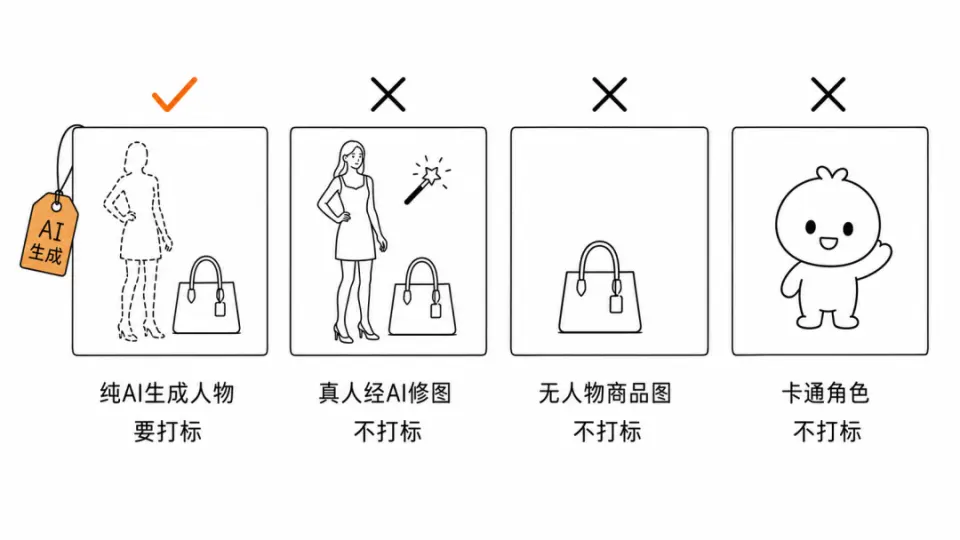
Which product images require labeling
The motivations for actively crossing the line are plain. First, moving the identification obligation upstream: for the platform itself to determine, image by image, whether the person in an image is AI-generated would be prohibitively costly, and an incorrect determination would also expose it to liability, whereas having sellers self-certify at upload costs almost nothing. Second, keeping the disclosure switch in its own hands: what sellers submit is merely metadata, and Amazon decides when and in what form that label is displayed to consumers; the notice says "where applicable," and the criteria have not been made public to date. It has also laid the groundwork in advance: with EU and California rules taking effect simultaneously on August 2, rather than building a separate set for each jurisdiction, it is better to build the fields once according to the strictest standard and apply them globally.
So this is not compliance driven by legal obligation; it iscompliance outsourcing plus platform infrastructureThe truly interesting consequence falls on penalties. Amazon's guidelines set out no dedicated penalty provision and give no grace period, but its existing image policies allow it to take down non-compliant images and block listings whose main image is non-compliant. For a seller, which hurts more, a USD 1,000 fine or a blocked listing, requires no calculation.
The enforcement power over the labeling obligation thus shifts from regulators to the platform. The law defines the boundary, that is, who counts as a synthetic performer; the platform defines the process and the punishment, that is, how to label and what happens if you do not.
After August 2, there is more than one set of obligations
If you operate only on the US site, getting Amazon's metadata process running through is enough for now. But after August 2, the source of obligations for operating on the EU site changes: it is no longer the platform requiring you to do it, but the law directly requiring you to do it.
Article 50(4) of the EU Artificial Intelligence Act is directed at 'deployers', that is, the persons who actually use an AI system. If you use an AI image-generation tool to produce marketing images, you are the deployer. This paragraph requires that a deployer using an AI system to generate or manipulate image, audio or video content constituting a deepfake shall disclose that the content has been artificially generated or manipulated.
Article 50(4), first subparagraph, of the EU Artificial Intelligence Act
Deployers of an AI system that generates or manipulates image, audio or video content constituting a deep fake, shall disclose that the content has been artificially generated or manipulated.
Translation: Deployers of an AI system that generates or manipulates image, audio or video content constituting a deepfake shall disclose that the content has been artificially generated or manipulated.
The key lies in how 'deepfake' is defined in this Act. Article 3(60) provides: AI-generated or manipulated image, audio or video content,that resembles existing persons, objects, places, entities or events, and would falsely appear to a person to be authentic or truthful.
Article 3(60) of the EU Artificial Intelligence Act
(60) 'deep fake' means AI-generated or manipulated image, audio or video content that resembles existing persons, objects, places, entities or events and would falsely appear to a person to be authentic or truthful;
Translation: (60) 'deepfake' means AI-generated or manipulated image, audio or video content that resembles existing persons, objects, places, entities or events and would falsely appear to a person to be authentic or truthful.
Note that 'objects' is listed alongside 'persons'. The EU standard is therefore broader than both New York State and Amazon: an AI product image that makes people mistake it for an actual photograph, or an AI studio scene that does not exist, may likewise fall within its scope; a person need not appear. Machine-readable marking, by contrast, is imposed on the image-generation tool providers by Article 50(2), which leaves one exception: it does not apply where the AI merely performs an auxiliary function for standard editing, or does not substantially alter the input data and their semantics. Whether AI cutout and background replacement amounts to a 'substantial alteration' is precisely the most contested point of this exception at present.
As for China, one point may be unexpected: domestic rules are considerably stricter than those of New York State, and they have long been in force. Article 37 of the Measures for the Supervision and Administration of Live-Streaming E-Commerce, effective 1 February 2026, is stated plainly.
Article 37: Where an operator of a live-streaming room uses character images or videos generated by artificial intelligence and other technologies to engage in live-streaming e-commerce activities, it shall comply with the requirements of relevant laws, regulations, rules and mandatory national standards, and shall, in accordance with relevant state provisions, mark such content and continuously remind consumers that the character images or videos are generated by artificial intelligence and other technologies.
Where the use of character images or videos generated by artificial intelligence and other technologies in live-streaming e-commerce activities involves circumstances violating the provisions of laws, regulations or rules, the operator of the live-streaming room that manages or uses such character images or videos shall bear liability in accordance with law. Where laws, regulations or rules provide otherwise, those provisions shall prevail.
New York requires prominent disclosure once in advertising, while China requirescontinuousprompts to consumers; New York requires distinguishing whether a real person can be recognized, while China makes no such distinction—any AI-generated image or video of a person must be labeled; liability in New York falls on the advertising producer, while in China it expressly falls on the livestream operator using the image. Layered on top of the dual-track mandatory labeling regime—explicit plus implicit—under the Measures for Labeling AI-Generated Synthetic Content effective September 1, 2025, sellers operating both domestic livestreaming and cross-border e-commerce will find that the metadata actions you perform for Amazon are precisely what domestic compliance already requires you to do—only the keywords differ.
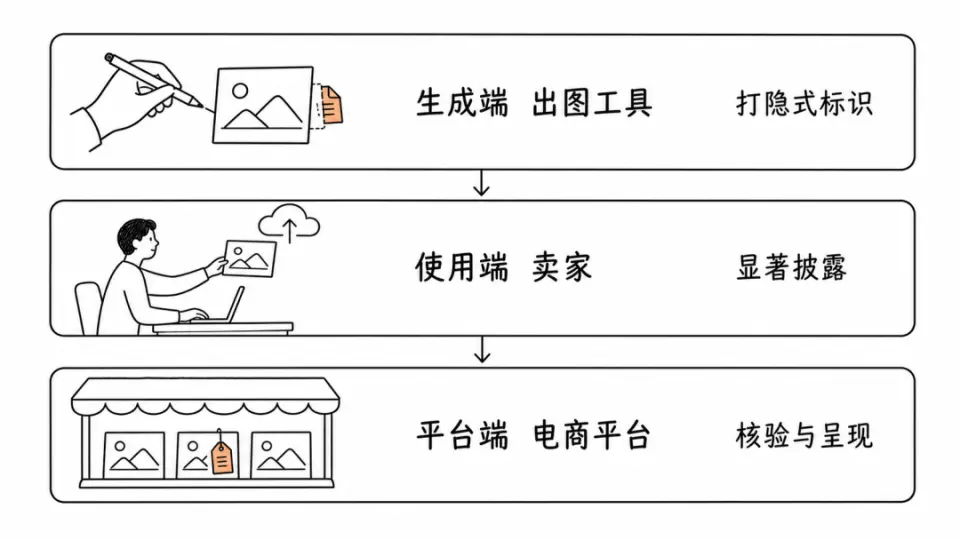
The three layers of the labeling obligation
What specifically needs to change
Sellers and agenciesThe first thing to do is bucket your assets into three piles: images shot with real people, images containing AI-generated persons, and AI images with no persons (pure product renders, AI backgrounds, AI scenes). Only the second pile needs labeling; labeling the first and third piles would actually be wrong—Amazon expressly states that real-person images should not carry this label, and over-labeling is equally misleading.
The second thing is to keep a close eye on metadata and not let it get lost in the workflow. This is the link most prone to problems and least noticed: image compression, batch cropping, re-exporting, and certain image hosting services and upload plugins can strip out an entire block of XMP metadata. The keywords you wrote in your editing software are gone after one pass through a compression tool, while you believe you are already compliant. Running a metadata spot check before uploading costs very little.
The third thing is contractual. If your images are produced by an outsourced party, or an agency uploads them on your behalf, two matters must be nailed down in the agreement: who is responsible for determining whether an image contains AI-generated persons, and who is responsible for writing the metadata; and how losses are to be shared where missing labels lead to images being taken down or listings being blocked. Such clauses take only two sentences to include now; negotiating them afterward means a dispute.
For those building AI image-generation toolsthe position is different. Article 50(2) of the EU places the obligation of machine-readable labeling directly on you; California's AI Transparency Act takes effect on August 2, requiring generative AI providers with more than one million monthly active users to apply implicit labeling, provide free AI detection tools, and pass labeling capability downstream through contracts—if a licensee modifies the system so that it loses labeling capability, the provider must revoke the license within 96 hours of becoming aware. The correct product approach is to make provenance metadata conforming to common standards such as C2PA a default output, and conveniently turn the keywords Amazon requires into a toggle, rather than making sellers install an IPTC editor and manually type fields themselves. This is the most certain product growth area over the next year and a half.
Brands and major sellersBeyond taking stock of existing materials, this tag should also be treated as a competitive variable: with two listings side by side, one bearing an AI-person disclosure and one without, how will consumers choose? This is a commercial judgment and is not explored in this article.
Conclusion
The significance of this matter does not lie in that USD 1,000.
When New York State legislated, it was aiming at Hollywood. The Governor's Office announcement framed the law as enhancing advertising transparency in the film and television industry, the Screen Actors Guild endorsed it, and the sponsor spoke of protecting New York's film and television workers from being replaced by AI. But Section 3 of the text reads "any person engaged in the business of selling goods or services who produces advertising for commercial purposes," without limiting the industry. More than forty days later, those whose workflows were altered by this general provision were a group of cross-border sellers with no connection to Hollywood, and third-party sellers account for more than sixty percent of product sales on Amazon's marketplace.
This is what AI regulation most genuinely looks like today: the reach of statutory text and the gaze of legislators often do not align, and what truly turns statutory text into everyday constraints is often not enforcement agencies but platforms. For those doing overseas business, reading platform rules matters more than reading statutes; but if you read only platform rules and not statutes, you will never know in which direction the next expansion will go, or how broad it will be.
If you are engaged in cross-border e-commerce, AI image-generation tools, or agency operation services, and are unsure which sets of rules your current material workflow must satisfy simultaneously, or on whom liability should be placed in contracts, you are welcome to talk with me. Clarifying disclosures and allocation of liability before launch is always cheaper than dealing with them after a takedown.
Sources
- Official text of Bill S8420A, New York State Senate, 2025–2026 Regular Session (amending Section 396-b of the New York General Business Law)
- New York State Governor's Office: "Governor Hochul Announces Nation's First Law Requiring Disclosure of AI-Generated Performers in Advertising Takes Effect" (June 9, 2026)
- CNBC: "Amazon makes sellers label AI-generated people in images after NY law" (July 23, 2026)
- eWeek: "Amazon Requires Sellers to Disclose AI-Generated People in Product Images" (July 24, 2026)
- Official text of Article 50 and Article 3, point (60), of the EU Artificial Intelligence Act (Regulation (EU) 2024/1689)
- California Artificial Intelligence Transparency Act (Business and Professions Code Sections 22757 to 22757.6, as amended by AB 853), official text
- Article 37 of the Measures for the Supervision and Administration of Live-Streaming E-Commerce (Order No. 117 of the State Administration for Market Regulation and the Cyberspace Administration of China, effective February 1, 2026)
- Measures for the Labeling of AI-Generated Synthetic Content (four departments including the Cyberspace Administration of China, effective September 1, 2025)
Author of this article:Lü Yinghui, a lawyer at Mankun Law Firm (Shenzhen). A graduate of China University of Political Science and Law, with nearly ten years of deep experience in the legal industry, having previously worked at a court in Shenzhen. Focused on legal services in the new-generation economy, with extensive practical experience and deep insights in fields such as Web3 and artificial intelligence. Account across all platforms: Lao Lü Talks New Money; you are welcome to follow.

