

In May of this year, a 79-year-old illiterate woman boarded a train alone, heading to Yuncheng, Shanxi, to see a child. The child was called Xiaohai, who called her "auntie" every day on her phone and invited the "auntie mommies" to Yuncheng to see the apricot blossoms. A railway police officer noticed the elderly woman, who could not clearly explain where she was going, and crouched down to tell her: the child on the phone was made by AI, and those affectionate words were spoken to millions of people. At first, the elderly woman refused to believe it.
In mid-October, The Beijing News and China National Radio successively uncovered the truth behind "Xiaohai." The same AI-generated boy's face was spread across a group of accounts in Liaoning, Fujian, Hebei and other places, telling the same life story: living with his father, motherless since childhood, falling behind in competitions, bullied by classmates, hiding in the classroom eating steamed buns. As he cried, he pulled a bottle of cooking oil from his bosom and asked the "auntie mommies" to help place an order. As of October 15, the "Xiaohai" topic had been viewed 600 million times on a short-video platform.
This business is not changing faces for the first time. A few years ago, it was accounts impersonating celebrities, calling viewers "sister" at every turn; last year, it was the suit-wearing "AI Wang Jianguo," and a batch of such accounts was shut down by the platforms; this year, his "son" Xiaohai took over the script, and in the same month, Beijing Evening News uncovered another batch of "AI elderly" selling local honey and black sesame pills in the first person. Each time the face changes, the cost drops a notch; now, following a tutorial, one can be generated in a dozen minutes or so.
If you are in digital-human tools, livestream commerce matrices, brand stores or content platforms, this wave is directly relevant to you. The legal consequences of this type of scheme have in fact already been calculated quite clearly by courts and regulators: labeling content as "AI-generated" is not enough, and the consequences run along three lines—civil, administrative and criminal—each heavier than the last.
Labeling AI does not exempt liability
First, the most common defense of operators: I labeled it.
They did indeed label it. A reporter from The Beijing News saw that most Xiaohai videos carried the notice "Work statement: content generated by AI," and some account bios even said "AI digital human, please view rationally." The labels required by the Measures for Labeling AI-Generated Synthetic Content, effective September 1, 2025, were basically all affixed to these accounts.
The problem is that this label answers a different question. Article 3 of the Measures defines what is to be labeled as follows:
AI-generated synthetic content refers to information such as text, images, audio, video and virtual scenes generated or synthesized using AI technology.
It tells you that this video was made by a machine. It does not tell you that being raised by a single parent, having no mother, eating steamed buns and the father being hospitalized are all fabricated.
A detail in the China National Radio report explains this gap very well: some elderly people understand "AI-generated" to mean "the real events could not be filmed, so AI had to act them out." In their eyes, the small line of text in the corner is like the "reenactment" in the upper right corner of a TV legal program: the images are acted, but the events are real.
What the court wants is another statement. In a judgment to be discussed later, the grounds for finding fraud state plainly: "did not declare that it was a dramatic reenactment." In plain terms, it did not tell the audience "this film is purely fictional." That statement is not in the AI label. Of course, analogies have limits; a "reenactment" itself promises that the story is true, whereas the AI label makes no such promise—but it does not deny it either, and these accounts profit precisely from this gap.
A label is one matter; whether the truth was told is another. The latter is governed by Article 20 of the Law on the Protection of Consumer Rights and Interests:
Where a business operator provides consumers with information on the quality, performance, use, effective term, and other particulars of goods or services, such information shall be true and comprehensive, and no false or misleading publicity shall be made.
The labeling measures govern what tools you use; the consumer protection law governs what you say with those tools. Complying with the former does not excuse you from the latter.

Two Separate Matters
The first line is refund plus triple damages
There is not yet a published judgment on AI Xiaohai, but courts have already ruled several times on the same playbook, except that the actors back then were real people.
In July 2021, a livestream room on a short-video platform staged a drama: a woman named Lingling was being abused, and the mother and daughter sought help in the livestream room, where the host called on viewers to rescue them and raise funds. How were the funds raised? By buying goods in the livestream room. One viewer bought 38 items, including ping'an kou pendants and pixiu charms, over 23 days, spending RMB 15,232.9. Later, a video surfaced showing several of the characters in the drama sitting together for a meal and holding a celebration banquet. Reading this part of the judgment, I genuinely felt for that viewer.
In July 2023, the Xinhe County People's Court in Hebei handed down a first-instance judgment: this constituted fraud; the purchase price was fully refunded, and triple damages of RMB 45,698.7 were additionally awarded. The court's exact words were that the livestream "fabricated characters and a storyline without stating that it was a dramatic performance," and that the entire rescue-and-fundraising plot "mainly served as emotional groundwork for the subsequent sale of jade through livestream commerce."
Companies engaged in digital-human marketing would do well to read this case carefully. The court did not dwell on whether the jade was genuine or fake; the fraud finding rested solely on the fabricated reason for purchase. Putting the reasoning of several similar judgments together, the courts in fact look at only four things: the seller deliberately fabricated the story, did not state that it was a performance, the viewers believed it, and it was precisely because they believed it that they placed orders. In the "Leng family feud" jade-selling case decided by the Beijing Internet Court at the end of 2024, there is also a sentence specifically addressing the argument that "viewers should have seen through it themselves": viewers affected by the storyline "consuming out of sympathy and a sense of justice is also a normal phenomenon." In that case, the plaintiff spent RMB 34,097 on eight orders, and the three defendants were jointly and severally ordered to pay triple damages of RMB 102,291.
Plug Xiaohai's backstory into these four elements, and every one of them is met. The court applied Article 55 of the Consumer Protection Law:
Where a business operator commits fraud in providing goods or services, it shall, at the request of the consumer, increase the compensation for the consumer's losses, and the amount of the increased compensation shall be three times the price paid by the consumer for the goods or the fee paid for the services; where the amount of the increased compensation is less than RMB 500, it shall be RMB 500. Where the law provides otherwise, those provisions shall prevail.
This article has a floor, which is especially consequential for small-ticket livestream sales. Two bottles of perilla seed oil in Xiaohai's link sell for RMB 99; three times that is RMB 297, less than RMB 500, so it is calculated at RMB 500, plus the RMB 99 refunded,A single order costs CNY 599.How much does the operator get from this order? The commission rate offered by the brand is 52%, a little over CNY 51.
Next, the operator will make a second statement: I did not sell the goods; I merely posted a link.
That path is not easy to take either. The 2022 judicial interpretation on online consumption by the Supreme People's Court contains a provision specifically addressing livestream selling:
Where a consumer's lawful rights and interests are harmed as a result of clicking to purchase goods in an online livestream room, and the livestream room operator cannot prove that it has indicated, in a manner sufficient for consumers to identify, that it is not the seller and has indicated the actual seller, and the consumer asserts that the livestream room operator should bear the liability of a goods seller, the people's court shall uphold such assertion.
If it does not indicate "I am not the seller, and who the seller is," consumers can sue the sales account directly as the seller. This provision addresses livestream rooms; for the scenario of short videos with product links, courts will most likely examine the appearance of the transaction under the same reasoning. First-person phrasing such as "I put up this ejiao cake" and "this is produced by my family" precisely pushes the sales account toward the seller side.
Even if it is indicated, that merely shifts who pays. The Zhenping County Court in Henan Province decided a case in November 2025: an anchor sold accessories in a livestream room by acting out a script; because the actual seller was indicated, the anchor was not held liable as the seller in the earlier lawsuit; the consumer then turned around and sued the store that listed the goods, and the court found that the store had commissioned the anchor to sell goods, that the anchor had committed fraud, and that the store, as the operator, had to bear that liability, still refunding the purchase price and paying three times the price as compensation.
Between the sales account and the store, one of them will always have to pay. The brand offers a commission of more than fifty percent to buy traffic, and the legal consequences of the promoter's script are also recorded on its own account.
The second line is fines and removal from shelves
Civil liability arises when consumers sue one by one; administrative liability arises when regulators come directly to the door. The Measures for the Supervision and Administration of Livestream E-Commerce, effective February 1, 2026, contains two articles specifically addressing "AI-generated personas."
Article 37 governs labeling and requires it to be "continuous":
Where a livestream room operator uses persona images or videos generated by artificial intelligence and other technologies to engage in livestream e-commerce activities, it shall comply with the requirements of relevant laws, regulations, rules and mandatory national standards, and shall label them in accordance with relevant state provisions, continuously reminding consumers that such persona images or videos are generated by artificial intelligence and other technologies.
Where the use of AI-generated or other technology-generated character images or videos in livestream e-commerce activities involves circumstances that violate laws, regulations or rules, the livestream room operator that manages or uses such character images or videos shall bear liability in accordance with law. Where laws, regulations or rules provide otherwise, those provisions shall apply.
The word "continuous" means that a brief flash at the start of a livestream or a small watermark tucked in a corner may not necessarily pass muster. Paragraph 2 places liability on the livestream room operator that "manages or uses" the digital human: those who sell image templates generally fall outside the scope of this paragraph, while those who use them to sell goods cannot escape it.
Paragraph 2 of Article 34 governs content: even if labeled, fabrication is not permitted:
Livestream room operators and livestream marketing personnel shall not use AI or other technical means to fabricate or disseminate false or misleading commercial information, or to impersonate others in commercial promotion, thereby deceiving or misleading consumers and other business operators.
Read together, these two articles are the administrative counterpart of the two accounts discussed in the previous section. For violations of Article 34, Article 62 of the Measures refers to Article 25, Paragraph 1 of the Anti-Unfair Competition Law,with a maximum fine of RMB 1 million, and a fine of RMB 1 million to RMB 2 million where the circumstances are serious, and the business license may also be revoked; where false advertising is constituted, penalties shall be imposed under the Advertising Law.
These Measures govern livestreaming. Short videos with product links fall outside their scope, but they cannot escape the Advertising Law. The batch of "AI elderly people" investigated by Beijing Evening News is a ready example: an AI-generated elderly fruit farmer holds a jar and says, "Look at the cliff honey I worked so hard to collect," while the link posted leads to someone else's shop. A reporter showed one such video to 10 people aged over 65, and only 1 recognized it as AI. Article 28 of the Advertising Law sets out a list of false advertising, and Item 2 of Paragraph 2 mentions place of origin and producer:
An advertisement shall be deemed false advertising under any of the following circumstances:
(1) the goods or services do not exist;
(2) information concerning the performance, function, place of origin, use, quality, specifications, ingredients, price, producer, period of validity, sales status, honors previously received or other information of the goods, or information concerning the content, provider, form, quality, price, sales status, honors previously received or other information of the services, as well as information concerning undertakings related to the goods or services, is inconsistent with the actual situation and has a material impact on purchasing behavior;
(3) fabricated, forged or unverifiable scientific research results, statistical data, survey results, abstracts, quotations or other information is used as supporting material;
(4) fabricating the effects of using goods or accepting services;
(5) other circumstances in which consumers are deceived or misled by false or misleading content.
"I went to great trouble to pick these" refers precisely to the producer and the place of origin, and that is exactly the sentence the elderly person relied on when placing the order. This category is in fact easier to characterize than Xiaohai's case; there is almost no room for interpretation.
The third line is the crime of fraud
For people in this business, the question they care about most is actually another one: could they go to prison?
My assessment is that most Xiaohai-type cases do not reach this line. The elderly person spent 99 yuan and received a bottle of oil; this was a genuine transaction, merely about thirty yuan too expensive, and the reason for the purchase was false. Fraud under criminal law requires obtaining property by deception for the purpose of illegal possession. Where there are genuine goods and consideration, high-price sales conducted through livestreaming are generally handled in judicial practice as civil fraud plus administrative violations.
Where is the line drawn? Look at what the money buys back. The Funing County Court in Jiangsu Province decided a case in December 2025: a group of people posed as female streamers on a short-video platform, "fabricating tragic life stories and a single-woman image to win sympathy," then used "you can only become a formal employee after completing the tasks" and "we can meet if we win the PK contest" to induce the other party to top up and send virtual gifts, and even used internal accounts to manipulate the outcome of PK contests. The money the victims paid out bought them nothing in return. All nine defendants were convicted of fraud; one of them, involved in an amount of more than 8.14 million yuan, was sentenced to four years and nine months.
Article 266: Whoever defrauds public or private property, if the amount is relatively large, shall be sentenced to fixed-term imprisonment of not more than three years, criminal detention or public surveillance, and shall also, or shall only, be fined; if the amount is huge or there are other serious circumstances, shall be sentenced to fixed-term imprisonment of not less than three years but not more than ten years, and shall also be fined; if the amount is especially huge or there are other especially serious circumstances, shall be sentenced to fixed-term imprisonment of not less than ten years or life imprisonment, and shall also be fined or have property confiscated. Where this Law provides otherwise, those provisions shall prevail.
With the same tragic persona, using it to sell goods results in refund plus three times compensation; using it to ask for money is the crime of fraud. Xiaohai's script already contains "the campus livestreaming sales contest is just two orders short," which is only one line away from "Xiaohai is in the hospital; can the aunties and mom help out?" Digital humans do not need sleep, and one person can run a batch of accounts at the same time; once that line is spoken, the amounts will accumulate very quickly.
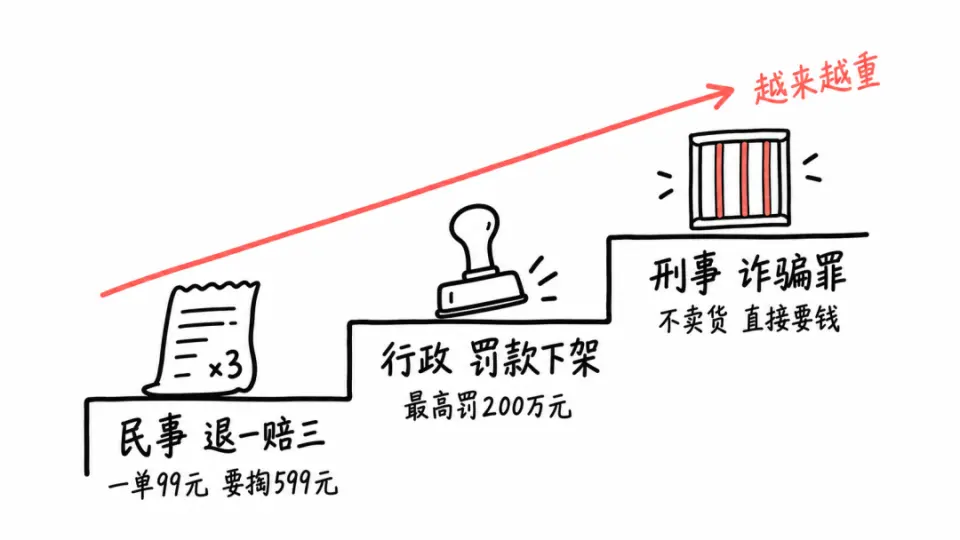
Three lines
How this business should be adjusted
Digital-human livestream selling is not itself illegal; the labeling measures and the livestream e-commerce measures are both establishing rules for it, not seeking to ban it. What causes problems is the material written into the scripts.
If you make digital human tools or sell avatars and templates, do not turn “claiming kinship” and “playing on pity” into ready-made script packages for sale. The live-streaming e-commerce rules place responsibility on the user, but if what you sell is a finished script of “a single-parent teenager plus aunties and mothers plus a sales contest,” it will be hard to claim afterward that you merely provided a neutral tool. Having the labeling function enabled by default and not deletable by users is the cheapest insurance on your side.
If you run a sales matrix or an MCN, draw some red lines for personas: do not fabricate origins, kinship, illness or poverty; do not use the first person to pose as the place of origin or the producer; and do not say things like “help me finish the contest” that package placing an order as helping someone. The live-streaming page must prominently and continuously identify who the actual seller is. Audit records of marketing language must be kept for no less than three years under the live-streaming e-commerce rules; if a dispute does arise, they are also your material for proving your own innocence.
Brands and stores: for orders with a commission of 50% or more, you must bring the promotional materials into your own review. The Zhenping case put it plainly: if the streamer you engaged commits fraud, you bear liability as the operator. A clause in the contract saying “the promoter bears its own responsibility” will not stop consumers from suing you; at most it lets you seek recovery after paying.
On the platform side, Article 44, paragraph 2 of the Consumer Protection Law is the gate:
Where a provider of an online trading platform knows or should know that a seller or service provider is using its platform to infringe the lawful rights and interests of consumers and fails to take necessary measures, it shall bear joint and several liability with that seller or service provider in accordance with the law.
In the earlier script cases, the platforms were not held liable, on the grounds that they had disclosed the seller information and there was no evidence showing knowledge and toleration. Xiaohai's situation is different: the same face, the same script, accounts launched in bulk, 600 million views, and a comment section full of “mothers” in their sixties and seventies. I think that at this scale, “should know” is hard to deny. Same-face clustering recognition, restricting recommendations to elderly users, pop-up risk warnings and one-click evidence preservation are all technically feasible for platforms.
Xiaohai's tears are calculated; the old people's heartache is real. Trading false sentiment for real money is an account that will sooner or later have to be recalculated on a refund-plus-three-times-compensation basis.
If your team is doing digital human sales and is unsure where the boundary lies for personas and scripts, you can leave a message in the backend and send me the specific scenario.
Sources
- The Beijing News: “Playing on Pity for Sympathy and Selling at High Prices: Batches of ‘AI Xiaohai’ Are Harvesting ‘Aunties and Mothers’” (2026-10-16)
- The Beijing News: “‘AI Xiaohai’ Plays on Pity to Sell Goods and Harvest Middle-Aged and Elderly People; Young People Create ‘Evil Xiaohai’ for Magical Counterattacks” (2026-10-18)
- China National Radio of China Media Group: “Batches of ‘AI Xiaohai’ Play on Pity for Sympathy to Sell Goods: Which ‘Aunties and Mothers’ Are Easy to Harvest?” (2026-10-18)
- Beijing Evening News: "Fabricating Stories to Attract Traffic and Then Promote Products: 'AI Elderly' Play on Sympathy Solely to Exploit the Elderly" (October 20, 2026)
- Measures for the Labeling of AI-Generated Synthetic Content (Guoxinban Tongzi [2025] No. 2)
- Law of the People's Republic of China on the Protection of Consumer Rights and Interests (2013 Amendment)
- Provisions of the Supreme People's Court on Several Issues Concerning the Application of Law in the Trial of Online Consumer Dispute Cases (I) (Fa Shi [2022] No. 8)
- Measures for the Supervision and Administration of Live-Streaming E-Commerce (Order No. 117 of the State Administration for Market Regulation and the Cyberspace Administration of China)
- Advertising Law of the People's Republic of China (2021 Amendment)
- Anti-Unfair Competition Law of the People's Republic of China (2025 Revision)
- Criminal Law of the People's Republic of China
- Civil Judgment of the People's Court of Xinhe County, Hebei Province, (2023) Ji 0530 Min Chu No. 30
- Civil Judgment of the Beijing Internet Court, (2024) Jing 0491 Min Chu No. 13454
- Civil Judgment of the People's Court of Zhenping County, Henan Province, (2025) Yu 1324 Min Chu No. 4656
- Criminal Judgment of the People's Court of Funing County, Jiangsu Province, (2025) Su 0923 Xing Chu No. 224
Author of this article:Lü Yinghui, a lawyer at Mankun Law Firm (Shenzhen). A graduate of China University of Political Science and Law, with nearly ten years of experience in the legal industry, having previously worked at a court in Shenzhen. Focused on legal services in the new-generation economy, with extensive practical experience and deep insight in fields such as Web3 and artificial intelligence. Account across all platforms: Lao Lü Talks New Money; you are welcome to follow.

