
In the first quarter of 2026, approximately 128,000 micro-dramas were launched nationwide, of which about 122,000 were AI micro-dramas, accounting for more than 95%. Converted, that means an average of more than 1,300 AI short dramas were launched every day. The China Netcasting Services Association described it this way: the short-drama industry covered in one year the road that long-form drama took ten years to travel.
At this time last year, "whether AI can produce a watchable short drama" was still a technical question. This year, it has become a business question—and a business in which quite a few people are quietly making money, while quite a few others are losing everything.
But recently I have heard many people say that the AI-generated short-drama track is extremely crowded. So can this track still be entered now? And if one really does enter, what pitfalls will make people fall in?
This article seeks to lay out these two matters clearly.
I. Why everyone is rushing in
The reason attracting everyone to rush in can actually be stated in one sentence: the extreme collapse of costs.
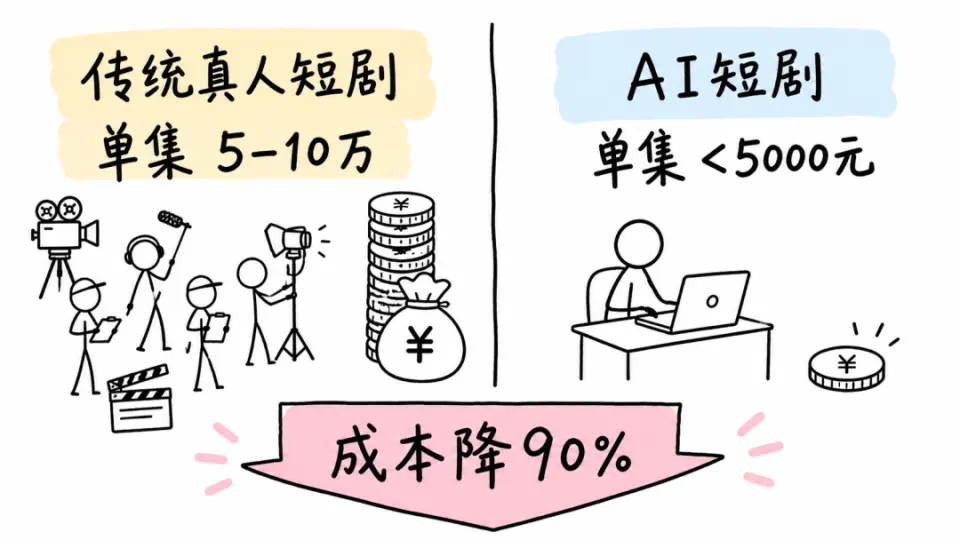
For traditional live-action short dramas, the cost per episode is RMB 50,000 to 100,000, and a premium production costs RMB 500,000 to 3 million. Actors, locations, costumes, makeup and props, lighting, and post-production—each item is a hard expenditure that cannot be pushed down.
After AI arrived, this cost curve fell off a cliff. Now, using video models such as Seedance and Kling, the cost per episode can be pressed to within RMB 5,000, and the pure computing-power cost can be as low as the thousand-yuan level, an overall reduction of more than 90%. Some teams can keep the comprehensive cost of one minute of comic-style drama at RMB 1,000 to 1,500.
With this extreme reduction in cost, several exaggerated samples have emerged.
A short drama called The Persian Revenge had a production cost of RMB 3,000, and after it was launched on overseas platforms, its revenue multiple is said to have reached 1,200 times.
Domestically, Huo Qubing was completed by a core team of 3 people in 4 days, with a computing-power cost of RMB 3,000.
There is also The Beast Alone Reigns Supreme, for which 5 people produced 60 episodes in 8 days.
The profit margins look good too. Industry insiders say that a comedic meme-style comic drama costs 20,000 to 30,000 yuan to produce, and net margins generally reach over 50%. One platform operator ran the numbers: once the per-minute cost of a comic drama is brought down to target levels, ROI is generally above 1.2, and "not a single one is losing money."
That is why, since the end of last year, online literature companies, film and television companies, MCNs, and even complete outsiders have all been crowding into this track. It fits the appetite for "low cost, fast production, high iteration" too well: invest a few thousand yuan to test a subject, scale it up if it takes off, and switch if it does not.
II. But is the money really that easy to make?
Now I want to pour a bucket of cold water.
Only a minority make money. The problem lies precisely in the very point that excites everyone: costs are too low and barriers to entry are too low, so supply explodes.
A person who knows nothing about AI short dramas can produce one after only one or two weeks of study.
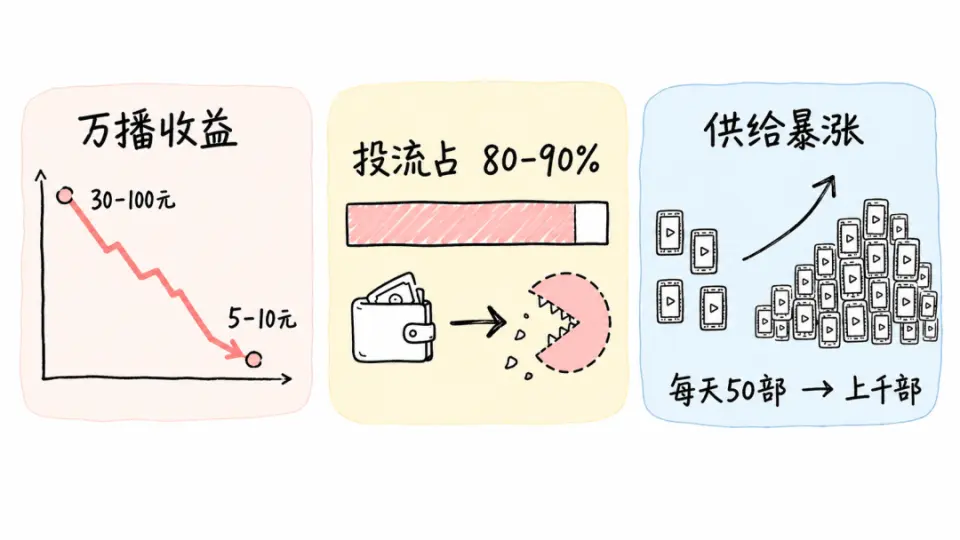
Last year, 50 new titles were released each day; this year, it is often over a thousand. Once supply is excessive, the money each piece of content can share is diluted. Practitioners report that last year, revenue per 10,000 views was generally 30 to 100 yuan; in May this year, revenue per 10,000 views on platforms such as Hongguo plunged to 5 to 10 yuan. A drama with 180 million views settled for only 180,000 yuan.
A design company in Shenzhen uploaded 11 AI comic dramas in March this year; a month later, revenue was only a few hundred yuan, and its 200,000 yuan production cost was a total loss. The reasons identified in the post-mortem were very realistic: only 16 episodes, which does not match the industry mainstream of 40 to 60 episodes; and the style was too mixed, failing to precisely hit the market.
Not to mention paid traffic. In the sales expenses of short dramas going overseas, the portion used for buying traffic and paid promotion accounts for 80% to 90%. In other words, the production costs you save are very likely to be thrown right back into traffic. Across the industry, "revenue grows but profit does not" is the norm.
Upstream models are still raising prices. After Jimeng's Seedance 2.0 burst onto the scene early this year, it became almost indispensable, and as a result the production cost of a 2-minute video climbed from 5 yuan all the way to 40 yuan. Caught between models raising prices and clients pressing prices down, frontline AI short drama practitioners describe themselves as "squeezed into sandwich biscuits."
One AI comic drama director put it even more bluntly: their volume team makes 30 titles a month; in April they hit one hit title, which just offset the losses on the other 29. "This is not content production; this is scratching lottery tickets."
So what this track really looks like is this: the ceiling is very high, the floor is also very low, and the ground underfoot is full of pits. Whether you can make money does not depend on whether you know how to use models—everyone knows how to use models—but on whether you have something others cannot replace.
III. What ordinary people can participate in is not the model, but the supporting ecosystem
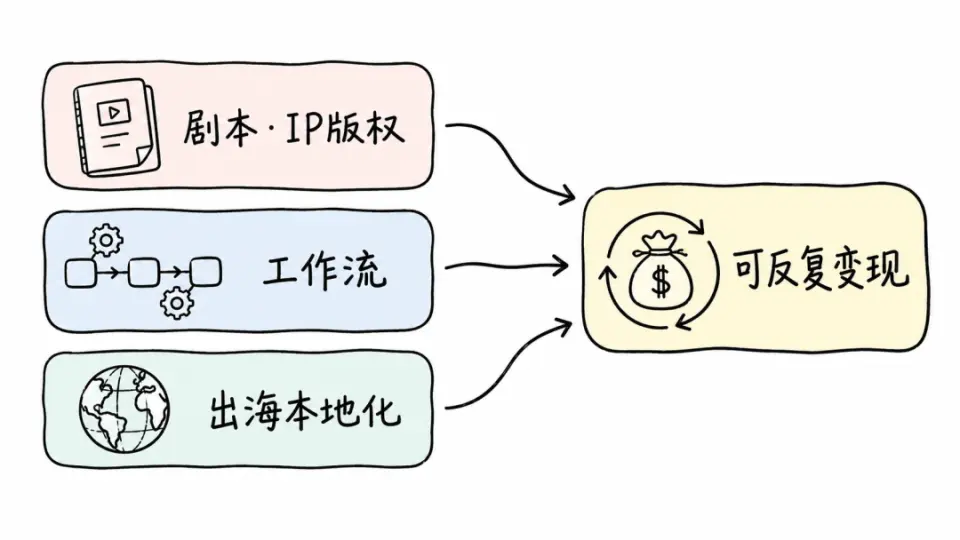
If you want to seriously pursue this business, my view is this: ordinary people cannot participate at the model layer, and the fiercer the competition among models, the cheaper the API call prices will become and the more homogeneous their capabilities will be. What can truly accumulate into assets are the three upstream elements.
Truly training and maintaining a high-quality video generation model requires extremely high computing power, massive video data, long-term engineering optimization, a complex content safety system, and a model team that invests continuously. This is not a direction that ordinary small and medium-sized companies can easily master.
For ordinary companies, the more realistic approach is not to train a Seedance 2.0 themselves, but to obtain certain model invocation permissions, API permissions, agency permissions, or industry cooperation permissions, and build application-layer products on top of large models. The real opportunity here is not to "build another large video model," but to achieve industrial implementation around large models.
The first isscripts and IPWhether it is live-action short dramas or AI short dramas, the source asset is always the story. Many people only focus on video generation models, yet overlook that the true source asset of short dramas is the script.
Whether live-action short dramas or AI short dramas, they essentially all require stories, characters, conflicts, reversals, pacing, and emotional hooks. Without a good story, even the most powerful video model can only generate a bunch of beautiful but ineffective images.
In the era of AI short dramas, high-quality scripts may become a long-term high-margin asset.
The reason is simple: if a script is repeatedly cited, adapted, remade, re-created, and localized for overseas markets by many AI short drama companies, it is no longer just one-off content, but a copyright asset that can be continuously licensed.
In the past, a script might only be filmed once by one production crew. But in the era of AI short dramas, the same story framework can be made by different companies into videos in different languages, different art styles, different character settings, and different market versions.
A script framework with strong reversals and strong emotions could only be filmed once in the past; now it can be made into a Chinese vertical-screen version, an English TikTok version, a Southeast Asian localized version, a comic-style version, and a digital human version. The same story can be repeatedly licensed and repeatedly monetized. This is also why companies such as Chinese Online, Yuewen, and Zhangyue, which hold online literature IP, took the lead from the very beginning.
Second,workflowsAn AI short drama is not just video generation; it also includes topic selection, character design, episode breakdown, storyboarding, shot prompts, character consistency, voiceover and music, subtitles and cover art, and distribution testing. Running this entire pipeline smoothly, reliably, and to a consistent standard, becoming a company that sells the picks and shovels, and turning it into a reliably profitable business—that is worth far more than a single-point capability.
Third,overseas localizationOverseas users have a stronger willingness to pay; research says 55% of overseas users are willing to pay for short dramas made with AI involvement. But customer acquisition costs are high and cultural differences are significant. Being able to turn a story into a version that genuinely fits local aesthetics is itself a barrier to entry.
In one sentence: tools will be replaced and models will get cheaper, but good stories, clear copyright, and proven processes can be monetized repeatedly.
IV. The legal costs you must think through before entering the market
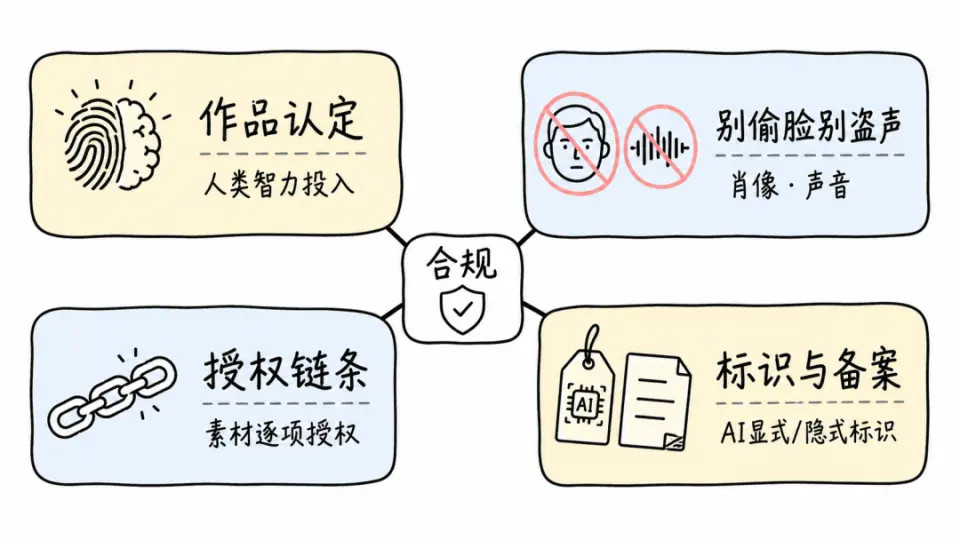
The assetization described above sounds appealing, but every item, when reduced to legal terms, is a hurdle. I have seen too many people, with a mindset of "let's just get it running first and figure things out later," bury mines beneath their own feet. The following four matters must be thought through before you enter.
First, is what you create actually a "work" protected by law?
This directly determines whether your short drama is truly an asset and whether you can enforce your rights if someone misappropriates it.
There was a landmark case in May this year. Two defendants in Guangdong, without authorization, copied at least 1,716 AI short dramas and sold them; each was sentenced to eight months' imprisonment, suspended for one year and two months, for copyright infringement, and also fined. This is the first case in China of criminal protection for AIGC works.
The signal it sends is crucial: AI-generated short dramas can be works protected by copyright law, and pirating them can lead to imprisonment. But the court's protection comes with preconditions—the short drama at issue was not "one-click generated"; rather, the creator input an original script, shot requirements, and plot settings, providing in-depth guidance that reflected human originality in the choices made.
A comparison with another case makes this clear. In a dispute in Urumqi, the court held that AI images generated purely by "one click" do not constitute works and are not protected.
The dividing line comes down to four words: human intellectual input.
So in operational terms, the conclusion is firm: from project inception, you must "document the creative process"—scripts, prompts, parameter settings, records of iterative modifications at each round, and post-production editing project files must all be retained. AI works without a human soul are, in the eyes of the law, merely a porter of code, and the law does not protect porters.
Second, do not use other people's faces, and do not misappropriate other people's voiceprints.
This is the red line most easily crossed in AI short dramas, and the one with the most serious consequences.
There are three industry slang terms: "skin-swap comics," "shell-wrap comics," and "live-action comics." Put plainly, they correspond respectively to copying others' artistic images, appropriating others' core expressive structures, and mixing real people's likenesses and voices. The screens full of "celebrity faces" and "familiar voiceovers" in AI comic dramas are, at bottom, mostly unauthorized materials.
Using a real person's likeness to create a digital human, or using AI to synthesize someone's voice, requires explicit written authorization. The fact that a photo has been made public does not mean it can be used to create a digital human; the fact that an influencer, lawyer, or doctor frequently appears on camera does not mean their face and voice can be imitated. In April 2026, the China Federation of Radio and Television Associations explicitly opposed unauthorized AI voice misappropriation.
Third, the authorization chain must be verified from the source.
This is the most hidden pitfall. Many people look only at the authorization for the main model or main framework and overlook the materials along the entire chain.
Remember a statement that has become consensus: authorization for traditional materials does not automatically include permission for AI training, synthesis, and generation. Buying an image, a piece of music, or the adaptation rights to an IP does not mean you can use it to train models or generate new content. Fonts, music, TTS voice libraries, third-party APIs, and online literature IPs—each link must be separately and clearly addressed in the contract: whether it can be used for AI, within what scope, and whether sublicensing is permitted. What goes wrong is often not the main framework but some material that no one paid attention to.
Fourth, labeling and filing are compliance steps that cannot be bypassed.
Under the Measures for Labeling Artificial Intelligence-Generated Synthetic Content, AI-generated videos must carry explicit and implicit labels, and viewers must not be led to mistake them for real footage. This is especially true in fields such as news, finance, healthcare and law, where the absence of a notice can easily lead to problems.
If you are a platform providing AI short-drama generation services to the public, you may also need to complete algorithm filing and security assessment. During filing, whether the training data is lawful, whether character images infringe rights, whether voices are authorized, and whether scripts are original are all key points of review.
Platforms must also pay particular attention to the boundaries of their liability. The safe-harbor rule and the red-flag standard still apply, but the deeper your involvement in content — actively pinning content, supporting it through trending searches, or participating in revenue settlement — the heavier your duty of care and liability become, and you can no longer use "technological neutrality" as a shield.
AI short dramas will become increasingly powerful, costs will keep falling, and barriers to entry will keep getting lower.
But a low barrier to entry means everyone can enter. The real dividing line has never been "whether you can generate a stunning video"; it lies in whether you can produce continuously, stably and at low cost, and build all of this on a lawful foundation.
Explosive technological popularity is only the beginning. Whether this business can truly achieve steady and long-term progress depends on whether it can scale lawfully.

