
Starting in April 2026, AI animated short dramas must be "licensed to operate," and existing works without filing are being forcibly taken offline; two more documents were issued in June. This article does not interpret the legal provisions; it does one thing only: translate the new rules, item by item, into the production company's ledger, to see exactly how the entry threshold, profit margin and hit rate change, and whose books remain in the black once the gate comes down.
On April 1, the National Radio and Television Administration's new filing rules for AI animated short dramas became fully mandatory. All existing works without filing were taken offline, and new works must be "filed first, launched later." More than two months later, on June 24, the Measures for the Administration of the Development of Micro Short Dramas (Draft for Comment) was released for public comment; immediately afterward, on June 25, the National Radio and Television Administration issued the Regulatory Notice (Classification and Tiering Standards for AI Micro Short Dramas), effective July 1.
With the three documents stacked together, AI short dramas have moved from "unrestrained growth" into "licensed entry."
And when the new rules took effect, the industry's real temperature was that only 1 in every 1,000 titles actually breaks out. Some have posted their backend settlement statements: hand-crafting 11 animated dramas earned just 9.6 yuan. But what the new rules do, plainly put, is not sentence this business to death; it is rewriting its ledger.
The new rules push AI short dramas from "launch first, supplement the license later" to "licensed before launch"
First, translate the new rules into the ledger, not into legal provisions.
The core change is classification and tiering. By investment amount and subject matter, AI micro short dramas are divided into three tiers: those with an investment of 800,000 yuan or more, or involving special subjects such as politics, military affairs or foreign affairs, are administered as "key micro short dramas" (Category I); those with 300,000 to 800,000 yuan and ordinary subjects are administered as "ordinary micro short dramas" (Category II); and those under 300,000 yuan with ordinary subjects are administered as "other micro short dramas" (Category III).
There is an easily overlooked signal here. The "key" threshold for ordinary micro short dramas is 1 million yuan, whereas the line the National Radio and Television Administration has drawn separately for AI micro short dramas is 800,000 yuan. For the same subject matter and recommendation slots, AI works are pulled into the strictest tier one step earlier than live-action works. Regulation of AI content is strict.
The ledger is entirely different for each tier. Category III is self-reviewed by the platform; a program number is all that is needed to go live, and this path is basically unchanged. Category II must be filed by reference to Category I. And the Category I threshold is genuinely high: under the design of the draft for comment, to produce a Category I micro short drama, the production entity must first hold a Radio and Television Program Production and Operation License, submit the Micro Short Drama Filing and Public Notice Application Form and a plot synopsis, and file for public notice with the radio and television authority at or above the provincial level; once the production is complete, it must also apply for a Micro Short Drama Distribution License before broadcast, with the competent department deciding within 20 days of acceptance, of which expert review alone takes 10 days.
One thing needs to be made clear: which of these are already in force and which are still on the way. Mandatory filing and the taking offline of unfiled works are already in implementation as of April 2026; the AI content classification standards took effect on July 1; and the labeling of AI-generated content has been regulated since September 2025. As for the Category I licensing requirement, the distribution license and the 100,000 yuan penalty provisions, these remain in the June 24 draft for comment, with the comment period closing on July 23 and the formal effective date not yet determined. The foundation has been poured, but the walls are still being built.
In the end it comes down to one sentence: in the past, a considerable portion of this business's profit was propped up by jumping the gun with "launch first, supplement the license later," by the information gap from unlabeled AI content, and by platforms' real-money guaranteed subsidies. What the new rules and platform policies are doing is taking these three things away, one by one.
Five thousand to ten thousand yuan per drama in hand, and piling on volume still means paying out of pocket
How will the billing change? First, look at the most mainstream way producers operate: taking outsourced orders.
The platform or distributor provides the script, and the producer is only responsible for making it with AI, with no access to backend data and no ability to attach its own label—in plain terms, it is outsourcing. The unit price for this outsourcing has been on a roller-coaster ride over the past year. Before the Spring Festival, quotes could still reach 1,500 to 2,000 yuan per minute, after which they plunged all the way to 300 to 500 yuan. The founder of Xuebao Studio told Tencent News that now "even at 200 yuan a minute, people will still scramble for orders." And that 200 yuan is subject to layer upon layer of commission, so what actually ends up in the producer's hands may be only 50 to 100 yuan per minute.
Let us do the math based on the amount actually received. For a 100-minute animated drama, revenue is roughly 5,000 to 10,000 yuan. On the cost side, computing power is the big item: tokens are getting more and more expensive, with the cost of some large models soaring nearly eightfold. Xuebao describes making a premium product now as "almost 1 yuan for 1 second," and 100 minutes is 6,000 seconds; add to that the labor of one or two people working 7 to 30 days. Squeezed at both ends, the midpoint gross margin is 30% at most, and the teams scrambling for orders at 200 yuan are in fact already losing money to do the work.
This is not a business; it is piecework. And it is piecework where, on the revenue side, pricing is set unilaterally by the platform, and on the cost side, pricing is set unilaterally by upstream—at neither end does the producer get a say.
Another way to operate is to produce independently and gamble on revenue sharing: establish your own label, bear your own profits and losses, and bet on the revenue share after one drama takes off. The upside is unlimited, which sounds tempting, but once probability is multiplied in, the math is negative.
What does a hit rate of 0.117% mean? Suppose a drama really does become a hit and reaches ten million views; at the current revenue of 15 to 30 yuan per thousand views, that is 150,000 to 300,000 yuan in gross revenue. Multiply by the 0.117% probability, and the expected gross revenue of one drama is only 175 to 350 yuan. As for the cost per drama, even if quality is pushed to the lowest and the cost is squeezed to the limit of 2,000 yuan, that is still far from covered. In other words, under the approach of piling up volume to gamble on probability, the expected result is a net loss of 1,650 to 1,825 yuan for every drama made.
Jiangyou Culture losing money even with a 90% hit rate, and someone earning only 9.6 yuan from 11 dramas, is not bad luck; it is the inevitable sampling outcome of this mathematics. Making 1,000 dramas in 10 days to gamble on a hit rate of a few per thousand is essentially trading a certain cost for a lottery ticket with negative expected value.
Here a more fundamental question must be asked: do audiences really need "AI short dramas"? The data suggest the answer is more likely no. Daily supply of 1,355 dramas is 19 times that of live-action short dramas, yet fewer than 150 exceed 100 million views. Supply exploding and the hit rate falling at the same time shows that the extra supply simply has no corresponding demand to absorb it. What truly sustains this 19-fold production capacity is the platform's guaranteed minimum subsidy, which takes the loss risk off the producer's shoulders and artificially drives supply to many times demand. Hongguo canceling its guaranteed minimum and Douyin lowering revenue shares is not because audiences stopped watching, but because the platforms are no longer backstopping these productions.
Production costs fell by 90%—whose pockets did the money go into?
There is a counterintuitive point: AI cut production costs by 90%, yet producers find it harder to make money.
Securities Times, citing DataEye's breakdown, put it directly: costs on the AI short-drama production side fell by roughly 90%, but traffic costs rose by more than 100% year on year, while the revenue side fell by more than 50%. The average cost of a premium live-action short drama is about 1.5 million yuan, while a premium AI simulated-live-action short drama can be compressed to under 200,000 yuan. Yet not a single cent of the money saved landed in the producer's pocket.
It went to two places. One end is upstream. ByteDance's Seedance has been called "the world's second good business in AI," with more than half of Volcano Engine's MaaS revenue this year contributed by it, monthly revenue exceeding 1 billion yuan, and multiple industry practitioners estimating its gross margin at as high as 90%. A large part of the production fees saved by producers has turned into money for buying models and competing for computing power, flowing into the accounts of the arms dealers. The other end is the platform. In April, Douyin cut the revenue-sharing coefficient for AI simulated-live-action dramas from 60 to 40 and for animated dramas from 50 to 40, and Hongguo partially canceled its guaranteed minimum; meanwhile, out of total gross revenue, traffic buying itself consumes about 70%. The production costs saved were taken back by the platforms through two gates: cutting coefficients and traffic buying.
ByteDance's position is the one most worth examining closely. On one hand, it offers Seedance to lower your production costs; on the other, it uses Hongguo and Douyin to cut your revenue share, and in between there are Tomato's IP, Jianying's tools, and Juliang Engine's ad placement—it stands at every link of the industry chain. The harder production contractors compete and the more they pile on volume, the greater ByteDance's model invocation volume and the fuller the platform's traffic pool. The so-called upstream price cuts never cut the production contractor's costs; they open up more room for the platform to extract value.
Following this line, one can see clearly who is actually hyping AI short dramas now. Course sellers charge 7,800 to 10,000 yuan per course, recruiting students with stories of "interns making hit dramas and taking home 100,000 yuan in bonuses"; the more people who sign up, the more they earn, and whether students produce a hit is none of their concern. ByteDance's Volcano Engine, which sells computing power, is the only money-printing machine in this game that reliably profits; its goal is simply to get as many people as possible into the arena burning computing power. The platforms seeking production contractors to take on projects want massive supply to drive unit prices to the floor, then use minimum guarantees as bait to shift content risk onto others.
The accounts of these groups and the accounts of production contractors differ in one respect: they earn from the act of "production contractors entering the arena," with near-100% certainty; production contractors earn from the result of "monetizing views," with a probability of less than 2% (for companies below the mid-tier, the probability of making money does not even exceed 2%). Who is selling certainty and who is buying probability is plain at a glance.
As for the repeatedly cited "20 billion yuan market size," it is mostly an illusory figure for production contractors as well. This 20 billion is the whole-chain pie: upstream models take a layer first, ad placement takes 70%, and the portion that actually reaches outsourced production contractors has a ceiling far smaller than imagined—and unit prices are still on a downward trajectory. It is true that capital is bullish on this track, but what capital is bullish on is the upstream models and the platforms holding traffic, not the production contractors standing at the very end. Being bullish on the track does not mean being bullish on your link in it.
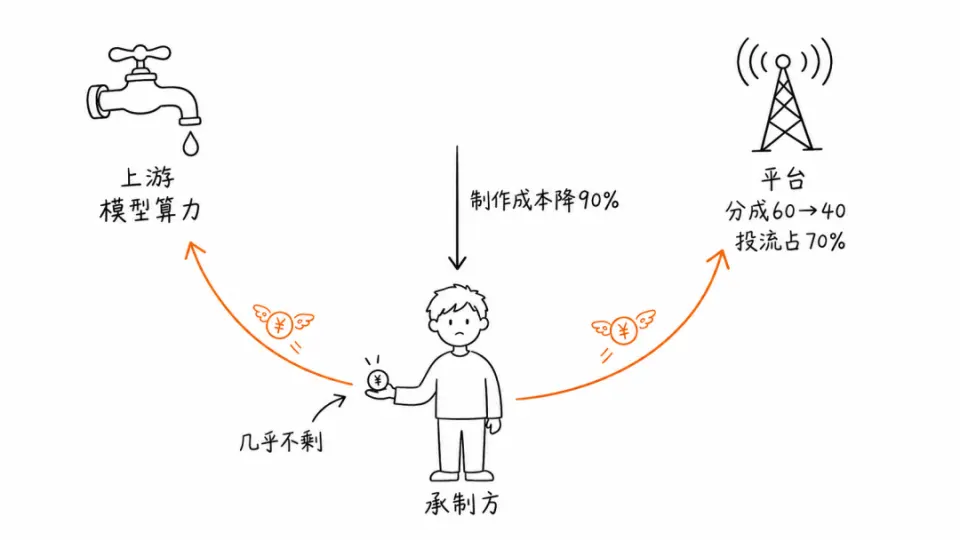
Production costs fell by 90%, yet money leaks out at both ends
The new rules do not raise the threshold; they relocate it
The most concrete impact of the new rules falls on the threshold. Their effect is not to raise the threshold overall, but to move it from a slope into a fault line.
In the past, entry was a matter of technological equality: anyone who could tune Seedance or Kling's API and afford the cost of tokens could get in, as evidenced by the 122,000 new releases in the first quarter of 2026. Now this business has been split into two halves, with a break in between. Making Category 3 remains as before: the production cost of a premium AI simulated-live-action short drama can be kept under 200,000 yuan, and for volume production, a few thousand to a few tens of thousands of yuan can also yield a finished film, which can go online through platform self-review—this path has not been blocked by the new wall. But to make Category 1, one must first be a company holding a Radio and Television Program Production and Operation License, and the hard thresholds for this license are: registered capital of no less than 3 million yuan, at least 3 professionals in radio and television-related fields, no foreign investment component, a Chinese citizen as legal representative, and no records of violations of laws or regulations in the past three years.
From 200,000 to 3 million is a 15-fold jump. And what this 15-fold buys is a license, not capability; it has nothing whatsoever to do with whether you can produce a hit.
Who exactly does this wall block? It does not block Category 3 individual players, who were already going through platform self-review; nor does it block leading institutions that already hold licenses. Those truly stuck in the middle are the teams that want to invest 800,000 yuan to gamble on a major production but cannot come up with 3 million yuan in registered capital or assemble 3 radio and television professionals. In other words, the tier most eager to scale up yet least capitalized—precisely the outsiders who rushed in after Seedance 2.0 launched and who now shout the loudest on social platforms.
So the new rules are not a prohibition; they are a repricing. They have not closed the small door of Category 3—"platform self-review is enough to get started"—but merely push major-production players toward licensed institutions.
When the threshold changes, the moat changes with it. In the past, the comparison was over "who can mass-produce dramas"; that premise no longer holds—knowing how to tune APIs is the literacy rate of 2026, not a skill, and something that can be replicated by 50,000 new films a month does not count as a threshold. Only two things truly cannot be copied: first, an IP copyright library—whoever holds exclusive IP at the level of Yuewen or Tomato earns money with their eyes closed, something legally exclusive that cannot be bought a second copy even with money; second, content and directing capability—the founder of Jiangyou achieves a hit rate of 90% precisely because of this, but it is bound to specific people and cannot be replicated across 100 production lines the way a license can. As for holding a license, it is a real threshold, but one that can be bought for 3 million yuan plus hiring 3 people; it is a toll gate, not a moat.
What is more troublesome is model iteration. Every step forward by Seedance and Kling lowers the threshold for the act of "production" a little further. This is not good news for production contractors: when anyone can make a drama in a day, those who make money from production itself are collectively pushed out; the lower the threshold, the fewer people can make money from low-threshold work. What can survive this round of iteration is still the same three things: licenses, IP, and traffic positions, and pure production contractors have none of the three.
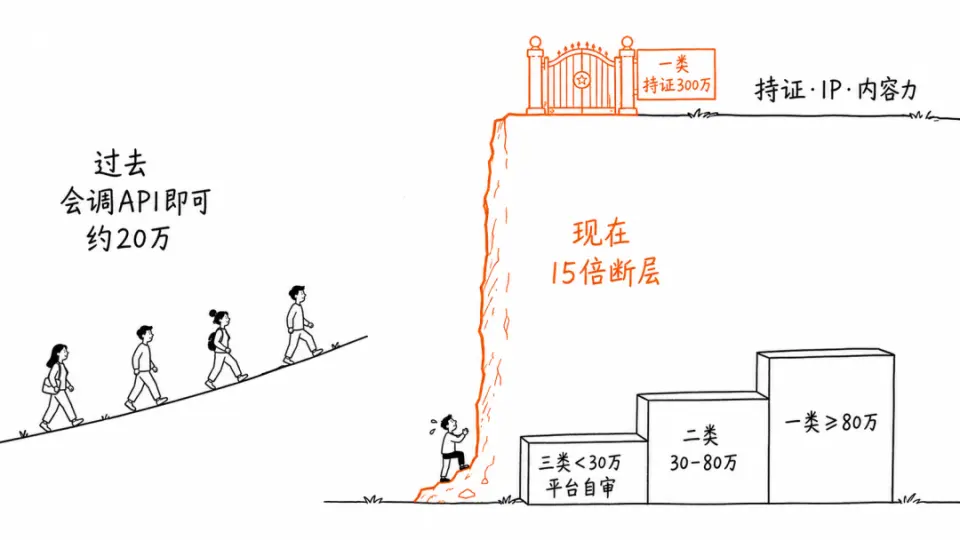
The threshold turns from a slope into a 15-fold fault line
Who should enter, who should exit
Adding up the accounts above, it is already possible to screen out who should do this and who should avoid it.
Those who hold exclusive IP at the level of Yuewen or Fanqie, or who have IP investment channels, are worth doing it. IP is the only thing in this business that reliably makes money and cannot be copied; Jiangyou took investment from Tencent and Yuewen, and that is the path it took. Teams with a live-action short drama production crew that are in transition are also worth doing it; their content and directing capabilities are cultivated over time and cannot be copied, and they can build a small and beautiful one-person company: collaborating online like Xuebao, with creators taking a 70% revenue share based on output, without bearing fixed labor costs, taking the three categories to avoid the RMB 3 million licensed threshold, and applying scarce content judgment where it matters most. For those who want to bypass the domestic coefficient war, going overseas is also a path; TikTok production contractors can receive RMB 100 to 150 per minute, and although it is a pure minimum guarantee with no revenue sharing, its advantage is stability.
Retail participants who can only call APIs should wait and see, and should not rush to invest in heavy assets. Wait for two signals before acting: first, the platform's revenue-sharing coefficients and minimum guarantee policies stabilize and are no longer cut unilaterally at will as in April; second, the official text of the Measures for the Administration of the Development of Micro Short Dramas is issued, to see whether the boundaries of the three-category self-review will be tightened. Before the signals arrive, piling up volume is working for free for the platforms.
Complete outsiders who enter with a set of courses and "get-rich myths" should not touch it. The most fatal point is this: the entire business model of such people is built on two things that are disappearing, one being platform minimum guarantees, which Hongguo is already canceling, and the other being the regulatory window, which the new rules are filling in one after another. ROI is generally below 0.8, and the probability of making money below the mid-tier is no more than 2%; this is not a luck problem that effort can turn around, it is a math problem. The harder you pile up volume, the more you are working for free for ByteDance's models and the platforms' traffic pools.
The last cost item: converting the new rules into money
What has been calculated above are all commercial accounts. Now add the last cost item: law. For those currently doing this business, it is not a question of "whether it can be done," but an amount of money that must be counted in the overall accounts.
First look at the window. This business has in the past fed on three regulatory gaps: racing ahead by launching first and supplementing certificates later, AI content not being labeled and passing as real people, and training models on celebrity faces with no one held accountable. Within a year, these three openings have been densely filled, from the tiered notice in February 2025 and the labeling measures in September, to the special governance in January 2026, the mandatory takedowns in April, and the administrative measures and classification standards in June; the six gates are stricter one after another, and the window is, as expected, heading toward closure. The good news is that the window is closing through a soft landing: compliance costs rise and compensable risks become explicit, rather than making this business impossible to do.
The first category is compliance costs that are certain to be incurred, directly counted as fixed costs. Filing is a hard requirement; from April 2026, existing works that have not been filed are subject to mandatory takedown, which means the existing dramas of a batch of unlicensed small studios are directly zeroed out. AI labeling is an action that must be done for every episode; the Measures for the Labeling of AI-Generated Synthetic Content took effect in September 2025 and require explicit labels plus implicit labels in file metadata, and Article 34 of the draft for comments of the administrative measures specifically reiterates that AI micro short dramas must be labeled in a prominent position episode by episode; omission is a reason for takedown as a violation, and although it costs no money itself, it must not be forgotten. If one wants to do Category I, the threshold of the Radio and Television Program Production and Operation License must also be added: RMB 3 million in registered capital, 3 professional personnel, plus a 20-day review period after acceptance. As for penalties, Article 46 of the draft for comments of the administrative measures states that those who produce content not in accordance with the filed content, or broadcast content not in accordance with the licensed content, shall be ordered to correct, warned, or criticized in a circular, and may also be fined not more than RMB 100,000; this is a figure that takes effect only after that document is formally implemented.
The second category is risks that can be solved by spending money, which can simply be counted into the accounts as "probability of occurrence multiplied by cost per occurrence." The two most realistic pitfalls in this business both fall into this category.
One issue is the right of portrait. AI face-swapping, using the faces of celebrities or internet personalities to train models, and generating characters that deliberately resemble popular artists run afoul of the right of portrait under the Civil Code and the Provisions on the Administration of Deep Synthesis of Internet Information Services. This year, artists such as Jackson Yee, Dilraba Dilmurat, and Yang Zi have successively issued statements to defend their rights, the China Television Artists Association Actors Committee issued a dedicated statement, and Hongguo also took down the allegedly non-compliant The Peach Blossom Hairpin on April 3. Such disputes mostly end in civil compensation and takedown, with payouts typically ranging from tens of thousands to several hundred thousand yuan, which many teams accept as an operating cost. But this cost can actually be reduced to zero: if you do not use real people's faces to train models and do not create characters that deliberately resemble real people, this cost does not arise. One caveat: if celebrity portraits are misappropriated systematically and at scale for profit, the nature of the conduct may be elevated to a more serious level, and this line should be actively avoided.
The other is copyright. Unauthorized adaptations of existing IP, such as live-action comics, reskinned comics, and shell-wrapped comics, run afoul of the Copyright Law. Judges from the intellectual property division of the Shanghai Xuchang District People's Court have reminded practitioners that when using AI to produce comic dramas, prior agreement on ownership of rights is most important, and beyond the Copyright Law, the Anti-Unfair Competition Law can also serve as a supplement. Translated into action: before adaptation, keep the full authorization chain and set out ownership of rights clearly in writing, and this potential payout can be substantially reduced.
Those with relevant legal needs may talk with the author.
Counting both types of cost, one finds that for the volume-stacking players, what truly crushes them is not the law: the business account itself is already negative, and compliance costs merely deliver the final blow. For the few with IP, licenses, and content strength, these are one-time investments; once paid, peers shut out of the door become their market instead.
Hongguo wants this industry to "walk without crutches." It removes the crutch of the minimum guarantee, and the new rules remove the crutch of the regulatory vacuum. Only those who can still stand on their own once both are withdrawn deserve a ticket to the next stage. As for those who shout the loudest, most of them are probably not among them.
