An AI recording card sells for six or seven hundred yuan, or even over a thousand, while a card from the same mold in Huaqiangbei sells for 120 yuan. In this business, which WeCom, Feishu and DingTalk are all eyeing at the same time, the hardware barely makes money — so what actually makes the money? This article walks you through all three sets of accounts.
On July 6, WeCom updated to version 5.0.8 and launched a feature called "Record Face-to-Face Chats": several people talk in a meeting room, colleagues pre-register their voiceprints, and the transcription automatically recognizes who is speaking, with the to-do items that come out of the conversation @-mentioned directly into the other party's WeCom to-dos. Launched alongside it was the TicNote WeCom collaboration edition, made jointly by Mobvoi and WeCom, starting at 699 yuan, with the hardware upgraded to more than 32 hours of continuous recording.
The card is the size of a credit card and magnetically attaches to the back of a phone. Yet for the same mold, the same magnetic card, and the same claim of AI summaries and mind maps, white-label quotes in Huaqiangbei are under 300 yuan, and the simplified circular version can be had for as little as 120 yuan. These are the prices Time Weekly obtained during an on-site visit to Huaqiangbei last September.
What exactly are you buying with a price gap of several hundred yuan? This business is worth doing the math on, because more than one company has its eye on it: Feishu teamed up with Anker to make the 899-yuan Recording Bean, and DingTalk entered the fray itself with the DingTalk A1, whose Youth Edition sells for only 499 yuan. Three of the strongest office software players have all put a recording card on the shelf at the same time — the money is certainly not in that card.
They sell the card, but the money is in renewals
Let us first explain this business clearly. What it sells is a recording card that attaches to the back of a phone, paired with a phone app for cloud transcription and AI summaries; the hardware moves volume at a low price or even a thin margin, and the long-term money comes from software subscriptions and being tied into an office ecosystem. The customers are businesspeople and enterprises that hold meetings, make calls and conduct interviews every day.
A single order runs like this. The user pays from 699 yuan for the hardware; the machines in different versions are in fact identical, and the only difference is how long a membership comes with them. After the app is bound, the recording card attaches to the back of the phone and records with one press; the cloud transcribes as people speak, and Mobvoi's self-developed Shadow AI automatically generates summaries, mind maps and to-do lists. Free users get 300 credits per month, equal to 300 minutes of transcription; members get 1,500 credits per month; if that is not enough, they can spend 22 yuan on a 150-credit top-up pack. Recordings, transcriptions and files accumulate in the account, which Mobvoi calls "traceable organizational assets."
Hardware is not the focus of this business, and the people running it know that best. Zeng Sen, Mobvoi's vice president of AI hardware, told Time Weekly that treating the hardware's own functions as the core competitiveness is not something Mobvoi is capable of, and that it cannot compete head-on with the big companies; hardware can take different forms, but AI is the core. Founder Li Zhifei put it more bluntly: at the launch event he admitted that large models are simply not something they can afford to play in, so they turned back to the hardware market they know well and compete through software.
Translated into the language of accounts, it comes down to one sentence: hardware is used to bring users in, and software subscriptions are the money they actually want to collect. Whether this business succeeds depends entirely on the subscription part.
The hardware accounts approach zero, and the subscription money is borrowed
Let us start with the hardware. How much does the bill of materials cost for a 699-yuan machine? We can use the public teardown of the DingTalk A1 as a reference: five omnidirectional microphones plus one bone-conduction microphone, a BES audio chip, a 660 mAh battery and 64GB of storage, all standard components available anywhere. Based on that teardown, a rough estimate puts the whole machine's materials in the 80 to 120 yuan range, with surface-mounting and assembly pushing it up a little further. Calculating generously, even if the whole machine costs 200 yuan, a 699-yuan price tag still looks like a 70% gross margin.
But that 70% is illusory. With the same mold, Huaqiangbei replicas sell for under 300 yuan, the simplified circular version for 120 to 150 yuan, and iFlytek simply advertises "same as Plaud Note, 365 days free." The hardware form factor presents no barrier whatsoever, which means the roughly 500-yuan premium in the 699 price cannot hold, and the real transaction price will be pushed down all the way by white-label products and the big companies. In the hardware accounts, the arithmetic shows a 70% gross margin, but commercially it approaches zero.
What they really want to earn is subscription revenue. 22 yuan buys 150 credits, which works out to 0.147 yuan per minute of transcription. On the cost side, transcription relies on speech recognition plus large models, billed by usage volume; the domestic version uses in-China models such as Doubao, Tongyi Qianwen, DeepSeek and Kimi. At current prices for domestic large models, the interface cost of transcribing and summarizing one minute of audio comes to within a few cents, estimated at under 0.05 yuan. A sale price of 0.147 yuan against a cost of under 0.05 yuan puts subscription gross margin comfortably at 60 to 80 percent, roughly the level of a pure software business. This is the real profit center: hardware is a one-off sale at zero gross margin, while subscriptions are recurring monthly revenue with extremely low marginal cost.
The problem is that this subscription gross margin is not conferred by a moat; it is conferred by time. The price gap between 0.147 yuan and 0.05 yuan comes from two things that have not yet happened: first, ordinary users do not yet know how cheap large-model interfaces are; second, the big platforms have not yet made transcription completely free. Both of these are moving in the same direction. DingTalk A1 gives away 1,000 minutes of free transcription plus 10GB of cloud storage with the purchase of the hardware; Anker's Feishu recording bean gives 6 months of 1,200 minutes per month; iFlytek gives a full year free. For the same minute of transcription, the giants give it away as a bonus, while Mobvoi sells it at 0.147 yuan. Low-cost open-source models such as DeepSeek and Kimi are already in its own call stack, and the direction of upstream interface prices is certain and monotonic: downward. Today's 60 to 80 percent subscription gross margin is closer in nature to a wrapper business whose margin is passively compressed as upstream prices fall, not structural profit that can be defended over the long term.
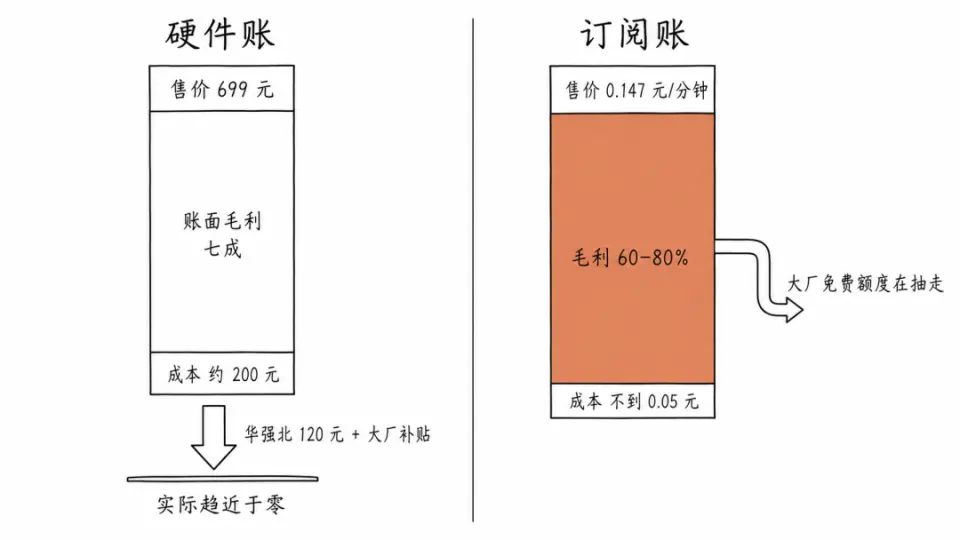
Two sets of accounts
The real money-making entry point is not in the hands of those who make the card
So the question arises: if the hardware does not make money and the subscription gross margin is being drained by the big platforms, why are DingTalk and Feishu still racing to do it, and why do they dare to give transcription away for free?
Because what they earn is fundamentally not the money from this card. Tian Feng, director of the Kuaishi Manxiang Research Institute, told Time Weekly that office software in the past missed a large amount of work-process data; whoever controls the interaction entry point controls the data source, and can then expand into industries such as finance, education and media. Translated: for DingTalk and Feishu, the recording card is an entry point for capturing real meeting data; the money lost on hardware is the customer acquisition cost of office software; the data sinks into DingTalk To-Dos and Feishu Bitable, and what it fattens is their own ecosystems. They collect money at another, larger table, so they can give away what is on this table for free.
This is where independent card makers suffer most. They must survive on subscriptions, so they dare not give transcription away for free; their competitors can, because their competitors do not count on subscriptions to make money. The giants entering the market are not making the cake bigger and giving them a slice; they are smashing their only profit item straight to the floor.
Mobvoi is betting on its self-developed Shadow AI and data accumulation, and whether that counts as a moat. For itself, it counts as half a moat, and a half that can be bypassed. Capabilities such as AI summaries, mind maps and to-dos are claimed even by Huaqiangbei white-label products as something their "smart mind maps can also do"; in the era of open-source models, they are not things that cannot be copied. What truly locks in users is where the data is stored. In the WeCom co-branded model, voiceprints, to-dos and @-mentions of colleagues all ultimately sink into WeCom's organizational structure, and cannot be used with a different card. But this lock-in belongs to WeCom, not to Mobvoi.
Anker has in fact already demonstrated the answer. With the recording bean it co-developed with Feishu, Anker earns the 899 yuan hardware money, while the subscription is handed over to Feishu's AI membership at 69 yuan a month, and the data goes into Feishu's pool. Anker did not stubbornly tough out the hardest path of "selling hardware and collecting subscriptions at the same time"; instead it honestly retreated to making a good piece of hardware for a giant's ecosystem. It voluntarily gave up the position of an independent brand, because in that position the hardware cannot beat Huaqiangbei on cost and the subscription cannot beat the big platforms' subsidies, so it wins on neither front.
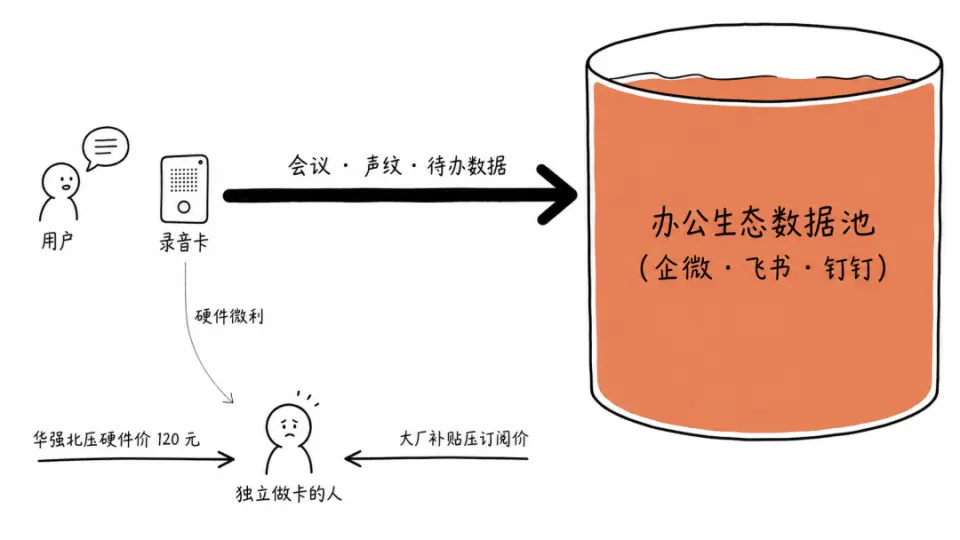
Where the money and the data flow
The ceiling is written in the financial reports; what capital is betting on is not the money you earn
Even if all of this is weathered, how big can this business get? The ceiling is in fact not high. Figures from market research firm QYResearch put the global AI audio tools market at about 9.3 billion yuan in 2024, rising to only 18.9 billion yuan by 2031, a 10 percent annual growth rate, which counts as slow for AI. Zeng Sen's own most optimistic estimate is annual sales of 500,000 units at 1,000 yuan each, or annual revenue of 500 million yuan, 5 percent of the ten-billion-yuan market. That is the top-end figure in the imagination of an industry vice president: at the very top, a brand is still only in the 500 million yuan range. The world's most successful player, Plaud, sold 1 million units in two years after launch, with annualized revenue of 100 million US dollars, or around 700 million yuan. This track can support a company with a few hundred million yuan in revenue, but it cannot grow a platform.
Moreover, this is about capturing existing demand, not creating incremental demand. A person will most likely buy only one recording product; this is exactly what a Suzhou hardware industry practitioner said in an interview with 36Kr. The demand pool is fixed, so every additional unit you sell is one unit someone else does not sell. Caught between Huaqiangbei driving down hardware prices and the giants subsidizing software prices, an independent brand without an ecosystem will face customer acquisition costs that remain higher over the long term than the subscription revenue it can collect.
So why is the secondary market still willing to give Mobvoi a premium? Because what capital is betting on and what you earn are not the same thing. Mobvoi is the first AIGC stock in Hong Kong; its 2024 revenue was RMB 390 million, down 23% year on year, and it lost RMB 722 million. Only because AI hardware revenue in the first half of 2025 was RMB 98 million, accounting for 54.78% of total revenue, was its half-year loss narrowed to RMB 2.9 million, approaching break-even. The story capital favors—"integration of software and hardware, data entry point, subscription imagination"—has so far validated only one thing: the hardware can sell, and the bleeding has been stopped. The actual subscription renewal rate, monthly active members and cumulative subscription revenue are not separately broken out anywhere in the financial reports. If there were favorable figures that could be broken out, they would have been broken out long ago. Capital can tolerate your losing money to hold a position; it is betting on data barriers and the valuation story at exit. Plaud's valuation of more than USD 1 billion rests on exactly this narrative. But an entrant spending its own money cannot afford to make that bet. What you need is cash flow you can actually collect every month, not a valuation three years from now. The two premises on which capital's logic depends—that subscriptions can be collected and that the data entry point belongs to you—do not hold for either one in the case of an independent entrant.
There is another layer of risk for entrants, coming from the models themselves. Real-time meeting transcription, speaker diarization and automatic meeting minutes are already done for free in software by Feishu Minutes, Tongyi and Tencent Meeting; you do not need to buy an extra card. Once the models become more capable, the microphone built into a phone plus cloud transcription will be enough, and the hardware advantage of an independent recording card—slightly "better audio capture"—will be worth only the difference of a few dozen yuan on the BOM. The stronger the models become, the more valuable the entry points of giants with ecosystems are, and the less reason independent card makers without ecosystems have to exist. This round of model iteration amplifies the former and erases the latter.
Policy and legal costs
The compliance gaps in this business are concentrated in voiceprints and recording, and both are the kind that can be solved by spending money; they do not involve crossing criminal red lines. Voiceprints are sensitive personal information, and Article 28 of the Personal Information Protection Law requires separate consent before processing. The "record in-person chat" feature in WeCom deserves the most attention: when several colleagues talk in a meeting room and each is asked to record their voiceprint in advance and then @ the other person with a to-do item, the consent obligation expands from "the user themselves" to "every colleague present who is identified," and in practice almost no one actually obtains separate consent for voiceprint processing from each colleague.
On top of that, recording others implicates privacy rights under the Civil Code, and uploading an entire meeting's content to a large model creates a risk of leakage. Most of these rules are already in force; the current window is not "no legislation yet" but "legislation exists, yet enforcement and civil claims have not yet come knocking intensively." What is being earned is the window created by delayed enforcement, not a window created by a gap in the rules. It is not hard to actually reduce this cost: add a step requiring separate authorization from everyone before the in-person chat feature records voiceprints, make meeting minutes non-shareable by default, and state clearly in enterprise contracts that data will not be used to train models; these costs then basically drop to zero.