
On July 16, the Mayor of New York City released a 68-page report aimed specifically at cracking down on the various tricks landlords use when renting out apartments. One item in it had never been singled out and discussed on its own before: landlords and agents who use AI-edited images in rental listings must disclose that fact clearly.
At roughly the same time, a bill in California was also moving forward, addressing the same issue and taking a tougher approach.
This is the first time in the United States that AI-edited real estate photos have been singled out for regulation. It may look far removed from us, but it is not. More and more people can generate images with AI, and real estate is simply the first scenario to be called out by name. How this line is drawn, and on whom it lands, is worth understanding.
First, what exactly is being regulated here
You are looking for a place online and scroll to a rental unit. In the photos there are floor-to-ceiling windows, wooden floors, and an open view outside, and it looks considerably nicer than what your budget can rent. You take half a day off to go see it, walk in, and find the windows are pitifully small, the floor is old tile, and directly outside is a wall.
The photos were not taken; they were added afterward with AI. Americans have coined a word for this: "housefishing," built on the same frame as the word for deceptive photos in dating.
For locals renting an apartment, this is at most a wasted trip. The real trouble is renting from out of town: you are relocating for a new job, you have not arrived yet, and you sign a lease based entirely on a few online photos; by the time you move in and realize what happened, the money and the contract are already gone. At the hearing held for that New York report, 2,400 tenants described exactly this kind of ordeal.
In regulating this matter, New York and California have chosen two completely different legal paths. Understanding these two paths matters more than remembering which city regulated it.
The New York path: no new offense, but bringing platforms in to regulate together
New York has taken the administrative and consumer-protection route.
The report is called the "Rental Ripoff Report," and it was compiled from hearings held in the five boroughs after the mayor took office. It is still only a policy report plus a series of recommendations, not a law already in effect, nor a rule that can directly impose penalties. Actual implementation depends on a New York City department, the Department of Consumer and Worker Protection, or DCWP, drafting the rules. The report says all these measures will be rolled out in stages over three years, and the specific effective date of the AI disclosure item has not yet been set.
How it is to be implemented is quite deliberate: DCWP does not plan to go after landlords one by one itself, but instead to bring the two listing platforms, Zillow and StreetEasy, in to implement the "clear and conspicuous disclosure" requirement together. On stage, the mayor also took a jab at the platform, saying it is "called StreetEasy, not StreetHard."
In plain terms, the New York approach is characterized by the following: it does not create new offenses; it relies on the consumer protection authority the government already has, together with platform cooperation. To trace the legal basis further, New York State also has a General Business Law, in which Article 349 governs deceptive business practices and Article 350 governs false advertising; these are the statutes that can be connected behind this type of enforcement.
The advantage is broad coverage and the ability to use the platforms' hands to control a massive number of listings at once. The cost is that it is soft, consisting mainly of administrative guidance and fines, and cannot reach the criminal level.
The California approach: written into the Civil Code, licensed agents may face imprisonment
California has taken the legislative route, which is much harder.
That bill is numbered AB 2025. It was introduced by a member of the Assembly in February 2026 and is still moving through the legislative process; it has not become formal law. One common claim needs correcting here first: some people online describe it as "a law already enacted in California," which is inaccurate—it is currently still a bill pending review.
What it does is add one section to each of two California codes. One is added to the Civil Code as new Section 1940.11; the other is added to the Business and Professions Code as new Section 10175.4.
What is interesting is where it comes from. California's current law already requires that a licensed real estate agent who uses digitally altered images in advertising for the sale of a house must disclose that; and if the advertisement is posted online, the same unaltered image must also be posted together with it. Note that this current law governs only sales. What AB 2025 does is extend this set of requirements from "sale" to "rental," and expand the obligated persons from "agents" to "any person who uses altered images in rental advertisements."
The core obligation is written as follows:
Proposed new Section 1940.11(b)(1) of the California Civil Code
A person who includes a digitally altered image in an advertisement or other promotional material for rental of real property shall include in the advertisement or promotional material a statement disclosing that the image has been altered and a link to a publicly accessible internet website, URL, or QR code that includes, and clearly identifies, the original, unaltered image. The statement shall be reasonably conspicuous and located on or adjacent to the image……
Translation: Any person who uses a digitally altered image in a rental advertisement or promotional material shall include in the material a statement explaining that the image has been altered, together with a publicly accessible website address, link, or QR code containing, and clearly identifying, the original, unaltered image. This statement shall be reasonably prominent and placed on or immediately next to the image...
Look carefully at what it requires. It is not merely requiring you to label an image "this image has been modified by AI"; it also requires you to present the unaltered original image for comparison. If the advertisement is posted on a website you control, the bill requires you to include the original image directly. It also closes a loophole for evasion: what is used as the "original image" must be a photograph actually taken by a camera, and another computer-rendered image may not be passed off as the original.
As for exactly what counts as "digital alteration" and what does not, the bill lists this clearly:
Subparagraph (a)(2) of the same section
(A) "Digitally altered image" means an image in which elements have been added, removed, or changed through photo-editing software or artificial intelligence, including but not limited to fixtures, furniture, appliances, flooring, walls, wall paint colors, hardscape and softscape, building facades, floor plans, and elements outside the property or visible from the property, such as streetlights, utility poles, views seen through windows, and neighboring properties.
(B) "Digitally altered image" does not include images that have only undergone common adjustments such as lighting, sharpening, white balance, color correction, angle, straightening, cropping, and exposure, and that do not change the presentation of the property.
To summarize this boundary in one sentence: if AI adds a set of furniture out of thin air, replaces the view outside the window, swaps old tiles for wood flooring, or renovates the building facade, all of these fall within scope; adjusting the color under natural light, straightening a crooked photo, or cropping the composition is permitted. These two columns—what is covered and what is not—are the most directly actionable part of the entire bill.
What happens if it is violated? California distinguishes between two categories of persons. A licensed real estate agent who violates Section 1940.11 is deemed to have violated the Real Estate Law, may face administrative sanctions, and may have their license suspended or revoked; if the violation is intentional, it also constitutes a crime. This is the origin of the saying that "licensed agents may go to prison." As for unlicensed persons, such as landlords renting out their own properties, the bill itself does not create separate penalties for them, nor does it give tenants a direct private right of action; recourse must be had under California's existing Unfair Competition Law.
This is also a convenient place to correct a widespread misunderstanding: some say that proceeding under the Unfair Competition Law can yield "two to five times the damages." That is incorrect. That law primarily provides for injunctions and restitution, and public authorities may impose per-violation fines in enforcement actions, but it does not provide punitive multiple damages.
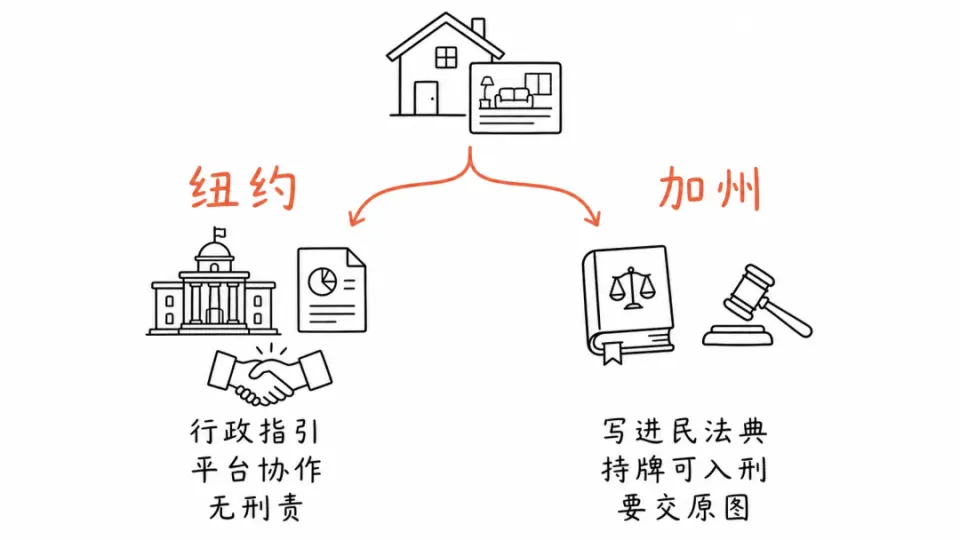
Two paths: New York and California
The real novelty: the question used to be "is it AI?"—now it is "what does the real house look like?"
Looking at New York and California together reveals one thing they share that differs from all past AI labeling rules.
Over the past years, AI content labeling laws enacted in various places have all addressed the same question: was this content made by AI? This is true of China's Measures for Labeling Artificial Intelligence-Generated Synthetic Content, effective September 1, 2025, of Article 50 of the EU Artificial Intelligence Act, and of another California law governing transparency of generative AI tools. They focus on transparency—letting you know that something was made by a machine.
Real estate is different this time. What it seeks to address is not "is it AI?" but "what does the real house actually look like?"
The difference between these two questions is actually crucial. Even if you honestly label an image "this image has been modified by AI," that does not stop a tenant from being drawn to view a property because of a floor-to-ceiling window that does not exist at all, or even from signing a lease through a screen. Labeling only answers "true or false"; it does not answer "what does the real thing look like?" That is why California simply bypasses labeling and directly requires the original image for comparison. This step goes much further than merely attaching an AI label.
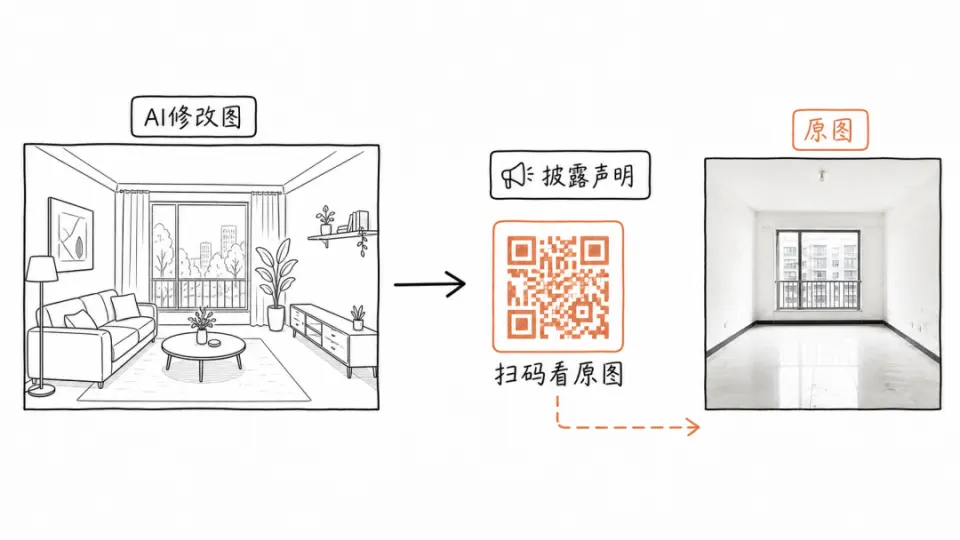
More than labeling: original-image comparison is also required
It is precisely because of this step that real estate became the first AI-related high-frequency fraud scenario in the United States to be singled out by name and pressed to “produce the original images.”
Gaps in jurisdiction, and the federal backstop net
Each of the two paths has its own blind spots.
The California path is state law and governs only rentals within California. StreetEasy is a New York platform listing New York properties, so California Section 1940.11 has no direct effect on it. Conversely, New York relies on platforms' cooperation; it cannot reach situations where a platform refuses to cooperate, nor can it reach criminal matters.
Is there a net at the U.S. federal level? Yes, but it is a wide net with large mesh. The federal government has the Federal Trade Commission Act, Section 5 of which provides:
Federal Trade Commission Act, Section 5(a)(1), 15 U.S.C. §45(a)(1)
Unfair methods of competition in or affecting commerce, and unfair or deceptive acts or practices in or affecting commerce, are hereby declared unlawful.
Translation: Unfair methods of competition in or affecting commerce, and unfair or deceptive acts or practices in or affecting commerce, are hereby declared unlawful.
This is the general federal backstop in the United States for deceptive advertising. An AI-edited property image, once it reaches the threshold of “likely to mislead a reasonable consumer and material,” gives the Federal Trade Commission authority to intervene, issue cease-and-desist orders, and, for knowing violations, seek civil penalties in court. The problem is that it must prove “deception” case by case, and to date the Federal Trade Commission has not taken specific action on AI property images.
So the current situation in the United States is this: states and cities each regulate their own patch, and their standards differ; the federal government has backstop provisions but has not acted. Listing platforms operating across states are the most hard-pressed, having to satisfy several sets of requirements at once.
Back to China: we are actually further ahead on the labeling front
Looking at these two new U.S. rules, do not rush to assume they are someone else's business. Comparing them with China actually makes it clearer where we stand.
On the question of labeling, China has moved further and broader than the United States. The Measures for the Labeling of AI-Generated Synthetic Content took effect on September 1, accompanied by a mandatory national standard requiring all AI-generated synthetic content to carry two types of labels: an explicit label visible to humans and an implicit label embedded in the file metadata. This coverage is far broader than the two US rules, which address only real property. In other words, AI-retouched images, AI floor plans and virtual staging images on Chinese real estate platforms already fall within the scope of the labeling obligation.
But there is one area China does not yet cover, and it is precisely the novelty of the US approach this time: user-side, scenario-specific "original-image comparison." China's current framework governs whether labeling is required on the generation side, but it has not yet adopted scenario-specific detailed rules aimed at "AI retouching in real estate advertising." To actually pursue a deceptive real estate image in China, one still relies on the false advertising provisions of the Advertising Law, the Law on the Protection of Consumers' Rights and Interests, and the Anti-Unfair Competition Law—reaching the conduct from the general anti-deception side rather than from the AI side.
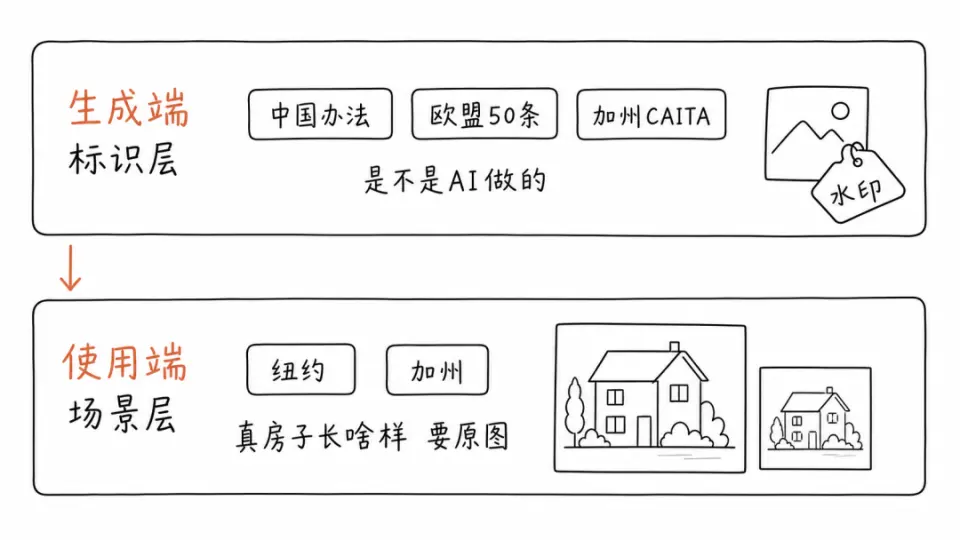
Two regulatory layers: generation-side labeling and user-side scenarios
For Chinese companies in the AI retouching and virtual staging business, especially those seeking to take this business overseas, there is one point to think through in advance: a product must not only be able to generate attractive images, but must also be able to generate disclosure statements with one click, retain the original camera images, and export comparisons at any time. Combined with the machine-readable labeling requirement under Article 50 of the EU framework and California's detection requirements for generative tools, this amounts to a compliance checklist that must be broken down by jurisdiction.
Looking ahead: where this logic lands in China, and which scenarios warrant attention first
What is worth noting for China about the US approach is not that it regulates real property, but the thinking behind it: in a scenario where consumers rely on images to make decisions and are particularly susceptible to being misled by AI beautification, a separate "disclosure plus original image" obligation is added. There are no fewer scenarios in China to which this thinking can be applied than in the United States. Moreover, China differs from the United States in one respect: there is no need to wait for dedicated AI legislation, because three tools are already at hand.
The Advertising Law is the first. It directly defines as false advertising "representations about the performance, functions or condition of goods that do not conform to reality and that affect purchasing." An image in which AI adds a balcony out of thin air or erases cracks in a wall can fall under this provision so long as it affects a person's decision to purchase or lease. The penalties are not light: an order to cease publication and eliminate the effects, plus a fine of three to five times the advertising expenses; where the expenses cannot be calculated or are obviously low, a fine of RMB 200,000 to RMB 1,000,000. For goods affecting consumers' life and health, a platform that publishes an advertisement while knowing it to be false bears joint and several liability with the merchant.
The Law on the Protection of Consumers' Rights and Interests is the second. Where an operator's use of AI-retouched images constitutes fraud, consumers may demand a refund plus treble damages, and where the compensation is less than RMB 500, it is calculated as RMB 500.
The Anti-Unfair Competition Law is the third, governing competitors using false or misleading promotional statements to capture business from one another.
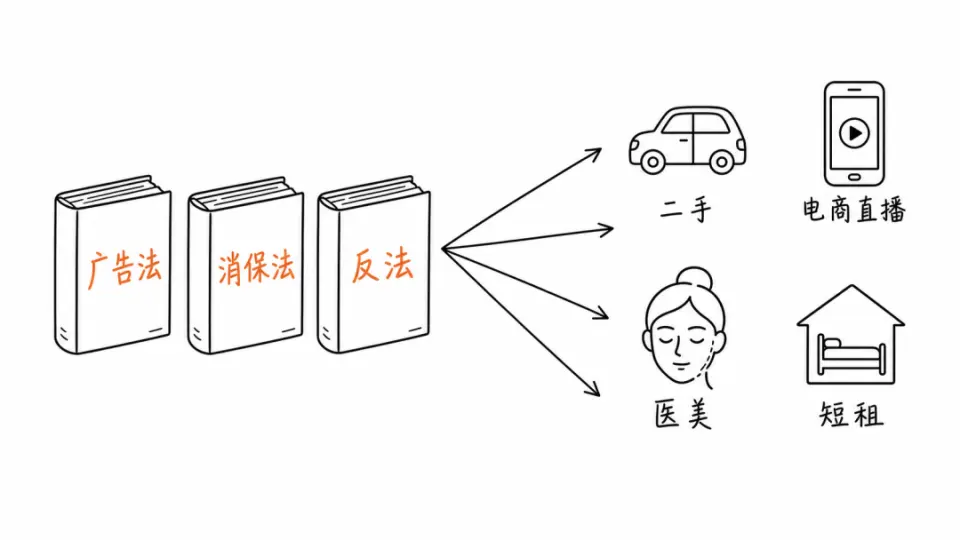
China's three existing laws and high-risk scenarios
Following these three tools, there are several scenarios that in fact warrant earlier attention than real property.
Second-hand transactions are the first to be affected. With second-hand cars, second-hand mobile phones and second-hand luxury goods, one-click AI removal of scratches and erasure of accident traces has long been occurring on platforms. What buyers see through a screen is precisely those few images, and once the item received does not match, the taint of fraud is stronger than in real property.
E-commerce product detail pages and livestream selling are another. AI-generated product images, AI virtual try-on, and AI renderings that do not match the actual goods received are already a high-incidence area for consumer fraud; add AI-synthesized anchors and digital-human livestream selling on top, and there is an additional layer of explicit labeling obligations under the Labeling Measures for synthesized voices and digital humans, and a failure to label can itself be investigated.
Medical aesthetics and healthcare are the most dangerous. AI-generated "before and after" comparison images and AI face-swapping to demonstrate efficacy are both false advertising and may cross the red line of medical advertising review, leaving neither side with a clean way out.
Short-term rentals and homestays are almost a replica of the US set of property rules, just under a different sign, with exactly the same logic.
Whether these scenarios will actually be reached, and how quickly, depends on regulators' attention and whether typical cases emerge; I will not overstate this here. But the direction is not hard to judge: China has already implemented labeling at the generation end, and tightening next at the use end and in specific industries is mostly a matter of time and sequence. For those doing this business, rather than waiting for the rules to come knocking, it is better to make "clearly state what was changed and keep a copy of the original image" a default product action now.
Who should pay attention to what
Those who truly need to be concerned are the businesses on the publishing end: platforms, advertisers, and companies doing AI marketing and photo editing. For tenants, remembering "ask for the original image before viewing" is enough; the pressure actually falls on the supply side.
Property platforms and listing websitesDo not treat this as the landlord's issue alone. The California statute says "any person who uses a modified image in a rental advertisement," and New York simply brought Zillow and StreetEasy into enforcement together; both approaches bring platforms within scope. In China, platforms such as Beike, Anjuke, and Ziroom follow the same logic. Platforms need to think through three things in advance: whether listing images can be mandatorily required to carry disclosures, whether AI-modified images can be identified, and how to quickly verify and take down listings upon receiving complaints. This is essentially a platform's duty of care; once the rules take effect, the statement "I merely provide landlords with a publishing slot" will no longer work.
Advertisers and AI marketing companiesIf you create AI marketing images of properties or goods for clients and then help place them, liability will travel down the chain to you. California's "any person who uses a modified image" reaches agencies, and the federal "deceptive practices" provision cares even less whether you are the final seller; whoever handles it is implicated. Two things to do are very practical: first, clearly set out in contracts the disclosure obligations, retention of original images, and who bears liability if something goes wrong, rather than defaulting to pushing it onto the client; second, deliver finished products to clients with disclosure statements and original images included by default, rather than waiting for them to ask. For those taking work across the United States, the European Union, and China, compliance also needs to be separated by region.
Tool service providers doing AI photo editing and virtual stagingThis is a real AI business, and building compliance into the product is a selling point, not a burden. There are three capabilities the product should have built in: one-click generation of disclosure statements, proper retention of original camera images with the ability to export them for comparison at any time, and, for overseas versions, machine-readable labels. Whoever builds these in first will be first to obtain the ticket to enter the US and EU markets.
Final sentence
AI regulation is moving from "telling you this was made by AI" toward "telling you, in specific scenarios, what the real thing actually looks like." Real estate is the first scenario to be pinned down, because deception there carries high costs and occurs frequently. The other scenarios mentioned above will sooner or later have to go through the same logic. Real estate is simply the first to take this hit.
Before the rules land on you, keeping the original images on file is the preparation that leaves you least exposed right now.
Those with legal needs related to AI marketing compliance or taking AI products overseas are welcome to talk with the author.
Reference sources
- New York City Mayor's Office, "Rental Ripoff Report" (released July 16, 2026)
- Business Insider: "Mamdani Is Now Targeting Deceptive AI-Made Apartment Listings" (July 16, 2026)
- PetaPixel: "Mayor Mamdani Says Landlords Can't Secretly Use AI Images to Advertise Properties" (July 16, 2026)
- The Verge: "New York City is cracking down on AI real estate listings" (July 16, 2026)
- California Assembly Bill AB 2025, "Tenancy: digitally altered images: disclosure," official text (version introduced February 17, 2026)
- Section 5 of the U.S. Federal Trade Commission Act, 15 U.S.C. §45, official text
- China's Measures for Labeling AI-Generated Synthetic Content (effective September 1, 2025) and GB 45438-2025
- Article 50 of the EU Artificial Intelligence Act (Regulation (EU) 2024/1689)
Author of this article:Lü Yinghui, a lawyer at Mankun (Shenzhen) Law Firm. A graduate of China University of Political Science and Law, with nearly a decade of deep experience in the legal industry, having previously worked at a court in Shenzhen. Focused on legal services in the new-generation economy, with extensive practical experience and deep insight in fields such as Web3 and artificial intelligence. Account across all platforms: Lao Lü Talks New Money; you are welcome to follow.

