In June 2026, WeChat and Alipay almost simultaneously embedded AI assistants into their chat interfaces, allowing users to speak a single sentence and have the AI invoke services and make payments on its own. This article first explains why the platforms are doing this and what the result of this move is, and then turns to a separate calculation: what opportunities this result leaves for small and medium-sized merchants and service providers, and whether those opportunities are worth taking on.
For those doing business in AI, the month of June is worth revisiting on the calendar.
On June 8, the WeChat Open Platform released the Guidelines on Developers' Access to the WeChat AI Ecosystem, opening access capabilities to all mini-program developers. The next day, JD.com, Meituan, Ctrip and Didi joined as the first batch of beta-testing teams. On June 16, the AI version of Alipay opened invitation-based testing, integrating tens of thousands of life services into a single chat interface. On June 17, WeChat Pay launched an AI-exclusive card, connected to the office agent WorkBuddy, so that saying "what good group-buy deals are nearby" can take you from a recommendation all the way to payment. Around June 20, WeChat's native AI assistant "Xiaowei" expanded its gray release.
A little earlier, at the Alipay AI Payment Ecosystem Conference on May 26, Ant gave a figure: AI payments had completed 300 million transactions in total, with over 100 million users, supporting 95% of general-purpose agent frameworks. For reference, Ant's own standalone AI assistant "Afu" had 24.12 million monthly active users that month. The former is the number of transactions accumulated over three months; the latter is the monthly active users an independent app fought desperately to push into the top five of the AI-native rankings. Put the two figures together, and you can read which one Ant is really betting on.
The answer is not that app; it is that chat interface.
Ant Group CEO Han Xinyi said at that conference that AI agents will overturn the "traffic is king" logic of the mobile internet era; the era of "traffic gateways" determined by people is about to end, replaced by an "agent ecosystem." At the same conference, Li Jiajia, co-president of the Digital Payment Business Group, put it more directly: currently they are not considering commerce, not considering revenue, and not considering competition; they only want to first make the ecosystem bigger, and "when the ecosystem grows, commercial revenue will naturally follow."
A company that does not lack money says it is not making money while setting the fee rate for its new product at more than double that of the old product. What game the platform is playing, and this new calculation, are hidden between these two statements.
The platform has folded the gateway into the chat interface
First, let us be clear about what the platform is actually doing with this move.
In the past, to order a cup of coffee, you had to open the Luckin app or search within Meituan. The current vision is that you say "order a Luckin" in the WeChat or Alipay chat interface; the AI understands the intent, selects the skill corresponding to Luckin from the ecosystem (the platform calls it a Skill), the skill calls the mini-program's interface, returns a product card, you confirm, and the AI directly initiates payment. Throughout the entire process, you have not opened any app.
This is what the platform really wants to replace. In the era when app icons were the gateway, the platform sold traffic: whoever was directed users paid more, and that is who got them. In the era when the chat interface is the gateway, the platform sells orchestration: the AI decides whose service is invoked, who receives payment, and how billing is done, and the platform takes a cut in every orchestration. From traffic fees to orchestration fees, this is the position it is determined to seize even at the cost of not making money now.
Alipay has split this capability into four products, corresponding exactly to the four stages of a transaction. AI Pay addresses "who pays," allowing an agent, after user authorization, to place orders and make payments on the user's behalf. AI Collect addresses "who receives," enabling automatic collection when an API, a piece of content, or a tool is invoked. Token Pay addresses "what is charged for," bringing in scenarios where billing is based on token usage for large models. The AI Wallet addresses "who authorizes and where the bill is viewed." WeChat's move is somewhat lighter: it first launched an AI-exclusive card isolated from the main account, with dedicated funds, confirmation for every transaction, and more like testing the waters on a small scale.
So is the platform making money now? No, and it is deliberately not making money.
300 million transactions sounds intimidating, but converting that into money requires several rounds of discounting. It is a three-month cumulative figure, not an annual one; in local-life scenarios the per-transaction amount is not high—ordering coffee, topping up phone credit, buying group-buy deals—I estimate the average order value by scenario at 10 to 50 yuan, taking the midpoint of 30 yuan, giving cumulative transaction volume of roughly 3 to 15 billion yuan. The AI collection fee rate is 1.0%; even if all 300 million transactions went through AI collection and were charged the full rate, the upper limit on commission would be 30 million to 150 million, and again that is cumulative, not annualized。
In reality it cannot even collect the full amount. Individual developers pay a zero fee rate from April 15 to December 31, 2026, enterprises get a 40% discount, and a large portion of the 300 million transactions go through AI Pay and Token Pay, which do not enter the AI collection fee rate. Add on top the 6 months of free cloud development and 100 million Token model quota that the platform is giving away,and on the platform's current books, net cash flow is negative。
So Li Jiajia's remark about "not considering revenue" is not false modesty. What the platform is betting on is the scheduling fee that will come once fee rates recover, transaction counts scale up, and the ecosystem is locked in. Estimating generously, if the AI payment base grows to 300 million people, each making 20 transactions a year at 30 yuan per transaction, annual transaction volume would reach 180 billion yuan, and at a 1.0% rate that is 1.8 billion yuan a year in scheduling fees. This is a billion-yuan-scale business, but it is an option written with the word "future" on it, not today's revenue.
Set out against the benchmarks, the nature becomes clearer. For traditional QR code collection, WeChat Pay and Alipay charge micro and small merchants fee rates of between 0.38% and 0.6%.AI collection charges 1.0%, which is 60% to 150% higher than the old ratesThe platform dares to set this price because it is betting that the conversion and convenience brought by AI scheduling can support this premium; whether it can actually collect it will only become clear after the zero-fee-rate period recedes in 2027.
To state the result of this move plainly, it comes down to one sentence:The platform has moved itself into the infrastructure layer, setting standards, holding the entry point, and collecting settlement fees; while all the apps and services that were originally independent are demoted to components on a shelf, each waiting to be picked up and used by AI. The era of app distribution is being replaced by the era of dialogue-box scheduling.
For platforms, this is a positioning play. For others, it is a door that has just opened.
The door has opened for two kinds of players, and each must do their own math
First, let us clarify for whom this door has opened.
There are two kinds of players who can seize this opportunity and enter the market to make money. One is Skill transformation service providers. A merchant has an existing mini-program or service, but it remains as it was—AI cannot recognize it or invoke it. The service provider breaks this service down into interfaces and descriptions that AI can understand, encapsulates it as a Skill, and makes it invocable by the AI in the chat interface; this work is charged on a project basis. The other is self-owned service providers—that is, merchants and brands themselves. They do not sell transformation; instead, they turn their own services into Skills and place them in the ecosystem, waiting to be repeatedly invoked by AI, and they earn transaction and subscription revenue shares after invocation. One earns labor fees for transformation, the other earns transaction volume from being invoked.
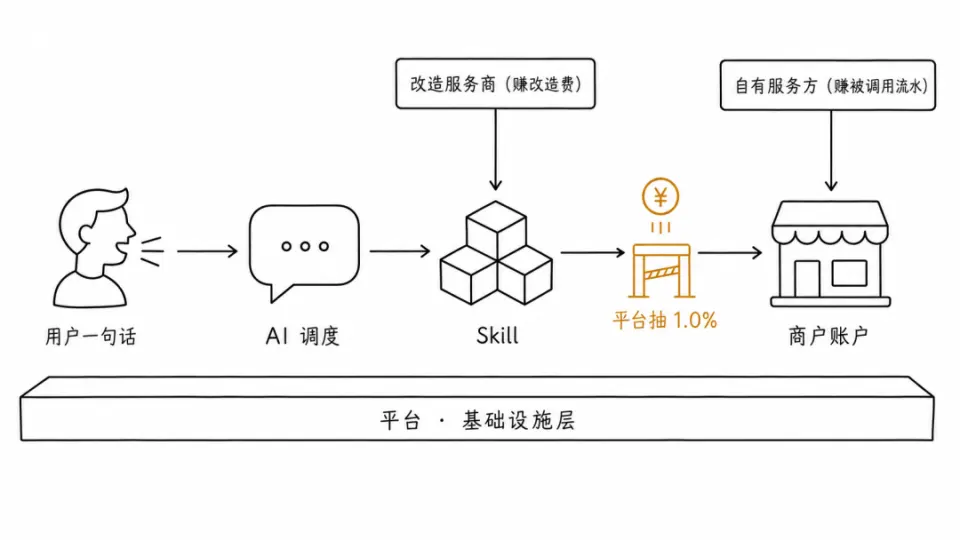
Fund flows
Why are merchants willing to pay this money? They are betting on a ticket to entry. What they fear is the day when Agent OS truly matures: users no longer open apps one by one but simply state their needs to a chat interface, and whoever's service has not been transformed into a Skill and is not invoked by AI will completely disappear from this transaction, without even a chance to be seen. Paying for transformation is essentially securing a seat in advance.
But securing this seat now is somewhat early. Alipay's 300 million transactions are a three-month cumulative total, which is not much when spread across each day, and those who truly treat the chat interface as a daily entry point are still a minority. The scenario of users no longer opening apps has not yet truly happened. Therefore, merchants' current payments are half driven by fear of falling behind and half pushed into the market early by zero fee rates and subsidies. Once the subsidy string is loosened, demand will shrink.
So, do the numbers of this business look good?
The most concrete figures currently visible come from a South China retail brand project reviewed by Youma Cloud: the merchant originally planned to split mini-program development and AI modules between two outsourcing firms, with combined quotes of 620,000 yuan and 14 weeks; later, it switched to a single firm doing an integrated package of mini-program mall, AI shopping guide, intelligent customer service, and automated copywriting, landing at 6 weeks, 310,000 yuanThis 310,000 yuan is what a single Skill transformation service provider can receive. Six weeks is approximately 1.5 person-months; after deducting labor and miscellaneous costs,gross profit per person-month is approximately 80,000 to 120,000 yuan, with a gross margin of 50% to 60%。
This gross margin looks good, but it is fed by subsidies. The computing power and cloud resources that must be burned during the transformation period were pressed down to near zero by WeChat's 100 million Token allowance and six months of free cloud development. Once the subsidies are withdrawn, these two cost items return, and the gross margin immediately drops by 10 to 20 percentage points, moving toward the level of 20 to 30 percent for wrapper-style delivery businesses. The expiry date set in the subsidy schedule is still that December 31, 2026.
Looking at the two accounts side by side, one sentence sums it up:The platform burns the future in options, while entrants earn window money from subsidies. Those who burn can afford to burn; those who earn must calculate when to stop.
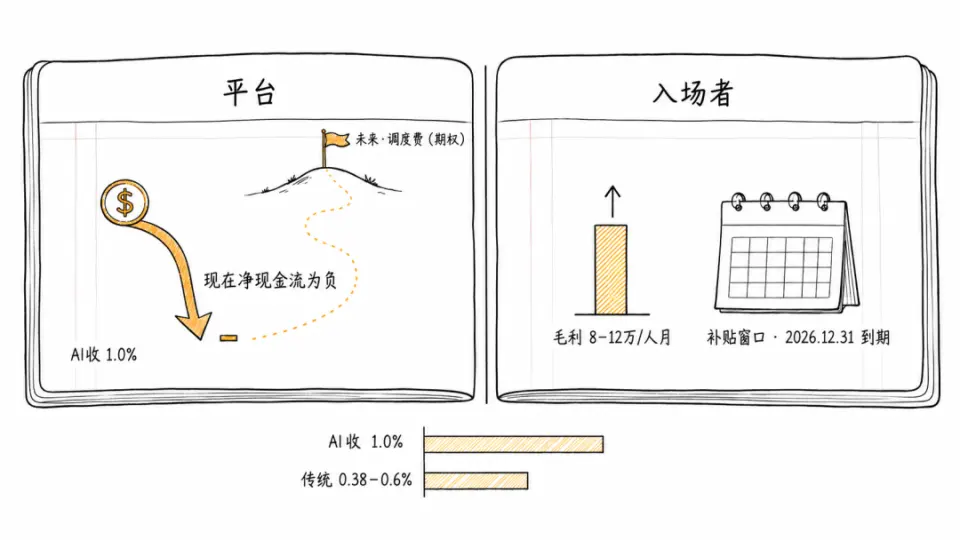
Two accounts
What you can do, the platform can let others do tomorrow
How long the window can remain profitable depends on whether this business has a moat. The conclusion of this section is not pleasant to hear: for most entrants, especially transformation service providers who take orders based on craftsmanship, there is almost no moat.
First look at the threshold. The technical threshold is as low as the 30,000 level; the platform covers the computing power, and if you can write a Skill configuration file, one or two people can deliver the first order in just over a month. The other side of a low threshold is that what you can do, others can do too. What really holds most people back is not technology, but whether they have merchants in hand. That 310,000 order could be collected not because the packaging technology was difficult, but because that retail brand trusted the person taking the order.Customer acquisition cost is the biggest hidden startup item in this business. For people with channels, this item is zero; for people without channels, the gross profit of the first order may be entirely filled into it.
Next, look at who holds the leverage. Transformation service providers earn money settled by project; they earn for each order they take and earn nothing if they do not take one. This work currently has a fashionable name: forward-deployed engineer, FDE, working on-site, customizing according to customer needs, and exchanging labor for money. Put nicely, it is hands-on service; plainly speaking, it does not work for you while you sleep, and it cannot accumulate reusable assets. What can truly touch "running while you sleep" is the model of turning one's own services into Skills that are repeatedly invoked by AI and repeatedly share in revenue. But this path runs into a softer and more fatal gate: when a user says "buy a cup of coffee," which provider's service is ultimately invoked depends on how the platform's AI understands the intent and how it chooses among a pile of candidates. This routing logic is held by the platform, not by you. The platform gives you 100 million Tokens today to invite you in; tomorrow it adjusts the weights inside, and you sink to the bottom. This is more fatal than whether a license is required: once a license is obtained, it is yours, but routing rights never are.
Moreover, the AI entrance, Skill standards, payment licenses, and those subsidies are all issued by the platform and can be taken back at any time.
So is there anything that cannot be copied? Yes, but it is not technology. Being able to write Skill configuration files is work that can be written into an operation manual, and anything that can be written into a manual will sooner or later be automated. There are only two things that truly cannot be copied: first, compliance qualifications; second, merchant channels. Neither can be produced by typing code.
The technical layer, however, is squarely in the crosshairs of the next generation of models. Translating a mini program's capabilities into a format that AI can invoke is essentially structured translation plus encapsulation, with no physical constraints, making it the ideal target for automation. What today takes a person a month and a half to write by hand may, with the next generation of models, be turned into an automatically generated draft from a single link. So the craft of 'helping people with Skill transformation' will most likely not be amplified but erased, and the time window is only 6 to 18 months.
Putting these together, the leading indicators of the several ways this business could die are all visible now. If the platform changes a Skill standard once and does not make it backward compatible, the work you have already delivered has to be redone. If the platform itself enters the field and builds a few high-frequency general-purpose Skills, such as official food ordering or official mobile top-ups, standardized orders immediately drop to zero. Once the zero-fee period expires, the accounts of self-owned service providers that rely on per-invocation revenue sharing go directly from positive to negative. If any one of these three things happens, it can be read in advance from ecosystem announcements.
Some will say that having channels makes this a sure thing. That is half right: what is a sure thing is these eight months, not this business.
Who should enter, and who should stay away
With the numbers worked out this far, a judgment can be made. This business is not an opportunity for everyone; it has to be assessed by type of person.
People who already hold a batch of merchants, or who themselves have resources in a certain industry, are worth entering this wave, and should do so early. What you lack is clients willing to pay RMB 310,000 for transformation, and that is exactly what you already have on hand. On the technical side, the platform covers the foundation for you, and the window of zero fees and model subsidies is open only until the end of this year. During this period, converting your existing merchants into Skills in batches is a race for clients; if you do not enter, you are handing this batch of clients to peers. But remember that this is a window business: do not expand headcount for it, do not load up on heavy assets. Money earned and in hand is yours; if you spread the operation too wide, it becomes a burden the moment the subsidies stop.
Technical individuals who can only call APIs and have no channels should not rush to go independent. The little encapsulation skill you have will be flattened by models within a year; if you take orders yourself, you will not land big ones. The more cost-effective approach is to sell your technical capability to people who have channels and share the money as partners. If you really want to watch for a signal, do not watch the wrong one. A Skill is not moving the entire mini program over; it is only a callable facade that the mini program presents to the outside, while the real service still runs inside the mini program and the merchant backend. Sooner or later the platform will turn 'reading an existing mini program and automatically generating that set of interface declarations' into a tool, because lowering the threshold is exactly what serves its desired number of developers. Once that automatic generation goes live, pure encapsulation subcontracting will be worthless, and that is the signal that this craft is out of the game.
Entrepreneurs who want to build an independent AI assistant App should not touch this. What you need to capture is the entry point, and the entry-point card is in the hands of giants: WeChat has 1.4 billion monthly active users, and AI-native Apps together have 710 million monthly active users. Yuanbao spent RMB 1 billion on subsidies during the Spring Festival, and after the tide receded its monthly active users still fell back, proving that even burning money cannot retain people in this position. The platform has already made it clear: the era of traffic entry points is coming to an end. Building an entry point in an era when entry points are disappearing is the most uneconomical bet.
The last cost that is not written into the quotation
Now add in the cost that is not on the quotation. Before adding it, first distinguish clearly whose head this cost falls on: merchants and transformation service providers have two different sets of accounts.
First, the money side, namely merchants, as well as those self-owned service providers that turn their own services into Skills and collect payment themselves. Current regulation has an obvious gap: when an agent pays on behalf of a user, it involves the Notice of the People's Bank of China on Regulating Payment Collection Business, which requires that payment collection authorization specify the payee, purpose, cycle and term, and also require per-transaction prompts. Yet under the currently popular quota authorization model, giving AI a quota of RMB 1,000 without per-transaction confirmation still leaves it undecided whether that satisfies 'per transaction'; and identity-attribution problems such as 'know your agent' proposed by the Chinese Academy of Social Sciences do not even have dedicated rules yet. This gap is a window for merchants already collecting payments, who can start first, but that is also where the pitfalls grow: under quota authorization, if AI deducts the wrong amount or initiates a transaction beyond the user's intent, civil disputes may arise. Such risks can be settled by paying money, and can also be treated as an operating cost. The way to reduce it is very concrete: on the authorization page, write the quota, the range of merchants where it can be spent, and the per-transaction cap as terms the user explicitly checks, rather than glossing over it with default consent; push an auditable prompt for each deduction. Do these two steps solidly, and this cost basically drops to zero. The window will not stay open forever either: the platform writing 'confirmation for every transaction' and 'primary account segregation' into products in advance, and various parties rushing to issue payment agreements, are all signals that regulatory expectations are tightening.
On the merchant side there is also an unavoidable compliance cost. Once AI features are added, category qualifications for deep synthesis services must be obtained, AI-generated content must be conspicuously labeled, and AI uses must be clearly stated in the privacy policy. There is one easily confused point that must be made clear: these qualifications are held under the merchant's own mini program entity, must be applied for using the merchant's business license, and the responsibility also lies with the merchant. Miss one item, and the mini program will be rejected; some teams have been stuck for three to five weeks supplementing qualifications, and schedule and manpower both cost money.
On the service provider side, the legal exposure is in fact lighter. The reason lies in the point you may already have thought of: the Skills built by service providers are connected on the back end to licensed institutions such as Alipay and WeChat, and funds flow directly from users through the platform into merchant accounts. The service provider itself does not touch the money, and therefore does not need any payment license. The compliance qualifications mentioned above also do not belong to the service provider. What it can do is handle applications and submissions on merchants' behalf and help them avoid those three-to-five-week rejections, which is precisely the incremental value it has over a party that merely does encapsulation; however, the qualifications and responsibility always remain in the merchant's name.
Therefore, the only line a service provider truly needs to hold is this: do not cross from "helping merchants integrate, with funds going directly into merchant accounts" into "building an aggregation platform that first collects users' or merchants' funds into its own account and then distributes them to downstream merchants." Once you cross that step, you change from a contract manufacturer that does not touch money into an unlicensed operator of payment business. This has a specific name, "second-tier clearing" (erqing), and at the upper end it can reach the crime of illegal business operations. Moreover, when money passes through your account and you can also split payments for others, this channel is inherently prone to money laundering: someone uses it to launder funds of unknown origin through one pass, and you will be drawn from second-tier clearing into money laundering, concealing or disguising criminal proceeds, or even providing assistance to criminal activities on information networks, bearing criminal liability for the upstream party. This line has nothing to do with how much you earn; as long as funds pass through your account and form a fund pool, the nature of the action changes. If you want to do aggregation or agency operations, design the flow of funds to connect directly to merchants' licensed accounts, with not a single cent passing through your account; if you cannot do that, this business is not viable for you.
In the final analysis, Agent OS has changed the entry point from icons to a dialog box, and has also moved the profit position from traffic to orchestration. The platform is betting on the orchestration fee three to five years from now, and it can afford the bet. What entrants can earn is the window money of these eight months, provided they calculate clearly which money is theirs, which money is the platform's, and which line must not be crossed even by a single step. On the day the window closes, those who remain will not be the people most familiar with encapsulation technology, but those who hold merchants in hand, have helped clients properly complete all the qualifications they should complete, and have not touched a single cent of a fund pool themselves.