
Voice-input rings, Vibe Coding microphones, and AI earbuds with direct internet connectivity all emerged in quick succession in the first half of 2026. What they sell is not hardware specifications, but the answer to the question, "Who will catch the first thing you say to AI?" This article seeks to make one thing clear: in this battle over the right to define interaction, victory at the product level is merely superficial; the real question is what underlying logic truly determines who can take the entry point, and for how long.
On April 27, Insta360 and TRAE, the AI coding tool under ByteDance, jointly released a lavalier microphone called Mic Air, officially priced at 399 yuan, with a limited-time promotional price of 319 yuan. Its primary use case is not shooting video, but Vibe Coding: wearing it near your mouth and speaking softly so that AI can write the code for you.
More than two months later, a smart ring called OASIS Ring became popular. It packs a microphone, buttons, and motion sensors into a ring. Its official website does not discuss heart rate or sleep; it talks about only one thing: using voice and gestures to directly command the AI on your computer.
Consider the temperature of this sector. According to the market research firm Omdia, global smart ring shipments were only 850,000 units in 2023, doubled to 1.8 million units in 2024, reached 1.6 million units in the first half of 2025, and are expected to exceed 4 million units for the full year, with a year-on-year growth rate of more than 100%. Meanwhile, in Huaqiangbei, a single factory's monthly smart ring shipments had already approached 800,000 units in early 2026—one month's output matching all of 2023.
For all the excitement, what is truly worth examining about this batch of products is not how accurately they can measure heart rate, but that they have all, without prior coordination, bet on the same thing: seizing the entry point for the next generation of human-computer interaction. And this matter will ultimately be decided at the legal level.
Phones are already sufficient; what the ring seeks to replace is not the phone
Let us first answer a simple question: when we already have phones, why do we still need a ring?
Leitech, as a smart ring user, offered a very practical judgment: mainstream smart rings today have still not shed the label of "a smaller fitness band": lighter than a band, comfortable to wear while sleeping, capable of continuous health data recording, but essentially still a fitness band made one size smaller. Why users should pay separately for it is a question that has never received a particularly convincing answer.
The approach of products like OASIS Ring is to answer on a different track. It does not compete with fitness bands over whose health data is more comprehensive; instead, it turns the ring into a pure input device. What it seeks to replace is not the phone, but the keyboard.
Behind this shift is a loosening of the way we work. For the past few decades, the default real productivity device has been the computer: for writing code, making spreadsheets, editing video, and handling complex files, the keyboard, mouse, large screen, and desktop software have been the most efficient combination. No matter how convenient a phone is, when it comes to heavy work, you ultimately have to return to the computer. This combination is highly exclusive: you have to sit at the desk, open the software, and type on the keyboard, and once your working state is interrupted, it becomes very frustrating.
But as more and more people begin to use natural language to direct AI to do work, the importance of "precise input" declines. You no longer need to type instructions character by character; you only need to state your requirements clearly. Requirements can be stated at your workstation, on the way downstairs to buy coffee, or even casually while driving, letting AI first look up information and write this week's weekly report.
Once input shifts from "typing" to "speaking," the hardware that carries input will inevitably move toward lightweight, all-weather, and unnoticeable forms. Rings, earbuds, and glasses—supporting players that used to revolve around phones—suddenly have new possibilities. Earlier this year, a spoof image circulated on X: a "keyboard exclusively for Vibe Coding" with only three keys—ChatGPT, copy, and paste. Joke aside, it precisely sketches the ambition of this batch of hardware: leave the "doing" part of creation to AI, and let humans handle only the "creating" moment.
Let people speak and let AI do the work: within a year, this idea has been given two names
The collective pivot of this batch of hardware, including rings and microphones, traces back to one term: Vibe Coding.
The term was coined in February 2025 by Andrej Karpathy, co-founder of OpenAI and former head of AI at Tesla, to describe a development approach that relies heavily on AI: developers barely touch the code itself, instead stating requirements in natural language and letting AI generate, test and optimize. In his own words, it means "fully giving in to the vibes, embracing exponential growth, and forgetting that the code even exists." How popular did the term become? At the end of 2025, Collins Dictionary named it Word of the Year.
The essence of Vibe Coding can be stated in one sentence: let humans speak and let AI act. It decouples creation from precise inputs such as the keyboard and mouse, pushing humans back to the position of "stating requirements, setting direction and accepting the results." As early as 2023, Karpathy had already put it even more bluntly: "The hottest new programming language is English."
But a year later, the person who coined the term changed his tune. On April 30, 2026, in a speech at Sequoia Capital, Karpathy pushed the concept one step further and gave it a new name: Agentic Engineering. His point was that, as model capabilities improve, the "vibe" approach suited to small weekend projects, in which one can forget the code even exists, is being replaced by a more serious mode: for 99% of your time you no longer write code directly, but direct AI agents to do the work, acting as a supervisor.
He did not mince words: the code AI writes today is still bloated, full of copy-paste, and its abstraction layers are clumsily and fragilely designed; "sometimes I look at it and have a bit of a heart attack." So humans cannot simply let go. Security, regression testing and maintainability are accounts that ultimately still have to be borne by humans.
This "change of tune" is key to understanding this batch of hardware. It shows one thing: even if the interaction mode has become speech, humans have not exited the loop; they are still inside it, acting as supervisor, reviewer and bearer of responsibility. This means that the hardware responsible for "catching what you say" catches not just an instruction, but also a record of "who, at what time, made AI do what." Who owns this record, where it is stored, and whether it can be taken and used are, as will be seen below, the most critical aspects of the whole matter.
Whoever catches that sentence first wants to be the next entry point
Turning our gaze back to the hardware itself, there is a somewhat awkward fact: the technical barriers of this batch of products are astonishingly thin.
Take the Insta360 Mic Air as an example. Its three main selling points are a 48kHz high sampling rate, AI noise reduction and 10-hour battery life. These are essentially the basic qualities of any professional lavalier microphone and have nothing whatsoever to do with AI or Vibe Coding. The same goes for rings. Data from GIR shows that in 2025, global sales of AI smart rings were about 3.47 million units, with an average price of USD 143 and an industry average gross margin of about 40%; white-label products from Huaqiangbei are flooding in, and converted on a monthly shipment basis, the annual capacity of white-label products is already more than twice the 4 million units of legitimate annual shipments. For a category with a 40% gross margin that white-label products can copy at any time, the hardware itself can hardly support much imagination.
What is truly valuable is not in the hardware, but in whom it is bound to.
The Mic Air bundle includes usage rights to ByteDance's TRAE; the OASIS Ring is about directly commanding the AI in your computer; and the AI earphones from Guangfan Technology reviewed by Leikeji sell on the point that they can connect to the internet independently and access AI assistants directly without going through a phone. You will find that what this hardware is really selling is the matter of "which AI it connects you to by default." The hardware is the shell; the entry point is the core.
This is the same logic as when browsers competed for the default search engine and phone makers competed for pre-installed app stores: whoever controls the entry point controls distribution and can collect a toll. Dreame states this logic most bluntly: it plans to launch "One Ring for All" by the end of 2026, using a single ring to control all the hardware in its own ecosystem. Pan Zhidong, President of Dreame's Global AI Hardware Business Group, offered this assessment: "The smart ring is the first AI smart hardware in the AI era that can achieve commercialization and reach a market size of tens of billions, hundreds of billions, or even trillions." The ceiling of this track is indeed not low. According to Fortune Business Insights, the global wearable AI market was approximately USD 48.8 billion in 2025 and is projected to approach USD 360 billion by 2034.
However, counting this entry point directly as the moat of ring manufacturers is a miscalculation. Hardware manufacturers sit at the end of the industry chain: they catch your sentence and immediately hand it upstream to a model company for processing. Mic Air directs users to ByteDance's TRAE; the ring earns money once per sale, but every sentence you subsequently say to the AI and every invocation is billed on the model company's side. From this perspective, hardware manufacturers are more like a "start button" that solicits customers for model companies, rather than the entry point itself.
More paradoxical still is that capital is paying high prices precisely for the "entry point." Oura, the leader in smart rings, has built a valuation of nearly USD 11 billion on a 74% share and years of accumulated health data—nearly 11 times its annual sales. That is a valuation multiple only software companies command; hardware companies typically command only one or two times. It is true that the market is willing to pay a premium for the entry point, but what it rewards is players like Oura that hold user data firmly in their own hands. By contrast, the requests spoken into a voice ring flow by default to the bound AI, and the hardware manufacturer does not even retain the data. The entry point is indeed valuable, but the valuable part may not belong to those who make the hardware.
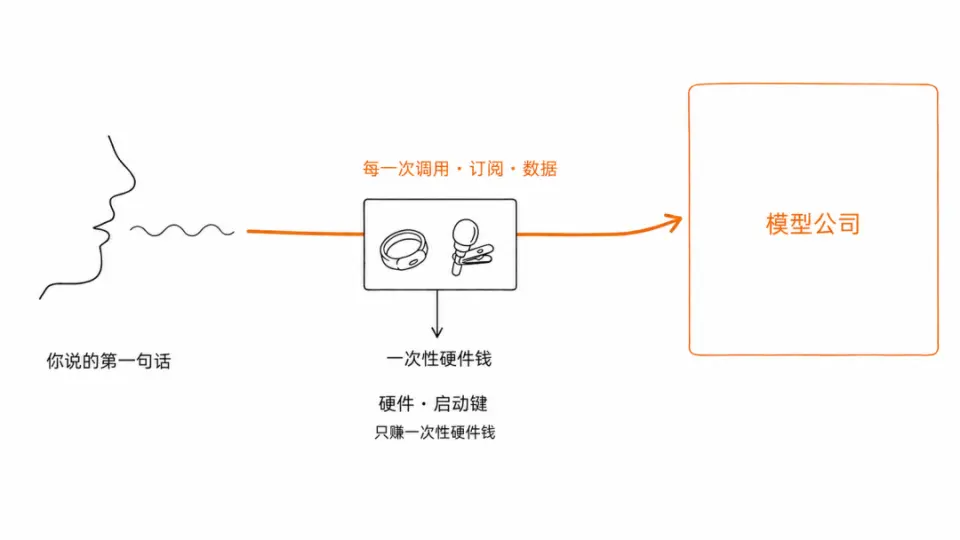
Hardware is merely the start button; the money and data flow upstream to model companies
The ring's own shortcomings are also obvious. Its form factor dictates that it can only "input" and cannot "output"; when it comes to checking code written by AI or handling complex workflows, you still have to sit back down at a computer—and once you are seated, why raise your hand to speak to a ring? Moreover, "saying the first sentence to AI" is something phones, earphones, and AI glasses have long been able to do, and these devices are already on your person, so the marginal cost of using one more is zero. Standalone rings and lapel microphones must compete for a position that others have already occupied for free. More critically, even if a certain hardware product does build up an entry point, a phone manufacturer can reclaim that entry point into the operating system with a single system-level update—press and hold a key to invoke AI directly and conveniently bundle in a microphone. Therefore, before a mature product emerges, it is more appropriate to regard the ring as a "supplementary device" for Vibe Coding; calling it "the next-generation entry point" is premature.
But "whether it can serve as an entry point" and "whether it wants to seize the entry point" are two different matters. Even if these products ultimately fail to become the main entry point, they are all doing the same thing: at this juncture when AI Agents and Vibe Coding are changing user habits, they are competing for the power to define the next generation of interaction. Whoever can deliver requests to AI faster and more naturally has the opportunity to become the new starting point for distribution. And as long as this position is valuable, the contest will not stop.
The problem is that whoever seizes this position will immediately run headlong into three legal issues.
The endgame of the battle for the entry point lies on three legal tables where the rules have not yet been settled
The closer a business moves toward being a "platform entry point," the greater the weight of legal risk. If these AI hardware products want to become entry points, they cannot avoid three contests: data sovereignty, interface openness, and technical standards. All of them are currently in a window period; the rules have not been settled, but the direction is already discernible. More precisely, most of these "windows" are not legal gaps but situations where "the rules are written but not yet seriously enforced"; the loopholes you can exploit now reflect enforcement not having caught up, not the law showing leniency.
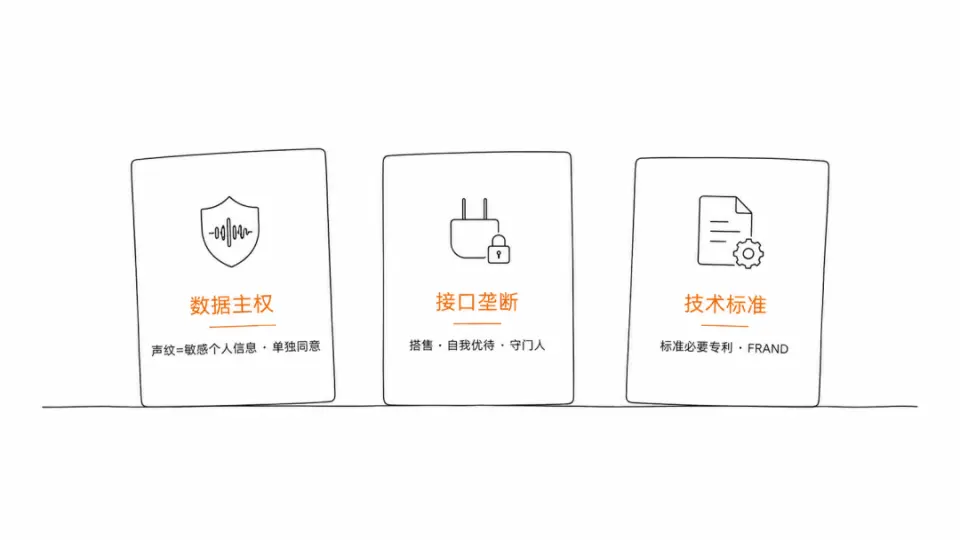
Three legal cards not yet settled: data sovereignty, interface monopoly, and technical standards
The first card: data sovereignty.
For these devices to catch your sentence at any time, the microphone must stay on continuously. What it hears is not only your commands but also the voices of everyone around you. This conceals two layers of legal issues.
For you personally, a voiceprint is sensitive personal information. Article 28 of the Personal Information Protection Law lists biometric information as sensitive personal information, and Article 29 requires that processing sensitive personal information must obtain the individual's "separate consent," rather than a "one-size-fits-all" checkbox buried in a long privacy policy. Professor Cheng Xiao of Tsinghua University put it clearly: anyone who wishes to use a natural person's voice to train AI voice products or clone voices must obtain separate consent or have a statutory ground; otherwise, the individual has the right to sue for infringement of personal information rights and interests. But reality is another matter. In 2026, Southern Metropolis Daily tested several mainstream domestic AI assistants and found that they basically all use "one-size-fits-all" authorization, and almost none separately informs users about and separately obtains consent for sensitive information such as voiceprints. In other words, the industry has generally not yet met this compliance line.
For bystanders, the problem is even thornier. You walk into a meeting room wearing the ring, and the voices of colleagues and clients recorded in it have not been consented to by any of them. This falls under the protection of voice rights and interests and privacy rights under the Civil Code. Google Glass stumbled on exactly this issue back then, except that this time the collection device is smaller, more concealed, and more all-weather.
In the Vibe Coding scenario, there is a third layer. What you read aloud into the microphone may be code the company has not yet made public, client materials, or business plans. Once such content passes through third-party hardware and is then handed to a third-party AI for processing, how do you keep trade secrets in your own hands? If that AI is still an overseas model, and many products already mix several major models, your voice constitutes cross-border data transfer and must go through the regime under the Measures for Security Assessment of Cross-border Data Transfer. Users think they are getting an efficiency tool, but in fact they have simultaneously opened an all-weather data pipeline. Whoever controls this pipeline holds data sovereignty.
The second card: interface monopoly.
The value of an entry point, as mentioned earlier, lies in whom it binds. But once a certain entry point becomes dominant, the practice of "hardware connecting only to its own AI, or prioritizing its own AI" will run into antitrust issues. In legal language, this is called tying and self-preferencing.
The European Union has already made the first move. Its Digital Markets Act created the "gatekeeper" regime, specifically targeting platforms that control key entry points and can influence how businesses reach users; six companies, including ByteDance, have been included in the first batch of gatekeepers. Even more noteworthy is that the EU is studying bringing services such as AI virtual assistants within the regulatory scope of "core platform services." Once included, whoever controls the entry point will bear ex ante obligations such as opening interfaces, prohibiting data combination, and prohibiting self-preferencing. The subtext of regulation is clear: AI assistants are changing from "upper-layer applications" into "platform entry points," and those who control the entry points will be regulated as platforms.
On the Chinese side, the Anti-Monopoly Law, after its 2022 amendment, introduced the concept of "super-large platforms," and there are also the Anti-Monopoly Guidelines for the Platform Economy Sector, but the gatekeeper-style obligations targeting super platforms are currently mostly advisory. This means the window is still open, but following the EU's direction, tightening is only a matter of time. Today everyone is racing to build entry points; once the entry points truly take shape, the antitrust reckoning will come sooner or later.
The third card: technical standards, and also the most concealed layer.
Once interaction methods are to be standardized—for example, the communication protocol between voice and AI, and the format of multimodal data—the standard-setters will obtain standard-essential patents. Others who want to connect will either pay licensing fees under the FRAND principle or be shut out. Industry reports show that international standards organizations already published a multimodal interaction data format standard in February 2026. This contest is not at the product layer but at the protocol layer: whoever's technology is written into the standard defines the threshold for "compliant access." It is a slow variable, but once locked in, it may lock things down for ten years.
Who should seize the opportunity, who should wait, and who should first build solid compliance
Laying out these three cards makes it fairly clear how to view this business.
Teams making AI hardware must recognize one thing: your moat is not in the hardware. The specifications of lavalier microphones and rings can all be copied by white-label manufacturers; pure hardware is an asset-heavy business, with inventory, supply chains, and certifications pressing down millions in costs, and still unable to protect gross margins. The only two things that truly cannot be copied are: engineering tuning for on-device noise reduction and battery life (Insta360 was able to make the Mic Air at 7.9 grams and 10 hours, relying on audio expertise accumulated during the camera era), and a supply chain, brand, and channel system that has already been proven. These two things are precisely what players who already have accumulated experience in the hardware or audio track currently hold.
If you have neither, then rather than selling hardware alone, it is better to reverse the order: first build a sticky AI application or vertical Agent, and treat hardware merely as a giveaway for customer acquisition, replacing "earning a margin by selling hardware" with "giving away hardware in exchange for users and data." Keep the data on your side, and only then can the entry-point value mentioned earlier be said to belong to you. As for compliance, it is unavoidable whichever side you take: how to design separate consent for voiceprints, how to disclaim liability for bystanders' privacy, and which channel to use for cross-border data transfer—these three matters must be handled solidly before launch. During the window in which the rise in compliance costs is closing, it is often those who achieve compliance first who take the market from those who comply later.
Those building AI applications and Agents and seeking to use hardware as an entry point must think through interface openness and ex ante antitrust obligations in advance. Do not wait until the entry point has grown large to discover that you are caught by gatekeeper rules; by then, changing the binding relationships will be far more costly.
Investors looking at this track are advised not to focus only on shipment volumes and gross margins. For a category with an average price of USD 143, a 40% gross margin, and white-label players ready to flood in at any time, looking only at the hardware accounts is meaningless. Look at whether the data compliance and interface relationships it binds are sustainable: once regulatory signals turn toward tightening, asset-heavy white-label players will be the first to exit.
As for those who use these products every day, the efficiency gains from Vibe Coding are real; there is no doubt about that. It is just that the ring you put on and the earphones you wear are both tools and an all-weather data pipeline. Where the things you speak into them go, who stores them, and whether they are transferred abroad are worth asking yourself before you press that "start" button.
Finally, a note from a lawyer's perspective. The most concentrated legal risk in this batch of products ultimately comes down to the pairing of "voice data + user authorization." How exactly to draft the separate-consent pop-up so that it counts, how to disclaim liability when bystanders are captured in image or sound, and whether cross-border data transfer should go through an assessment or standard contracts—the depth of the pitfalls in how these points are handled varies widely. I have recently reviewed several compliance matters of this kind, and a common lesson is that straightening out the authorization chain before launch is far cheaper than remedying matters after something goes wrong. Readers doing business in this field who are unsure can reach out to me to talk.
This battle over the right to control interaction, from keyboard to voice, has only just begun. Who makes hardware smaller and more wearable is merely the surface of this war. The real decisive factor lies in three unanswered questions: who owns the data, to whom interfaces are opened, and who sets the standards.

