
This article answers three questions: how the anti-hidden-camera device business makes money, whether you can get into it, and whether it is still worthwhile once all costs are accounted for. The conclusion first: a volume-selling detector earns only one and a half yuan per unit; the real profit lies at the three-hundred-dollar average selling price end, but that end splits into two kinds—one is a business, the other is a case.
On July 7, Meta acknowledged on its official blog something that made it somewhat uncomfortable. Someone was taking apart its AI glasses, using an electric drill and dental probes to pry off the white LED light that indicates "recording," and then using them for covert filming. To close this route, Meta pushed a mandatory firmware update: anyone who tampers with that light will have the camera locked out entirely, and it warned that it would pursue legal liability against those running the light-removal business.
Two days later, the matter turned again. According to the Financial Times, Meta was internally testing a prototype pair of glasses codenamed "Super Sensing" that automatically takes a photo every few seconds while recording ambient sound, storing everything you see and hear throughout the day and handing it to AI for indexing. And among the options executives discussed was precisely turning off that recording indicator light.
Locking others' lights is out of fear that its own glasses will acquire a reputation for covert filming; turning off its own light is because that light is a nuisance. With both matters crowded into the same week, Meta itself may not feel any contradiction.
Meta and EssilorLuxottica sold 7 million smart glasses in 2025, more than three times the combined total of 2023 and 2024. More than 80% of the global AI glasses supply chain is in China, with production capacity concentrated in the Pearl River Delta. In other words, the capacity to make "liable to be covertly filmed at any time" cheap and widespread is rolling out at triple the annual rate.
Where there is demand, there is a hedge. Just as one group of TikTok users was served angry videos about "AI glasses covert filming," another group began ordering a small gadget called an "anti-hidden-camera detector." One model, the GM231 detector, sold on TikTok 969,000 units, at a unit price of 5.3 US dollars, with sales exceeding 5 million US dollars。
This is the account to be calculated today. AI glasses are stealing your face, and someone is selling devices to prevent your face from being stolen—sounds like a natural good business. But nine out of ten people planning to enter will miscalculate at the same place.
Selling covert-recording capability on one side, and anti-covert-recording capability on the other
First, let us be clear about what this business is actually selling. It is in fact two businesses sharing one name.
One is consumer-grade detectors. This means devices like the GM231: palm-sized, weighing a few dozen grams, using infrared to spot lens reflections and radio frequency to pick up the wireless signals emitted by cameras, helping you sweep a hotel room, homestay or fitting room. The wholesale price is USD 2.35 to 40, and on Alibaba anyone can slap on a private label; retail has been driven down to just over USD 5. Buyers are ordinary people who stay in hotels on business trips or rent homes away from home, especially women.
The other is professional-grade jammers. It does not "find"; it "jams." It actively emits energy so that whatever nearby cameras, voice recorders and phone microphones capture becomes a mass of noise that cannot be reconstructed. One unit retails for USD 300 to 500, and a set costs over a thousand; buyers are corporate meeting rooms, law firms, government and enterprise security teams and high-net-worth individuals seeking to prevent eavesdropping.
One is passive-reception "detection"; the other is active-emission "jamming." A one-character difference, and all the numbers that follow branch off from here.
The position in the industrial chain also needs to be made clear. Some package this business as an "AI hardware dividend," but that is only half true. There is not a single large model or a single line of inference code in a detector; it is old hardware that existed a decade ago, infrared plus RF reception, the work of analog circuits. It rides the AI hype, but what it earns is not AI money; it is money made from panic. The real AI is on its opponent's side, inside those glasses that covertly record.
This leads to a critical inference: the demand engine of this business is not in the seller's hands. The fuel it burns is the heat of the "AI glasses covert recording" issue in public discourse, and when that fire burns and how fiercely, the pricing power lies with Meta, not with you.
Incidentally, that supply chain in the Pearl River Delta contract-manufactures more than half of the world's AI glasses on one hand, and on the other can slap your private label on detectors. The spear-makers and the shield-makers are the same group of people. This "hedge" sounds stable, but the one truly eating from both ends is the factory: when spears sell well it earns spear money, and when shields sell well it earns shield money. As a downstream private-label customer, you are merely one of its many clients.
At USD 5.3 a unit, the seller actually earns only about one and a half dollars
Let us lay out the GM231 numbers and work through them.
Sales are a hard figure: 969,000 units times USD 5.3, about USD 5.13 million. That sounds like a lot. But this is the historical cumulative total of a single hit champion product, and it is the aggregate of all stores selling it combined, not the monthly revenue of any one seller.
How much can be kept per unit. Retail is USD 5.3, wholesale purchase is USD 2.35 to 3, so the gross spread is just over two dollars. Then deduct three more layers: platform commission of six to ten percent, cross-border first-leg shipping plus overseas-warehouse fulfillment at roughly twenty percent of a USD 5 order, and returns and bad debt taking another bite. After all that, the net amount kept per unit is roughly USD 1 to 1.5969,000 units sold, amounting to gross profit of just over one million US dollars, which still has to be split among all sellers.
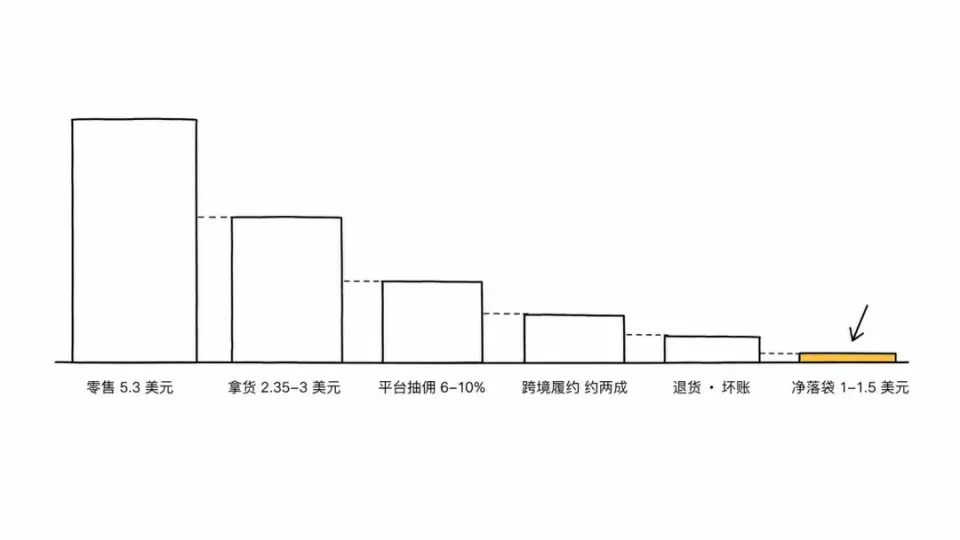
A net of one and a half dollars per detector
The question is not whether one and a half dollars is a lot, but whether that one and a half dollars can be held onto.
For a single detector, the bill-of-materials cost is already pressed against the floor of USD 2.35, leaving little room to squeeze on the manufacturing side. Its only high-cost front is customer acquisition: of that USD 5, commissions to TikTok creators and paid traffic promotion consume ten to twenty percent. And that money buys nothing that accumulates: a creator may drive sales for you today and drive sales for an identical competing product next door tomorrow, and the product is still the same product on that 1688 link.
You have no moat. The data sits with the platforms and product-selection sites, the channel is rented from TikTok, the brand simply cannot be established on a USD 5 white-label product, and switching costs are zero. If another person enters with the same product and the same "60-second hotel anti-spying" content template, your per-unit margin goes to zero that very day, and all that remains is a contest over who can afford to lose more on paid traffic. GM231 being driven down to USD 5.3 is not an accident; it is the inevitable endpoint of this kind of business.
And there is still only one lifeline. The entire USD 5.13 million depends on TikTok's interest-based e-commerce distribution, with one viral video moving a batch of goods. If the platform's algorithm one day downranks "safety anxiety" content, or a store is throttled or shut down, the sales channel is cut off that very day, with no second leg to fall back on. A Shenzhen team with an average age under 25 that sold USD 60 AI glasses at scale in the US region through TikTok Shop is the positive model for this playbook; it is also a cautionary warning, because those orders were built on land rented from the platform.
So who exactly is calling this a blue ocean?
Four parties promote this narrative: AI product-selection sites, cross-border e-commerce bloggers, device manufacturers selling jammers, and institutions issuing market reports. They share one thing in common: none of them makes money by "selling detectors to consumers"; they all make money by "getting you into this business." Product-selection sites earn tool subscriptions, bloggers earn course fees, device manufacturers earn the wholesale margin on supplying you, and report institutions earn report fees. Whether you lose money is not on their books.
Market reports are an especially good sample. One institution says this market was USD 1.2 billion in 2025 and will be USD 2.8 billion in 2034, growing 11.8% annually; another says USD 3.8 billion to USD 7.9 billion; yet another gives USD 1.14 billion to USD 3.37 billion. The same market, three conflicting sets of figures. The bigger the number, the better it sells, because the buyers are on one hand entrepreneurs taking it to investors and on the other sellers using it to persuade themselves. There is only one hard number: GM231's 969,000 units times USD 5.3. And that hard number does not describe a blue ocean; it describes a bloodbath.
The real profit lies at the USD 300 average-order-value end, but it comes in two forms
A detector earns one and a half dollars per unit; so what about the other business?
An ultrasonic jammer retails for USD 425 to 500 each, and a set can reach USD 1,495. The hardware cost is indeed high: dozens of ultrasonic emitting units and a nearly 10,000 mAh battery are packed into a single unit, yet the gross margin can hold steady above 70%. For a 20-square-meter meeting room, the manufacturer's solution calls for seven jammers plus one control terminal, roughly USD 3,000 per order, which equals the net profit accumulated from selling two thousand detectors.
The absolute gross profit differs by several hundred to a thousand times. In the same line of business, one end is working for the platform, while the other is a large government and enterprise order with a 70% gross margin. At this point, anyone who has done the math on detectors wants to move to this end.
Not so fast. This end also splits into two types, and the two look almost identical on the spec sheet.
One type is ultrasonic. It emits sound waves inaudible to the human ear, flooding the microphone diaphragm with noise and turning recordings into static. It emits no radio waves, and manufacturers' spec pages specifically state one line: no electromagnetic radiation, no interference with mobile phone signals.
The other type is radio-based. It emits radio frequency to directly suppress and override nearby wireless communications. We will set this type aside for now and address it when we tally the overall account at the end.
Even if one only pursues the lawful ultrasonic version, the numbers are not that attractive. Its profit margin is high, but the market is small. Government and enterprise meeting rooms, law firms, and anti-eavesdropping are inherently low-frequency, low-volume demand; selling a few thousand units a year would already be decent, and at USD 450, even ten thousand units would amount to only USD 4.5 million, comparable to the volume of a single hit product like the GM231, yet customer acquisition is an order of magnitude harder. It is not a track that can grow a large company; it is a niche boutique business worth a few million US dollars. Some will call it the next big trend, but the numbers are right here: the profit margin is real, and so is the ceiling.
What is more critical is that the barrier at this end is not in the goods at all.
Ultrasonic jammers can be made by the Shenzhen supply chain; whoever can make AI glasses can make them. What truly cannot be copied is the admission ticket to get onto government and enterprise procurement lists: bidding qualifications, case endorsements, and the trust that anti-eavesdropping solution providers have built up over many years. Cross-border sellers cannot knock down this wall with an influencer matrix. Your viral videos about "hotel anti-hidden-camera detection" are worthless in this business.
So the barriers of the two businesses are inversely related to their profits: the barrier to detectors is so low that one can start with RMB 3,000, and the profit is so thin that it is RMB 1.5 per unit; jammers have profits as thick as several thousand US dollars per order, but the barrier starts at RMB 300,000, plus a government and enterprise ticket that cannot be bought.
Who should do this, and who should forward this article to friends
Who this business suits can be viewed across four types of people.
If you are a TikTok content operator with the ability to create viral "security anxiety" content and a roster of influencers, you can do the thin-margin detector business. The 969,000 units of the GM231 prove that volume can be achieved, and you happen to hold the only real lever in this business: content. But what you earn is hard-won cash flow, not an asset that can accumulate; do not treat it as a career that can scale up, but as a traffic business to be harvested batch after batch.
If you are a pure cross-border seller with no content capabilities and simply want to follow the “blue ocean” and enter with product selection, I suggest you wait and see. Wait for a specific signal: the appearance on the market of a differentiated detector with an OLED screen that can consistently sell for more than USD 30 without losing volume. Until then, entering means operating at a cost line of USD 5.3 and working for TikTok and influencers.
If you are a hardware engineer eyeing the 70% gross margin on jammers, take your hands off the fattest version first; the reason is in the last section. Your correct approach is not to go it alone, but to supply concealed-information-protection solution providers that already have government and enterprise channels, letting those whose channels cannot be copied sell your goods for you.
If you already have government and enterprise as well as security channels and qualifications, the ultrasonic jammer is an easy win for you. Others can copy your product, but they cannot copy your relationships. The thickest lawful profit in this business was always reserved for people like you.
As for people who can only call APIs and have neither content nor channels, there is no place for you to stand in this business: detectors compete on content distribution, jammers compete on government and enterprise relationships, and you have neither.
The final cost item: a one-character difference, with a business on one side and a criminal case on the other
Now, bring back the version of the jammer we set aside earlier and calculate the full account.
As mentioned earlier, jammers fall into two types, ultrasonic and radio, and their specification sheets are almost identical. The difference lies in the physical principle, and that difference determines which criminal-law provisions apply.
First, look at China. Selling radio jammers that emit radio frequency and suppress communications runs into the crime of illegal business operation: the 2017 judicial interpretation of the Supreme People's Court and the Supreme People's Procuratorate expressly lists “radio jammers,” and illegal production or sale of three or more sets of such equipment, or illegal business turnover of RMB 50,000 or more, is sufficient for “serious circumstances”; if the equipment is appraised as special-purpose equipment, the charge will be even more serious, and where two crimes are involved, the heavier one applies. Using them is another track: where circumstances are serious, it constitutes the crime of disrupting the order of radio communications management, and Article 1, Item 4 of the same interpretation expressly lists “illegally setting up or using radio jammers”; only where interference reaches frequencies involving public safety such as aviation and railways, or illegal gains reach RMB 30,000 or more, are circumstances serious, and comparable cases have ranged from several months' suspended sentences to two or three years' imprisonment plus fines; where the threshold is not met, there is still administrative punishment of confiscation of equipment plus a fine of up to several hundred thousand yuan, which cannot be avoided. All of this is set out in Articles 225 and 288 of the Criminal Law, and it is not as light as merely paying a fine.
Now look overseas, especially the U.S. market you want to export to. Signal jammers are completely prohibited in the United States, and federal law prohibits their production, import, marketing, sale and use, without exception. There is one figure you should remember: a Chinese manufacturer, C.T.S. Technology, because it marketed about 285 models of jammers to U.S. consumers, was issued by the FCC USD 34.91 millionin fines. An individual named Humphreys was fined USD 48,000 merely for using a jammer in his own car to block nearby mobile phone signals. The FCC also specifically stated that disclaimers of the kind saying “liability rests with the buyer” are entirely ineffective.
Now go back and recalculate that account of 70% gross margin.
Radio jammers are indeed the hardest-pain-point, highest-volume version in the jammer category, with unit prices of three hundred US dollars and up and genuine demand. But add this cost in: it is not a civil risk that can be balanced out by 'expected cost equals probability multiplied by cost,' but a criminal red line that uproots the entire business entity. However high a ninety-percent gross margin may be, multiplied by the probability of a case occurring, minus all illegal gains that may be confiscated, and minus personal liberty, the calculation comes out negative for most people. In this business, 'thickest profit' and 'lawful' are two mutually exclusive words.
So is there anything that can still be pocketed? Yes, just one narrow gap: ultrasound.
It emits sound waves, not radio frequency. The line on the specification page reading 'no electromagnetic radiation, does not interfere with mobile phone signals' is not marketing talk; it is the key that blocks off the heaviest criminal charge. The serious offenses concerning radio jammers in both China and the United States all presuppose 'emitting radio waves and interfering with radio communications,' and ultrasound is physically outside that range. This does not mean it is subject to zero regulation: exported to the United States, it is still an ordinary electronic product that must pass FCC equipment certification, which is a compliance cost, not a red line. As for detectors, they only passively receive and do not emit, so they do not touch the criminal line for radio jammers at all and can be sold in both China and the United States.
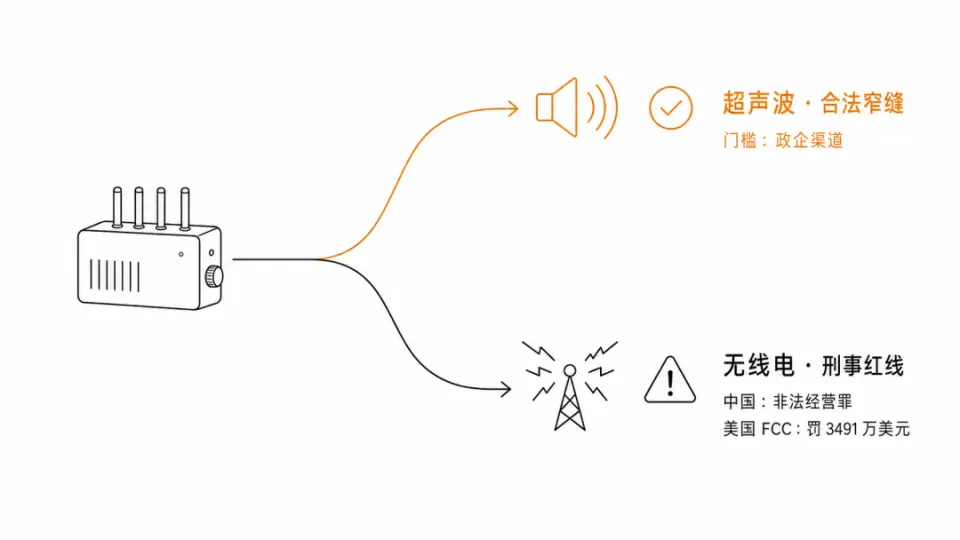
Ultrasound is a business; radio is a case
So the 'calculation that ninety percent of people get wrong' mentioned at the outset is wrong precisely here. They see 'detector' and 'jammer,' 'ultrasound' and 'radio' looking similar on the specification sheet, assume they are all hardware businesses, and cannot tell which is a business and which is a case. This piece of understanding can be grasped by reading a few regulations, costs almost nothing, yet can block ninety percent of competitors who would otherwise charge headlong into the red line. It is the cheapest threshold in this business, and the one that is hardest to copy.
If you really want to do this, weld four things firmly into the product definition. First, make detectors, not jammers; if you must make jammers, make only the ultrasonic acoustic version, and do not touch radio frequency at all. Second, in product descriptions and marketing language, not a single word such as 'signal shielding,' 'RF jamming,' or 'jamming mobile phone WiFi' may appear; they will reclassify your ultrasonic product as a radio jammer, and the narrow gap instantly becomes a red line. Third, do not write the product up as 'helping you secretly record or counter others'; in a dozen or so US states, recording requires the consent of everyone present, and leaning the language that way turns the trouble from selling a product into helping people break the law; when going overseas, do not skimp on the compliance money for FCC equipment certification either. Fourth, do not say things like 'can detect all hidden cameras' or 'specifically defeats AI glasses'; a passive detector like the GM231 most likely cannot scan the new generation of AI glasses that store data locally, transmit only metadata, and do not do wireless live streaming at all, and making full claims is just waiting for false-advertising trouble.
The money in this business is not in the goods; the goods are just sitting there, 5.3 US dollars apiece, and anyone can get them. What truly separates a business from a case is whether you dare to write those few words on the product page: 'detect' and 'ultrasound' can be written; 'RF jamming' and 'signal shielding' cannot be touched, not one word.
This article was written by Lawyer Lü Yinghui and may not be reproduced without permission.

Appendix: Main legal provisions involved in the main text
Article 225 of the Criminal Law of the People's Republic of China (crime of illegal business operation)
Whoever, in violation of state regulations, commits any of the following illegal business operations, disrupting market order, and the circumstances are serious, shall be sentenced to fixed-term imprisonment of not more than five years or criminal detention, and shall also, or shall only, be fined not less than one time but not more than five times the illegal gains; if the circumstances are especially serious, shall be sentenced to fixed-term imprisonment of not less than five years, and shall also be fined not less than one time but not more than five times the illegal gains or have property confiscated:
(1) operating, without permission, goods that are monopolized or exclusively sold as prescribed by laws and administrative regulations, or other goods whose purchase and sale are restricted;
(2) buying or selling import and export licenses, certificates of origin for imports and exports, or other operating licenses or approval documents prescribed by laws and administrative regulations;
(3) illegally engaging in securities, futures or insurance business without approval from the relevant competent State authorities, or illegally engaging in fund payment and settlement business;
(4) other illegal business operations that seriously disrupt market order.
Article 288 of the Criminal Law of the People's Republic of China (Crime of Disrupting the Order of Radio Communications)
Whoever, in violation of State regulations, sets up or uses a radio station (radio station) without authorization, or uses radio frequencies without authorization, thereby disrupting the order of radio communications, if the circumstances are serious, shall be sentenced to fixed-term imprisonment of not more than three years, criminal detention or public surveillance, and shall also, or shall only, be fined; if the circumstances are especially serious, shall be sentenced to fixed-term imprisonment of not less than three years but not more than seven years, and shall also be fined.
Where a unit commits the crime in the preceding paragraph, the unit shall be fined, and the persons directly in charge and other persons directly responsible shall be punished in accordance with the provisions of the preceding paragraph.
Article 1, Item 4 of the Interpretation of the Supreme People's Court and the Supreme People's Procuratorate on Several Issues Concerning the Application of Law in Handling Criminal Cases such as Disrupting the Order of Radio Communications (2017)
Where any of the following circumstances exists, it shall be determined as "setting up or using a radio station (radio station) without authorization, or using radio frequencies without authorization, thereby disrupting the order of radio communications" as provided in Paragraph 1 of Article 288 of the Criminal Law... (4) illegally setting up or using radio jammers.
Article 4 of the Same Interpretation
Whoever illegally produces or sells radio equipment such as "black broadcasting", "fake base stations" or radio jammers, where any of the following circumstances exists, it shall be determined as "serious circumstances" as provided in Article 225 of the Criminal Law:
(1) illegally producing or selling three or more sets of radio equipment;
(2) the amount of illegal business operations is 50,000 yuan or more;
(3) Other circumstances of a serious nature.

