
In recent days, a home appliance brand has been heavily criticized and trended on social media. Its officially verified flagship store on Douyin published a series of AI-generated short videos to promote a steam cleaner: a woman is taking a shower when a male bathhouse attendant pushes the door open and offers to scrub her back; a woman is using the toilet when a male cleaner enters to clean. The caption read "What hasn't Uncle seen?" Each video properly carried an "AI-generated" label.
In mid-July, this batch of videos had already been reported by the media once, and the account quietly deleted them. In early August, similar content resurfaced, and the account simply cleared almost all of its historical videos, leaving only three pinned product introductions. On August 6, the brand responded to the media, stating that it had taken down all the videos involved, conducted a comprehensive review of its material review process, and acknowledged that "there are still gaps in content management and publication review mechanisms for authorized stores." There was no public apology.
If your company is also using AI to mass-produce marketing materials, this matter is worth ten minutes of your time. It brings several issues that people usually do not think of onto the table all at once: whether AI-created content counts as advertising, whether labeling it "AI-generated" can exempt liability, whether deleting all the content means the matter is closed, and who will receive the penalty if something really goes wrong. The answers to these four questions are not quite what most people would intuitively expect.
First, a preliminary question: does this count as advertising?
Many people's first reaction is that it was just a skit the store made for fun and does not count as advertising. However, when the Advertising Law defines advertising, it looks at the purpose, not the form.
Article 2: Within the territory of the People's Republic of China, commercial advertising activities in which commodity operators or service providers directly or indirectly introduce the commodities or services they are promoting through a certain medium and form shall be governed by this Law.
As long as you are promoting your own commodities or services and publish it through some medium, this Law applies. The shell of a skit does not change this, nor does the shell of a storyline. In the video, the cleaning machine is lifted up and demonstrated on the spot; this is introducing the commodity you are promoting, and it is standard commercial advertising.
What is AI's position here? It is a tool. It determines how this advertisement is made, not what this advertisement is. Whether you shoot with a camera, hire real people to act, or have AI generate it, legally it is the same thing: you have published an advertisement. Changing the tool does not reduce the characterization in the slightest.
Many operators' compliance awareness is still stuck at "advertising equals paid hard ads," categorizing sales-driven short videos, store storyline accounts, and livestream clips as content operations and not running them through advertising review procedures at all. This is the most common loophole.
What was violated is not the "pornography" item, but the "social morals" item
Article 9 of the Advertising Law lists eleven circumstances in which advertisements may not appear. When public opinion discusses this type of incident, the favorite word is "pornography," but when it actually reaches the enforcement level, borderline content is almost never characterized under that item.
Article 9: Advertisements shall not contain any of the following circumstances: (1) using or disguisedly using the national flag, national anthem, or national emblem of the People's Republic of China, or the military flag, military anthem, or military emblem; (2) using or disguisedly using the name or image of a state organ or a functionary of a state organ; (3) using terms such as "national-level," "highest-level," or "best"; (4) harming the dignity or interests of the State or divulging state secrets; (5) obstructing social stability or harming the public interest; (6) endangering personal or property safety or divulging personal privacy; (7) obstructing public order or violating good social morals; (8) containing obscene, pornographic, gambling, superstitious, terroristic, or violent content; (9) containing content that discriminates on the basis of ethnicity, race, religion, or gender; (10) obstructing the protection of the environment, natural resources, or cultural heritage; or (11) other circumstances prohibited by laws or administrative regulations.
The term "obscene or pornographic" in Item (8) has relatively strict criteria under Chinese law, and it connects upward to the regime of public security administrative penalties and even criminal liability; a narrative video that contains no nudity and relies only on dialogue and context to suggest sexual content generally does not meet that threshold.
What genuinely captures this conduct is Item (7): obstructing public order or violating good social customs. The threshold for this item is far lower than most operators imagine. It does not require the content to be explicit; it requires only that the manner of expression be unacceptable under generally accepted social standards.
This is not merely my own view; consider three penalties that have already taken effect.
In August 2025, the Yangpu District Market Supervision Administration of Shanghai imposed a fine of RMB 200,000 on a trading company, one ground being that it "suggested 'sexual' elements and 'sexual' content through vulgar and low-grade expressions in its advertisements, violating good social customs." This case was selected by the State Administration for Market Regulation as one of the ten typical cases of illegal internet advertising published that year. Note the official wording: suggesting sexual elements, characterized as violating good social customs, not as obscene or pornographic.
The two RMB 400,000 fines imposed on the Ye Mou Mou group are even more typical. In the 2021 fine, the Hainan Provincial Market Supervision Administration found that its recruitment advertisement conveyed a money-worshipping and vulgar view of marriage and relationships through statements such as "enroll and you'll have a car, a house, a high salary, and surely beautiful women and handsome men chasing you," violating good social customs. The 2024 fine was imposed by the Longhua Branch of the Haikou City Market Supervision Administration (Hai Shi Jian Long Chu [2024] No. 26); because its self-operated website used advertising slogans such as "wipe breasts with coconuts" and "few beauties in the South Pacific are 'airports,'" it was found to have violated Article 9, Items (2) and (7), and Article 17, and was fined RMB 400,000 pursuant to Article 57, Item (1).
Three penalties, and all three landed on Item (7).
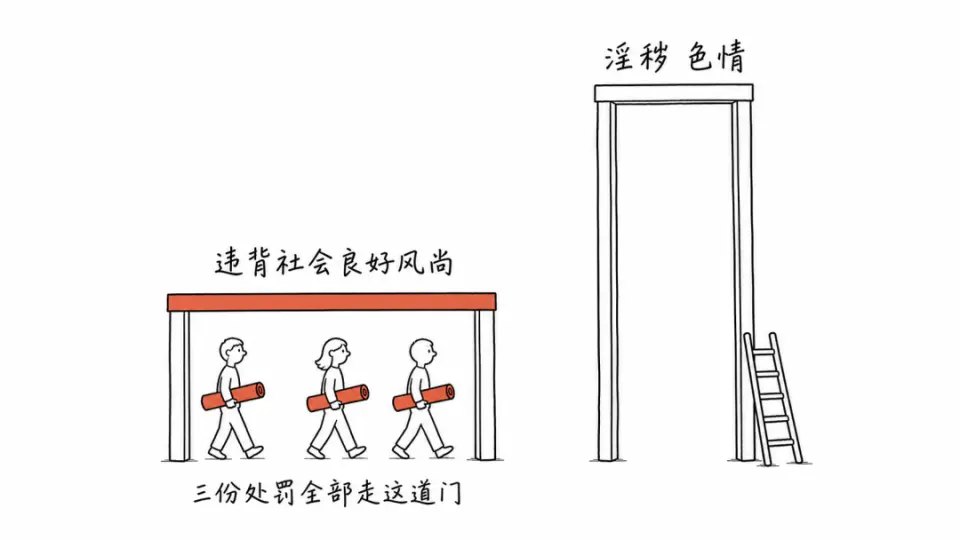
The threshold difference between Item (7) and Item (8) of Article 9 of the Advertising Law
Returning to the batch of videos mentioned at the outset: a middle-aged man entering a women's bathhouse and offering to scrub backs, and a cleaning man entering a women's restroom to clean, paired with titles such as "What hasn't Uncle seen?"—sexual suggestion is the sole driving force behind the spread of these storylines, and the product demonstration is merely an appendage. Placed under Item (7), this is not difficult to adjudicate.
"Labeled as AI-generated" answers a different question
Every one of these videos bears an "AI-generated" label. A claim has therefore emerged: since labeling was carried out in accordance with the Measures for Labeling AI-Generated Synthetic Content, the compliance obligation has been fulfilled.
This conflates into one thing matters governed by two separate laws.
The Labeling Measures took effect on September 1 last year, and they address only one issue: letting people know whether the content was made by a machine.
Article 3: AI-generated synthetic content refers to text, images, audio, video, virtual scenes, and other information generated or synthesized using artificial intelligence technology.
Labels for AI-generated synthetic content include explicit labels and implicit labels.
Explicit labels refer to labels added to generated synthetic content or interactive scenario interfaces, presented in the form of text, sound, graphics, or other means, and capable of being clearly perceived by users.
Implicit labels refer to labels added to the file data of generated synthetic content through technical measures that are not easily and clearly perceived by users.
Reading through this article, not a single word concerns whether the content itself may be published. It regulates disclosure of the production method, whereas the Advertising Law regulates the legality of the content. One governs "who made this and how it was made"; the other governs "whether this thing may be published externally." The two tracks run separately, do not intersect, and cannot offset each other.
By way of analogy, the labeling obligation is the ingredient list, and the Advertising Law is the food safety standard. No matter how properly the ingredient list is printed, it cannot turn a batch of spoiled food into food that may be placed on shelves. The analogy is not entirely precise; the difference lies in the fact that the two have different levels of legal effect—one is a departmental rule jointly issued by four departments, and the other is a law adopted by the Standing Committee of the National People's Congress. But the direction is correct: disclosure does not equal clearance.
Conversely, an explicit label is not only not a talisman; it is more like a confession. By writing "AI-generated" on the image, you are confirming to the whole world that this content constitutes generated synthetic content, and law enforcement authorities are spared even this step of proof.
The label itself also cannot be affixed however one pleases. In May of this year, the Market Supervision Administration of Liangjiang New Area, Chongqing Municipality, investigated and handled a case in which a certain enterprise used AI to generate a sensational scene of consumers queuing at a store to snap up new energy vehicles. The entire scene was fabricated, and two violations were ultimately found: one was false advertising, and the other was precisely the failure to implement the statutory labeling obligation for AI-generated content, because it had only added a "#AI#" topic hashtag on the video. A topic hashtag is not equivalent to a standardized and conspicuous label. In its notice, the law enforcement authority stated plainly that the application of new technology is not itself unlawful, but it absolutely must not become a "shield" for false publicity or non-compliant marketing.
Everything has been deleted, so why is there still a penalty?
The account has been emptied and the videos taken down—does that mean it is over?
No. Administrative penalties target unlawful acts that have already occurred, not whether the content is still posted there at this moment. Deletion can only prevent the harmful consequences from expanding further; it cannot change the fact that the unlawful act has already been completed.
Under the Administrative Penalty Law, the act of taking content down has its fixed place.
Article 32 Where a party falls under any of the following circumstances, the administrative penalty shall be mitigated or reduced: (1) the party voluntarily eliminates or mitigates the harmful consequences of the illegal act; (2) the party commits the illegal act under coercion or deception by another person; (3) the party voluntarily confesses an illegal act not yet known to the administrative organ; (4) the party cooperates with the administrative organ in investigating and handling the illegal act and demonstrates meritorious performance; or (5) other circumstances under which an administrative penalty shall be mitigated or reduced as provided by laws, regulations or rules.
Voluntary removal of the content falls under item (1), and the legal effect is that the penalty "shall be mitigated or reduced." Mitigation or reduction is not exemption from penalty.
Some may think of another route: does Article 33 not provide that a penalty may be waived?
Paragraph 1 of Article 33 Where an illegal act is minor and is corrected promptly and no harmful consequences are caused, no administrative penalty shall be imposed. Where a party commits an illegal act for the first time, the harmful consequences are minor and the act is corrected promptly, no administrative penalty may be imposed.
Paragraph 2 of Article 33 Where a party has evidence sufficient to prove that it is not subjectively at fault, no administrative penalty shall be imposed. Where laws or administrative regulations provide otherwise, those provisions shall prevail.
Neither of these two doors is easy to enter. Paragraph 1 requires that "the illegal act is minor and is corrected promptly and no harmful consequences are caused," and it is difficult to say that a public-opinion event on a platform-wide scale caused no harmful consequences; the latter part, "first-time illegal act," also does not fit, because one round of deletions occurred in mid-July and similar content reappeared in early August. Paragraph 2 requires the party to produce evidence proving that it is not subjectively at fault, yet this batch of videos was posted on an officially verified flagship store account and served as a long-term exposure tool, and the brand owner also stated in its 2025 financial report that it was promoting test applications of AI in the fields of graphics and text, short videos and livestreaming to improve marketing efficiency. This was an organized marketing action, not an accident.
As for the idea that "if it is deleted cleanly, it cannot be investigated," that idea has long been unworkable in practice.
Paragraph 1 of Article 36 Where an illegal act is not discovered within two years, no administrative penalty shall be imposed; where the act involves citizens' life, health and safety, or financial security, and harmful consequences are caused, the above period shall be extended to five years. Except as otherwise provided by law.
Paragraph 2 of Article 36 The period specified in the preceding paragraph shall be calculated from the date on which the illegal act occurs; where the illegal act is continuous or ongoing, it shall be calculated from the date on which the act ends.
The period for pursuing liability is two years, and where the illegal act is continuous or ongoing, it is calculated from the date on which the act ends. The series of actions from mid-July to early August pushed the starting point later, not earlier.
Evidence collection is likewise not a problem. In the 2024 case involving Ye Moumou Group mentioned above, the clue was transmitted by the State Administration for Market Regulation to the local authority in the form of a Referral Letter (Guang Han [2024] No. 13), the local authority opened a case on the same day, and the case file included an electronic data preservation document issued by a third-party judicial appraisal institution. Regulatory action to preserve evidence has never depended on your content still being displayed on the page. The path of a public-opinion hotspot being referred by the State Administration for Market Regulation and investigated and handled by the local authority upon case opening has already been proven workable.
To whom will the penalty notice be issued
The brand's response placed responsibility on the "authorized stores." What this sentence can shield against legally depends first on how the Advertising Law allocates roles.
Article 2, Paragraph 2: For the purposes of this Law, an advertiser refers to a natural person, legal person, or other organization that, in order to promote the sale of goods or services, designs, produces, or publishes advertisements itself or by entrusting others to do so.
Article 2, Paragraph 3: For the purposes of this Law, an advertising operator refers to a natural person, legal person, or other organization that, accepting entrustment, provides advertising design, production, or agency services.
Article 2, Paragraph 4: For the purposes of this Law, an advertising publisher refers to a natural person, legal person, or other organization that publishes advertisements for an advertiser or for an advertising operator entrusted by an advertiser.
For these three roles, who is who depends on what was actually done, not on what names appear on the cover of a contract.
If an authorized store purchases its own goods, opens its own shop, and sells the goods itself, and it is promoting its own goods, then it is the advertiser, and first-tier liability is unavoidable. But whether the brand can thereby be clean depends on several matters: whether the materials were provided or designated by the brand, whether there was a brand review step before publication, whether the store used the brand's trademarks and official certified identity, and whether the store's goods were obtained from the brand. Taken together, these facts may well lead to the brand being identified as a joint advertiser, or at least as an advertising operator providing design and production services. The platform, in turn, is an advertising publisher.
The sentence "there are still omissions in the authorized store content management and publication review mechanism" is, from a public-opinion perspective, a separation; from a legal perspective, it is an admission: it acknowledges that the brand had management and review duties over the content published by that store. Having a duty and failing to fulfill it is precisely how fault is expressed.
On the penalty side, Article 57 of the Advertising Law sets out different penalties for different roles.
Article 57: Where any of the following acts is committed, the market supervision and administration department shall order the publication of the advertisement to be stopped, impose a fine of not less than RMB 200,000 and not more than RMB 1,000,000 on the advertiser, and, if the circumstances are serious, may also revoke the business license, and the advertising review authority shall revoke the advertisement review approval document and shall not accept its advertisement review application within one year; for advertising operators and advertising publishers, the market supervision and administration department shall confiscate advertising fees, impose a fine of not less than RMB 200,000 and not more than RMB 1,000,000, and, if the circumstances are serious, may also revoke the business license: (1) publishing advertisements containing the prohibited circumstances specified in Articles 9 and 10 of this Law; (2) through (6) omitted.
Two details are worth noting.
First, for advertisers the fine is RMB 200,000 to RMB 1,000,000; for advertising operators and advertising publishers, in addition to a fine in the same range, advertising fees must also be confiscated. Companies that provide outsourced content operations often overlook the second half of that sentence.
Second, in this article, "revoke the advertisement review approval document and not accept its advertisement review application within one year" is in fact an empty provision for ordinary goods such as cleaning machines: advertising review covers only medical treatment, pharmaceuticals, medical devices, pesticides, veterinary drugs, and health foods, and ordinary home appliances simply have no review approval document to revoke. The "revoke the business license" tier would in practice not be applied to a listed company either. Therefore, what would actually land on paper is an order to stop publication plus a fine of RMB 200,000 to RMB 1,000,000.
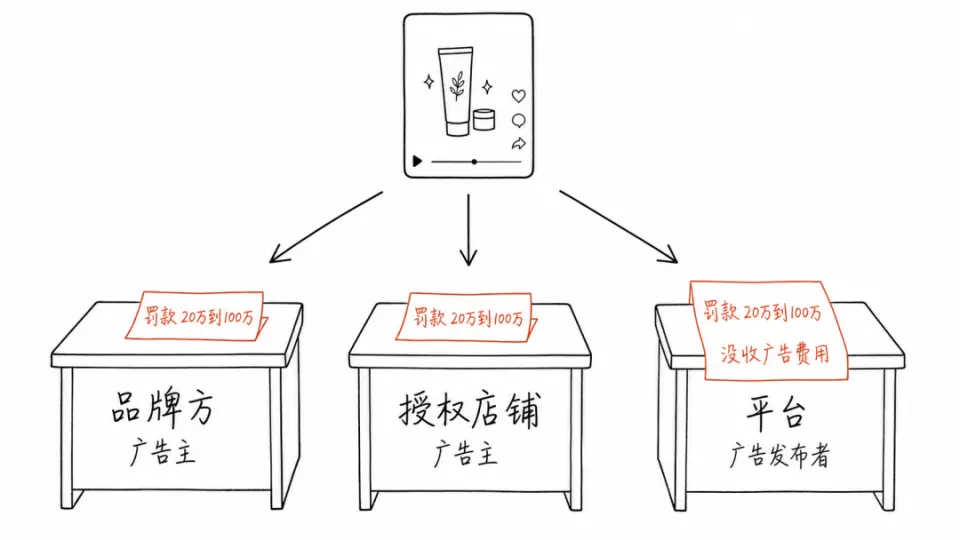
One non-compliant advertisement generates three different penalty decisions: the differences in penalties applicable to advertisers, advertising operators and advertising publishers
What is truly expensive is not the fine
A cap of one million is nothing to a company with annual revenue in the billions. So if only the fine is counted, this account can never be squared.
The truly expensive part comes later. Administrative penalty information()must be published on the National Enterprise Credit Information Publicity System, and listed companies also have their own information disclosure obligations to fulfill. Once a penalty decision stating "offends good social customs" is posted, it will be dug up in every due diligence exercise for tendering, awards, financing and platform cooperation. It exists for far longer than the fine.
The timing is also poor. On April 30, the Cyberspace Administration of China issued a notice deploying a nationwide four-month special campaign, "Qinglang: Rectifying Chaos in AI Applications," and we are still within that window. In the list of priority rectification items for the second phase of this campaign, one item is written almost precisely for this type of content: the production and publication of undesirable information such as violent or vulgar content, including "generated or synthesized vulgar, borderline images and videos that highlight specific female body parts, with revealing clothing, suggestive posing and the like." The targets of enforcement are also clearly stated: non-compliant accounts, MCN agencies and website platforms, with none left out. Another item in the first-phase list is "inadequate implementation of labeling for generated or synthesized content," which even covers non-standard size, placement and transparency of labels. At the same time, the notice Shi Jian Guang Fa [2026] No. 17 issued by the State Administration for Market Regulation this March lists "AI-generated advertising" as a priority focus of a six-month rectification campaign.
There are three things that should be set in motion now.
Brands must write advertiser liability into authorization contracts. Every piece of sales content published by authorized stores, distributors or agencies may legally be attributed to you. The contract must include content review rights, restrictions on the source of materials, and clauses on takedown for violations and recovery of losses, and these must actually be enforced, rather than produced after an incident as evidence of exemption from liability. The review process must be moved forward to before publication and cannot rely on public opinion to trigger it.
Agencies and MCNs must first clarify what role they play. Those commissioned to design and produce are advertising operators; those who open their own stores and sell goods are advertisers. The penalties issued under Article 57 differ between these two capacities, and the former faces an additional confiscation of advertising fees. Before using AI to improve efficiency, retain the people who review content. AI increases output, not compliance capacity.
Any entity using AI to generate marketing content must treat labeling as an obligation rather than a means of exemption from liability. Explicit labels must be implemented in accordance with the Labeling Measures and the supporting mandatory national standards, implicit labels must not be omitted, and a separate content compliance review line must be established specifically against the eleven items in Article 9 of the Advertising Law. These two lines cannot be merged, because they do not answer the same question at all.
Returning to the question at the outset: why should AI-generated advertisements be properly reviewed?
Because AI has only changed the speed of advertising production, not the legal nature of advertising. In the past, an advertisement passed through many pairs of eyes from concept to launch: writing scripts, finding actors, renting venues. Costs were high and output was slow, and slowness itself was a brake; now a single prompt produces ten advertisements in minutes, human review has been squeezed out, and the law's requirements for content have not retreated an inch. However many times output is multiplied, risk is multiplied by the same factor.
The brakes were removed by AI, yet the penalty decision bearing the words “contrary to good social morals” at the end of the accelerator still has to be signed for and accepted by the company itself.
Companies that are using AI to produce marketing content and wish to have their publication review process and authorization contracts reviewed together may speak with the author.
Reference Sources
- Advertising Law of the People's Republic of China (amended in 2021), Standing Committee of the National People's Congress
- Administrative Penalty Law of the People's Republic of China (revised in 2021), Standing Committee of the National People's Congress
- Measures for the Labeling of AI-Generated Synthetic Content, Cyberspace Administration of China, Ministry of Industry and Information Technology, Ministry of Public Security, and National Radio and Television Administration, effective September 1, 2025
- Ten Typical Cases of Internet Illegal Advertising Published by the State Administration for Market Regulation, State Administration for Market Regulation, October 16, 2025
- Administrative Penalty Decision of the Longhua Branch of the Haikou Municipal Administration for Market Regulation (Hai Shi Jian Long Chu [2024] No. 26)
- The Central Cyberspace Affairs Commission Office Deploys the “Qinglang · Rectifying Chaos in AI Applications” Special Action, Office of the Central Cyberspace Affairs Commission, April 30, 2026
- Notice of the General Office of the State Administration for Market Regulation on Strengthening the Regulation of Reminder Wording in Advertisements (Shi Jian Guang Fa [2026] No. 17)
- Using AI to Generate a False Video of Queuing to Snap Up Cars: Chongqing Liangjiang New Area Investigates and Handles a New Type of Illegal Case, IT Home
- Su Moumou Responds to “AI-Generated Vulgar Short Videos”: Already Taken Down, Content Review Strengthened, The Beijing News Shell Finance
- "Su Moumou's AI Vulgar Advertisements Repeatedly Spark Controversy; Officials Delete Video Without Responding", Guancha Syndicate
- "A Girl Is Showering, and an Older Man Helps Scrub Her Back? Su Moumou Empties Account After AI Vulgar Marketing", Sina Finance "BUG" Column
Author of this article:Lü Yinghui, a lawyer at Mankun (Shenzhen) Law Firm. A graduate of China University of Political Science and Law, with nearly ten years of deep experience in the legal industry, having previously worked at a court in Shenzhen. Focused on legal services in the new-generation economy, with extensive practical experience and profound insights in fields such as Web3 and artificial intelligence. All-platform account: Lao Lü Talks New Money; you are welcome to follow.

