
A product listed on Xianyu is priced at RMB 9.9 and titled "Brand-New AI Digital Human Livestreaming System." The description advertises digital human cloning, real-time audio and video driving, two digital humans interacting on the same stream, AI-generated livestream scripts, and round-the-clock unmanned nonstop broadcasting.
What RMB 9.9 buys is being used toimpersonate securities analysts。
Since July of this year, nearly 10 securities firms, including Galaxy Securities, Guosheng Securities, Zhongtai Securities, Huafu Securities and Huaxin Securities, have issued risk alerts in quick succession. A review by Securities Times found that since 2025, more than 30 securities firms have encountered App impersonation and identity-fraud scams, with leading institutions such as GF Securities, Founder Securities and China Securities International all on the list. An aggrieved investor at a securities firm in central China was added to a WeChat group purportedly run by a co-head of research and, following the instructions given, downloaded a fake stock-trading app and ultimately transferred more than RMB 1.8 million, which could no longer be withdrawn. A securities firm in southern China disclosed that in 2025 it received more than 1,900 leads on impersonation cases, involving RMB 30 million.
The people who carry out the fraud will be caught; there is no suspense about that. What remains genuinely unsettled is the role of several actors upstream in this chain. The sellers of digital human systems, the parties that take orders to clone real people's likenesses, and the platform that let the impersonation livestreams run for three months: should they pay compensation, how much, and on what basis.
If you are in digital human SaaS, voice cloning or AI video generation, or if you are responsible for reviewing content on a platform, the three judgments already in force below are directly relevant to your business. None of the three cases has a securities-fraud factual background, but the liability pathways each establishes map precisely onto three positions in this chain.
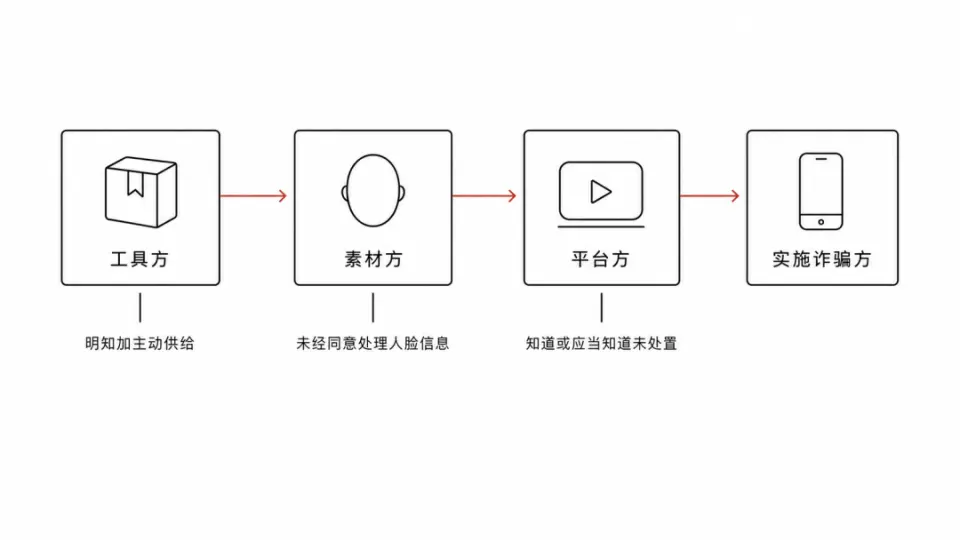
The chain of liability
What the court pursues is not "you used AI" but "what should have been labeled was not labeled"
In a case decided by the Guangzhou Internet Court on February 8, 2024, docket number(2024) Yue 0192 Min Chu No. 113The defendant operated an AI image-generation website where users could generate images highly similar to Ultraman by entering prompts. The copyright owner sued, claiming RMB 300,000 in damages.
There is nothing novel about the finding of infringement. What really matters is how the court reasoned that the defendant "was at fault." The judgment listed three points: the website had not established a complaint and reporting mechanism, had not warned of intellectual property risks in its user agreement, and had not affixed conspicuous labels to generated content. All three were missing, and on that basis the court found that the service provider had failed to exercise reasonable care and was subjectively at fault, and awarded RMB 10,000 in damages.
Please note the direction of this logic. A compliance obligation originally set out in administrative regulations, which was originally the basis for the Cyberspace Administration to inspect and penalize you, is now being used by the court to determine civil liability. If you fail to label, administratively you may merely be summoned for a talk and required to rectify; but once someone sues you, this "failure to label" becomes ready-made evidence proving that you were at fault.
The timing is even more worth watching closely. This judgment was rendered in February 2024, while the Measures for the Labeling of Artificial Intelligence-Generated Synthetic Content only took effect on September 1, 2025. At the time, the court cited the Interim Measures for the Administration of Generative Artificial Intelligence Services and the Provisions on the Administration of Deep Synthesis of Internet Information Services. The transformation of the labeling obligation into liability for damages did not need to wait for the labeling measures to take effect; the courts were already ruling this way in 2024.
Companies engaged in digital human cloning fall squarely within the scope delineated by Article 17, paragraph 1 of the Deep Synthesis Provisions:
Article 17 Where a deep synthesis service provider provides any of the following deep synthesis services, which may cause public confusion or misrecognition, it shall place a prominent label in a reasonable position and area of the generated or edited information content to inform the public of the deep synthesis situation:
(1) text generation or editing services that simulate natural persons, such as intelligent dialogue and intelligent writing;
(2) speech generation or editing services that significantly change personal identity characteristics, such as synthesized human voice and voice imitation;
(3) person image or video generation or editing services that significantly change personal identity characteristics, such as face generation, face replacement, face manipulation and posture manipulation;
(4) generation or editing services such as immersive simulated scenes;
(5) other services with the function of generating or significantly changing information content.
"1:1 voice cloning" falls under item (2), and "image cloning" falls under item (3). These two items are not a gray area.
Selling software does not necessarily create liability; selling software plus materials plus tutorials does create liability
The defense most commonly used by tool providers is technological neutrality: I only provide the technology, and what downstream users do with it is none of my concern.
This defense has boundaries. Where those boundaries lie was delineated by a judgment as early as 2023.
Hangzhou Internet Court(2023) Zhe 0192 Min Chu No. 4563, the first civil public interest litigation in China concerning personal information protection in connection with "AI face-swapping," brought by the People's Procuratorate of Xiaoshan District, Hangzhou. The defendant, Yu, used face-swapping software to fabricate videos and disseminate them in social groups; that conduct was pursued separately in a criminal case. The public interest litigation focused on a different set of acts: he sold face-swapping software to the public, taught tutorials on its use, and provided the facial material needed for face-swapping.
The court found that Yu, while knowing that others might use the software for improper purposes such as infringing personal information, nonetheless sold the software, provided material, and taught tutorials, thereby further expanding the social danger that the personal information of unspecified subjects would be infringed, and that he should bear civil liability. The judgment contained three items: cease the infringement and delete retained personal information, publish an apology statement in Legal Daily, and pay public interest damages ofRMB 60,000。
There is a widely circulated misreading here that needs to be clarified. In this case Yu was the sole defendant and bore his own tort liability; the judgment contains no joint liability whatsoever. To use it to argue that "tool providers and fraudsters must jointly compensate" finds no support in the judgment.
The combination that triggers liability is "knowing" plus "actively supplying the three-piece set." Merely selling a general-purpose tool and hand-holding the other party through how to forge a particular person's face are not the same thing in terms of legal assessment. A statement by the procuratorial authority at trial summarized it accurately: technological neutrality does not mean value neutrality.
For companies that make tools, the actions that can create distance are actually quite specific. Conduct real-name verification of purchasers and keep records; state prohibited uses in the contract rather than merely writing "for lawful purposes only"; embed anti-fraud warnings in the product; and reserve and exercise the right to refuse service for obviously abnormal bulk cloning requests. If these items are done, the "knowing" element becomes very difficult to prove.
Incidentally, let me correct a contractual misconception. When digital human SaaS is sold to enterprise customers, the buyer is not a consumer, and the Law on the Protection of Consumer Rights and Interests does not apply here; the validity of exemption clauses must be judged under the standard-form clause rules of Article 497 of the Civil Code. Moreover, no matter how a clause is drafted, it cannot counter the fact that you already clearly know what the other party intends to do with it.
Cloning a face resulted in an award of two thousand yuan
The material-provider link refers to the role that collects real people's images and voices to make templates or digital humans. If the impersonated analyst himself seeks to vindicate his rights, what can he obtain? The Beijing Internet Court(2023) Jing 0491 Min Chu No. 3820provided a real-world answer.
The plaintiff, Ms. Liao, is a traditional Chinese style creator and hanfu model whose two Douyin accounts together have more than ten million followers, and both account descriptions state "not authorized to any paid software." Without her consent, a company used videos in which she appeared to create AI face-swap templates and uploaded them to its own face-swap app for use by paying members. She brought suit, asserting rights in her likeness and personal information rights, and sought RMB 50,000 in damages.
The court's two conclusions appear contradictory but are in fact internally consistent.
No infringement of the right to likeness was found. In the template videos, the plaintiff's face had already been replaced, so what the public saw was someone else's face, and the plaintiff herself could not be identified. The judgment further explained that the makeup, hairstyle, clothing, lighting and shot transitions remaining beyond the face are not elements inseparable from a specific natural person.
Infringement of personal information rights was found. Creating the templates required collecting videos containing the plaintiff's face, detecting facial key points, and using algorithms to fuse the new face with the facial features and expressions in the original video; this entire process constitutes the collection, use and analysis of personal information, and doing so without obtaining consent is an infringement. The court specifically noted that although the videos had been publicly released, the account stated "not authorized to any paid software," so the plaintiff's consent could not be presumed.
One provision that is widely miscited should be cited here. Article 44 of the Personal Information Protection Law is not some platform assistance obligation; it is the basis on which an infringed person sues the tool provider, and this judgment cites precisely that provision:
Article 44: Individuals have the right to know about and the right to decide on the processing of their personal information, and have the right to restrict or refuse the processing of their personal information by others, except as otherwise provided by laws and administrative regulations.
How much was awarded? Emotional distress damagesRMB 500, and property losses including reasonable rights-protection costsRMB 1,500, totalingRMB 2,000The plaintiff claimed RMB 50,000.
The court's reasons for the discretionary reduction were stated plainly: the defendant's use of the plaintiff's personal information no longer enabled the general public to accurately identify the plaintiff, so the harm was relatively minor; the defendant's profits derived mainly from the labor invested in the video rather than from personality elements, and the focus of the face-swapping service was not the use of the plaintiff's face but rather applying makeup to users.
This creates an awkward situation. When a cloned analyst brings a personal lawsuit, they handle evidence collection, retain counsel, attend the hearing, and after a full round obtain RMB 2,000. This is precisely why the Yu case proceeded through public interest litigation, and it also explains why the practical constraints on such conduct derive mainly from administrative penalties and criminal prosecution.
For companies engaged in digital humans, this figure should not be read as "the risk is very small." The fact that private-interest litigation yields low damages does not mean the other two tracks are also light. The administrative penalty gradient for failure to perform labeling obligations is a warning, circulated criticism, an order to correct within a specified period, an order to suspend services, up to a fine; where the source material involves illegally obtaining facial information, this touches on the crime of infringing citizens' personal information.
At the platform level, statutory provisions are often cited incorrectly
Impersonation accounts and digital-human livestream rooms are hosted on Bilibili, Douyin, and Xiaohongshu. As to when platforms bear liability, incorrect citation of statutory provisions is quite common in practice.
The most common error is citing Articles 42 to 45 of the E-Commerce Law. This set of provisions does indeed provide for notice-and-takedown and joint liability, but its applicable subject is limited to "e-commerce platform operators," and its object is limited to intellectual property infringement. For impersonation fraud on content platforms, neither the subject nor the object matches. Second-hand trading platforms such as Xianyu may fall within the E-Commerce Law, but what applies is also the general obligations of platform operators, not the intellectual property provisions.
The correct anchor is the Tort Liability Part of the Civil Code:
Article 1195, Paragraph 2: After a network service provider receives a notice, it shall promptly forward the notice to the relevant network user and take necessary measures based on the preliminary evidence of infringement and the type of service; if it fails to take necessary measures promptly, it shall bear joint liability with the network user for the expanded portion of the damage.
Article 1197: Where a network service provider knows or should know that a network user is using its network service to infringe upon the civil rights and interests of another person and fails to take necessary measures, it shall bear joint liability with the network user.
The difference between the two lies in the trigger mechanism. Article 1195 requires that a qualified notice be issued by someone; if the platform fails to act after receiving it, it is liable for the portion of losses that expand after the notice. Article 1197 requires no notice; as long as the platform "knows or ought to know" and fails to act, it bears liability.
The purpose of announcements on securities firms' official websites and the monthly list of impersonating entities published by the Securities Association of China lies precisely here: they push "ought to know" a significant step forward. Where a livestream impersonating a certain securities firm continues to broadcast normally after that firm has issued a risk warning and the Association has already blacklisted it, a platform's further claim of ignorance is highly unpersuasive.
Combined with the path in the Ultraman case discussed above, whether the platform itself fulfilled its labeling verification obligation will also be factored into the finding of fault. Article 6 of the Labeling Measures requires platforms providing content dissemination services to verify the implicit labels in file metadata and to add prompts in three tiers: "belongs to," "may be," and "suspected." A single clause in the user agreement prohibiting the uploading of AI-generated content does not exempt the platform from this obligation.
Whether an impersonated securities firm should compensate investors
This is the question victims ask most often, and the answer is that in principle there is no compensation.
The securities firm is the victim of the impersonation, and no contractual relationship arising from this fraud exists between it and the defrauded investors. Suitability obligations are often invoked, but their premise is that the securities firm itself sells products or provides services to investors, and that premise does not hold in an impersonation scenario. As for "failing to promptly ban the impersonating App," the authority to ban lies with app stores and regulators; this is not a statutory duty of the securities firm to act toward unspecified investors.
In theory, there are exceptions. Where a securities firm clearly knows of a specific impersonation fact—for example, having received investor reports or a regulatory referral—yet fails for a long period to issue warnings or make reports, and investors are subsequently defrauded, there remains room for discussion of a claim based on fault liability. However, my research has not found any public judgment supporting an investor's claim against an impersonated securities firm, and until a judgment is rendered, I do not recommend treating this as a viable avenue for recovery.
The mandatory label disappears the moment you screen-record
A popular saying in the industry goes: once the mandatory watermark under the Labeling Measures takes effect, AI-generated fraud videos will be traceable through forensic examination. This saying is built on a misreading of Article 5.
Article 5: Service providers shall, in accordance with Article 16 of the Provisions on the Administration of Deep Synthesis of Internet Information Services, add implicit labels to the file metadata of generated synthetic content; implicit labels include attribute information of the generated synthetic content, the name or code of the service provider, the content number, and other production element information.
Service providers are encouraged to add implicit labels in forms such as digital watermarks to generated synthetic content.
File metadata refers to descriptive information embedded in the file header according to a specific encoding format, used to record information such as the file's source, attributes, and purpose.
Two sentences, two verbs. The file metadata uses "shall," while the digital watermark uses "encouraged."
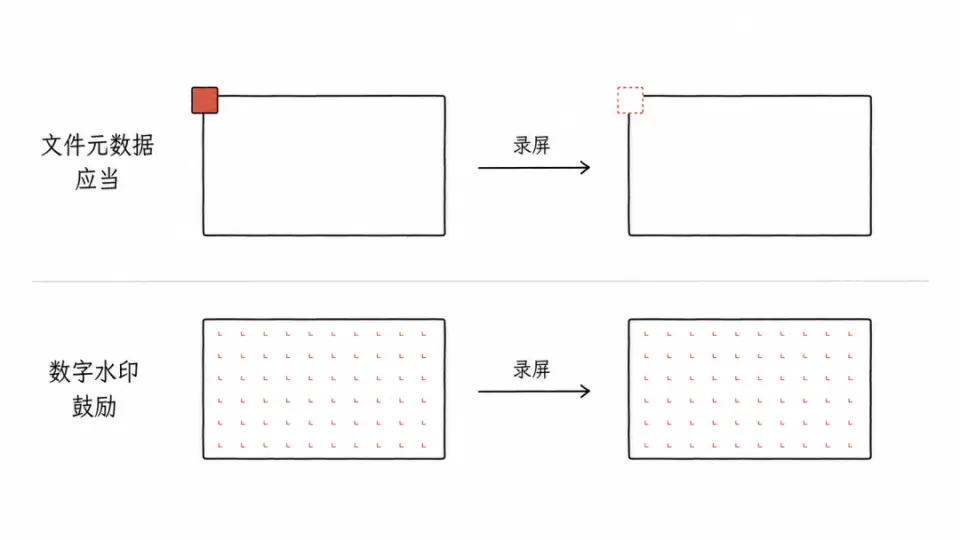
Marking
In fraud scenarios, this distinction is decisive. File metadata is embedded in the file header; a single screen recording wipes it out, a single transcoding wipes it out, and screenshots, secondary editing and forwarding wipe it out entirely. Yet the digital watermark that can genuinely withstand secondary dissemination is not legally mandatory. When a fraudster exports a video from a digital human system, casually records the screen and then posts it to a livestream room, the statutory marking is long gone.
The party gathering evidence should not expect to extract the statutory marking from a circulating fraud video; the focus of evidence preservation must shift to the front end of the dissemination chain, to obtaining platform backend logs, original files and upload records. One frequently misquoted basis should also be corrected here: the duty to cooperate in data production is set out in Article 35 of the Data Security Law, not Article 21; Article 21 concerns the data classification and grading protection system.
The service provider, by contrast, must think in reverse. Metadata marking is the compliance baseline, but when a dispute arises and you need to prove that "this video was not generated by our product," metadata alone cannot accomplish source tracing. Although a digital watermark is not a statutory obligation, it is the only self-verification capability you can present in a dispute. No one is forcing you to make this investment now, but on the day something goes wrong, it is the distance between you and liability for damages.
From the Yu case to the Liao case and then to the Ultraman case, with the three judgments placed side by side, the path is in fact quite clear. The law does not impose an extra penalty on you merely because you used AI; what it focuses on is always the same two old matters: knowingly providing the means, and failing to mark when marking is required. The cheaper the tool, the more valuable these two matters become.
If your company is engaged in digital human, voice cloning or AI video generation business, the time you spend now on the purpose clauses in contracts, the implementation of markings in products, and the verification records for customer onboarding all reduces the scope for future findings of fault. If you have specific scenarios requiring a practical judgment, you are welcome to leave a message in the backend.
Reference Sources
- Shanghai Securities News, "AI Securities Fraud Draws Attention; Brokerages Intensively Issue Risk Warnings," July 24, 2026
- Securities Times, "AI Face Swaps and Counterfeit Apps! Exposing the 'Fake Brokerage' Stock Recommendation Scam," July 9, 2026
- Supreme People's Procuratorate, "Inside the 'AI Face Swap' Public Interest Lawsuit for Infringement of Personal Information: Face Swapping Is Not Something to Do at Will," August 23, 2023
- Hangzhou Internet Court (2023) Zhe 0192 Min Chu No. 4563 Civil Judgment
- Civil Judgment of the Beijing Internet Court, (2023) Jing 0491 Min Chu No. 3820
- Civil Judgment of the Guangzhou Internet Court, (2024) Yue 0192 Min Chu No. 113
- Provisions on the Administration of Deep Synthesis of Internet Information Services, Cyberspace Administration of China, Ministry of Industry and Information Technology, and Ministry of Public Security, effective January 10, 2023
- Measures for the Labeling of Artificial Intelligence-Generated Synthetic Content (Guo Xin Ban Tong Zi [2025] No. 2), Cyberspace Administration of China, Ministry of Industry and Information Technology, Ministry of Public Security, and National Radio and Television Administration, effective September 1, 2025
- Civil Code of the People's Republic of China, Personal Information Protection Law of the People's Republic of China, and Data Security Law of the People's Republic of China
Author of this article:Lü Yinghui, attorney at Mankun (Shenzhen) Law Firm. A graduate of China University of Political Science and Law, with nearly ten years of deep engagement in the legal profession and prior experience working at a court in Shenzhen. Focused on legal services in the new-generation economy, with extensive practical experience and profound insights in fields such as Web3 and artificial intelligence. Account across all platforms: Lao Lü Talks New Money; you are welcome to follow.

