
On July 17, TikTok began testing a new tool with some U.S. creators: it scans the platform for AI videos that misappropriate your face and lets you report them with one click. To use it, you must first complete a real-time selfie and identity verification. YouTube moved earlier, having already made a similar feature available to all adult users.
There is a background to the platforms' sudden attention. Three months ago, the Guangzhou Internet Court published a set of typical cases involving disputes over livestream e-commerce. In one of them, someone cut a livestream by the host Zhu into 102 videos, superimposed his face and voice, attached "same-item links," and sold masks and rice; rice alone generated hundreds of thousands of orders. The court ultimately ordered the infringing party to pay compensation: RMB 8,000.
More than 900,000 orders and RMB 8,000 — put these two figures together and you have the entire answer to why this business persists despite repeated prohibitions. It is not that the law is absent; it is that, by any calculation, the business is profitable.
A business that steals trust can be up and running in six steps
First, let us be clear about what this business is.
In one sentence: misappropriating the face and voice of a celebrity or host at zero cost, fabricating the false impression that "the celebrity is recommending it," and converting the public trust that someone spent decades building into sales commissions for oneself. What it sells is not the product; it is the two words "trust."
The complete chain for a single order involves six steps.
Step one: choose the target. Pick a face that matches a certain category of product and also carries public trust. Wang Mouheng, whose face was used in AI face-swap marketing, is a typical example: the persona of high intelligence and scientific literacy he established on variety shows was exactly suited to categories such as children's health foods and children's books, where parents are most willing to spend money.
Step two: obtain source material. The target's livestream clips, variety-show segments, and clear frontal-face photos on social platforms are all publicly available; the raw material costs almost nothing.
Step three: clone. Use AI face-swap and voice-synthesis tools to superimpose the target's face and voice onto a marketing voiceover. With today's voice cloning, a three-second sample is enough to get started.
Step four: mass-produce. One person who knows how to edit, with an ordinary computer, can produce hundreds of videos a month. The earlier case involving the misappropriation of Zhu's livestream clips produced 102 videos in one go.
Step five: attach links. Attach a "same-item link" below the video; clicking it redirects to a third-party store. Some consumers believed it, commenting: "I bought it because I saw Wang Mouheng recommending it."
Step six: collect the money and play hide-and-seek. The money arrives through e-commerce revenue sharing; if a complaint is filed, the videos are taken down, and a few days later they are re-listed under a different account. Wang Mouheng's exact words were: "He takes them down today and re-lists them in a couple of days; you can't keep watching him forever, so he can just keep playing hide-and-seek with you."
Across the entire chain, the only bottleneck is not technology—the technical barrier is roughly zero. There is only one real bottleneck: the probability of being caught and ordered to pay damages. And that probability, like the amount, is low enough to be ignored.
Laying out the numbers: gross margin of ninety percent, and unlawful cost roughly nonexistent
With unlawful costs this low and profits this high, the economic drivers behind it are clearly significant. Next, let us run the numbers.
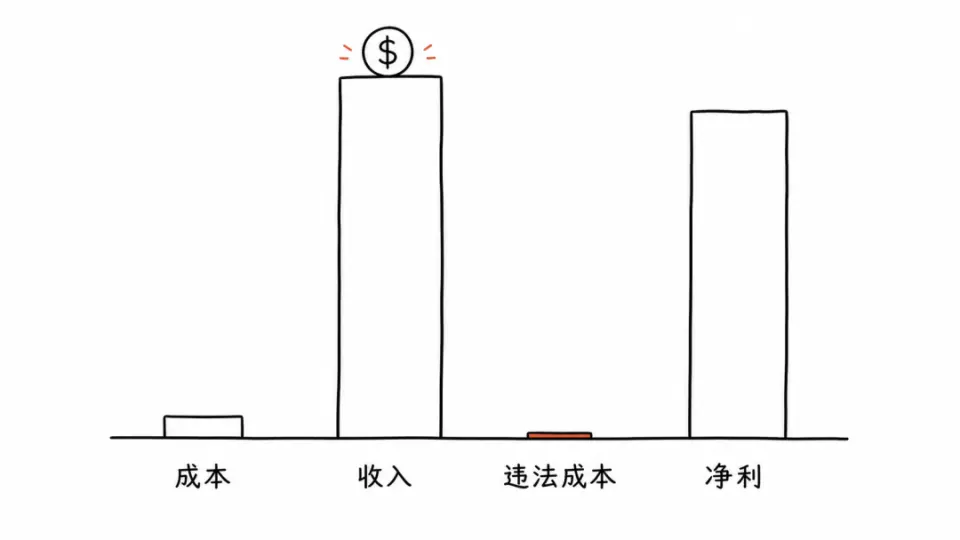
First, the costs. The upstream AI tools are subscription-based: a domestic digital-human product costs 198 yuan a month for unlimited cloning; overseas tools such as HeyGen offer a package including voice cloning for USD 29 a month. Once you have paid the monthly subscription, what is the marginal cost of making one more video? A few kilowatt-hours of electricity, a few minutes of rendering, a few yuan. Add in a computer and the labor of an editor, and the true cost per video is pressed below one hundred yuan.
Next, the revenue. Suppose a viral product-promotion video generates 100,000 yuan in transaction value, and the illicit operation takes twenty percent as a commission share—20,000 yuan per video. One point to add here: the commission share depends heavily on what products it chooses. For high-margin products such as health supplements and children's food, the nominal influencer commission is already thirty to fifty percent; for standardized products such as masks and rice, the commission is much thinner, only ten to fifteen percent. So the step of choosing targets involves optimization: it deliberately strikes at the intersection of public trust and high-commission categories, rather than stealing just any face.
Cost per video under one hundred yuan, revenue per video in the tens of thousands,gross margin exceeding 99% 。
But when a business can reach a 99% gross margin, it is usually not because it creates 99% of the value, but because it leaves 99% of the costs that should be recorded off its own books. The cost of rights enforcement is pushed onto the celebrities whose faces are stolen; the losses from fraud are pushed onto the consumers who place orders; the erosion from diluted trust is pushed onto the entire content ecosystem. In its own books, all three of these columns are zero.
And what about the unlawful-cost column? To actually be ordered to pay damages, four hurdles must be cleared in succession: the celebrity discovers it, evidence is successfully obtained, a lawsuit is filed, and judgment is rendered. Most never even reach the first hurdle. Even if they do, how much is awarded? In the case of the stolen clips of Zhu Mou, 8,000 yuan; in another case involving a departed livestreamer subjected to AI livestreaming, 25,000 yuan. Wang Mouheng put it more directly: "Even if sued, losing just means paying ten or twenty thousand—very cost-effective for the merchant."
Convert this into an expected cost per video. Optimistically, assuming one in ten videos is sued and each case results in 15,000 yuan in damages, that spreads to 1,500 yuan per video, or 7.5% of per-video revenue; in reality the proportion sued may be less than one percent, which means 150 yuan per video, or 0.75%.
So the monthly accounts look like this: one person produces 100 videos a month; even if only two or three truly go viral, at 20,000 yuan per video, monthly gross revenue is tens of thousands of yuan; expected damages spread over the month come to one or two thousand to tens of thousands; net profit remains positive, and the net margin is still above sixty percent.
Here I have deliberately used a conservative measure. Even if this business were so small that it earned only a few tens of thousands of yuan a month, an award of 8,000 yuan in damages would still not deter it. This precisely shows how serious the problem is: when the cost item is this low, you do not need the explanation that 'the other side is very wealthy' to explain why it persists despite repeated prohibitions.
It is not a moral issue; it is an arithmetic issue. The damages figure of 8,000 yuan itself declares to every potential entrant: the cost item of this business is approximately nonexistent.
The accounts of a single video
No one can control it because, on the chain, every party loses by controlling it
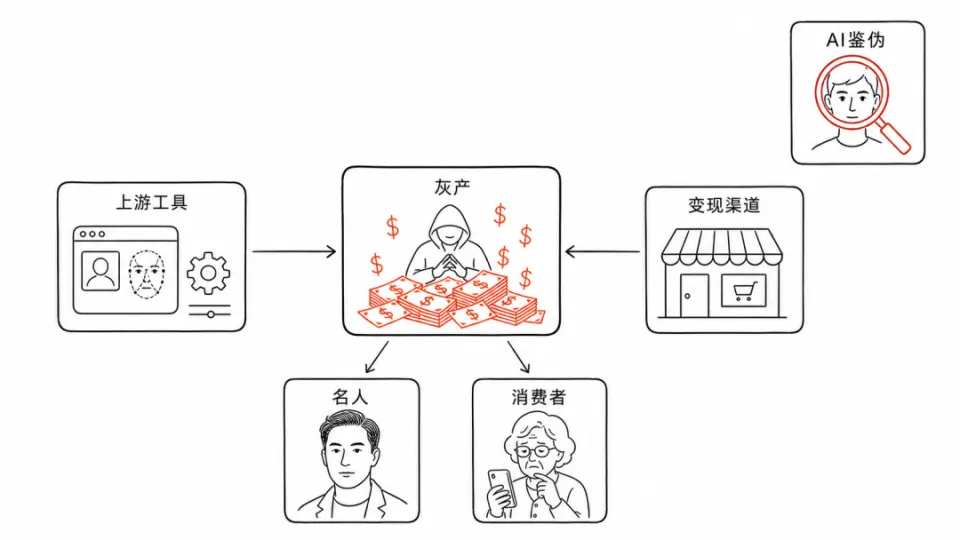
Since the accounts are so easy to calculate, why can no one bring it under control? Because in this industrial chain, every role capable of exercising control suffers a net loss from doing so.
First, look at the upstream sellers of tools. In the domestic digital-human product's phrase '198 yuan a month for unlimited cloning,' the word 'unlimited' is key. It means that once the upstream party collects the 198 yuan, its profit is locked in; whether you clone yourself or Wang Mouheng has nothing to do with its revenue curve. Requiring it to add a purpose review would only increase costs, slow conversion, and deter users—purely self-harm. It is farthest from the victims and closest to cash flow; it is the cleanest and most profitable link in this chain, and also the link with the least reason for self-restraint.
Next, look at the platforms. The platform is the only party with the technical ability to intercept in advance, but it is also the only party that directly loses money because of interception. The traffic and transaction commissions generated by these face-stealing videos go into the platform's pocket. The stricter the detection, the more of its own revenue it loses. So its incentives are the most tangled.
Next, look at the celebrities whose faces are stolen. The cost of defending their rights is far higher than the infringer's cost of violating the law. Obtaining evidence requires doggedly pursuing the other side's cat-and-mouse evasion; hiring a lawyer costs money; and after a lawsuit runs its course, the damages awarded may be only ten or twenty thousand yuan, possibly not even enough to cover the lawyer's fees. The rational choice is not to sue.
Finally, look at the defrauded consumers, especially middle-aged and older people. Research shows that people's accuracy in identifying high-quality AI-forged videos is only about 20 percent—equivalent to picking out only one out of five. If they cannot even tell eight times out of ten that they have been defrauded, there is no way for them to pursue accountability.
Put the four parties side by side: for the platform that should act most, interception equals cutting its own revenue; for the celebrity with the strongest incentive to defend rights, suing equals paying out of pocket; for the largest victim group, the ability to identify is the weakest. All four incentive lines point to 'do not move.' The gray industry in the middle thus lives most comfortably.
And it itself actually has nothing. It has no data, no channels, no license, no brand. Its only valuable asset is the credibility of 'celebrity endorsement,' and that is stolen. Change an account and start over, and everything returns to zero. The essence of this business is one-off arbitrage, relying entirely on two other people's loopholes: the time lag while enforcement cannot keep up, and the cognitive gap that prevents consumers from telling true from false.
This also explains why platform tools are the real switch. The illicit industry relies on two layers of leverage: zero-cost content and platform traffic. But the traffic leverage that amplifies it is lent to it by the platforms, and can be withdrawn at any time. The judicial route requires a dogged game of cat-and-mouse, and even a judgment yields only 8,000 yuan in damages—slow, and not painful. Once the switch in the platform backend is fully turned on, videos produced by the hundreds each month simply cannot be published—an order of magnitude faster than the courts. Whether it is technically possible to block them has never been the question; whether the platforms are willing to flip that switch is.
Who Is Making the Money
Bubbles and Embankments: The Money Is Actually on the Antidote Side
Pull the camera back and look at the ceiling of this business.
It is a parasitic business. The total transaction volume skimmed each year across the country by this kind of face-swapping and voice-stealing sales is roughly estimated at several billion to tens of billions of yuan, but the ceiling of this pie is fixed: it equals the total amount of trust in celebrities that can be misappropriated, and every use depletes it. It creates no new value, and once consumers generally learn to question "same-item links," its conversion rate will collapse.
What is truly growing is its opposite: the business of selling the antidote.
AI-generated content detection is that antidote. Hive's detection service charges US$6 per thousand images, or three-tenths of a cent per image; Reality Defender charges US$399 a month for 1,000 scans. The unit price looks negligible, but demand comes from the massive volume of content uploaded to platforms every day, liveness verification by banks, and evidence-gathering for rights protection by celebrities and MCNs—on a scale of hundreds of millions of scans. TikTok requires third parties to conduct likeness detection, and YouTube has rolled it out across the board; these are mandatory purchases forced by regulation and public opinion. The growth curve of this business follows regulation, not the awakening of victims.
One is a bubble, the other an embankment. When the illicit industry recedes, nothing is left: the faces are stolen, the shops move from place to place, and the customers are one-off traffic obtained by deception. By contrast, every order taken by those doing detection and rights protection adds transferable assets to the books: trained detection models, accumulated case-law databases, and platform partnerships. When the same wave hits, one is swept away and the other remains.
But do not rush in to make the antidote. The moat of this business is also shallow. Attack and defense are asymmetric: the counterfeiters are open-source, free, and spread instantly, while the defenders must train targeted models and are always half a step behind. So detection services earn hard money for running faster than peers, not rent that lets you lie back and win once built. It is more like selling vaccines: the virus keeps mutating, you have to keep updating, and whoever stops iterating is immediately out of the game.
So for this antidote business, who should do it and who should avoid it must be made clear.
Teams that already hold platform-level authenticity data should do detection. The ceiling of a 20% accuracy rate can only be broken through massive samples; if the data is in your hands, it is a threshold others cannot copy. Conversely, technical entrepreneurs with a pure algorithm background and no platform data should stay away: your product, whose accuracy falls short, would be thrown against the platforms' self-built full-scale systems, and you are bound to lose.
Intellectual property lawyers who already have a client pool of celebrities and MCNs should do batch rights protection. Take the low cost-effectiveness of a mere 8,000 yuan in damages per case and turn it into scale through one-time authorization, batch litigation, and public-interest litigation to spread costs. For creators below the mid-tier who have only had their faces stolen sporadically, suing now is not yet worthwhile—the cost of evidence-gathering exceeds the damages awarded. The signal you should wait for is: platforms make detection a default action, and punitive damages become the norm rather than a case-by-case exception. Until then, putting an official verification watermark on your own account is more practical than going to court.
The final cost is the real ceiling of this business.
The calculations above all stop at the civil level. Now let us add the final cost into the equation.
First, look at the window. This business cannot be reined in not because there is no law. The personality rights part of the Civil Code, the Personal Information Protection Law, the Supreme People's Court's judicial interpretation on facial recognition, and the regulations on deep synthesis—all four nets are in place. What they can govern is whether there is law to rely on; what they cannot govern is enforcement. Discretionary damages are too low—infringing on more than 900,000 orders of goods yields only 10,000 to 20,000 in compensation; punitive damages are written into the statutes, but few cases actually obtain such awards; evidence collection is so difficult that it means playing cat-and-mouse; and platforms' proactive review obligations have yet to be made truly enforceable. Illegal gains are hundreds of times the cost of illegality, and in that ratio, eighty to ninety percent is a free gift from this enforcement gap.
But the window is narrowing. Among the batch of cases announced by the Guangzhou Internet Court in March this year, one recognized for the first time that voice, as a personality identifier, can be asserted independently, and also made clear that portrait, voice, and name remain protected even in publicly disseminated scenarios, while also making employers and platforms' responsibilities enforceable. Add to that TikTok and YouTube launching detection, and increasingly strict requirements for deep synthesis labeling—each one is adding bricks to that empty cost item.
What truly needs to be drawn is another line: the line of whether money can solve it.
So far, mainstream face-swap livestream selling and unauthorized clip use for virtual endorsements mostly stop at the civil compensation level—paying some money can resolve it. But as long as the conduct takes one more step forward, its nature changes.
Some people use AI face-swapping to forge liveness verification videos, to force login to others' accounts, and to package and sell the shipping addresses and purchase records inside. This conduct hits the crime of infringing on citizens' personal information. This year the Hangzhou Intermediate People's Court ruled on such a public interest litigation: the two defendants, because the circumstances were minor, they returned the illicit gains, and they pleaded guilty and accepted punishment, received a relative non-prosecution decision on the criminal side, and on the civil side were ordered to pay 5,857 yuan in compensation and to publish an apology in national media. They passed the criminal threshold by treading the line. The case number is (2025) Zhe 01 Min Chu No. 2028.
Others use AI face-swapping plus voice synthesis to forge the image of a highly recognized male actor, specifically to carry out targeted fraud against middle-aged and elderly women. This conduct hits the crime of fraud.
These two are the line that money cannot solve. Civil compensation is a cost that can be entered into the accounts; criminal liability is not a cost—it is the switch that zeroes out the entire business. Once a person is incarcerated, the previously mentioned ninety percent gross margin must be multiplied by the probability of case detection, and then the entire illegal gains that may be confiscated must be subtracted; for most people, this calculation comes out negative.
So the real ceiling of this business is not how much trust it can exploit, but how close its core conduct is to the criminal line. Stopping at the civil level, it is a gray business that makes window-period money off others' loopholes; once it touches account theft and sale of information, or targeted fraud, it is no longer a business—it is a case.
For the infringed party, here is a judgment that can be calculated clearly. If you are a celebrity or streamer of a certain scale, with an MCN behind you to share evidence-collection costs, and you find that the same face has been batch-stolen by three to five accounts and is being used to sell goods with links attached, then it is time to act. Because large-scale infringement happens to satisfy the elements for punitive damages or even personal information crimes, and the recovery from a lawsuit far exceeds the 8,000 yuan baseline. The best signal to open fire is not being stolen from once, but being batch-stolen and already monetized.
If you have legal needs related to rights protection or compliance, you can talk with the author.
Sources
- Southern Metropolis Entertainment / Tencent News, "Exclusive Interview: 'Brother Shui' Wang Mouheng's Likeness Used for Product Endorsement Without Consent — How to Address AI Chaos?", June 13, 2025
- Cover News, "First Case Nationwide! Stolen Livestreamer Clip Used to Create a 'Virtual Endorsement' Selling Hundreds of Thousands of Units of Rice; Court Awards RMB 8,000 in Damages," March 13, 2026 (announced by the Guangzhou Internet Court)
- Cover News, "Unauthorized Use of a Departed Livestreamer's Image and Voice for 'AI Livestreaming'; Court Awards RMB 25,000 in Damages," March 13, 2026
- The Verge, "TikTok is testing an AI likeness detection tool," July 17, 2026
- Hangzhou Intermediate People's Court, (2025) Zhe 01 Min Chu No. 2028, Civil Public Interest Litigation Judgment
- Public pricing pages on the official websites of HeyGen, Hive, Reality Defender and Sightengine
Author:Lü Yinghui , attorney at Mankun (Shenzhen) Law Firm. A graduate of China University of Political Science and Law, with nearly a decade of experience in the legal industry, including prior work at a Shenzhen court. Focuses on legal services for the new-generation economy, with extensive practical experience and deep insight in Web3, artificial intelligence and related fields. Follow the author on all platforms at "Lao Lü Talks New Money."

