
There is an AI company in Sydney, Australia, doing something quite unusual: it creates a large number of "fake victims" specifically to answer scam calls and chat with scammers. The scammer thinks they have hooked an elderly person who is not very computer-savvy, but in fact the other end of the line is a bot. The bot is not after money; it just wants to keep the scammer occupied and, along the way, extract the other party's receiving account.
If you work on AI agents, risk management, or security products, seeing this news probably brings two thoughts to mind. The first is whether something similar could be done in China. The second is a bit wilder: since AI can deceive scammers, why not go ahead and trick the scammers out of their money too—wouldn't that be enforcing justice on behalf of heaven?
The former has a legally viable path. The latter has already been adjudicated by domestic courts several times this year.
First, how this company does it. According to an October 19 report by Forbes Australia, it began with a phone call. The founder is a professor researching cybersecurity at a university in Sydney. One year, while the whole family was picnicking in a park, he received a scam call. To amuse his children, he pretended not to understand, deliberately gave wrong information, and even pretended to order pizza with the scammer—the conversation lasted 44 minutes. His wife said, you can never get those 44 minutes back. His answer was: that is all the more reason to let machines do it.
In 2024, this idea became a company. The bots play ordinary people of different ages, genders, and accents; when they answer the phone they say "uh-huh, uh-huh," say they do not really understand computers, and say "hold on, let me go make a cup of tea first." There are two channels through which scammers reach them. One is cooperating with telecom operators to route identified suspected scam calls directly to the bots; the other is deliberately scattering a batch of dedicated numbers online and waiting for scammers' automatic dialing systems to come looking on their own.
According to the company's own account, there are already more than 200,000 bots, which have cumulatively chatted with scammers about 2.5 million times, with the longest single call dragging on for 2 hours and 12 minutes, and only about 2% of scammers seeing through the fact that the other side is a bot. These figures have not been verified by any third party; just look at the order of magnitude.
Delaying time and extracting intelligence is not illegal
First, answering the first question.
For the crime of fraud to be established, the core is obtaining another person's property for oneself. What the bot does is occupy the scammer's time, listen to the scammer finish speaking, and note down the accounts and websites the scammer provides, without taking a single cent itself. Without a transfer of property, there is no question of fraud, nor of theft. By analogy, it is like a phone that is forever engaged: the scammer calls in, cannot get through to a real person's home, and wastes an entire afternoon for nothing.
Domestic law has an explicit stance on this type of technology. Article 32, paragraph 1 of the Anti-Telecom and Online Fraud Law specifically addresses "countermeasure technology":
Article 32 The State supports telecom business operators, banking financial institutions, non-bank payment institutions, and internet service providers in researching and developing countermeasure technology related to telecom and online fraud, for use in monitoring and identifying, dynamically blocking, and handling abnormal information and activities related to fraud.
Note the four types of entities named in this sentence: operators, banks, payment institutions, and internet platforms. The law says "support," and what it supports is their research and development. This point will come up again later when discussing market entry.
There is only one point to be careful about when it comes to stalling for time. To convince the scammer that they have "taken the bait," some people go along with the scammer's demands and actually hand over their bank cards and mobile phone SIM cards, hoping to catch a bigger fish. This step must not be taken. Article 31, paragraph 1 of the same law states clearly:
Article 31 No unit or individual may illegally buy, sell, rent or lend telephone cards, IoT cards, telecommunications lines, SMS ports, bank accounts, payment accounts, internet accounts, etc., and may not provide assistance in real-name verification; may not open the aforementioned cards, accounts, accounts, etc. by impersonating another person's identity or fabricating an agency relationship.
When playing along with a scammer, the names and information you report can be fabricated, but the cards and accounts must not be real. Once real cards and real accounts fall into the scammer's hands and are used to receive illicit funds, you change from someone fighting fraud into someone helping the scammer collect money.
Once the money is in hand, it constitutes fraud
Someone actually tried the second idea.
In July 2025, a man in Jiangxi took a job to "collect cash by hand" for an upstream fraud gang, that is, to go to a designated location, take away cash that a victim had left there according to the scammer's instructions, and then hand it over to the upstream party. On July 24, the upstream party sent an order of more than 200,000 yuan. He had the idea of pocketing it himself, so he found three helpers and staged a scene: he took the cardboard box and walked back, the helpers pretended to be plainclothes police officers chasing him from behind, and as he ran he threw away the cardboard box, which the helpers picked up and drove off with. Afterward, he told the upstream party that the police had chased him and the money was lost.
The upstream party sent another order, 60,000 yuan in cash, placed under a "No Dumping of Garbage" sign. He collected it and likewise did not hand it over. When the upstream party urged him to go back and look for the lost money, he found a video online of someone being chased and sent it to them to report back. The two orders totaled 324,000 yuan; he paid the helpers 5,000 yuan and kept 319,000 yuan for himself.
In March 2026, the Shicheng County People's Court of Jiangxi Province issued a first-instance judgment: he was convicted of fraud and sentenced to six years in prison. He had surrendered voluntarily, but was a recidivist. The two helpers tried together with him were also convicted of fraud and sentenced to two years and six months and two years and seven months respectively. The case number is (2026) Gan 0735 Xing Chu No. 15.
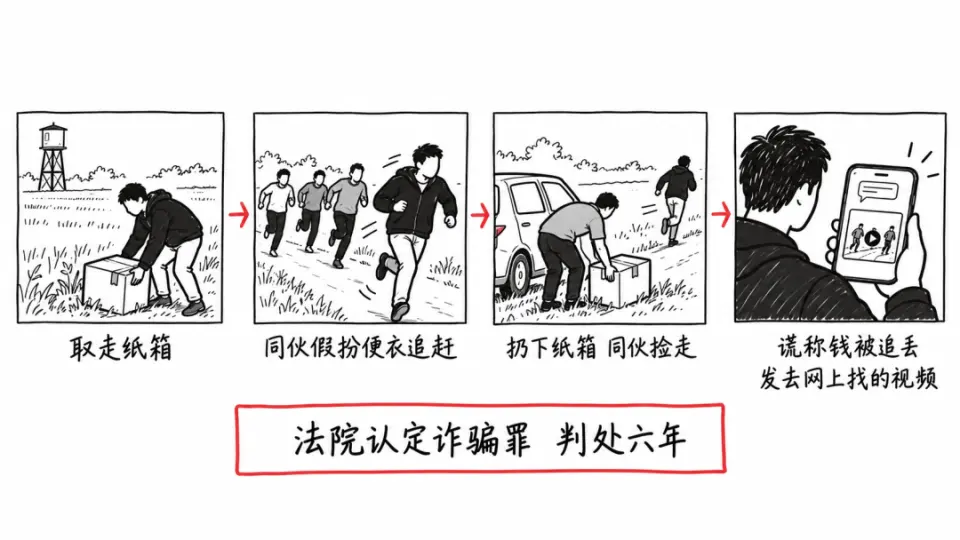
I went through this judgment, and it sets out the legal logic of "black eating black" (scammers defrauding scammers) quite completely, and it can be broken down into three layers.
The first layer: the money in the scammer's hands is not the scammer's at all. That 264,000 yuan was placed by a victim in a roadside farmland with their own hands according to the scammer's instructions. Article 64 of the Criminal Law is very clear about who owns this kind of money:
Article 64 All property illegally obtained by criminals shall be recovered or ordered to be returned or compensated; lawful property of victims shall be returned promptly; contraband and personal property used in the crime shall be confiscated. Confiscated property and fines shall all be turned over to the state treasury and may not be misappropriated or disposed of on one's own.
At the end of this case, the full 319,000 yuan was recovered and returned to the two victims respectively. In other words, illicit funds are like a stolen bicycle: the thief rides it, but the bicycle still belongs to the owner; if you then trick the thief out of the bicycle, the owner is still the same owner, and you are merely the second person to take it. Of course, money circulates mixed together and cannot be identified like a bicycle, but the legal logic of who the owner is does not change.
The second layer: illicit proceeds can likewise be the object of fraud. Article 8 of the new judicial interpretation issued by the Supreme People's Court and the Supreme People's Procuratorate, effective from August 26, 2025, specifically addresses this matter:
Article 8 Where acts such as theft, robbery, fraud or forcible seizure are committed against criminal proceeds and the gains therefrom, and such acts constitute a crime, the perpetrator shall be convicted and punished for the crimes of theft, robbery, fraud or forcible seizure respectively.
This means that targeting illicit proceeds is treated as theft if stolen and as fraud if obtained by deception; the fact that the money was already tainted does not result in a lower tier of treatment. How the crime of fraud is sentenced depends on the amount:
Article 266 Whoever defrauds public or private property, if the amount is relatively large, shall be sentenced to fixed-term imprisonment of not more than three years, criminal detention or public surveillance, and shall also, or shall only, be fined; if the amount is huge or there are other serious circumstances, shall be sentenced to fixed-term imprisonment of not less than three years but not more than ten years, and shall also be fined; if the amount is especially huge or there are other especially serious circumstances, shall be sentenced to fixed-term imprisonment of not less than ten years or life imprisonment, and shall also be fined or have property confiscated. Where this Law provides otherwise, such provisions shall prevail.
The third layer: even where a fraudster is defrauded, it still counts. The defenders of the two accomplices argued that their conduct at most constituted the crime of concealing or disguising criminal proceeds, an offense that is usually punished more leniently. Their reasoning was that the upstream party did not know them at all, and that the upstream party's belief rested on a video downloaded from the internet and had nothing to do with their pursuit performance. The court did not adopt this argument, and its reasoning was straightforward: the several individuals intended to misappropriate the money before it was handed to the upstream party, and staged a performance to make the upstream party believe it was genuine; this constituted fraud; whether the video was filmed by themselves "does not affect the upstream party's falling into a mistaken understanding."
Some also sought mitigating grounds from the "black-on-black" conduct itself. In a case in Hunan, the defendant provided a bank card to receive 89,000 yuan in "black money" and, after the funds arrived, misappropriated them, deleted the software and cut off contact. At second instance, the defender argued that the appellant's conduct was "black-on-black," that the subjective malice was relatively minor, and that leniency should be granted as appropriate. The Intermediate People's Court of Yongzhou City, Hunan Province, did not adopt this argument and upheld the first-instance sentence of three years for fraud, case number (2026) Xiang 11 Criminal Final 302.
Black-on-black is still eating.
To want black-on-black, one must first board the pirate ship
These cases share another common point that is easily overlooked: to engage in black-on-black, one must first take on the fraudster's orders.
One must first establish contact with the upstream party and first withdraw, collect or transfer money on the fraudster's behalf before there is any opportunity to intercept it. This first half is itself working for the fraudster. Article 38, paragraph 1 of the Anti-Telecom and Online Fraud Law:
Article 38 Whoever organizes, plans, implements or participates in telecom and online fraud activities, or provides assistance to telecom and online fraud activities, and such conduct constitutes a crime, shall be investigated for criminal responsibility in accordance with law.
In a case in Zhanjiang, Guangdong, the court convicted on precisely this basis. Three individuals conspired to collect money on the upstream party's behalf and misappropriate it once received; one of them impersonated a collection officer and collected 200,000 yuan in cash from the victim in person, then cut off contact upon receipt. The upstream party immediately threatened and intimidated them; that night the other two flew from Chengdu to Zhanjiang to discuss how to handle the money, and the three were then arrested on the spot by the police. The court held that, knowing others were committing fraud, they still assisted in collecting money, constituting the crime of fraud; each of the three was sentenced to two years and six months, case number (2026) Yue 0804 Criminal First Instance 9.
Once the money is in hand, both sides will come looking to settle scores with you. The upstream party will seek revenge, and the police will pursue recovery of the illicit proceeds.
Only one situation is different: you were defrauded yourself, and you find a way to get the scammer to return the money. If you only recover the portion you were defrauded of, with no intent to take others' property as your own, my judgment is that this generally does not constitute fraud. But take one cent more, and the nature changes. In practice, the safest course is still to report to the police and let them pursue recovery of the illicit proceeds through official channels. Article 34 of the same law makes "timely return of the lawful property of victims" a duty led by public security authorities:
Article 34 Public security authorities shall, together with the financial, telecommunications, and cyberspace administration departments, organize banking financial institutions, non-bank payment institutions, telecommunications business operators, internet service providers, and others to establish early-warning and dissuasion systems, and, for potential victims identified through early warnings, take corresponding dissuasion measures promptly as the circumstances require. In telecommunications and online fraud cases, efforts to recover illicit proceeds and compensate losses shall be strengthened, the system for handling funds involved in cases shall be improved, and the lawful property of victims shall be returned promptly. For victims suffering major hardship in daily life who meet the relevant state assistance conditions, the relevant parties shall provide assistance in accordance with regulations.
Domestic teams wanting to enter the market must pass three hurdles
Back to the first thought: if a domestic team wants to build a similar product, what legal hurdles must it clear? I will address them in order.
The first hurdle is the phone number hurdle. In the Australian company's model, half of its approach relies on scattering numbers online itself. This tactic is hard to copy domestically. Article 9 of the Anti-Telecom and Online Fraud Law requires comprehensive real-name registration for telephone users, and Article 31, cited earlier, prohibits renting or lending. A startup team wanting to accumulate tens of thousands of SIM cards as bait would face compliance risk with every single card.
Article 9 Telecommunications business operators shall, in accordance with law, comprehensively implement the real identity information registration system for telephone users.
Basic telecommunications enterprises and mobile communication resale enterprises shall bear responsibility for ensuring that agents implement real-name management for telephone users, and shall specify in agreements the agents' responsibility for real-name registration and the relevant measures for handling breaches of contract.
A more realistic path is to have both the numbers and the incoming calls come from the carrier: the carrier transfers identified suspected fraudulent calls to your system, while the number resources and real-name responsibility remain with the carrier. This also aligns precisely with the four categories of entities named in Article 32; your position is that of a technology supplier to them.
The second hurdle is the information hurdle. Much of what the bots extract—payment accounts, mobile phone numbers, wallet addresses, phishing URLs—can be linked to a specific person, such as a "card farmer" (kānóng) recruited by scammers. Legally, this constitutes personal information. The Personal Information Protection Law requires a lawful basis for processing personal information:
Article 13 A personal information processor may process personal information only under one of the following circumstances:
(1) where the individual's consent has been obtained;
(2) it is necessary for the conclusion or performance of a contract to which the individual is a party, or it is necessary for the implementation of human resources management in accordance with labor rules and regulations formulated in accordance with the law and collective contracts concluded in accordance with the law;
(3) it is necessary for the performance of statutory duties or statutory obligations;
(4) it is necessary to respond to public health emergencies, or, in emergency situations, to protect the life, health and property safety of natural persons;
(5) personal information is processed within a reasonable scope for the public interest through news reporting, public opinion supervision and other such activities;
(6) personal information that an individual has made public by himself or herself or that has otherwise been lawfully made public is processed within a reasonable scope in accordance with the provisions of this Law;
(7) other circumstances provided for by laws and administrative regulations.
Scammers, of course, will not agree. Telecommunications operators differ from banks: the Anti-Telecom and Online Fraud Law imposes on them statutory obligations to prevent fraud, and when they process such information, they can rely on the ground that processing is "necessary for the performance of statutory obligations"; a startup operating on its own would find it difficult to identify a corresponding basis. Therefore, the most robust structure is to act as an entrusted party of a telecommunications operator or bank, sign an entrusted processing agreement in accordance with Article 21, Paragraph 1 of the Personal Information Protection Law, and clearly set out the purpose, term and method:
Article 21 Where a personal information processor entrusts the processing of personal information, it shall agree with the entrusted party on the purpose, term and method of the entrusted processing, the types of personal information, protection measures, and the rights and obligations of both parties, and shall supervise the entrusted party's personal information processing activities.
To whom the intelligence is sold is also a red line. Selling the account information obtained through such means as a "data product" to unrelated third parties will most likely run into the crime of infringing on citizens' personal information:
Article 253-1 Whoever, in violation of the relevant provisions of the State, sells or provides citizens' personal information to others, if the circumstances are serious, shall be sentenced to fixed-term imprisonment of not more than three years or criminal detention, and shall also or only be fined; if the circumstances are especially serious, shall be sentenced to fixed-term imprisonment of not less than three years but not more than seven years, and shall also be fined.
Information such as bank account information is generally treated in practice as property information, and the "serious circumstances" threshold set for property information by the judicial interpretation of the Supreme People's Court and the Supreme People's Procuratorate is 50 items. For a system that runs tens of thousands of conversations every day, 50 items amounts to only a few minutes' worth.
The third barrier is the money barrier, which is also the main thread of this article. At the product level, this must be hard-coded: the robot does not accept any transfers, does not hold or transfer any funds on behalf of scammers, and, when clues about funds appear in a conversation, only records and reports them. The judgments above have already shown that once this line is crossed, the nature changes from anti-fraud to fraud.
Different actors should take different approaches. Startups should not rush to build their own number pools, nor should they contemplate selling intelligence externally; instead, they should first find a telecom operator or bank to carry out a commissioned project, and clarify the commissioning agreement and data usage purposes. For telecom operators and banks, Article 32 already supports your countermeasures technology; when engaging external suppliers, write into the contract that they 'must not take money,' 'must not subcontract,' and that 'data must not be used beyond the agreed purposes,' so that responsibility can be clearly allocated if something goes wrong.

Back to the question at the beginning
Is it illegal to use AI to scam the scammers?
It depends on what is being scammed. Scamming the scammer's time, making him talk to a robot for two hours, and then handing his receiving account over to the bank and police, is legally defensible, and domestic law expressly supports such technology. Scamming the scammer's money, no matter how justified the reason sounds, is fraud the moment the money is obtained; the illicit proceeds must ultimately be returned to the true victim, and one bears a criminal charge oneself.
Delaying time is acceptable; taking money is not. A gentleman loves wealth but obtains it in a proper way.
If you are working on products related to anti-fraud, risk management, or AI agents, and are unsure whether a certain feature might cross the line, you can talk with the author.
Reference Sources
- Forbes Australia, October 19, 2026, report on an Australian AI anti-fraud company
- TechCrunch, October 14, 2026, report on an Australian AI anti-fraud company
- Criminal Judgment of Shicheng County People's Court, Jiangxi Province (2026) Gan 0735 Xing Chu No. 15
- Criminal Judgment of Potou District People's Court, Zhanjiang City, Guangdong Province (2026) Yue 0804 Xing Chu No. 9
- Criminal Ruling of Yongzhou Intermediate People's Court, Hunan Province (2026) Xiang 11 Xing Zhong No. 302
- Articles 64, 253-1 and 266 of the Criminal Law of the People's Republic of China
- Interpretation of the Supreme People's Court and the Supreme People's Procuratorate on Several Issues Concerning the Application of Law in the Handling of Criminal Cases of Concealing or Disguising Criminal Proceeds and Proceeds Derived from Criminal Proceeds (Fa Shi [2025] No. 13)
- Anti-Telecom and Online Fraud Law of the People's Republic of China
- Personal Information Protection Law of the People's Republic of China
- Interpretation of the Supreme People's Court and the Supreme People's Procuratorate on Several Issues Concerning the Application of Law in the Handling of Criminal Cases of Infringing on Citizens' Personal Information (Fa Shi [2017] No. 10)
Author of this article:Lü Yinghui, a lawyer at Mankun (Shenzhen) Law Firm. A graduate of China University of Political Science and Law, with nearly ten years of experience in the legal industry, having previously worked at a court in Shenzhen. Focused on legal services in the new-generation economy, with extensive practical experience and deep insights in fields such as Web3 and artificial intelligence. Account across all platforms: Lao Lü Talks New Money; you are welcome to follow.

