
On July 15, two events collided on the same day: Doubao and Qwen officially discontinued their user-built agent features, and the PRC's first dedicated legislation on anthropomorphic interactive services took effect the same day. The big platforms' public explanation was "product feature adjustments," but placing the two events on a single calendar points to a different answer. This article breaks down three questions: which business the new rules actually constrain, why open-ended agents were the first model to be abandoned, and which compliance cards entrepreneurs who still want to build AI companionship must hold.
On the evening of July 3, Doubao issued a "Notice on the Discontinuation of Doubao Agent Features." The notice stated that due to product feature adjustments, the agent features would be discontinued on July 15, 2026. After the discontinuation, users cannot create new agents, and previously saved agents cannot be invoked or run; by October 15, the relevant data will be handled in accordance with the Privacy Policy and cannot be viewed or recovered. The official recommendation was that users take screenshots or export backups in advance.
At almost the same time, Tongyi Qianwen also pushed a similar reminder: anthropomorphic interactive agents and user-built agent features would be discontinued first on July 10, and on July 15, Qwen's agent features and services would be fully discontinued.
Two companies, one under ByteDance and one under Alibaba. The discontinuation dates each chose both fell on July 15.
And July 15 was not a date they chose. On April 10, 2026, five departments—the Cyberspace Administration of China, the National Development and Reform Commission, the Ministry of Industry and Information Technology, the Ministry of Public Security, and the State Administration for Market Regulation—jointly published the Interim Measures for the Administration of Anthropomorphic Interactive Services of Artificial Intelligence (hereinafter the "Measures"), whose effective date is precisely July 15. This is the PRC's first legislation specifically governing AI anthropomorphic interaction, and the Cyberspace Administration itself characterized it as "small, fast, and flexible" legislation.
On one side, "product feature adjustments"; on the other, the new rules taking effect. The same date is hard to treat as a coincidence.
The reference point had already been laid out half a month earlier. On June 26, the Cyberspace Administration of the Shanghai Municipal Committee reported the first-phase results of the "Qinglang · Rectifying Chaos in AI Applications" special action: a cumulative total of more than 14,000 non-compliant agents were taken down, more than 18,000 non-compliant accounts were handled, and more than 4.87 million pieces of illegal and non-compliant information were cleaned up and intercepted. The same report contained a key sentence—the Cyberspace Administration had conducted outreach on the Measures to nearly one hundred key platforms, requiring enterprises to strictly implement minor identity verification and to prevent emotional dependence and consumption inducement.
Translated, this means: before the law even took effect, enforcement had already been warming up for two months. The big platforms did not wait for the statutory provisions to land before acting; they cleared inventory in advance.
This Measure governs only one kind of AI, but the big platforms shut down all of them
To understand this discontinuation, one must first see clearly what the Measures actually govern. It is not a law governing all AI; its scope is drawn very narrowly.
Article 2, paragraph 1 of the Measures: These Measures apply to the use of artificial intelligence technology to provide the public within the territory of the People's Republic of China with continuous emotional interaction services that simulate the personality traits, thought patterns, and communication styles of natural persons.
Paragraph 2 makes "emotional interaction" more specific: including interactive services such as emotional care, companionship, and support provided through text, images, audio, video, and other forms.
The third paragraph, however, draws a line outside its scope: services such as intelligent customer service, knowledge Q&A, work assistants, learning and education, and scientific research that do not involve sustained emotional interaction are not subject to these Measures.
In other words, what the law targets is sustained emotional companionship of the kind found in "virtual lovers," "AI companions," and "role-play," whereas a work assistant that helps you write weekly reports or look up information was never within its scope.
That is where the problem lies. What Doubao and Qwen took offline this time was not "emotional-companionship agents" but the entire "user-built agents" feature, including the productivity-type agents used to write copy, do translation, or serve as study buddies. The law drew only a small circle, yet the major platforms cleared the entire field.
This is a classic case of over-compliance. The logic is simple: in an open agent marketplace, a user can conjure up any persona with a single System Prompt, and you cannot guarantee that not one person in ten thousand will shape it into a form expressly prohibited by Article 8.
Article 8 lists seven categories of prohibited content, three of which strike directly at the lifeline of companionship-type agents. Item 1 of Article 8 prohibits the generation or dissemination of obscene, pornographic, gambling, or violent content, or content that incites crime; Item 5 prohibits excessively catering to users, inducing emotional dependence or addiction, and harming users' real interpersonal relationships; Item 6 prohibits inducing users to make unreasonable decisions through emotional manipulation or other means, thereby harming users' lawful rights and interests.
"Inducing emotional dependence" and "emotional manipulation" are almost precisely the core source of user stickiness for companionship-type products. The law has written stickiness into a red line. For an open UGC platform, the roles users can generate are infinite, and the platform must bear ultimate responsibility for every one of them. Rather than reviewing them one by one, it is easier to shut down the creation entry point.
Why open agents are the first to be abandoned
The 14,000 agents taken down in Shanghai provide a sample of regulatory action. The notice named names: MiniMax's platform focused on cleaning up "one-click undress" and sports-betting and gambling-related non-compliant agents, and Xingye had previously conducted a comprehensive review of agents. These are all typical cases of user-built agents beyond platform control.
When the logic of regulation is applied to business, it becomes a matter of cost.
For an official assistant, the platform reviews it once and that is enough; the persona, boundaries, and scripts are all set by the platform itself. An open agent marketplace is different. Users can conjure up "yandere girlfriends," "unrestricted personas," and "borderline roles," and the platform must bear ultimate responsibility for each of them under Articles 8 and 14, and these roles are precisely the high-risk areas named by the law. The objects of review go from one to an uncertain and countless number.
What is more troublesome is the method of review. UGC agents cannot be reviewed only at the moment of creation based on the persona; the real risk lies hidden in dynamically generated conversations—the same persona may slide into non-compliance after ten rounds of chat. This means the platform can only deploy real-time model review plus manual re-review, and review costs rise linearly with conversation volume and cannot be brought down.
The revenue side is another matter entirely. The vast majority of user-built agents do not generate direct payment; they are more a feature for retaining users than a feature for making money. On one side are compliance and review costs that rise with scale, and on the other is direct revenue approaching zero; the math itself does not add up.
Article 22 of the Measures pushes costs up another notch. It provides that where a service has more than one million registered users or more than 100,000 monthly active users, launches or adds relevant functions, or undergoes major changes caused by the use of new technologies, among other circumstances, a security assessment must be carried out and an assessment report submitted to the provincial cyberspace administration department. Doubao and Qwen long ago crossed this threshold in scale. For every additional day they keep their open agent functions, they must spend another day conducting a separate assessment for those functions and bearing the associated primary responsibility.
Add to this the algorithm filing requirement under Article 26 and the content management personnel commensurate with scale required by Article 9, and the conclusion at the bottom of the ledger is clear:Shutting down the entry point is far cheaper than keeping it running.
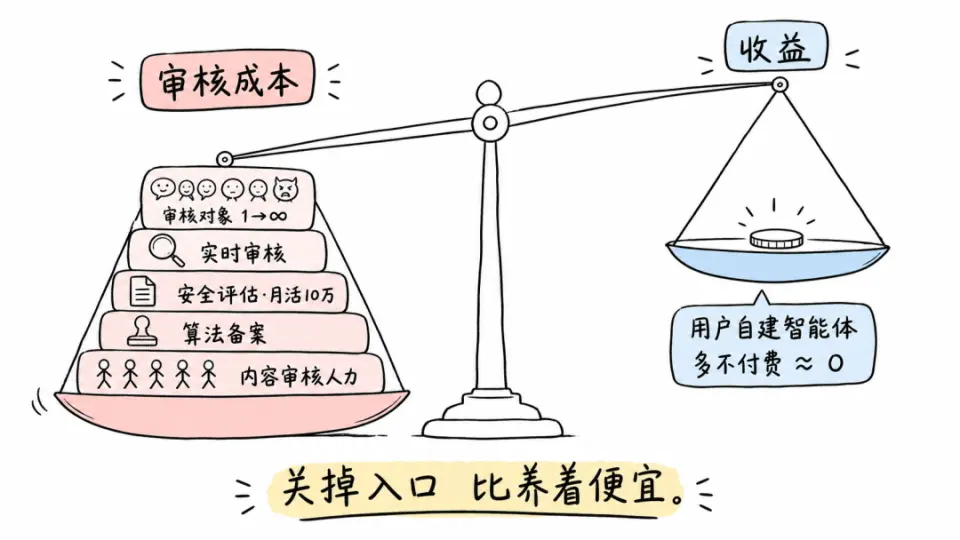
The cost-benefit ledger of open agents
This is not because Doubao and Qwen fear any particular penalty provision. The maximum fine under Article 30 of the Measures is only RMB 100,000 to 200,000 even in serious circumstances, which is little more than a pinprick for a major company. What actually prompted them to act is the two-edged sword of being "ordered to cease providing the relevant services" and being "removed from app stores," together with a long-term review bill that simply does not add up.
Can Maoxiang hold up?
Doubao pointed users to a fallback: Maoxiang, an app under ByteDance, can continue to be used to create agents and start conversations, and "the new agent experience can subsequently be launched in the Maoxiang app."
Spinning off companion-type UGC from the all-purpose Doubao app and housing it in a dedicated app is a move to isolate risk. But whether this move can succeed depends on whether Maoxiang itself can hold up.
The answer is not so optimistic. On April 28, 2026, "Cyber China" reported that Jianying, the Maoxiang app and the Jimeng AI website had been summoned for talks, ordered to rectify, and given warnings for, among other issues, failing to effectively implement the requirements for labeling AI-generated and AI-synthesized content. Maoxiang is not a clean compliance enclave; it has already crossed a line once itself.
More critically, there is its positioning. Doubao is an all-purpose assistant, and emotional companionship is only a small part of it; Maoxiang is an app dedicated to virtual characters and plot-based dialogue, and its core business is itself the "continuous emotional interaction service" defined in Article 2 of the Measures. Doubao can avoid risk by shutting down one function, but Maoxiang has nowhere to hide—its entire product stands at the dead center of the target.
This means ByteDance has put the risk into a separate box, but the box still has to be kept open lawfully. Maoxiang must independently bear the entire set of requirements: the content red lines under Article 8, the minor mode under Article 14, the AI identity labeling and usage-duration reminders under Article 18, and the security assessment under Article 22. Its earlier summons for talks precisely shows that this set of requirements is not automatically in place.
The risk has been transferred from an all-purpose platform to a dedicated app; it has not vanished into thin air.
If you still want to play, you need to hold these cards
If you are currently building, or plan to build, AI agents or AI companion products, after July 15 the following obligations are unavoidable—they are not optional.
The first is to determine whether you are subject to the rules. Return to Article 2: is your product engaged in “continuous emotional interaction”? If it is companionship, role-play, or a virtual romantic partner, the full set applies; if it is a pure tool, pure customer service, or pure knowledge Q&A, it may not apply—but do not edge your feature design toward emotional companionship, because once you cross that line, the full set of obligations applies.
The second is algorithm filing. Article 26 requires completing algorithm filing procedures under the Provisions on the Administration of Algorithm Recommendations for Internet Information Services, with the cyberspace administration conducting annual verification. This is the entry ticket.
The third is to watch the trigger line for security assessment. Among the circumstances in Article 22, the one startups are most likely to hit is “more than 1 million registered users or more than 100,000 monthly active users.” In the companion sector, 100,000 monthly active users is not a high threshold; you may cross the line without realizing it, and then you must submit a security assessment report to the provincial cyberspace administration.
The fourth is minors. Article 14 is very firm: virtual kinship, virtual partners, and other virtual intimate relationship services must not be provided to minors; providing other services to minors under the age of fourteen requires guardian consent; and a minor mode must be established that can identify minor status and switch modes. For those making virtual romance products, this article essentially closes off the possibility of treating minors as users.
The fifth is identity labeling and addiction intervention. Article 18 requires fulfilling the obligation to label AI-generated content, clearly prompting users that they are interacting with AI rather than a real person; and when a user uses the service continuously for more than 2 hours each time, they must be reminded of the duration. Anyone making companion products understands that making users forget the other side is AI and making users unable to stop is precisely part of the product experience—yet the law requires you to do the opposite.
The sixth is data. Article 16 provides that, unless otherwise provided by law or the rights holder has explicitly consented, user interaction data must not be provided to third parties; and unless provided by law or the user has separately consented, interaction data that constitutes the user’s sensitive personal information must not be used for model training. Those private conversations users have with an AI lover—if you want to use them to train models, you must first pass the “separate consent” threshold.
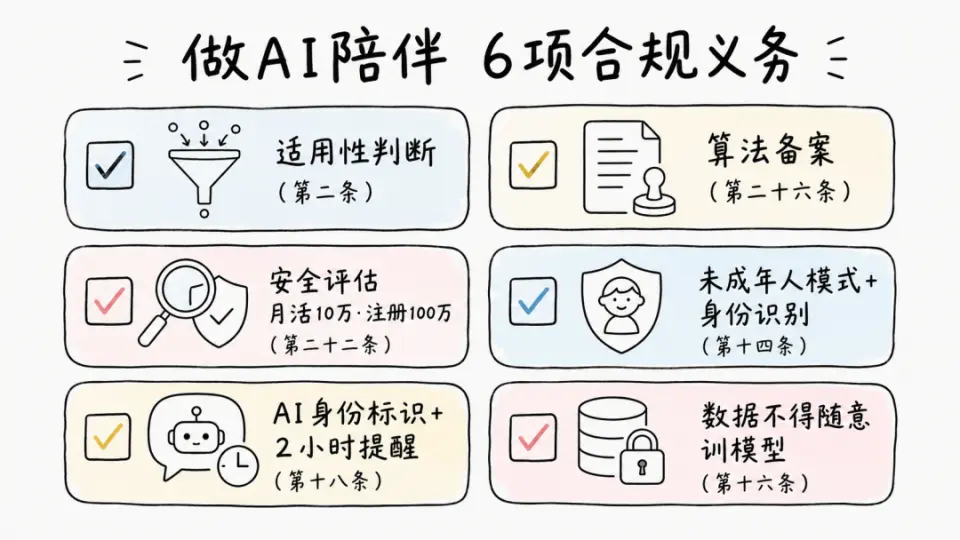
Six compliance obligations for AI companionship
Looking at these matters together, it is actually already clear who should do what and who should stay away.
What is worth doing is for teams with a clear vertical scenario: elderly companionship, childcare, and psychological counseling backed by professional qualifications. Article 6 of the Measures explicitly encourages these directions; when regulation raises the threshold, those who achieve compliance first will eat the market of those who comply later. The premise is that you are willing to build review mechanisms, minor mode, and identity labeling as part of the product from day one, rather than as patches added after launch.
What should be watched is for teams building broad role-play or broad virtual romance UGC platforms. Where exactly the red line is drawn will be answered more clearly by the first batch of enforcement cases than by the statutory text. Until then, do not rush to pour money into a review system that may need to be torn down and rebuilt next year—wait for the signal.
What you must not touch is the cohort that generates traffic and paid conversions through "borderline content," "unrestricted personas," and "virtual lovers." This is precisely the bullseye of Article 8, Items 5 and 6, and of the 14,000 takedown cases in Shanghai. After July 15, this path will not merely become harder to pursue; it will become non-compliant.
Finally, a candid legal point. In this business, the most easily overlooked and most fatal pitfall is not the fine itself, but two actions. First, app store listing review: Article 25 expressly requires distribution platforms to verify security assessments and filing status, and to refuse listing or take down non-compliant products; your product may lose even the entry point for reaching users. Second, using user conversation data to train models: many teams assume by default that the data belongs to them, but the phrase "separate consent" in Article 16 engages the sensitive information processing rules under the Personal Information Protection Law, and once investigated, the nature of the issue is more serious than content non-compliance. I have recently reviewed these two types of compliance architecture and data clauses for several AI teams, and the depth of the pitfalls varies greatly. If you are genuinely going to enter this market, clarify these two points before signing contracts, drafting privacy policies, and filing for registration. If anything is uncertain, you are welcome to contact me to discuss it.
Appendix: Provisions of the Interim Measures for the Administration of AI Anthropomorphic Interactive Services Cited in This Article
Article 2 These Measures apply to the use of artificial intelligence technology to provide the public within the territory of the People's Republic of China with continuous emotional interaction services that simulate the personality traits, thought patterns, and communication styles of natural persons (hereinafter referred to as anthropomorphic interactive services).
The emotional interaction services referred to in the preceding paragraph include interactive services such as emotional care, companionship, and support provided in the form of text, images, audio, video, and other forms.
These Measures do not apply to the provision of services such as intelligent customer service, knowledge Q&A, work assistants, learning and education, and scientific research that do not involve continuous emotional interaction.
Article 8 Providers of anthropomorphic interactive services shall comply with laws and administrative regulations, respect social morality and ethical standards, and shall not engage in the following activities:
(1) Generating content that endangers national security, honor, and interests; incites subversion of state power or overthrow of the socialist system; incites secession or undermines national unity; promotes terrorism, extremism, or historical nihilism; violates core socialist values; carries out illegal religious activities; promotes ethnic hatred or ethnic discrimination; incites group antagonism; disseminates obscenity, pornography, gambling, violence, or instigates crime; spreads rumors; insults or defames others or infringes upon the lawful rights and interests of others; or other such content;
(2) Generating content that encourages, glorifies, or hints at self-harm or suicide or otherwise harms users' physical health, or content such as verbal violence that harms users' human dignity and mental health;
(3) Generating content that induces or extracts state secrets, work secrets, trade secrets, personal privacy, and personal information;
(4) generating content for minor users that may induce minors to imitate unsafe behavior, produce extreme emotions, induce unhealthy habits in minors, or otherwise affect the physical and mental health of minors;
(5) excessively catering to users, inducing emotional dependence or addiction, or harming users' real interpersonal relationships;
(6) inducing users to make unreasonable decisions through emotional manipulation or other means, harming users' lawful rights and interests;
(7) other activities that violate laws, administrative regulations, and relevant state provisions.
Article 14 Providers of anthropomorphic interactive services shall not provide minors with services involving virtual kinship, virtual partners, or other virtual intimate relationships; where other anthropomorphic interactive services are provided to minors under the age of fourteen, the consent of the minors' parents or other guardians shall be obtained.
Providers of anthropomorphic interactive services shall establish a minor mode and provide personalized safety setting options such as switching to minor mode, periodic reality reminders, and usage duration limits; to meet the protection needs of minors of different age groups, they shall support guardians in receiving safety risk reminders, understanding an overview of minors' use of the services, blocking specific roles, and restricting top-ups and spending, among other measures.
Providers of anthropomorphic interactive services shall, on the premise of protecting users' right to privacy and personal information, take effective measures to identify minor users; where a user is identified as a minor, the provider shall switch the relevant services to minor mode or take other measures in accordance with relevant state provisions, and shall provide corresponding appeal channels.
Article 16 Providers of anthropomorphic interactive services shall implement systems such as data property rights in accordance with the law, and take measures such as data encryption and access control to protect the security of user interaction data.
Unless otherwise provided by law or expressly consented to by the rights holder, providers of anthropomorphic interactive services shall not provide user interaction data to third parties.
Providers of anthropomorphic interactive services shall provide users with options to copy, delete, and otherwise handle interaction data; users may choose to copy, delete, and otherwise handle historical interaction data such as chat records.
Unless otherwise provided by laws or administrative regulations or unless the user's separate consent is obtained, providers of anthropomorphic interactive services shall not use interaction data that constitutes sensitive personal information of users for model training.
Article 18 Providers of anthropomorphic interactive services shall perform the obligation to label AI-generated synthetic content and take effective measures to remind users that they are interacting with an artificial intelligence service rather than a natural person.
Where a provider of anthropomorphic interactive services finds that a user exhibits excessive dependence or a tendency toward addiction, it shall dynamically remind the user, by prominent means such as pop-up windows, that the interactive content is generated by an artificial intelligence service; where a user's continuous use of anthropomorphic interactive services exceeds two hours each time, the provider shall remind the user to pay attention to the duration of use by means such as dialogue or pop-up windows.
Article 22 Where any of the following circumstances applies, a provider of anthropomorphic interactive services shall conduct a security assessment and submit an assessment report to the provincial cyberspace administration authority at its location, and the provincial cyberspace administration authority shall, in accordance with procedures, share information from the assessment report with the relevant departments:
(1) launching an anthropomorphic interactive service, or adding functions related to anthropomorphic interactive services;
(2) using new technologies or new applications, resulting in major changes to an anthropomorphic interactive service;
(3) having more than 1 million registered users or more than 100,000 monthly active users;
(4) the existence of security risks that may affect national security, public interests, or the like;
(5) other circumstances prescribed by the national cyberspace administration authority and the relevant departments.
Where a cyberspace administration authority at or above the provincial level notifies that a security assessment is required, the provider of anthropomorphic interactive services shall conduct the security assessment in accordance with the requirements.
Article 25 Internet application stores and other application distribution platforms shall implement security management responsibilities such as listing review, routine management, and emergency response, and shall verify the security assessments, filings, and other relevant circumstances of applications that provide anthropomorphic interactive services; where such applications violate relevant state provisions, they shall promptly take measures such as refusing listing, issuing warnings, suspending services, or removing them from listing.
Article 26 Providers of anthropomorphic interactive services shall, in accordance with the Provisions on the Administration of Algorithm Recommendations for Internet Information Services, complete algorithm filing and the procedures for modifying or canceling filings. The cyberspace administration departments shall conduct annual verification of filing materials.
Article 30 Where providers of anthropomorphic interactive services violate these Measures, the cyberspace administration, development and reform, industry and information technology, public security, and other departments shall handle and penalize such violations in accordance with the provisions of relevant laws and administrative regulations; where no such provisions exist in laws or administrative regulations, the cyberspace administration, industry and information technology, public security, and other departments shall, within their duties, issue warnings or circulate criticism, order correction within a specified period, and may require them to take measures such as suspending user account registration or other related services; where they refuse to correct or the circumstances are serious, they shall be ordered to stop providing the relevant services and may also be fined not less than RMB 10,000 but not more than RMB 100,000; where the violation endangers the life, health, or safety of citizens and has harmful consequences, they shall also be fined not less than RMB 100,000 but not more than RMB 200,000.

