This is my 25th legal commentary article of 2026, and it concerns Song Ningfeng and Zhang Wanting, a couple whose relationship is intertwined with love and hate.
In Zhang Wanting, I see the inner conflict that many female clients experience when they encounter marital problems: they are unwilling to endure it any longer, yet they are also unwilling to leave.
Not leaving is sometimes not because of love, but because the pain has not yet become thorough enough, or because the pain has lasted so long that one has already grown accustomed to its shape.
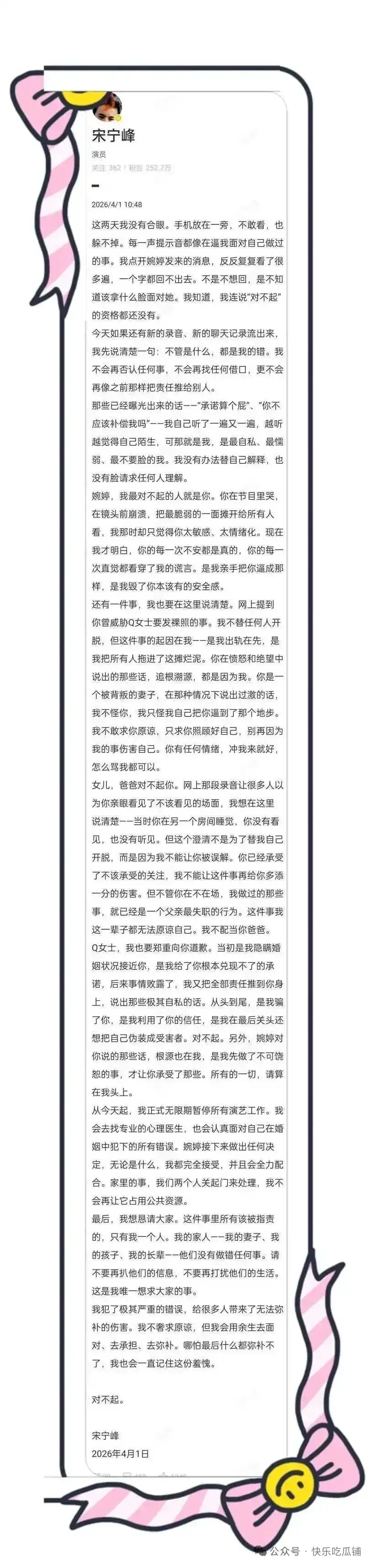
On April 1, 2026, after Song Ningfeng's apology letter was published, the entire internet was waiting for Zhang Wanting's response.
However, unlike the public's expected script of a decisive divorce, as of the time of publication, Zhang Wanting had not publicly announced a decision to divorce.
This inevitably leaves many people puzzled: the evidence is conclusive and known across the internet, so why has she still not left?
As a lawyer, I have seen too many similar cases. After a tearful outpouring, you might think she utterly hates him, but when you ask whether she has thought through whether to divorce, most of the time she is silent.
This is the most paradoxical aspect of infidelity incidents: what bystanders fail to understand is often not the betrayal itself, but why the betrayed person chooses to stay.
Zhang Wanting's hesitation precisely reveals the most complex and most counterintuitive psychological mechanism in marriage: traumatic bonding.
In today's article, let us together answer this question.
01 Traumatic Bonding: When Pain Becomes the Nourishment of Attachment
The psychological concept of "Traumatic Bonding" precisely explains this contradiction. It refers to a pathological emotional dependence formed between an abuser and a victim in a relationship with an imbalance of power, through repeated harm, control, and intermittent "rewards" (such as apologies or brief tenderness).
Looking back at See You Again 2, the interaction pattern between Zhang Wanting and Song Ningfeng is a typical example:
- Power imbalance: Zhang Wanting appears dominant, but in reality her emotions are entirely controlled by Song Ningfeng's silence and avoidance. Her every outburst is a desperate demand for attention and response.
- Intermittent reinforcement: Song Ningfeng's occasional compromises, tears on the show, and apologies afterward constitute unpredictable "rewards." This uncertainty reinforces dependence—just as a gambler waits for an occasional win.
- Cognitive dissonance: When the facts (infidelity) conflict with self-perception ("we once loved each other / he is not fundamentally bad"), the brain chooses to distort the facts to alleviate the pain. Zhang Wanting may still be making excuses for Song Ningfeng, or constantly recalling "the good times," in order to maintain the rationality of her decision "not to divorce."
Hoarse shouting is a cry for help, not madness. Her emotional loss of control precisely proves that she is still investing emotional energy in this relationship. And when one day she no longer even has the strength to shout, and only utter indifference remains, that is the moment the relationship truly dies.
02 Zhang Wanting's "Not Leaving": A Multidimensional Psychological Prison
Beyond the traumatic bond, multiple psychological mechanisms trap her in this relationship:
1. The sunk-cost effect and self-justification
Nearly a decade of relationship, a daughter they have together, a public marital image... The enormous investment makes it difficult for her to admit "investment failure." Divorce means negating all past choices, and the pain brought by this self-negation is sometimes harder to bear than a partner's betrayal.
2. The obsession with a "complete family" and the shackles of motherhood
"For the sake of the child" is the primary reason many women do not divorce. Society forcibly binds "complete family" with "good mother," making women fear that divorce will harm their children. However, a family full of deception, indifference, and conflict harms children far more than a healthy divorced single-parent family. What children need is a loving, stable environment, not a formal "completeness."
3. The binding of self-worth
In long-term relationships, a person's identity is often deeply intertwined with that of their partner. "Song Ningfeng's wife" may already have become an important part of Zhang Wanting's social identity. Leaving the marriage means having to answer anew the fundamental question of "who am I," which is an enormous psychological challenge for anyone.
4. A deep-seated fear of "being abandoned"
Infidelity is, in essence, a form of emotional abandonment. But actively filing for divorce means bearing the label of "abandoner" and the associated social pressure. Many women would rather remain in known pain than face an unknown "active choice" that may invite blame.
03 Song Ningfeng's "not divorcing": interest calculations and emotional compensation
So why might Song Ningfeng, who had an affair, also not necessarily want a divorce? Behind this lies the typical logic of emotional compensation.
For many people who have affairs, an extramarital relationship is not intended to replace the marriage but to make up for emotional deficits within it. In the marriage, Song Ningfeng may have felt suppressed and unacknowledged (Zhang Wanting frequently negated him on the show), and the third party's admiration and tenderness filled precisely this void. The extramarital affair became a "pressure-relief valve" that allowed him to maintain the marital system, rather than an exit through which to escape.
From the perspective of practical interests, maintaining the marriage remained the "optimal solution" for him:
- Social image: the persona of a good husband and good father is crucial to his acting career.
- Economic cost: divorce involves division of property and may affect his financial situation.
- Convenience of life: Zhang Wanting has taken on the roles of mother and wife, providing a stable rear support.
- Moral high ground: as long as he does not divorce, he can, through apologies, craft the image of one who has repented and returned, occupying a moral buffer zone.
His "grievance-bearing compromise" is, in essence, a strategic silence aimed at maximizing his interests.
Of course, after this incident, I think the public images of Song Ningfeng and Zhang Wanting have been completely ruined, and they will never be able to recover for the rest of their lives.
04 A family lawyer's perspective: the real-world shackles behind not divorcing
Setting aside emotions, from a legal and practical perspective, Zhang Wanting's decision not to divorce may be based on the following real-world considerations:
1. The complexity of property division
As public figures, their marital community property may involve complex assets such as company equity, intellectual property, and investment returns. Divorce litigation is lengthy and may trigger chain reactions such as breaches of commercial cooperation agreements and termination of endorsement contracts.
2. The contest over child custody
Their daughter is still young, and a custody dispute would be exceptionally fierce. As the mother, Zhang Wanting may fear losing custody, or fear that divorce litigation would cause secondary harm to her daughter.
3. Career entanglement and public image
The two gained a great deal of attention because of See You Again 2, and their marital status has become part of their public image. A sudden divorce could affect their commercial value and may even provoke a public-opinion backlash.
4. Evidence preservation and legal preparation
From the leaked recording to Song Ningfeng's apology, the incident developed rapidly. She may need time, under a lawyer's guidance, to systematically collect evidence (including evidence of infidelity, evidence of assets, and so on) in preparation for possible divorce litigation or negotiation. Not announcing a divorce immediately does not mean she is not preparing for one.
05 Not divorcing does not mean the relationship has been repaired
It must be clearly recognized that a marriage after trauma has only two possible outcomes—genuine repair or a slow death. There is no intermediate state.
If the parties choose not to divorce, both parties must:
1. The party who committed infidelity must sever all contact: completely cut ties with the third party and provide verifiable evidence.
2. In-depth attribution and accountability: the party who committed infidelity must acknowledge that this was a personal choice and a moral defect, rather than a "result" of marital problems.
3. Professional intervention: long-term, professional marriage counseling and individual psychotherapy must be accepted.
4. Rebuild a trust mechanism: including transparent itineraries, open communications, and jointly establishing new rules for the relationship, among other measures.
However, judging from Song Ningfeng's apology letter, he still attributes the infidelity in part to "work pressure" and "losing control after drinking." Such external attribution is a major taboo for repair. True repentance is acknowledging that "I made a choice to hurt you while I was sober."
06 An Action Guide for All the "Zhang Wantings"
If you are also in a similar predicament, regardless of whether you ultimately divorce, please start immediately:
Step One: Emotional isolation; stop internal friction
Allow yourself to feel angry and sad, but set a time limit for emotional venting. Set aside one hour each day as "pain time," and force yourself to devote the remaining time to work, exercise, or hobbies. Your emotions are precious energy and should not be drained by endless internal friction.
Step Two: Reality audit; know your bottom line
With the assistance of a family lawyer, clarify:
- An inventory of family assets (real property, savings, investments, and debts)
- Your own earning capacity and career plans
- The practical arrangements for child custody (time, expenses, and education)
- A concrete list of the pros and cons of divorcing versus not divorcing (rather than emotional imaginings)
Step 4: Establish a support system
Seek out trusted relatives and friends, support groups, or psychological counselors. Do not bear this alone; the shame of being betrayed often festers in isolation.
Step 5: Set bottom lines and a timeline
For example: "If within three months he has not completely cut off contact with the third party and begun receiving ongoing counseling, I will initiate divorce proceedings." Bottom lines must be specific, verifiable, and time-bound.
Finally, please remember:
The integrity of a marriage does not lie in whether the certificate remains valid, but in whether the relationship has vitality. When the cornerstone of trust has been shattered, repairing it requires extraordinary courage and sincerity from both parties. If only one party is carrying the burden forward, then the so-called "intact family" is nothing more than an exquisite emotional tomb.
Every hesitation of Zhang Wanting poses a question to all women: how much of our true selves must we sacrifice for an empty shell of "completeness"?
Sometimes, leaving is not a failure but the most responsible investment you can make in the rest of your life. Your worth never depends on any relationship, and it is not diminished in the slightest by anyone's betrayal.
Finally, here is the full text of Song Ningfeng's apology. If you are a woman who has been deceived, take a moment to understand the inner journey of someone who had an affair.