
Today I came across an interesting case in the People's Court Daily.
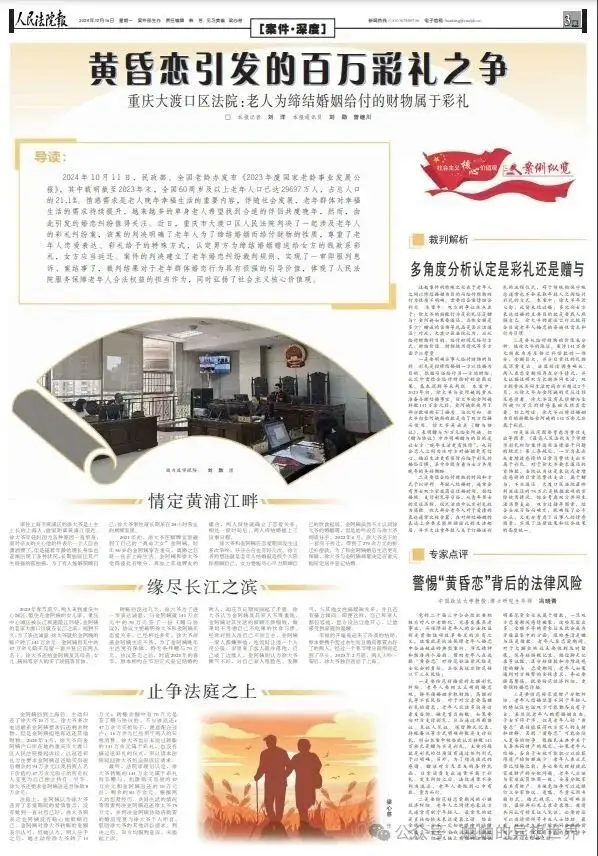
Mr. Xu, who lives in Huangpu District, Shanghai, met his "true love" Ms. Jin at a card and chess parlor. Ms. Jin, then 50 years old, is from Chongqing and has lived in Shanghai since her divorce. Ms. Jin and Mr. Xu felt that they were destined for each other, and with the matchmaking of other card players, the two quickly established a romantic relationship.
In June 2022, a house under Mr. Xu's name was demolished, and he received more than 2700 thousand in demolition compensation. To provide greater security for their married life, Mr. Xu and Ms. Jin discussed and decided to buy a home and settle in Chongqing and register their marriage.
Shortly after arriving, to express his sincerity, Mr. Xu transferred more than 1410 thousand to Ms. Jin's account. Ms. Jin used more than 470 thousand of it to purchase a house, which was registered in both their names. Mr. Xu also bought necklaces and other jewelry for Ms. Jin and her mother, daughter, aunt and other relatives.
A few days after the transfer, to further express his sincerity, Mr. Xu signed a Gift Agreement with Ms. Jin concerning 700 thousand of the more than 1410 thousand. The agreement mainly stated that Mr. Xu and Ms. Jin were in a romantic relationship and had been together for many years, that Mr. Xu deeply felt that Ms. Jin's life was not easy, and that to provide greater security for Ms. Jin's later years, he unconditionally gifted 700 thousand.
After the agreement was signed, the 2023 Spring Festival arrived. The two, who had originally agreed to formally register their marriage after the holiday, fell into conflict during the holiday and ultimately parted ways.
After Ms. Jin returned to Shanghai, she voluntarily returned 100 thousand to Mr. Xu. Mr. Xu contacted Ms. Jin by telephone many times demanding the return of the remaining property, but Ms. Jin refused to return any other property. In March 2024, Mr. Xu filed a lawsuit with the Chongqing Dadukou District People's Court, where Ms. Jin's household registration is located, on the ground of return of bride price, demanding that Ms. Jin return the more than 940 thousand remaining after the purchase of the house and change the owner of the house worth more than 470 thousand registered in both their names to himself as sole holder. In addition, Mr. Xu demanded that Ms. Jin return more than 80 thousand for the jewelry.
In court, Ms. Jin argued that Mr. Xu had broken his vows of love during their relationship and had failed to treat her well consistently, while Mr. Xu stated that Ms. Jin had not cared for him attentively. Ms. Jin acknowledged the amount transferred by Mr. Xu, but argued that after they broke up she voluntarily transferred 100 thousand to Mr. Xu;
that 700 thousand of the transfer balance was covered by a gift agreement and should not be returned; that she was willing to cooperate in transferring the house purchased for more than 470 thousand; and that more than 140 thousand had already been used for their daily consumption. Mr. Xu had never said that the more than 1410 thousand transferred was bride price, nor had he held any bride-price ceremony, so she requested that the court dismiss all of Mr. Xu's claims.
Ultimately, after trial, the court determined that the more than 1410 thousand transferred by Mr. Xu constituted bride price rather than a gift. After deducting the more than 470 thousand used to purchase the house and the 100 thousand returned by Ms. Jin, of the remaining more than 830 thousand, and based on factors such as the parties' romantic history and their circumstances of living together, the court ordered Ms. Jin to return 750 thousand to Mr. Xu and ordered Ms. Jin to assist in changing the marital home purchased to Mr. Xu's sole ownership, and dismissed Mr. Xu's other claims. After the judgment, both parties accepted it and did not appeal.
Case analysis:
1. Must the determination of bride price necessarily require a bride-price ceremony and an explicit bride-price agreement?
There is no requirement that there must be a betrothal gift ceremony or an explicit betrothal gift agreement; the key remains the parties' true intent and the logic of their conduct.
A betrothal gift refers to property given by one party to the other for the purpose of marriage in accordance with custom. It is best if there is an engagement ceremony, or an explicit transfer memo identifying the payment as a betrothal gift, or chat records between the parties concerning the betrothal gift. If none of these exist, the betrothal gift nature of the payment may also be determined by reference to the following:
(1) The amount: generally, an amount greater than 10 thousand is regarded as a large amount at the court level; from the perspective of ordinary people's common sense and lawyers' practice, generally an amount greater than 100 thousand is regarded as a large amount.
(2) Whether the background and consequences of giving the property are related to future life plans: for example, in this case, purchasing a marital home, and purchasing jewelry as gifts when visiting the woman's relatives and friends.
(3) The basic logic behind the conduct: but for discussions of marriage, the expenditures in this case would not have occurred. In this case, after Mr. Xu transferred more than 1410 thousand yuan to Ms. Jin, Ms. Jin used part of the funds to purchase a marital home. Although Mr. Xu issued a Gift Agreement stating that 700 thousand yuan was gifted to Ms. Jin, the Gift Agreement also expressly stated that the purpose of the gift was to give the woman "greater security in her later years," which is also consistent with the marriage custom of giving betrothal gifts between lovers so as to give the other party greater confidence in the marriage and greater security in married life, and it also implicitly embodies the beautiful expectation of spending one's later years together with the woman.
2. If the other party is required to return the betrothal gift, generally how much can be returned?
Betrothal gift disputes are in essence family disputes, and how much is returned involves many considerations of "human relations and social sensibilities." Courts usually consider the following factors and, at their discretion, determine whether to order return and the amount to be returned:
(1) Whether a wedding was held. Holding a wedding means that the relationship has been publicly announced as husband and wife and that part of the preparatory work for marriage has been carried out, so the portion of the betrothal gift to be returned will be reduced.
(2) Whether the marriage was registered. If the marriage has been registered, the parties are legally husband and wife; if the marriage registration has been in place for more than one year, the betrothal gift is generally not returned.
(3) Whether the parties lived together. The longer they lived together, the more the recipient of the betrothal gift contributed to the marriage; taking into account whether children were born, whether the betrothal gift was used for joint consumption, and the reasons for the parties' separation, the longer the period of cohabitation, the harder it is to claim return of the betrothal gift.
(4) Whether a common child was conceived or a miscarriage occurred. Conceiving a child or suffering a miscarriage means the recipient of the betrothal gift has contributed more, and the harder it is to claim return of the betrothal gift.
(5) Whether giving the betrothal gift caused hardship in life. This situation is rare in practice; generally, to establish that giving the betrothal gift caused hardship in life, it is necessary for the local village committee or community to issue a certificate of economic hardship, or to prove that the betrothal gift came from a loan, that the loan cannot be repaid, and that there are no other funds for subsistence; such situations are extremely rare in reality.
(6) Whether the bride price has already been used for joint consumption. The portion of the bride price used for joint consumption must be deducted. Items purchased through such consumption may be divided.
(7) The reasons for the separation and the financial dealings between the parties after separation: In this case, the reasons for the separation are significantly related to Aunt Jin (Jin Ayi). Uncle Xu (Xu Daye) once made efforts to integrate with Aunt Jin, but they were unable to live together. After the parties could no longer continue living together, Aunt Jin returned part of the money during her own negotiations with Uncle Xu. In judicial practice, bride price disputes are essentially property division disputes arising from emotional disputes. Lawyers will dissect and examine the reasons for the breakup in detail, and judges will also consider the degree of fault of both parties when determining the amount to be returned.
In summary, bride price disputes are family disputes with typical family-dispute characteristics. They are usually closely related to emotional entanglements and are not resolved purely as economic disputes; judges have considerable discretion in adjudicating them. Therefore, in bride price disputes, clearly laying out the full context of the emotional dispute has a significant impact on the determination of bride price return.
In practice, some lawyers may think that it is simply a matter of calculating the economic account: the bride price paid minus the portion used for joint consumption equals the amount to be returned. Failing to comprehensively consider the parties' emotional history, their lives beyond economic matters, and their emotional contributions and losses will not only lead to biased adjudicative outcomes and leave the parties dissatisfied with the amount, but may also cause the parties to suffer a double loss: the marriage did not take place, they suffered a disadvantage, yet this cannot be reflected in the final outcome. This in turn undermines the parties' trust in the fairness of the law and in lawyers' commitment to fully safeguarding their interests, and may even generate negative views of the legal profession.
Therefore, making every effort to tell the client's story well, not only calculating the economic account properly but also clearly accounting for the emotional account (quantifying contributions and losses), is the standard that professional family lawyers set for themselves when representing bride price disputes, and it is also the professional pursuit by which family lawyers seek to fulfill their mission.

